
Pricing isn't a single line item either. Costs shift based on input/output tokens, invisible thinking tokens, caching, batch processing, and whether you're calling through Google AI Studio or Vertex AI. Get any of these wrong and your invoice won't match your estimate.
This article breaks down exactly what Gemini 2.5 Flash costs in 2026, what quietly inflates your bill, how it stacks up against newer models, and how to budget for — or migrate off — it before the clock runs out.
Key Takeaways
- Gemini 2.5 Flash costs $0.30 per million input tokens and $2.50 per million output tokens on the standard paid tier.
- Thinking tokens count as output tokens and can inflate real costs well past the sticker price.
- Google has scheduled Gemini 2.5 Flash for retirement in October 2026.
- Named successors: Gemini 3 Flash Preview ($0.50/$3.00) and Gemini 3.1 Flash-Lite ($0.25/$1.50).
- Batch processing cuts costs by 50%; context caching can slash input costs by up to 90%.
Gemini 2.5 Flash API Pricing Overview
There is no single Gemini 2.5 Flash price. What you pay depends on three variables: tier (free vs. paid), processing mode (standard vs. batch), and modality (text vs. audio input).
Here's the breakdown:
| Mode | Text/image/video input | Audio input | Output (incl. thinking) |
|---|---|---|---|
| Free tier | $0 | $0 | $0 |
| Standard paid | $0.30/M | $1.00/M | $2.50/M |
| Batch | $0.15/M | $0.50/M | $1.25/M |
| Cached input | $0.03/M | $0.10/M | N/A |

The free tier runs through Google AI Studio with rate limits (requests per minute and per day), no credit card required, and a note that your data may be used to improve Google's products. Fine for prototyping — not for production.
The paid standard tier unlocks the full 1M-token context window, higher rate limits, and production-grade access at the standard rates in the table above.
Critical detail: that output number includes any internal reasoning the model generates, not just the words you see in the response. More on that below.
The Batch tier — async processing with a ~24-hour turnaround — cuts both input and output rates in half.
Price is only half the decision — model lifespan matters too if you are locking in a stack for 2026.
Deprecation Timeline
Google's official Cloud lifecycle documentation lists October 20, 2026 as the retirement date for gemini-2.5-flash, with Gemini 3.5 Flash-Lite or Gemini 3.1 Flash-Lite named as replacements. Some internal migration guides reference October 16 as a buffer deadline. For new projects, evaluate Gemini 3 Flash or a Flash-Lite variant rather than building on a model with a fixed shutdown date.
Pricing Tier 1: Free (Prototyping)
- What's included: Flash models only, low rate limits, no credit card
- Best for: testing, personal projects, pre-budget evaluation
Pricing Tier 2: Paid Standard
- What's included: Full rate limits, 1M-token context, production access
- Best for: Production apps, chatbots, moderate-volume workloads
Pricing Tier 3: Batch Processing
- What's included: 50% discount, async processing with ~24-hour turnaround
- Best for: bulk document processing, evaluations, non-real-time pipelines
What Drives Gemini 2.5 Flash API Costs Up or Down
The $0.30/$2.50 sticker price rarely matches your actual invoice. Four hidden multipliers explain why.
Thinking Tokens
Gemini 2.5 Flash generates internal reasoning (thinking tokens) that never appear in your visible response but are billed at the full output rate. Per Google's own thinking documentation, response pricing is the sum of output tokens and thinking tokens, based on the full thought volume generated, not just what's returned.
You can configure a thinking budget of 0 to 24,576 tokens per request. The API exposes total_thought_tokens separately from total_output_tokens — use it. Measure the ratio on your actual prompts before finalizing a budget; estimates without real traffic data are where most teams overspend.

Context Length and Caching
Repeated large system prompts or documents don't need to be paid for at full price every time. Cached input runs $0.03/M for text (versus $0.30/M standard) — a 90% reduction.
- Implicit caching is enabled by default for Gemini 2.5 and newer models
- Cache storage carries its own charge: roughly $1.00 per million tokens per hour
- Savings apply to input costs only — output and thinking tokens are unaffected
Request Volume and Modality
Audio input costs more than text, image, or video: $1.00/M versus $0.30/M standard. If you're building a voice agent, budget accordingly.
High-frequency applications such as chatbots and autonomous agents rack up costs faster than one-off batch jobs through sheer volume. A single complex agent loop can burn thousands of output tokens per turn before the user sees a word.
Processing Tier Choice
Switching non-real-time workloads from standard calls to Batch API cuts costs in half automatically. If your pipeline doesn't need instant responses (document summarization, bulk evaluations), this is the easiest cost lever available.
Gemini 2.5 Flash vs Other Gemini and Competitor Models
Gemini 2.5 Flash sits in the middle of Google's price and performance range, while newer Flash-class models are already undercutting it.
| Model | Input | Output | Notes |
|---|---|---|---|
| Gemini 2.5 Flash-Lite | $0.10/M | $0.40/M | Cheaper, lower quality; good for high-volume simple tasks |
| Gemini 2.5 Flash | $0.30/M | $2.50/M | Balanced, but scheduled for retirement |
| Gemini 3 Flash Preview | $0.50/M | $3.00/M | Higher price; direct successor with stronger reasoning |
| Gemini 3.1 Flash-Lite | $0.25/M | $1.50/M | Cheaper than 2.5 Flash; named lifecycle replacement |
| Gemini 2.5 Pro | $1.25/M | $10.00/M | Much more expensive; reserved for complex reasoning |

Outside Google's lineup, common list-price anchors look like this:
- Claude Haiku 4.5: about $1.00/M input and $5.00/M output
- Claude Sonnet 5: about $2.00/M input and $10.00/M output
- GPT-5 Mini: about $0.25/M input and $2.00/M output
On sticker price alone, Gemini 2.5 Flash still lands competitively. These figures do not capture latency, quality, or reasoning depth.
Is Gemini 2.5 Flash still worth using? Yes for existing workloads that already run well on it. For new products, a confirmed shutdown date makes it a weak long-term foundation. Use it as a bridge while you validate Gemini 3 Flash Preview, 3.1 Flash-Lite, or a cross-provider fallback.
Google AI Studio vs Vertex AI: Pricing Differences for Gemini 2.5 Flash
Google AI Studio lists Gemini 2.5 Flash at the standard rates above, plus a free tier. That free tier makes it well suited for prototyping and early evaluation.
When you need production controls beyond that free tier, Vertex AI adds enterprise SLAs, VPC controls, and compliance features.
Google's documented 10% non-global endpoint surcharge applies explicitly to newer model families (Gemini 3.6 and 3.7 Flash) starting July 2026. There is no confirmed equivalent surcharge specifically for Gemini 2.5 Flash in the official rate card.
Practical guidance:
- Teams already on Google Cloud with compliance requirements → use Vertex AI
- Startups and prototypes without enterprise needs → stick with AI Studio's simplicity and free tier
How to Estimate and Control Your Gemini 2.5 Flash Budget
Budgeting starts with a basic formula: estimate monthly input and output token volume, then multiply by your applicable rate (standard or batch).
- Measure thinking-token overhead first. Run representative prompts and check
total_thought_tokensbefore finalizing any budget. Real usage often exceeds initial estimates significantly. - Cache aggressively. Repeated system prompts or reference documents dropped into cache can cut recurring input costs by up to 90%.
- Route non-real-time work to Batch. Instant 50% savings on eligible workloads.
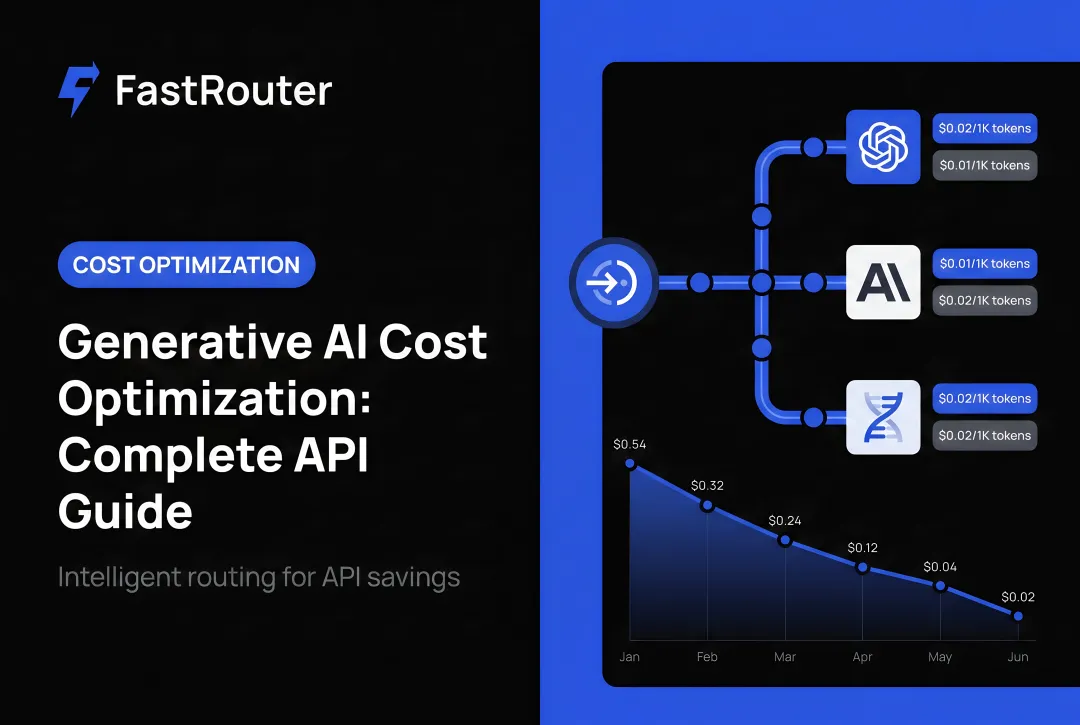
- Plan the migration budget now. Gemini 3 Flash and 3.1 Flash-Lite pricing will replace 2.5 Flash rates after retirement. Don't wait until the deadline to model the cost difference. Teams increasingly spread workloads across multiple providers and models to balance cost against quality. That makes single-provider budgeting harder to track. A platform like FastRouter handles this with an OpenAI-compatible gateway that routes requests across Gemini and 100+ other models through one integration. Its Usage Analytics dashboard breaks down:
- Token consumption by model and provider
- Cost and request volume by project and team For a Gemini 2.5 Flash migration, FastRouter's Virtual Model Lists let you point your application at a stable alias instead of a hardcoded model ID. When you move to Gemini 3 Flash or 3.1 Flash-Lite, you update the alias configuration centrally—no code changes or redeployment. Add threshold-based spend alerts and consolidated multi-provider billing, and you can spot cost shifts before they hit the invoice.

Frequently Asked Questions
How much does Gemini 2.5 Flash cost?
It costs $0.30 per million input tokens and $2.50 per million output tokens on the standard paid tier, with a 50% discount available through the Batch API.
Is Gemini 2.5 Flash free?
Yes, on Google AI Studio's rate-limited tier with no credit card required. Production use at any meaningful volume requires the paid tier.
How much does the Gemini API cost?
Overall Gemini API pricing ranges from roughly $0.10/M (Flash-Lite) up to $2.00–$4.00/M input tokens for Pro-tier models, with 2.5 Flash in the mid-range.
Do thinking tokens cost extra on Gemini 2.5 Flash?
Yes. Thinking tokens are billed as output tokens at the standard output rate, so enabling deeper reasoning raises cost per request even when input size stays the same.
What is the price of Gemini Flash-Lite?
Gemini 2.5 Flash-Lite costs $0.10/M input and $0.40/M output, roughly 3x cheaper than standard 2.5 Flash.
Is Gemini 3 Flash cheaper than Gemini 2.5 Flash?
No. Gemini 3 Flash Preview is priced higher at $0.50/$3.00 versus 2.5 Flash's $0.30/$2.50, but it offers stronger reasoning and is the recommended migration path ahead of the 2026 retirement.