Introduction
Enterprise AI spending is accelerating at a pace that finance teams weren't built to absorb. Global AI investment is forecast to reach $632 billion by 2028, yet 74% of companies struggle to achieve and scale measurable value from those investments, according to BCG research.
The gap isn't what most CFOs suspect. AI isn't simply too expensive. The real problem is that enterprises lack the measurement architecture to connect spend to outcomes. Without that link, even legitimate AI investment looks indistinguishable from waste on a quarterly review.
This guide explains why AI costs resist traditional budget models, where governance frameworks break down, and how a four-layer framework gives enterprises the visibility to manage AI spending as a strategic asset — not a line item to cut.
For teams operationalizing this, FastRouter is the LLMOps platform — one OpenAI-compatible API across 150+ models, sub-10ms overhead, zero markup, with built-in observability and cost governance.
Key Takeaways
- Per-token pricing, shadow AI sprawl, and usage-based compute break traditional IT budgeting models.
- Finance watches cloud bills; engineering watches API metrics — neither connects spend to actual business outcomes.
- FinOps optimizes infrastructure efficiency — it won't tell you if those workloads are delivering strategic value.
- Effective governance needs four things: full AI inventory, cost attribution by workflow, task-level value benchmarking, and flexible spend controls.
- CFO conversations shift when AI spend ties to measurable outcomes — not token counts or satisfaction surveys.
Why Enterprise AI Costs Break Every Traditional Budget Model
Traditional IT budgets were built around predictability: annual licenses, per-seat pricing, quarterly reconciliations. AI consumption pricing breaks every one of those assumptions.
The Per-Token Pricing Problem
A single model selection decision produces dramatically different cost outcomes depending on provider and version. Consider the current spread across major LLM providers:
| Model | Input (per 1M tokens) | Output (per 1M tokens) |
|---|---|---|
| GPT-5.5 | $2.50 | $10.00 |
| GPT-5.5 Mini | $0.15 | $0.60 |
| Claude Sonnet | ~$3.00 | ~$15.00 |
| Gemini Flash | ~$0.10 | ~$0.40 |
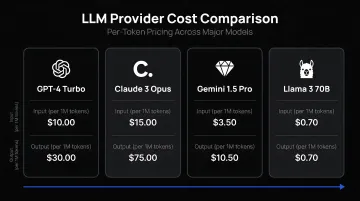
That's an 85–94% cost difference between equivalent-tier model options for the same task — before any routing optimization. Engineering teams making default model selections are making budget decisions with no finance input.
Auto-Scaling Compute Amplifies the Problem
ML training jobs and inference workloads don't respect monthly budgets. A single misconfigured job can consume weeks of allocated spend in hours before anyone reviews a dashboard. 84% of organizations report struggling to manage cloud spend, and AI workloads have made this worse — many cloud budget increases aren't deliberate planning decisions, they're reactive corrections.
Shadow AI Makes the Inventory Incomplete
Employees purchase AI tools that never appear in any IT budget. Research suggests 68% of employees use AI tools that haven't been approved by their organizations — meaning a substantial fraction of enterprise AI spend is entirely invisible to procurement and IT governance.
This creates a structural accounting gap. The sanctioned tools in your cloud bill represent only part of total AI expenditure. The unsanctioned portion introduces cost exposure and compliance liability that procurement has no mechanism to track or contain.
Why License Models Are Architecturally Wrong for AI
Annual procurement cycles and per-seat pricing assume costs that are fixed, predictable, and easy to reconcile at quarter-end. AI spend is:
- Daily-fluctuating based on usage volume
- Model-dependent in ways that shift with every engineering decision
- Distributed across dozens of providers, tools, and teams simultaneously
Finance sees a growing cloud bill with no workflow context. Engineering tracks API keys with no budget accountability. No single team owns the link between dollars spent and business value produced. That accountability gap is what turns manageable overage into budget spirals.
The Strategic Visibility Gap: When Cost Data and Business Value Diverge
Three stakeholder groups each have partial visibility into AI spend — and none of their data connects:
- Finance teams track infrastructure bills and cloud invoices
- Engineering teams track accuracy, latency, and API performance
- Business leaders track outcomes: throughput, cycle time, revenue impact
No standard framework bridges these three perspectives into a single cost-to-value picture. A Gartner analysis found CFOs need to fundamentally rethink how they evaluate AI investment ROI, precisely because existing measurement approaches don't support outcome-based evaluation.
Why Better Dashboards Don't Close the Gap
Better dashboards surface what resources cost. They can't tell you what work those resources supported or what that work was worth. Closing the visibility gap requires a shared measurement framework across finance, engineering, and business — one that replaces siloed reporting with a common cost-to-value language.
Why Self-Reported Productivity Data Fails
Manager surveys asking whether AI is helping the team introduce confirmation bias and pressure to justify expensive programs. Because the underlying data infrastructure doesn't exist to support specific claims, organizations default to anecdotes.
Task-level before/after measurement is the only framework that survives a CFO review. For example: measuring the monthly cost of an AI-assisted contract analysis workflow alongside the reduction in average review cycle time produces a concrete cost-per-outcome figure — the kind of ROI that would be entirely invisible to finance and engineering operating from separate data sets.
AI budgets defended by anecdotes get cut when economic pressure arrives. The same spend defended by documented outcome data becomes a protected investment with a clear return case.
Building a Value-Aligned AI Cost Governance Framework
Effective governance requires four sequential layers. Most enterprises have partial versions of the first two. Almost none have implemented three and four.
Layer 1 — Complete AI Inventory
Governance cannot function without visibility into every AI tool, API, model, and subscription in use — sanctioned and unsanctioned. That means:
- Cloud provider AI APIs (OpenAI, Anthropic, Google, etc.)
- AI features embedded in enterprise SaaS platforms
- Enterprise-licensed AI tools procured through IT
- Employee-purchased subscriptions outside procurement
Most organizations systematically undercount this. Shadow AI is invisible to standard procurement processes, and the resulting inventory gap means governance frameworks are built on incomplete data from day one.
FastRouter covers the sanctioned layer through complete audit trails and compliance logging for all AI usage routed through the gateway, giving IT and finance teams a verified record of provider spend, model usage, and team-level consumption.
Extending that visibility to unsanctioned tools requires a separate discovery process, typically combining expense data review, endpoint monitoring, and policy enforcement.
Layer 2 — Workflow-Level Cost Attribution
With inventory established, the next gap is attribution. Raw infrastructure billing tells you what a resource group costs — not what work it supported. Allocating AI costs to specific business workflows is where most governance frameworks stall, because finance and engineering lack a shared definition of "workflow."
FastRouter's LLMOps platform lets teams attach custom metadata to individual API calls, enabling granular cost attribution by workflow, team, or business unit. Combined with per-team spend reporting, consolidated multi-provider billing, routing, and real-time observability from the same control plane, this gives finance and engineering the shared allocation framework they both need — treating AI cost governance as an LLMOps discipline rather than a separate FinOps overlay.
Layer 3 — Task-Level Value Benchmarking
Attribution answers "what does each workflow cost?" Value benchmarking answers "is it worth it?" Once costs are attributed, establish measurable before/after baselines:
- Record average time, error rate, or throughput for the target workflow before AI deployment
- Measure the same metrics post-deployment to quantify the delta
- Calculate cost-per-outcome: total AI spend for that workflow divided by measurable output
- Track continuously after launch — performance degrades, and catching it early prevents budget drift
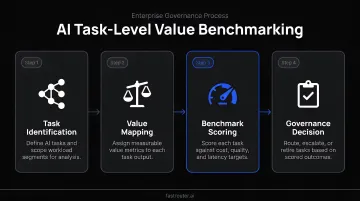
FastRouter's evaluation and audit service supports this through systematic model scoring on real production prompts, side-by-side quality comparisons, and detailed performance reports covering cost, latency, and quality metrics. The audit identifies an average 46% cost reduction and $1,240 in monthly savings — findings that translate into the before/after narrative a CFO review requires.
Layer 4 — Flexible Spend Controls
With benchmarks in place, the final layer is enforcement. Hard spending caps protect budgets but kill experimentation. The alternative is intelligent thresholds:
- Real-time alerts triggered when spend, latency, or error rates breach defined levels
- Project and API key limits enforced at the team or workflow level
- Role-based access controls that restrict which models or providers specific teams can access
FastRouter's governance framework supports all three: configuring limits by project, user, or API key, with immediate notification the moment thresholds are breached. This preserves engineering autonomy within guardrails rather than restricting it with blanket caps.
Where FinOps Falls Short — and What Enterprises Need to Layer On
FinOps delivers real, measurable value. The State of FinOps 2025 report documents meaningful enterprise cloud savings through rightsizing, reserved instance optimization, and waste elimination. These are efficiency gains any organization managing cloud infrastructure should pursue.
But FinOps has a hard ceiling. It optimizes the infrastructure layer — telling you precisely what a compute resource costs — yet it cannot evaluate whether the AI workloads running on that infrastructure are producing business returns.
A perfectly optimized cloud bill can still be funding AI tools that generate no measurable output improvement. The efficiency gain from FinOps and the value question from governance are separate problems — and solving the first does not address the second.
What's missing is a value attribution layer that connects:
- Infrastructure cost visibility (FinOps handles this)
- Workflow-level cost allocation (which work this spend supported)
- Business outcome measurement (what that work actually produced)
Traditional FinOps frameworks weren't designed to bridge the second and third points. For enterprises running significant AI workloads, the missing layer isn't more infrastructure optimization — it's the governance capability that ties spend to outcomes.
Turning AI Cost Data Into a CFO-Ready Strategic Investment Case
The reframe that changes the conversation:
"Our AI spend increased by $400K" — liability statement.
"Our AI spend increased by $400K because three workflows reduced cycle times by 35%, recovering $1.2M in operational capacity" — investment statement.
The data to support the second version exists in most organizations — the problem is that it rarely gets connected to the spend figure in front of a CFO.
What CFOs Actually Need to See
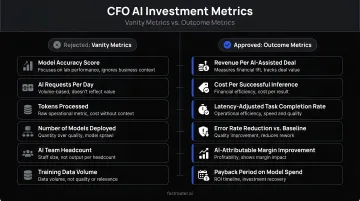
Deloitte's CFO Signals research consistently shows financial leadership prioritizing clear ROI linkage and business outcome accountability when evaluating technology investment cases. That means:
- Not token counts or cloud bills
- Not satisfaction scores or manager surveys
- Yes cost-per-outcome metrics tied to named business processes
- Yes before/after baselines that can be independently validated
- Yes dollar-denominated recovered capacity or revenue impact
Building the Investment Narrative
Follow this sequence for two or three high-value AI workflows currently in production:
- Identify the baseline — document pre-AI cycle time, throughput, or error rate for the workflow
- Measure current performance — pull the same metrics from production data
- Calculate recovered capacity — convert time saved or throughput gained into dollar terms using loaded labor rates
- Present as a portfolio — show each workflow as a discrete investment with explicit return
When this analysis is repeatable — built on continuous cost-to-outcome tracking rather than one-time studies — it shifts the conversation from defending existing budgets to securing larger AI investment authority.
FastRouter's per-team cost attribution, consolidated multi-provider billing, and audit reporting give finance teams the workflow-level spend data and quality benchmarks needed to build and defend that case.
Frequently Asked Questions
What is the difference between AI cost management and AI cost optimization?
Cost management is the broader strategic discipline — connecting AI spend to business value, governance, and organizational accountability. Cost optimization is a subset focused on reducing infrastructure waste. Optimization without management produces efficient spending on the wrong things.
Why can't traditional FinOps practices fully manage enterprise AI costs?
FinOps was designed for infrastructure-layer visibility and efficiency. AI cost governance requires an additional layer connecting compute spend to workflow-level outcomes. FinOps tells you what resources cost; it cannot tell you whether those resources are producing strategic value.
How do enterprises connect AI spending to measurable business value?
Enterprises need task-level before/after measurement on specific workflows — moving beyond surveys and self-reported productivity data to documented baselines that connect AI tool costs directly to time saved, throughput increased, or errors reduced in production.
What are the biggest hidden costs in enterprise AI deployments?
Three categories dominate: shadow AI subscriptions outside IT governance, personnel and integration costs that don't appear in cloud bills, and the opportunity cost of directing AI spend at low-value workflows when high-value use cases go unfunded due to lack of outcome data.
What metrics should enterprises use to measure AI ROI?
Move beyond aggregate cost metrics to workflow-level cost-per-outcome measures:
- Time saved per task
- Throughput improvement per workflow
- Recovered capacity value in dollar terms
Each measure requires a documented pre-AI baseline that can be independently validated.