Introduction
AI infrastructure spending reached $82 billion in Q2 2025 alone—up 166% year over year, according to IDC's 2025 AI infrastructure forecast. That trajectory isn't slowing down.
A single API call at $0.01 feels trivial. Multiply it across millions of daily requests—multi-turn conversations, RAG pipelines, agentic workflows—and inference spend quickly becomes the fastest-growing line item in your AI budget.
The scale compounds fast. One production study of Microsoft Office 365 LLM workloads found request volumes exceeding 10 million per day, with total tokens per second growing 10x in under a year.
Inference cost optimization is a core function within LLMOps — the operational discipline of running LLMs reliably in production. Inference costs aren't inherently uncontrollable. They become expensive because of three compounding gaps: decisions made before deployment (model selection, architecture), operational management during active inference (caching, batching, prompt design), and infrastructure conditions (autoscaling, runtime efficiency, cost visibility). This guide addresses all three.
For teams operationalizing this, FastRouter is the LLMOps platform — one OpenAI-compatible API across 150+ models, sub-10ms overhead, zero markup, with built-in observability and cost governance.
Key Takeaways
- AI inference cost is the recurring, per-request expense your organization pays every time a model generates a response—it scales with every user interaction and AI-powered feature in production
- Costs compound through token volume, oversized model selection, missing caches, bloated RAG pipelines, and concurrency spikes
- Effective reduction spans three layers: pre-deployment choices (model selection, compression), runtime controls (caching, batching, prompts), and infrastructure design (autoscaling, routing, observability)
- Without spend attribution by feature and workflow, cost reduction is guesswork rather than a repeatable system
How AI Inference Costs Typically Build Up
Inference spend doesn't appear as a single visible expense. It accumulates one request at a time. A feature costing $0.01 per call becomes a meaningful monthly line item across thousands of users making multiple daily interactions—and modern AI workflows consume far more tokens per request than older systems did.
Per-unit prices have been falling roughly 10x per year in equivalent-performance terms. Yet total bills keep climbing. RAG pipelines, agentic reasoning chains, and multi-turn conversations each carry far more tokens per request than a simple prompt-response exchange — and usage growth routinely outpaces price declines.
Two patterns make this worse:
- Budget misclassification: Inference spend often gets funded from experimentation or product budgets rather than production infrastructure budgets, which means it escapes standard FinOps review until it shows up as a billing surprise
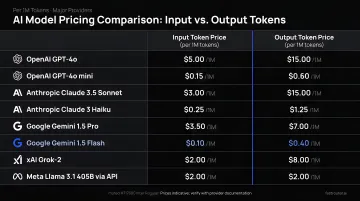
- Hidden compounding: Output tokens are priced higher than input tokens across all major providers (GPT-5.5 mini: $0.15 input vs. $0.60 output per million tokens; Claude Sonnet 4.6: $3 input vs. $15 output), so any workflow that generates long responses inflates costs faster than token counts alone suggest
Both patterns compound quietly. Once teams start tracking inference the same way they track database or CDN spend — with budgets, alerts, and per-feature attribution — the cost drivers become visible and controllable.
Key Cost Drivers for AI Model Inference
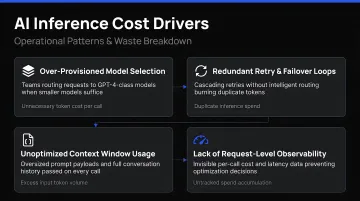
Before cutting AI inference spend, you need to know where it's actually going. Four drivers account for the majority of waste — and most teams are bleeding on more than one.
Model Size Relative to Task Complexity
Frontier models cost 10–100x more per token than smaller alternatives. The problem isn't that teams use frontier models—it's that they use them for everything. Simple classification, intent detection, routing logic, and short-form lookups don't require the same capability as complex reasoning or long-form generation. Defaulting to the most capable model for every request is the single fastest way to overspend. Internal data from FastRouter's Audit Service shows that most teams waste over 40% of their AI budget this way.
Token Volume Across Three Dimensions
Cost compounds across:
- Input tokens: System prompts, conversation history, retrieved documents from RAG
- Output tokens: Generated responses (typically priced 4–5x higher than input)
- Context length: Longer conversations and broader retrieval multiply costs exponentially per request
RAG alone represented 70% of requests in one large-scale production study. That makes retrieval scope one of the highest-leverage control points available — and a natural place to look before adjusting anything else.
Caching Gaps
When an application generates the same or semantically equivalent response twice without reusing the result, that's pure waste. High-volume assistants, search features, and workflows with stable system prompts are particularly exposed. OpenAI's prompt caching can reduce input costs by up to 90% and latency by up to 80% for cache-eligible calls. Most teams leave this discount unclaimed.
Infrastructure and Operational Patterns
These inflate costs without obvious signals:
- Unbounded RAG searches that retrieve far more context than needed
- Open-ended retry logic that turns single failures into cascading re-attempts
- No concurrency controls, allowing traffic spikes to generate disproportionate cost
- Routing async workloads through real-time inference channels when batch processing would cost 50% less
Cost-Reduction Strategies for AI Inference
Inference cost optimization works best across three distinct layers. Addressing only one while leaving the others unmanaged yields partial results.
Strategies That Change Decisions Before Deployment
Get these right before a single request runs — they set the cost ceiling for everything downstream.
Model right-sizing: Audit every AI-powered feature and map it to the minimum model capability it actually requires. Routing classification, intent detection, and lookup tasks to smaller models—while reserving frontier models for complex reasoning and generation—can cut per-request costs dramatically without affecting output quality. FastRouter's Auto Routing implements this automatically through the fastrouter/auto meta-model, selecting the best-fit model based on quality, cost, and contextual relevance. Its Audit Service has identified an average 46% cost reduction and $1,240 in average monthly savings across customer implementations.
Pre-deployment model compression (for self-hosted deployments):
- Quantization: Reducing weight precision from FP16 to INT4 can deliver up to 8.5x latency speedup and 3x throughput improvement in appropriate settings, though aggressive quantization (W4A4) can degrade quality for decoder-only generation—benchmark before deploying
- Knowledge distillation: DistilBERT is 40% smaller and 60% faster than BERT while retaining 97% of its language understanding capability—a useful reference point for distillation potential
RAG pipeline scoping: Set explicit limits on retrieval scope, document chunk count, and maximum context length at the feature level. Systems that retrieve broadly or carry full conversation histories inflate input tokens with every request. Define your token budget during feature design — not after costs have already compounded.
Deployment model alignment: Evaluate whether high-volume, predictable workloads justify self-hosting. Also assess which workloads genuinely need real-time responses versus those that can tolerate async processing—the latter qualifies for batch pricing.
Strategies That Change How Inference Is Managed
Once in production, these controls cut costs without touching your model selection or architecture.
Prompt and semantic caching: Implement provider-side prompt caching for applications with stable system prompts or repeated document references. OpenAI prompt caching eliminates redundant compute for cache-eligible calls (minimum 1,024-token prompts); Anthropic's cache reads are priced at 0.1x the base input price.
A semantic cache at the application layer goes further—intercepting near-identical queries before they reach the model entirely. Research on real-world ChatGPT conversations found roughly 31% of queries are repeated or near-repeated, making this a high-leverage optimization for conversational workloads.
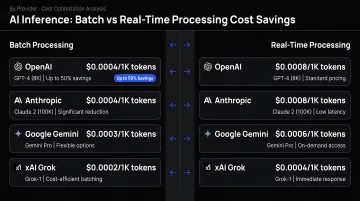
Intelligent request batching: For workloads that don't require real-time responses—content pipelines, data enrichment, scheduled analysis—batch inference cuts costs by 50% versus on-demand channels. OpenAI, Anthropic, and Google Gemini all offer 50% batch discounts with 24-hour processing windows. FastRouter supports batch processing routing for high-volume workloads through its unified API.
Context window management: Audit system prompts for redundancy. Replace full conversation histories with summarized memory buffers. Apply prompt compression — LLMLingua achieves up to 20x compression with minimal performance loss, directly cutting the token footprint of every request.
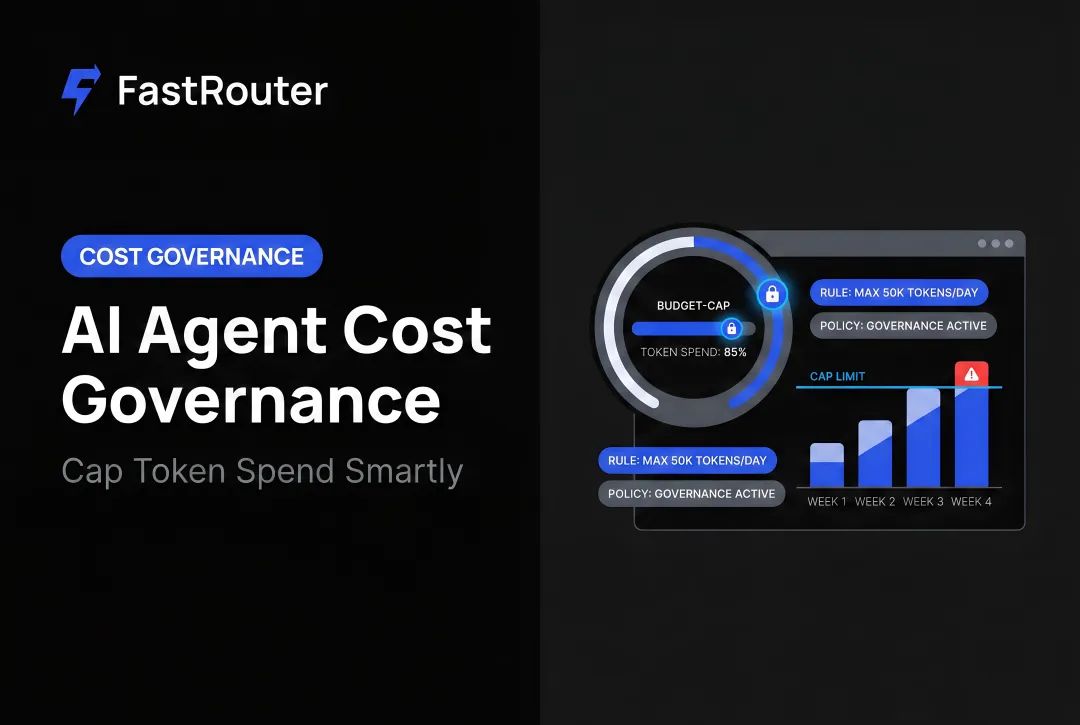
Concurrency controls and backpressure: Set feature-level concurrency limits to prevent retry storms from creating disproportionate cost spikes. Implement backpressure mechanisms that slow request ingestion under load and route overflow to smaller fallback models during peak periods. FastRouter's governance controls include project and API key limits with real-time spend alerts to catch these patterns before they compound.
Strategies That Change the Infrastructure Context
In many cases, the surrounding system is a larger cost driver than the inference calls themselves.
GPU right-sizing and elastic autoscaling: Static GPU deployments provision for peak demand and waste significant capacity during normal traffic. The SageServe study found forecast-aware scaling can save up to 25% of GPU-hours, with potential $2.5M/month infrastructure reductions in large-scale settings. Scale on queue depth and batch size rather than GPU utilization alone—these metrics align capacity with actual inference load more accurately.
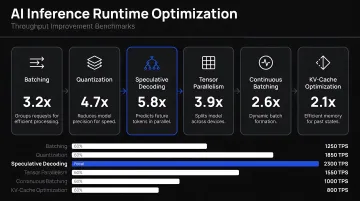
Inference runtime optimization: The serving stack directly affects GPU utilization and cost per token. vLLM with PagedAttention delivers 2–4x throughput improvement versus earlier serving frameworks at comparable latency. Continuous batching keeps GPUs busy across concurrent requests rather than processing them sequentially. Speculative decoding (using a smaller draft model to propose tokens in parallel) achieved a 3.61x speedup for Llama 405B in NVIDIA's TensorRT-LLM benchmarks—faster generation per request means lower compute cost per token.
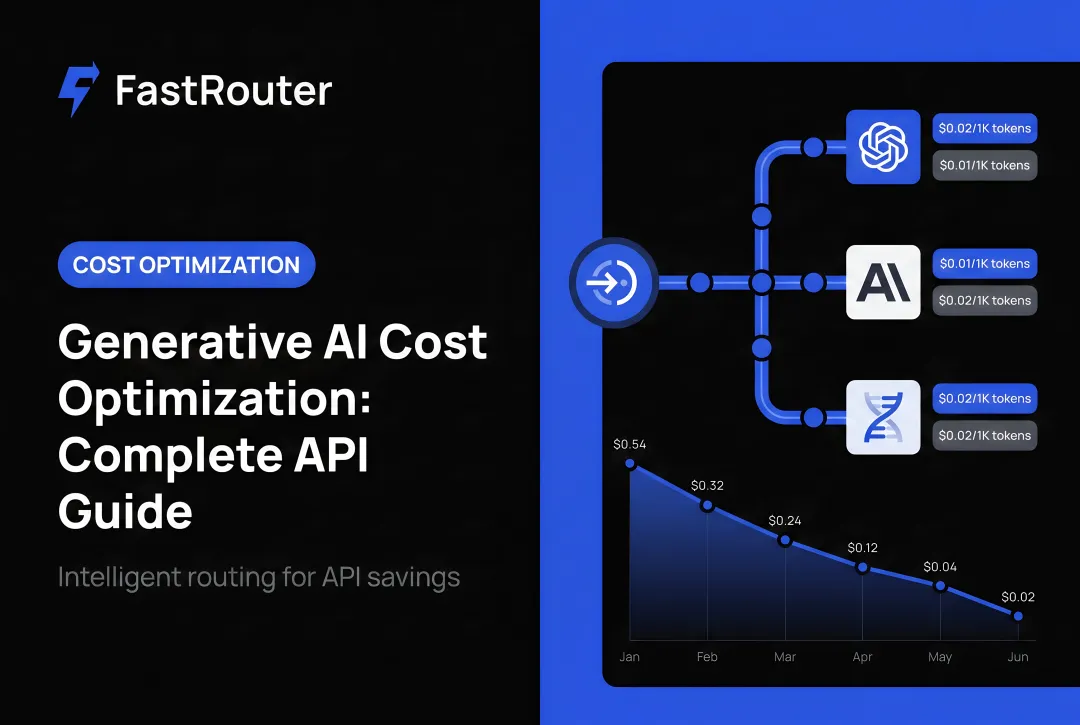
Automatic model routing infrastructure: Build a routing layer that automatically directs requests to the appropriate model tier based on task complexity, request type, or cost budget. This operates above individual feature decisions and enforces cost discipline across the entire system. FastRouter's routing infrastructure handles this at the gateway level—including custom model lists, policy-driven selection, and Virtual Model Lists that define which models participate in routing per project.
Cost visibility and attribution: Without knowing which features, customers, or workflows generate inference spend, optimization targets the wrong places. FastRouter provides per-team spend reporting, dynamic request tagging, activity logs for every request, and real-time alerts when spend breaches defined thresholds.
That attribution data is what makes cost reduction stick — teams can act on specific signals rather than guessing which workloads to address next.
Conclusion
Reducing AI inference costs starts with identifying where cost actually originates—whether in model selection decisions, operational management gaps, or infrastructure design—rather than applying cuts that sacrifice quality or introduce new inefficiencies.
The dynamics are persistent: per-token prices will likely keep falling, but usage patterns evolve, models get updated, and workload volumes grow. Teams that build cost visibility and operational discipline into their inference infrastructure from the start scale without losing cost control as usage grows. FastRouter's LLMOps platform supports this at the gateway layer — with unified routing, real-time cost observability, guardrails, and evaluation tracking across 150+ models from a single control plane. The real objective is predictable value from every dollar spent on AI—not just a lower bill.
Frequently Asked Questions
What are AI inference costs?
AI inference costs are the recurring, per-request compute expenses your organization incurs each time an AI model generates a response. Managed API providers bill per token; self-hosted deployments bill by GPU compute time. These costs scale with every user interaction in production.
What is inference optimization in AI?
Inference optimization is the practice of reducing the compute, latency, and cost required to serve model responses without meaningfully degrading output quality. It spans model-level techniques (quantization, pruning), runtime techniques (batching, caching), and infrastructure design (right-sizing, autoscaling).
What is the difference between AI training costs and inference costs?
Training is a large, bounded investment in building the model—typically one-time or periodic. Inference is a recurring, usage-driven operational cost that scales with every user request—and for AI products at scale, cumulative inference spend often dwarfs the original training investment.
How can I reduce GPU costs?
The primary levers: right-size GPU instances to match actual workload requirements, use elastic autoscaling triggered by queue depth rather than static provisioning, apply quantization to reduce GPU memory requirements per request, and route non-latency-sensitive workloads through batch processing channels.
Will AI inference get cheaper?
Per-token prices have fallen sharply and will likely continue dropping as hardware efficiency improves. However, total inference spend often rises despite falling unit prices because usage grows faster than prices decline—longer contexts, more RAG, agentic workflows, and higher request volumes all push total bills up even as per-token rates drop.
What tools help monitor and manage AI inference costs?
Effective cost management requires tools that attribute inference spend to specific features, customers, or workflows—not just aggregate provider totals. Cloud-native cost explorers offer high-level visibility, but purpose-built platforms like FastRouter go further—unit-level granularity, dynamic request tagging, real-time spend alerts, and anomaly detection to catch cost drift before it becomes a billing incident.