
Many teams face this exact dilemma. They either trust their gut and hope the new model works, or they push a full-scale swap and cross their fingers. Neither approach gives you real evidence before you've already taken on the risk.
The champion-challenger model solves this by letting you test a new candidate against your current production standard, on live data, without exposing users to unproven results. This post breaks down what it is, how the testing process works step by step, and how it applies to modern challenges like comparing large language models.
Key Takeaways
- The champion-challenger model tests a candidate against your live standard using real data, without disrupting users
- It originated in credit risk and banking and now powers ModelOps, BPO evaluation, and LLMOps decisions
- Promotion decisions rely on statistical significance, not gut feel
- Reduces regression risk while enabling continuous, data-driven improvement
- For LLMs, this requires infrastructure that can route, observe, and evaluate multiple models in parallel
What Is the Champion-Challenger Model?
The champion-challenger model is a decades-old risk management technique from banking, not a recent AI invention. Credit card issuers needed a way to test new lending and scoring strategies without gambling on their entire portfolio.
FICO's adaptive control framework formalized this approach: the champion is the documented current business rules and models, while challengers are alternatives that measurably differ from it. A small share of transactions routes to challengers while the champion keeps the majority, and results get compared over time. A winning challenger becomes the new champion.
That structure has since spread well beyond credit risk into MLOps, BPO evaluation, and LLMOps:
- Champion: the current production model, process, or vendor. The established baseline everyone measures against.
- Challenger: one or more candidate alternatives introduced to compete against the champion, using identical inputs.
The Core Principle: Parallel Evaluation Without Disruption
This works through what's often called shadow testing. The challenger processes the exact same live, real-world inputs as the champion, but its output never reaches end users. If the challenger makes a bad call, nobody outside the test sees it. The champion keeps running the show while the challenger proves itself in the background.
This framework isn't limited to machine learning models anymore. Teams now use it to compare:
- AI/ML models against each other on identical data
- BPO or outsourcing providers handling the same customer queries
- Business processes or marketing campaigns competing for the same audience
Picture a bank testing a new credit scoring algorithm. The existing model, the champion, keeps approving or denying loans as usual. A new model, the challenger, scores the same applications in parallel, but its decisions never actually determine outcomes. They're just logged and compared.
After months of data, if the challenger consistently identifies risk more accurately, it takes over. The same logic applies when you're comparing two contact center vendors handling identical ticket types side by side.
How Does the Champion-Challenger Model Work? (The Testing Process)
The champion-challenger process follows a repeatable five-step cycle, whether you're comparing lending algorithms, contact center vendors, or AI models.
- Establish the baseline and define success metrics. Document what the champion does today and set metrics upfront, things like accuracy, latency, fairness, cost, and business impact. Decide this before testing starts, not after you've seen results.
- Introduce challengers on real production data. One or more candidates run in parallel, processing identical, real-time inputs alongside the champion. No synthetic test sets.
- Collect performance data over a meaningful window. Short bursts of good performance can be noise, not signal. Give the test enough time to separate real patterns from randomness.
- Run statistical significance tests. Confirm whether observed gains are real and sustained, not random variance. This is the step most teams skip, and it's the one that actually matters.
- Promote or discard. If the challenger consistently and clearly outperforms, it becomes the new champion. If not, iterate on it or drop it entirely.

This is an ongoing loop: establish, test, measure, decide, repeat. Once a challenger becomes the new champion, the cycle restarts with fresh challengers testing against it. Platforms like FastRouter make this loop practical, letting you route production traffic to multiple challenger models and compare results before promoting a new champion.
Champion-Challenger vs. A/B Testing vs. Canary Deployment
These three methods often get lumped together because they all involve splitting traffic. But they answer fundamentally different questions.
A/B testing splits traffic simultaneously between two fixed variants to test one specific change, like a new checkout button. It's built for a single product decision, not ongoing model management.
Canary deployment gradually rolls a new software version out to a small percentage of users to check for stability issues before a full release. The goal is safe rollout, not performance measurement.
Champion-challenger is different. It's an ongoing incumbent-vs-candidate structure focused on continuous optimization. The champion doesn't disappear once a test ends; it just faces the next candidate.
| Method | Best For | Typical Duration |
|---|---|---|
| Champion-Challenger | Ongoing model or process performance decisions | Months, repeats indefinitely |
| A/B Testing | Feature-level or UX decisions | Days to weeks, one-time |
| Canary Deployment | Safe rollout of new software releases | Hours to days, incremental |
If you're deciding whether a new checkout flow converts better, use A/B testing. If you're releasing a new app version, use canary deployment. If you're deciding whether a new AI model or vendor should replace your current one, that's champion-challenger territory, and it's the exact scenario FastRouter's evaluation and routing tools are built for: testing a challenger model against your production champion without re-engineering your stack.
Key Benefits of the Champion-Challenger Approach
Risk mitigation. Big-bang replacements are risky because you're betting your entire production system on unproven performance. Champion-challenger avoids that by keeping the incumbent in control while challengers prove themselves on a contained slice of traffic.
This matters more than ever. Gartner predicted that at least 30% of generative AI projects would be abandoned after proof of concept by the end of 2025, citing poor data quality and weak risk controls. Structured challenger testing catches those problems before they hit full production.
Continuous improvement culture. Static, one-time upgrades create a "we fixed it, move on" mindset. Champion-challenger builds testing into your operating rhythm. There's always a challenger in the wings, which keeps teams iterating instead of settling for good enough.
Data-driven decision-making. Arguments about "which model is better" become measurable questions instead of opinions. Statistical significance testing replaces the loudest voice in the room with actual evidence.

Champion-Challenger Testing for LLMs: Challenges and Best Practices
Testing a credit scoring model against a challenger is fairly straightforward. You know what "correct" looks like. LLMs don't work that way.
Why LLM Evaluation Breaks the Traditional Playbook
- Outputs are non-deterministic, so the same prompt can produce different answers on different runs
- There's no single ground truth to check open-ended generation against
- Success requires multiple metrics beyond accuracy: relevance, hallucination rate, latency, and cost per token all matter at once
A single favorable output from a challenger proves very little. You need repeated trials and multi-metric scoring before trusting a result.
The Infrastructure Problem
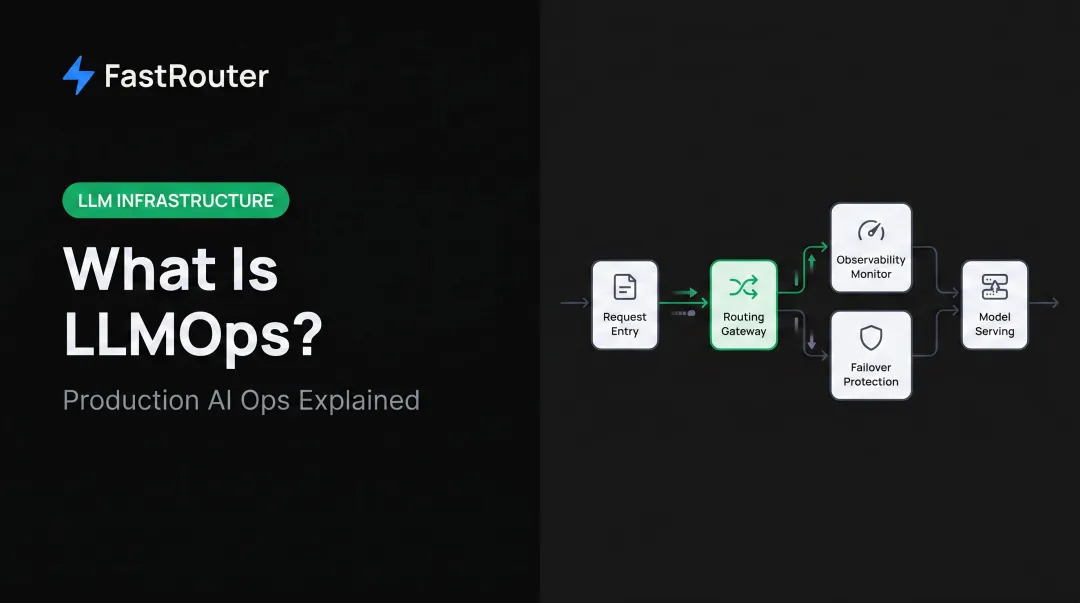
Running a genuine champion-challenger test for LLMs means sending identical prompts to multiple models or providers at once, capturing consistent metrics across all of them, without building a separate integration for each provider. That's a routing and observability challenge as much as an evaluation one.
Cost adds another layer. Testing several challengers simultaneously multiplies token spend. Without per-model cost tracking, evaluation budgets can spiral before you've even reached statistical significance.
Best practice: score challenger outputs against the champion using structured evals and guardrails covering quality, safety, and consistency before considering promotion. A challenger that's slightly better on relevance but worse on hallucination rate isn't a clear win.
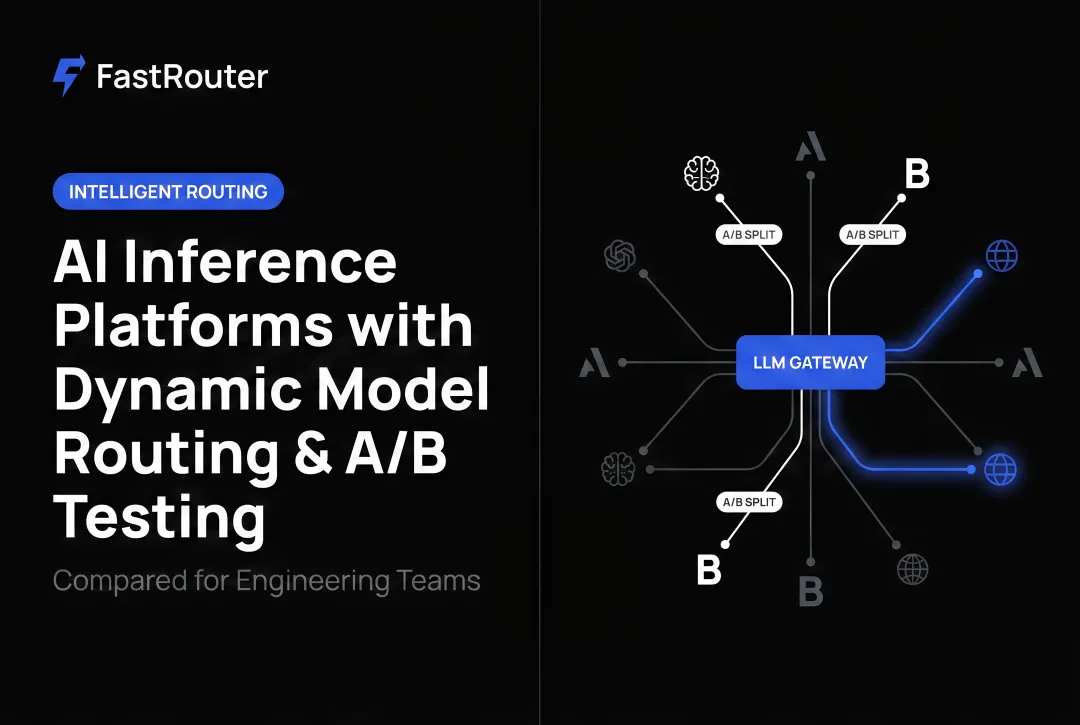
This is the gap FastRouter is built to close. It's an OpenAI-compatible control plane that unifies routing across 100+ models from providers including OpenAI, Anthropic, Google Gemini, and xAI, so champion and challenger models run through the same gateway on identical prompts.
Three built-in capabilities make that comparison possible:
- Experiment tracking logs results over time instead of relying on one-off comparisons
- Built-in evaluations score outputs on quality and consistency
- Observability surfaces latency and cost per model side by side
Together, these features let teams run real champion-challenger tests without stitching together custom infrastructure across providers.

RouteLLM's research on model routing found that intelligently routing between models cut inference costs roughly in half on some benchmarks, a reminder of how much is at stake in getting routing and evaluation right.
Best practice: define promotion criteria before testing starts, such as a statistically significant eval improvement with no increase in latency or cost. Deciding this upfront keeps teams from rationalizing a mediocre result after the fact.
Frequently Asked Questions
What is the champion-challenger concept?
It's a method for testing a candidate alternative (the challenger) against your current production standard (the champion) using real production data. The champion keeps running production while the challenger proves itself before any replacement decision is made.
What's the difference between champion-challenger and A/B testing?
Champion-challenger is an ongoing incumbent-vs-candidate comparison built for continuous model or process improvement. A/B testing typically compares two fixed variants for one specific, time-boxed decision, like a UI change.
How many challenger models can be tested at once?
This varies by platform and use case, but best practice is to cap it at two or three challengers. Too many candidates at once makes statistical comparisons messy and harder to manage cleanly.
How do you decide when to promote a challenger to champion?
Promotion should rest on statistically significant, sustained outperformance across metrics defined before the test began, not a single favorable result. Consistency over time matters more than a strong first showing.
Is champion-challenger testing only used for credit risk models?
No. It started in credit and banking risk management, but it's now widely used across MLOps, LLMOps, BPO outsourcing evaluation, and workforce management decisions.
How does champion-challenger testing apply to LLMs and generative AI?
It involves running candidate models in parallel on live prompts, scoring them with evals across quality, cost, and latency. Platforms like FastRouter provide the unified model routing, observability, and evaluation tools needed to run these comparisons reliably at production scale.