AI spend management platforms now handle everything from receipt capture and invoice coding to real-time budget enforcement and fraud detection — automatically, without manual review queues. The right platform doesn't just reduce administrative work; it gives finance teams the visibility to act on spend data before problems compound.
This article covers what AI spend management actually means in 2026, breaks down the five best platforms across different use cases, and explains the criteria that separate genuinely capable tools from those that just market AI features.
TL;DR
- AI spend management platforms use ML, OCR, and predictive analytics to automate expense tracking, procurement, and policy enforcement
- Top platforms in 2026 include corporate card tools (Ramp), enterprise source-to-pay suites (Coupa, SAP Concur), and AI-native procurement analytics (Payhawk, Procurify)
- Key evaluation criteria: automation depth, ERP integration quality, real-time visibility, scalability, and total cost of ownership
- LLM and model API token costs now form a distinct spend category that needs its own governance layer alongside traditional tools
- Each platform below includes pricing, core features, and best-fit guidance
What Is AI Spend Management?
Traditional spend management means spreadsheets, manual receipt uploads, end-of-month reconciliation, and finance teams chasing down missing documentation. It's reactive by design: problems surface after they've already happened.
AI spend management replaces that cycle with intelligent automation. Platforms in this category use machine learning, OCR, NLP, and predictive analytics to capture expense data automatically and categorize transactions in real time.
The key difference from legacy tools: policy enforcement happens at the point of spend, not during a month-end audit, and anomalies get flagged before they become compliance issues.
Core Capabilities AI Brings to Spend Management
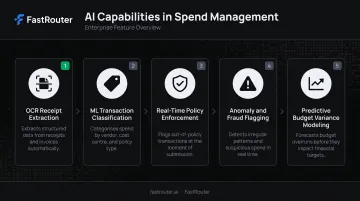
- Extracts receipt and invoice data via OCR, eliminating manual entry
- Classifies transactions against your chart of accounts using ML models
- Applies spending rules at transaction time, not during month-end review
- Flags deviating spend patterns for fraud or policy violations as they occur
- Surfaces budget variance risk before period close through predictive modeling
The market reflects this shift. The procurement analytics segment was projected to reach $8.0 billion by 2026, growing at a 25.3% CAGR from $2.6 billion in 2021 — one of the clearest signals that organizations are moving spend intelligence from spreadsheets to software.
That growth spans four distinct categories today: expense management, procurement, accounts payable automation, and AI infrastructure spend (LLM API token costs). The five platforms below represent the strongest evaluated options across these categories for US-based businesses.
Top AI Platforms for Spend Management
These platforms were selected based on:
- AI capability depth — how meaningfully AI is embedded in core workflows
- Integration breadth — compatibility with major ERP and accounting systems
- US market presence — active adoption evidence in US markets
- Business size fit — ability to serve startups through large enterprises
Ramp
Ramp launched as a corporate card company and has evolved into a full AI-first finance operating system for startups and mid-market businesses. More than 70,000 finance teams use the platform, and Ramp reports customers have collectively saved over $12 billion and 27 million hours — though these are aggregate platform figures, not isolated AI benchmarks.
What distinguishes Ramp is the tight loop between corporate cards, expense workflows, and accounting automation. AI agents perform real-time fraud detection, automatic receipt matching via OCR, and proactive compliance checks without creating manual review queues. Transactions flow from card swipe through categorization to accounting system sync with minimal human intervention.
| Feature Area | Details |
|---|---|
| Key Features | AI receipt matching, real-time policy enforcement, automated expense categorization, contract and subscription tracking, corporate card management |
| Best For | Startups and mid-market US companies seeking an all-in-one expense and spend management platform |
| Pricing | Free tier available; Ramp Plus at $12/user/month (billed annually); Enterprise at custom pricing |
| Integrations | 200+ integrations including NetSuite, Sage Intacct, QuickBooks Online, QuickBooks Desktop, Xero, and Workday Financial Management |
Coupa
Coupa operates at the enterprise end of the market, covering the full source-to-pay lifecycle — procurement, invoicing, supplier management, and expense reporting — within a single platform. It's built for large organizations with complex supply chains and multi-country operations.
The platform's AI engine, Coupa Navi™, powers supplier discovery, bid evaluation, spend analysis, and risk monitoring. Navi agents handle autonomous sourcing, collaboration, and orchestration, including the Navi Cost Formula Assistance Agent, which converts plain-language inputs into cost and scoring formulas for sourcing optimization. This multi-agent architecture supports fully autonomous spend management workflows, going beyond basic AI assistance to handle entire process sequences without human hand-holding.
| Feature Area | Details |
|---|---|
| Key Features | AI-powered sourcing via Coupa Navi™, real-time supplier risk monitoring, guided buying, e-invoicing, spend analytics, contract management |
| Best For | Large enterprises with complex supply chains, multi-country operations, and end-to-end source-to-pay requirements |
| Pricing | Custom enterprise pricing — contact sales for a demo and quote |
| Integrations | Integrates with major ERP systems; verify specific SAP, Oracle, and Workday connector details directly with Coupa during evaluation |
SAP Concur
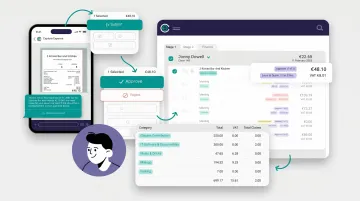
SAP Concur is the default choice for multinational corporations already running on SAP infrastructure. It has nearly a decade of ML model development across its core products — Concur Expense, Concur Travel, and Concur Invoice — and was recognized as a Leader in all four 2025 IDC MarketScape reports for AI-enabled travel and expense applications.
The standout capability is ExpenseIt, which received an agentic AI upgrade in late 2025. It uses LLMs alongside company policy data to extract receipt information, auto-fill expense reports across multiple currencies and languages, and estimate travel costs before they're incurred. For global organizations with heavy travel spend, that pre-trip cost estimation capability sets SAP Concur apart: most competitors only analyze spend after the fact, not before the trip is booked.
| Feature Area | Details |
|---|---|
| Key Features | LLM-based travel cost estimation, AI OCR receipt capture (ExpenseIt), deep SAP ERP integration, multi-currency/multi-language support, mobile expense management |
| Best For | Multinational companies within the SAP ecosystem requiring enterprise-grade global travel and expense management |
| Pricing | Request pricing — no public price table available; contact SAP Concur directly |
| Integrations | Native integration with SAP S/4HANA and SAP ERP; synchronizes data automatically between SAP Concur and SAP modules |
Payhawk
Payhawk combines corporate cards, expense management, accounts payable, and procurement into a single platform with a strong US and European presence. Its appeal for multi-entity businesses is its group dashboard — a single view of global spend across all entities with consistent policy enforcement applied everywhere.
Payhawk's AI agents handle end-to-end financial workflows — document upload, data extraction, approval routing — without requiring teams to switch tools. Its AI Procurement Agent keeps purchase requests moving through intake-to-pay without manual intervention. The multi-entity management layer is built specifically for companies running several subsidiaries from a single finance team.
| Feature Area | Details |
|---|---|
| Key Features | AI agent-based expense and invoice automation, multi-entity management, real-time budget tracking, corporate card controls |
| Best For | Mid-market to enterprise companies with global or multi-entity operations needing unified spend management |
| Pricing | Modular "build your stack" model; Payhawk Complete available; Travel module from $299/month |
| Integrations | NetSuite, Xero, QuickBooks, Microsoft Dynamics 365 Finance, Sage Intacct, BambooHR, Workday, Okta, Azure |
Procurify
Procurify focuses on mid-market procurement and spend management, offering intake-to-pay capabilities with a conversational AI layer that mid-market teams can actually use without dedicated analytics staff.
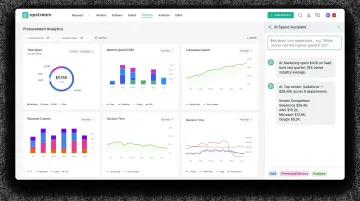
Its Spend Insights feature lets finance and procurement teams ask plain-language questions against live spend data — "Which vendors are driving the spike in this category?" — and get immediate answers without exporting spreadsheets or building reports. That means procurement and finance teams share the same real-time view without waiting on report runs or BI requests. Procurify earned 2026 Capterra and Software Advice recognition, with official AI Spend Insights capabilities confirmed on its product pages.
| Feature Area | Details |
|---|---|
| Key Features | Conversational AI spend analysis (Spend Insights), purchase order and requisition management, AP automation, budget tracking, vendor management |
| Best For | Mid-market companies seeking AI-powered procurement and spend analytics without enterprise-grade complexity |
| Pricing | Small Business at approximately $1,000/month; Corporate at approximately $2,000/month — verify current tiers on Procurify's pricing page before purchasing |
| Integrations | NetSuite, QuickBooks, Sage Intacct, Microsoft Dynamics 365 |
How to Choose the Right AI Spend Management Platform
Evaluation Criteria That Actually Matter
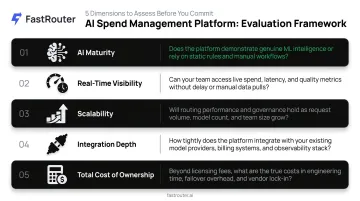
A common mistake: prioritizing feature count over integration quality. A platform with 50 features that doesn't sync cleanly with your ERP will create more reconciliation work, not less. Evaluate platforms on these five dimensions:
- AI maturity — Does the platform use ML, NLP, or predictive analytics in core workflows, or just as a marketing add-on?
- Real-time visibility — Can finance act on spend data as it happens, not at month-end?
- Scalability — Does it support growth in headcount, entities, and spend volume without requiring a platform change?
- Integration depth — Are ERP connections bidirectional and real-time, or batch-based? Batch syncs can delay your financial data by hours or days
- Total cost of ownership — Include implementation, training, and ongoing configuration — not just the subscription fee
The Emerging Criterion: AI Infrastructure Spend
There's a category most traditional spend management platforms don't address yet: LLM and model API token costs.
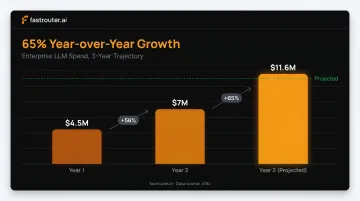
According to a16z, average enterprise spending on LLMs rose from approximately $4.5M to $7M over two years, with enterprises projecting another 65% growth in 2026. That's now a material budget line in most technology organizations — and it sits completely outside the visibility of Ramp, Coupa, or SAP Concur.
Teams running AI-powered applications at scale need a separate governance layer for this spend category. FastRouter is an LLMOps control plane designed specifically for AI infrastructure costs — providing multi-provider model routing, real-time cost observability, spend alerts, and project-level budget enforcement across 100+ models. Its audit tool reports an average cost reduction of 46% identified per audit. Traditional spend management platforms handle procurement and corporate card spend — FastRouter handles the AI infrastructure layer they weren't built to track.
Conclusion
The right AI spend management platform depends on where your biggest spend control gaps are and how much complexity your operations carry. Ramp works well for startups and mid-market companies that want automation without a lengthy implementation. Coupa and SAP Concur are built for enterprises that need end-to-end source-to-pay coverage or deep SAP integration. Payhawk fits multi-entity operations that need unified global visibility. Procurify serves mid-market procurement teams that want intelligence without enterprise overhead.
Evaluate platforms not just on current features but on integration ecosystem, roadmap transparency, and what implementation, onboarding, and ongoing maintenance actually cost. The platforms that hold up long-term are the ones that scale with your operations — not the ones that force a migration when your needs outgrow the original fit.
For teams whose spend now includes AI model and LLM infrastructure costs, FastRouter gives engineering and product teams a single control plane to manage multi-provider model routing, cost governance, and real-time observability across 100+ models. As AI infrastructure becomes a standard budget line item, having visibility and control over that spend from the start prevents the kind of cost sprawl these platforms are designed to solve.
Frequently Asked Questions
What AI platform is best for budgeting?
Ramp and Procurify work well for mid-market teams needing budget tracking tied to expense and procurement workflows. Coupa and Payhawk serve enterprise teams with multi-entity or global needs. The best fit depends on whether your primary budgeting need is expense-driven, procurement-driven, or both.
What is AI spend management software?
AI spend management software uses machine learning, OCR, and predictive analytics to automate expense tracking, invoice processing, policy enforcement, and spend analysis. It replaces manual, spreadsheet-based processes with real-time intelligent workflows that flag issues as they happen rather than after period close.
How does AI improve spend management compared to traditional tools?
The core improvements are timing and automation. AI platforms enforce policies at the point of spend, detect anomalies in real time, and automate transaction categorization — replacing after-the-fact audits and manual coding. Predictive analytics add forward-looking budget variance signals that static historical reports can't provide.
What features should I look for in an AI spend management platform?
Prioritize AI-powered receipt and invoice capture (OCR), automated spend categorization, real-time policy enforcement, native ERP integrations, fraud detection, and mobile accessibility. For organizations with international operations, multi-currency support and multi-entity management are essential.
How do AI spend management platforms integrate with ERP systems?
Most leading platforms offer native connectors to QuickBooks, NetSuite, SAP, Xero, and Microsoft Dynamics. Before committing, verify whether the integration is bidirectional and real-time or batch-based — batch syncs can delay spend data by hours and slow down financial reporting.
Are AI spend management platforms suitable for small businesses?
Several platforms are built with SMB-friendly pricing and fast deployment in mind — Ramp's free tier and Expensify's $5/member/month plan are common starting points. Coupa and SAP Concur are designed for enterprise complexity and aren't typically cost-effective for smaller organizations. Small businesses should prioritize ease of setup and core automation over feature breadth.