
AI routers have emerged as one of the fastest-growing categories in enterprise AI infrastructure precisely because of this volatility. As companies adopt more models from more providers, someone (or something) needs to decide which model handles which request.
This guide covers what AI routers are, how they work, the router-versus-gateway distinction that trips up most buyers, and how to actually choose one.
Key Takeaways
- Every request can hit the best-fit LLM for cost, speed, and quality—not a single default model
- Simple or low-stakes tasks skip frontier models, so you stop overpaying for capacity you don’t need
- Gateways unify access; routers add the decision layer that chooses where each call goes
- Enterprises now adopt routing for governance and vendor resilience, not just savings
What Are AI Routers?
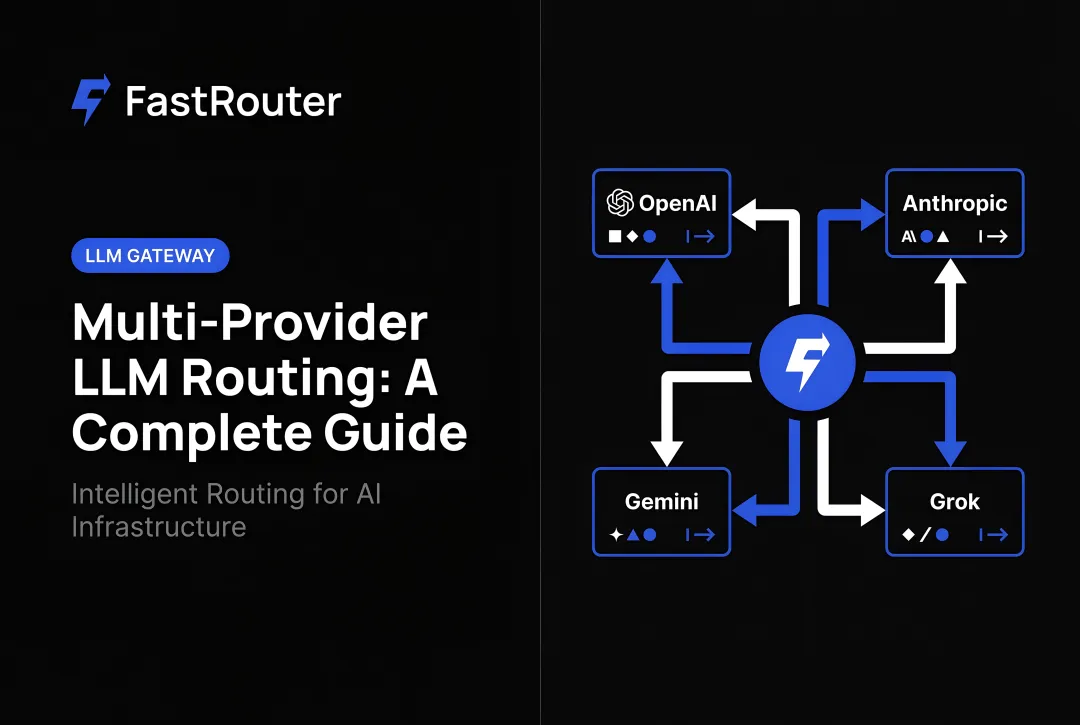
An AI router is a software layer that sits between your application and multiple LLM providers, deciding which model handles each incoming request. Instead of hard-coding a single model into your app, the router makes that call dynamically.
Why Routing Became Necessary
The model landscape exploded fast. Stanford's AI Index counted 149 foundation models released in 2023, more than double the previous year. Of those, 65.7% were open source (Stanford HAI, 2024). Hard-coding one provider stopped making sense once teams had dozens of viable options across cost and capability tiers.
Several tools emerged to handle that choice:
- OpenRouter: One API to hundreds of models with automatic fallbacks
- Not Diamond: Recommends the best model per prompt
- LiteLLM: Open-source gateway with routing, load balancing, and fallbacks across 100+ providers
Router Models vs. API Routers
Some routing systems use trained ML or heuristic models to predict the optimal downstream LLM for a given request. That internal predictor is sometimes called a "router model."
An API router is different: it parses incoming requests and directs traffic to the correct backend endpoint. The two ideas often sit in the same product, but they are not the same layer.
FastRouter's Auto Router is a practical example of objective-based routing. Teams pick Cost Optimized, Low Latency, or High Throughput, and the router evaluates each request against that goal across its catalog of 100+ models.
How AI Model Routing Works
Every routing request follows the same basic lifecycle. Understanding each stage makes the strategy choices below easier to evaluate.
- Request hits an OpenAI-compatible endpoint
- Router evaluates rules, policies, or content signals
- A model is selected and the request is forwarded
- The outcome is logged for cost, latency, and error tracking

Three Generations of Routing Logic
- Simple proxy/fallback: Send traffic to a primary model; on failure, retry a backup after cooldown. Solves reliability, not quality.
- Static rule-based routing: Operators set provider order, cost caps, or allow-lists. Predictable, but someone has to anticipate every request type.
- Intelligent content-aware routing: The router scores content or intent (often via embeddings) and picks a specialized model for that workload.
Red Hat's semantic router, for example, sends math questions to math-tuned models and creative prompts to writing-focused ones.

Common Routing Strategies
- Manual selection: The developer picks the model on each call for full control
- Auto-router: The system scores the request and chooses a model automatically
- Fallback chains: Ordered backup models/providers kick in when the primary fails
A quick example: Your primary model is Claude Opus and it hits a rate limit mid-spike. A fallback chain reroutes the request to GPT-4.1 or Gemini 2.5 Pro instead of erroring out. Platforms like FastRouter encode this as prioritized fallback lists plus multi-provider redundancy, so traffic shifts to the next healthy option without code changes.
Intelligent Saturation
Not every task needs your smartest, most expensive model. Route simple classification or formatting work to cheaper models and keep frontier reasoning models for hard problems. That split is how teams cut spend without lowering quality where it matters.
Observability Matters
Good routers expose dashboards for token spend, latency, error rates, and per-request logs. FastRouter's dashboard, for example, breaks cost and usage down by model, provider, project, and team, and can alert on spend spikes or anomalies so routing stays auditable in production.
AI Router vs. AI Gateway: What's the Difference?
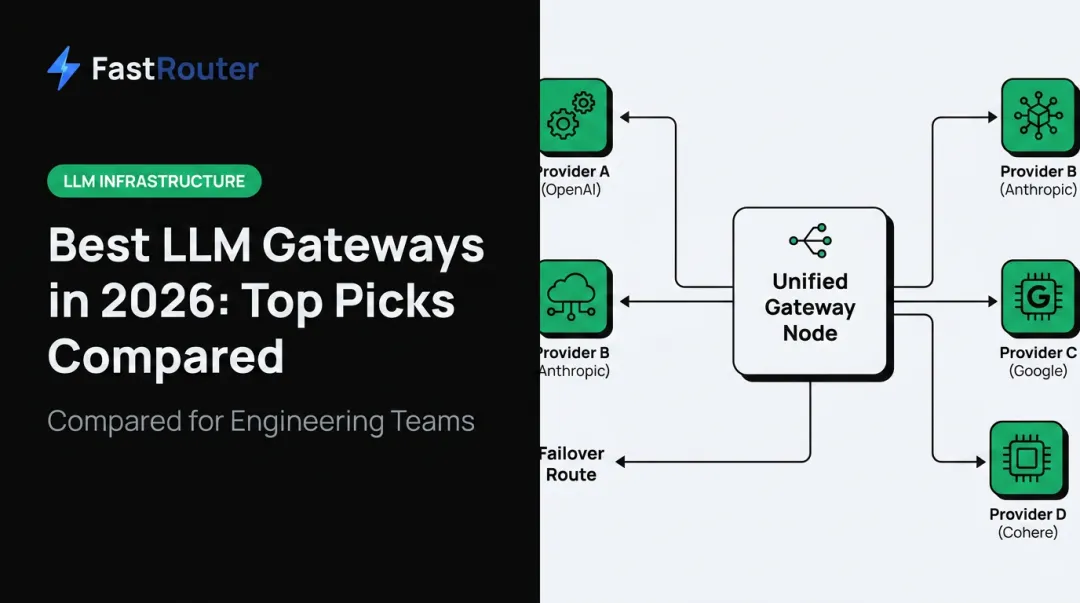
Gateways provide unified API access, authentication, and basic failover. Routers add dynamic, context-aware model selection on top of that access layer.
| Capability | AI Gateway | AI Router |
|---|---|---|
| Unified API access | Yes | Often included |
| Authentication & normalization | Yes | Sometimes |
| Dynamic per-request model selection | Minimal | Core function |
| Cost optimization by task | Limited | Built-in |
| A/B testing across models | Rare | Common |

In practice, the line has blurred. Many platforms, including FastRouter, combine both functions in one product, so vendors often use "router" and "gateway" interchangeably.
When you evaluate a platform, ignore the label and ask one question: does it only provide access, or does it choose which model handles each request?
Why Companies Are Adopting AI Routers Now
The Cost Problem Is Real and Growing
Autonomous coding agents and AI assistants call frontier models repeatedly, often without a human reviewing each call. CloudZero's 2025 survey of 500 US software professionals found average monthly AI spend hit $62,964 in 2024, projected to reach $85,521 in 2025 (a 36% jump) (CloudZero, 2025).
Routing lower-complexity requests to cheaper models, while reserving frontier models for complex reasoning, directly attacks this cost curve.
Vendor Resilience Isn't Optional Anymore
On December 11, 2024, OpenAI's ChatGPT, Sora, and developer API all went down simultaneously, with recovery taking roughly three hours (TechCrunch, 2024). Companies locked into a single provider had no recourse. Multi-provider routing with automatic failover turns that kind of outage into a non-event.
Beyond Cost: Trust and Governance
Routing decisions increasingly touch compliance, not just economics:
- Restricting which teams can access which models
- Enforcing spend caps at the project or API-key level
- Masking PII and enforcing data-residency rules
- Logging every request for audit trails
FastRouter operates as that control plane: unifying routing across 100+ models with observability, guardrails, cost governance, and evaluations.
Its guardrails validate inputs and outputs for policy violations. Project-level spend limits and role-based access controls contain damage from a leaked API key or an overzealous agent loop. For regulated industries like fintech and healthcare, that governance layer often matters more than the routing logic itself.

Choosing the Right AI Router for Your Team
Before committing, evaluate candidates against these criteria:
- Model catalog breadth — Does it cover the providers and modalities you need (text, image, video, speech, embeddings)?
- Routing intelligence type — Rule-based, cost/latency threshold, or content-aware?
- Observability depth — Can you see cost, latency, and errors per model, project, and team?
- Fallback reliability — Are failover chains automatic, or do you have to build them yourself?
- OpenAI-API compatibility — Can you migrate by changing a base URL, or does it require a rewrite?
Production Routing Is Harder Than It Looks
A thin API wrapper can be stood up quickly. Production-grade routing demands deep provider partnerships, constant endpoint health monitoring, and fast response when a provider degrades or goes down.
Gartner's 2025 Market Guide for AI Gateways treats governance, private-data protection, and unexpected-cost reduction as baseline expectations for this category (Gartner, 2025), not optional extras.
FastRouter's catalog spans 100+ models from OpenAI, Anthropic, Google, xAI, Meta, Alibaba, DeepSeek, and Mistral, across text, image, video, speech, and embeddings. Migration stays close to a drop-in change: teams keep existing OpenAI SDK calls, point base_url at FastRouter, and select models with provider-qualified IDs like anthropic/claude-opus-4.5.
A practical starting point:
- Start with an OpenAI-compatible router to avoid rewriting integrations
- Test with free credits before committing budget: FastRouter offers millions of tokens to start, no credit card required
- Layer in observability and cost controls early, not after your first billing surprise
- Keep BYOK support in mind if you already have negotiated provider rates worth preserving

Choosing this way avoids paying switching costs twice.
Frequently Asked Questions
What are AI routers?
AI routers are systems that dynamically select among multiple LLMs for each incoming request, based on cost, speed, and quality requirements. They sit between your application and model providers, making that decision automatically.
What does AI routing mean?
AI routing is the decision-making process that directs each individual request to the model best suited to handle it. This can be based on rules, cost thresholds, or content analysis.
What is the difference between an LLM router and an AI gateway?
A gateway provides unified access, authentication, and basic failover across providers. A router adds intelligent, per-request model selection on top of that access layer. Many products today do both.
What is a router model?
A router model is a trained ML or heuristic system used inside some routers. It predicts which downstream LLM best fits a request based on content, complexity, or cost.
What is a router in an API?
In an LLM API stack, a router parses each incoming request and forwards it to the best model endpoint or provider, based on your routing rules and policies.
What is the purpose of a router?
An AI router's purpose is to optimize cost, latency, and reliability across model providers. That way apps avoid overpaying on simple tasks and stay up when one provider fails.