Generative AI is changing that equation. Not by making old workflows slightly faster, but by converting spend management from a reactive compliance exercise into a proactive source of strategic intelligence.
This article covers why traditional approaches fail, how GenAI addresses the most critical spend management functions, the measurable business benefits, the real implementation challenges, and how finance teams can start building AI into their spend strategy today.
Key Takeaways
- GenAI adds predictive intelligence, natural language querying, and real-time decision support to spend management — going well beyond rule-based automation
- Core use cases: spend classification, contract risk detection, anomaly monitoring, demand forecasting, and supplier discovery
- Key benefits: cost savings through visibility, faster cycle times, tighter policy compliance, and reduced fraud exposure
- Biggest risks: poor data quality, integration complexity, and change management failures
- Gartner reports that at least 50% of GenAI projects were abandoned after proof of concept by end-2025 — execution matters more than technology selection
Why Traditional Spend Management Is Failing Finance Teams
Spend data lives in too many places at once — ERPs, procurement platforms, p-cards, expense tools, contract systems — none of which communicate in real time. A "single source of truth" is theoretically possible but practically out of reach for most organizations running legacy infrastructure.
Three failure patterns show up consistently:
Maverick spend leakage. When procurement workflows are too slow or too complex, employees route around them. According to CIPS research citing Hackett data, the average company loses more than 5% of negotiated contract value this way. That leakage compounds annually, erodes budget accuracy, and creates compliance exposure that's hard to audit after the fact.
The manual work trap. Finance and procurement teams spend an outsized portion of their time on low-value tasks: invoice matching, spend categorization, data cleansing, duplicate entry resolution.
Hackett's 2024 benchmark data shows Digital World Class procurement functions use 32% fewer FTEs and spend 24% less on labor than peers — not because they cut headcount arbitrarily, but because they eliminated transactional drag and redirected that capacity to strategic work.
Low spend under management. "Spend under management" (SUM) measures the percentage of total organizational spend flowing through approved contracts and official procurement channels. It's the clearest indicator of how much control a procurement function actually has. ISM's 2023 structured spend data shows even top-quartile performers only reached 67.6% structured spend — meaning roughly one-third of catalog-relevant spend was still outside controlled channels at the highest-performing organizations. For average teams, that gap is wider.
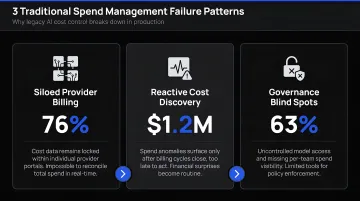
Low SUM translates directly to fragmented buying power, weakened supplier leverage, and savings targets that erode under scrutiny — often by more than finance leadership realizes until year-end.
How Generative AI Transforms Key Spend Management Functions
Unlike rules-based automation, GenAI learns from large datasets, generates insights and content, and lets users query complex financial data in plain language. That capability is what enables GenAI to handle messy, unstructured, cross-system spend data — not just the clean, pre-formatted inputs that legacy tools require.
Spend Classification and Data Hygiene
Spend classification is where most AI projects in procurement start — and for good reason. A 2025 study from the Journal of Purchasing and Supply Management found that large companies experience a 30% mean error rate in manual spend codification, with approximately 20% of data improperly classified. NLP-based classification approaches observed in the study reached 95% accuracy in specific settings, compared to roughly 80% for knowledge-base automated methods.
GenAI uses NLP and pattern recognition to automatically cleanse, deduplicate, and classify spend data from disparate sources, applying standard taxonomies like UNSPSC at a scale manual teams can't match.
That scale introduces a practical challenge: different classification tasks — high-volume deduplication vs. nuanced category mapping — benefit from different models. Teams using a platform like FastRouter can route classification requests across models like Anthropic Claude or Google Gemini through a single API, with intelligent auto-routing to balance cost, latency, and output quality per request.
Contract Review and Risk Detection
Poor contract management is expensive. World Commerce and Contracting estimates that effective contract development and management could save organizations an average of 9% of annual revenue — value lost through missed obligations, pricing escalation clauses, auto-renewals, and non-standard terms that manual reviewers regularly miss under volume pressure.
GenAI can analyze large volumes of contracts in minutes, surfacing:
- Renewal deadlines and auto-renewal triggers
- Pricing escalation clauses and volume commitment obligations
- Non-standard terms that create legal or financial exposure
- High-risk supplier obligations that require renegotiation
One important caveat: Stanford HAI found that legal AI models hallucinate in 1 out of 6 or more benchmarked legal queries. Contract review AI should flag and summarize risk — but human review remains essential before acting on AI-generated contract assessments. A related constraint is context length: processing a full contract without chunking or truncation requires models with large context windows. FastRouter's catalog includes models up to 2 million tokens (xAI's Grok 4.3 Fast), which matters for teams building contract analysis pipelines that need to ingest complete documents in a single pass.
Anomaly Detection and Policy Compliance
The ACFE's 2024 Report to the Nations estimates organizations lose 5% of annual revenue to fraud, with billing schemes producing a median loss of $100,000 per case. Most of that loss is recoverable only in retrospect — after a quarterly review catches what real-time controls missed.
ML models trained on transaction history can identify anomalies as they happen:
- Duplicate invoices submitted across periods
- Purchases outside approved contracts or supplier lists
- Sudden supplier price changes that deviate from benchmarks
- Patterns consistent with split invoicing or approval bypass
Gartner's 2024 finance AI survey found 39% of finance functions already use AI for anomaly and error detection. That adoption reflects a concrete operational change: moving from quarterly audits to continuous transaction monitoring means catching fraud and policy violations when intervention is still possible, not after the fiscal quarter closes.
Predictive Forecasting and Supplier Discovery
Detection addresses problems that already exist. Forecasting shifts the posture entirely. GenAI can analyze historical spend patterns alongside external signals — commodity indices, FX movements, supplier market conditions — to generate forward-looking budget projections that let finance teams act before variance becomes a problem, not explain it afterward.
On the sourcing side, McKinsey documented a supplier-discovery implementation where an AI prompt for ISO 9002-certified high-pressure injection molding suppliers in Southeast Asia returned three times the results of traditional search engine approaches. A separate McKinsey example in telecom showed up to 90% reduction in negotiation analysis and email time, with 10–15% savings across vendors.
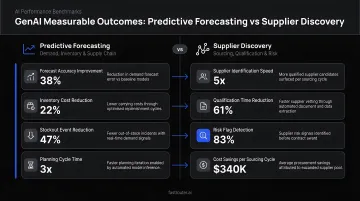
For RFX (requests for proposals, information, and quotes) generation and supplier research, multimodal models in FastRouter's catalog can process supplier documents, PDFs, and structured data simultaneously — reducing manual document parsing across the sourcing workflow.
The Business Case for Generative AI in Spend Management
Generative AI's value in spend management clusters into four areas:
- Cost visibility: AI surfaces tail spend and shadow spend that was previously invisible — duplicate supplier relationships, off-contract purchases, and volume consolidation opportunities. McKinsey's agentic AI procurement data shows 1–3% value capture improvement and 20–30% staff efficiency gains in documented implementations.
- Cycle time compression: Automating spend categorization, invoice processing, contract summarization, and report generation gives procurement teams time back for strategic supplier negotiations. Hackett's benchmark shows top procurement functions achieve 23% shorter cycle times than peers — AI is how others close that gap.
- Continuous compliance monitoring: AI monitors every transaction in real time, flagging exceptions before approval or reimbursement. Prevention costs far less than remediation — catching a policy violation before reimbursement beats discovering it in a quarterly audit.
- Compounding model improvement: AI models improve as they process more organizational data. Teams that start now build a training advantage over time. Gartner placed GenAI for procurement at the Peak of Inflated Expectations in 2024, with a plateau expected in 2–5 years — organizations building on their own spend data today will have more accurate models and more historical data to benchmark against when the technology matures.
Key Challenges Finance Teams Must Address
Data Quality as the Foundation
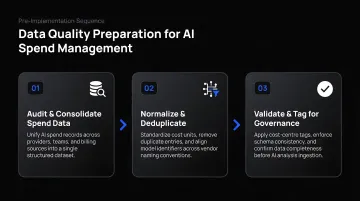
GenAI is only as accurate as the data it trains on. Organizations with fragmented, inconsistent, or incomplete spend data will generate misleading outputs — and misleading AI outputs are worse than no outputs, because teams may act on them with false confidence.
Deloitte's 2024 procurement research identified data quality as the primary internal barrier to AI adoption. The recommended starting sequence:
- Normalize supplier profiles before any model touches vendor data
- Fill in missing values across transaction and category records
- Clean spend categorization to ensure consistent taxonomy throughout
Integration and Security
AI tools must connect to existing ERP, procurement, and financial platforms without creating new silos. FastRouter's OpenAI-compatible API reduces this friction — teams can point existing integrations to FastRouter's endpoint (https://go.fastrouter.ai/api/v1) and access 150+ models without rebuilding connectors for each provider.
For organizations in fintech or handling sensitive financial data, governance matters. Relevant US frameworks include:
- FTC Safeguards Rule — information security requirements for covered financial institutions
- SEC cybersecurity disclosure rules — material breach disclosure obligations for public companies
- California CCPA/CPRA — privacy requirements for supplier contacts and workforce-related procurement data
Teams should contact their AI infrastructure provider directly to confirm data residency, retention policies, and enterprise security configurations before sending sensitive spend or contract data through any gateway.
Change Management and Skill Building
Technical readiness only gets you so far. Finance and procurement teams that aren't trained to use AI outputs are the most reliable predictor of a failed pilot — not the technology itself. Successful adoption requires:
- Training staff to interpret and act on AI-generated insights (not just receive them)
- Redefining workflows to incorporate AI recommendations at decision points
- Cross-functional sponsorship from finance, IT, and leadership — not just a procurement champion
Gartner's failure analysis found that at least 50% of organizations abandoned GenAI projects post-proof-of-concept — most citing poor change management, unclear business value, and weak governance. Scoping clear success metrics before launch is what separates pilots that scale from pilots that stall.
How to Start Implementing AI in Your Spend Management Strategy
A phased, narrow approach consistently outperforms broad deployments.
Run an AI readiness audit. Assess the maturity of your spend data across systems, identify where classification accuracy is weakest, and select 2–3 high-impact use cases to pilot. Spend classification and anomaly detection are the strongest starting points because results are measurable against clear baselines.
Pilot on a single spend category or business unit. Define KPIs before you start: classification accuracy rate, time-to-insight, savings identified, exceptions flagged. Run the pilot, measure against those baselines, and use the results to build the business case for broader rollout.
Choose tooling built for financial workflows. General-purpose AI tools require significant configuration before they perform well on spend classification tasks. Look for platforms with model evaluation capabilities that let teams compare output quality across providers. For example, you can test GPT-5.5 against Claude Opus and Gemini Flash on the same classification task before committing to a production choice. FastRouter's Evaluations feature supports exactly this kind of systematic cross-model comparison, including side-by-side output scoring with free testing credits.
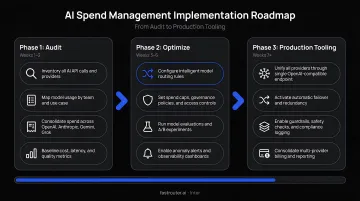
A successful pilot proves three things: the technology works, your team can govern its outputs, and the results connect to real financial decisions. Nail those three, and scaling becomes straightforward.
Frequently Asked Questions
Can procurement be done by AI?
AI can automate substantial portions of procurement — spend classification, purchase order creation, invoice processing, and even routine supplier negotiations. High-stakes decisions involving strategic supplier relationships, risk trade-offs, and ethical judgment still require human oversight and remain outside what current AI handles reliably.
What is generative AI in spend management?
GenAI in spend management uses advanced AI models to analyze spend data, automate categorization and reporting, generate documents like contract summaries or RFX drafts, and support predictive decision-making across procurement and finance functions.
How does generative AI reduce unmanaged spend?
GenAI analyzes transaction data across systems to surface off-contract purchases, shadow spend, and maverick buying patterns. Procurement teams gain visibility they can't achieve manually, redirecting spend toward preferred suppliers and approved channels in near real time.
How is generative AI different from traditional spend management software?
Traditional tools rely on structured data and predefined rules. GenAI can interpret unstructured data (contracts, invoices, emails), learn from patterns over time, generate new content, and answer complex queries in natural language — making it far more adaptive to real-world spend complexity.
What are the biggest challenges of implementing AI in spend management?
Three core hurdles: poor data quality that produces inaccurate outputs, integration complexity with legacy ERP and procurement systems, and the organizational change management required to get teams to trust and act on AI-generated recommendations. Data quality is where most projects fail first.
What is "spend under management" and how does AI improve it?
Spend under management (SUM) is the percentage of total organizational spend flowing through approved contracts and official channels. AI improves SUM by accelerating approval workflows and giving procurement teams real-time visibility to correct maverick spend before it compounds into a reporting problem.