That gap is where real risk lives. Hallucinations, copyright exposure, data leakage through public LLM prompts, and unpredictable content outputs aren't theoretical — they're operational hazards that can trigger regulatory penalties, erode stakeholder trust, and derail AI ROI.
This guide covers what generative AI governance actually is, the ethical principles that underpin it, the regulatory frameworks shaping compliance obligations, and how to build a governance program that scales with your AI ambitions.
For teams operationalizing this, FastRouter is the LLMOps platform — one OpenAI-compatible API across 150+ models, sub-10ms overhead, zero markup, with built-in observability and cost governance.
Key Takeaways
- GenAI governance is a structured framework of policies, ethics guidelines, and oversight mechanisms for AI systems.
- Without it, organizations face regulatory fines, data leakage, model bias, and trust erosion.
- Five ethical principles anchor every effective program: fairness, accountability, transparency, privacy, and human oversight.
- NIST AI RMF, EU AI Act, ISO/IEC 42001, and OECD Principles serve distinct roles — layer them rather than treating them as interchangeable.
- Effective governance is cross-functional, continuously monitored, and embedded from the start of the AI lifecycle.
What Is Generative AI Governance?
Generative AI governance is the framework of policies, processes, and oversight mechanisms that guide how organizations build, deploy, and manage GenAI systems. It covers the full AI lifecycle: training data practices, output monitoring, access controls, and regulatory compliance.
How It Differs from Broader AI Governance
Traditional ML governance handles relatively predictable model behavior. GenAI introduces a different class of challenges:
- Unpredictable content generation — outputs vary significantly across identical prompts
- Multimodal risk — text, image, audio, and video outputs each carry distinct legal and ethical exposure
- Prompt injection vulnerabilities — adversarial inputs can manipulate model behavior
- Copyright and IP risk — training data provenance creates potential infringement liability
- Black-box opacity — large language models resist straightforward interpretation
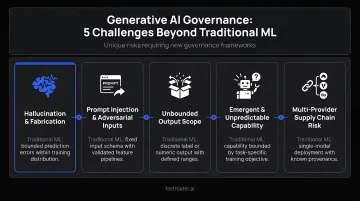
These factors demand governance approaches tailored specifically to GenAI, not just extensions of existing ML practices.
Governance vs. Security
Security and governance are related but distinct. Security protects AI infrastructure from external threats. Governance defines how decisions get made about AI development, use, accountability, and ethics. An organization can have strong security controls and still deploy AI irresponsibly — which is why both disciplines need to operate in parallel.
Why Generative AI Governance Matters
The business stakes are concrete. Gartner predicted in 2024 that at least 30% of GenAI projects would be abandoned after proof of concept by end of 2025 — citing poor data quality, inadequate risk controls, and unclear business value as primary causes. Without governance structures in place before scaling, those failure modes don't disappear — they compound.
Regulatory Exposure
Financial penalties for governance failures are material:
- EU AI Act: Up to €35M or 7% of global annual turnover for prohibited AI practices
- HIPAA violations: Civil monetary penalty maximums reach $2.1M for willful neglect; the Anthem settlement totaled $16M
- State-level laws: Colorado SB24-205, California AB 2013, and Texas HB149 are already creating patchwork compliance obligations for US enterprises
GenAI-Specific Workplace Risks
These risks differ from traditional software risk and require proactive policy:
- Shadow AI: Employees using unauthorized GenAI tools outside IT oversight
- Data leakage: Samsung banned employee use of public LLM tools after staff uploaded sensitive source code — a documented example of what unmanaged GenAI access enables
- Biased or harmful content: McKinsey found 44% of organizations had experienced at least one GenAI-related negative consequence
- Deepfakes and misinformation: Reputational damage from AI-generated content that reaches customers or media
Each of these risks has a governance counterpart — and addressing them proactively generates measurable returns.
Four Business Benefits of Robust Governance
| Benefit | What It Delivers |
|---|---|
| Brand trust | Customers and partners can verify how AI decisions are made and contested |
| Legal compliance | Audit trails and access controls reduce penalty exposure across EU AI Act, HIPAA, and state-level regulations |
| Operational reliability | Policy-enforced model behavior prevents output inconsistency across deployments |
| Strategic alignment | Teams can move faster on AI initiatives when risk guardrails are already in place |
Core Ethical Principles of Generative AI Governance
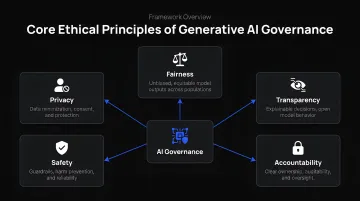
Five foundational principles anchor any effective GenAI governance framework. These aren't abstract ideals — each has direct operational implications.
The Five Principles in Practice
- Fairness: Diverse training data, bias audits on generated content, and output testing across demographic groups before deployment — not just a goal, but a process checkpoint.
- Accountability: Every deployed GenAI system needs a named owner responsible for its performance. "The team did it" isn't an accountability structure.
- Transparency: EU AI Act Article 13 requires high-risk AI systems to be sufficiently transparent for deployers to interpret outputs. In practice, that means documenting model assumptions, data sources, and known failure modes.
- Privacy and Security: Data protection across the full AI lifecycle, including controlling what enters prompts sent to external LLM providers — a gap that PII masking at the API gateway layer directly addresses.
- Human Oversight: Healthcare diagnoses, legal analysis, and financial decisions all require human review before acting on GenAI outputs. Under the EU AI Act, this isn't discretionary for high-risk contexts.
The Deployment Speed Tension
These principles create real friction — governance slows deployment, and teams feel that pressure. But embedding controls during model design costs far less than retrofitting them after a model has caused harm. NIST's lifecycle framing in SP 1270 makes this concrete: identifying and managing AI bias during development is far more manageable than remediating it in production systems already affecting users.
Key GenAI Governance Frameworks and Regulations
No single framework fits every organization. Selection depends on geography, industry, risk profile, and organizational maturity. The regulatory environment is also moving fast — what's voluntary today may be mandatory next year.
Framework Overview
| Framework | Type | Core Focus |
|---|---|---|
| NIST AI RMF (2023) | Voluntary US standard | Risk identification and mitigation across four functions: Govern, Map, Measure, Manage |
| ISO/IEC 42001:2023 | Certifiable international standard | Establishing and maintaining an AI management system with third-party auditability |
| EU AI Act (2024) | Binding EU law | Risk-tier classification (prohibited, high, limited, minimal) with strict GPAI obligations |
| OECD AI Principles (updated 2024) | Global baseline | Five values-based principles adopted by 47+ countries |
The EU AI Act applies to any organization deploying AI to EU users, regardless of where that organization is headquartered. US companies with European customers or operations cannot treat it as someone else's problem.
US organizations should also monitor OMB M-24-10, which establishes federal agency AI governance requirements including Chief AI Officers, and track state-level legislation. Banking and financial services firms remain subject to SR 11-7, the Federal Reserve and OCC's foundational model risk management guidance, and should watch for updated supervisory guidance as regulators extend those principles to generative AI applications.
How to Layer These Frameworks
Rather than treating these frameworks as competing alternatives, most enterprises benefit from a layered approach:
- NIST AI RMF as the operational risk management backbone
- EU AI Act compliance layered in for regulatory obligations where applicable
- OECD Principles grounding ethical decision-making across the program
- ISO/IEC 42001 for organizations pursuing formal third-party certification
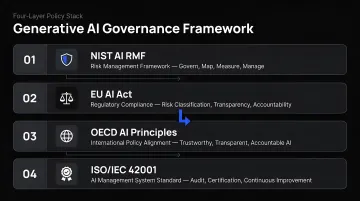
Start with your regulatory geography. EU presence means AI Act compliance is mandatory. High-stakes sectors like healthcare or finance benefit from NIST or ISO/IEC 42001's rigor. Smaller teams can use OECD Principles as a lightweight ethical baseline while building toward a more structured program.
Building a GenAI Governance Program: 5 Key Domains
Building a GenAI Governance Program: Key Domains
Effective governance distributes responsibility across five domains rather than concentrating it in a single compliance team.
Domain 1: AI Organization and Roles
Establish a cross-functional AI governance committee with representatives from legal, compliance, IT, data science, and business units. Define specific accountabilities — who owns model validation, who reviews ethical concerns, who manages regulatory reporting. Use a RACI matrix to close accountability gaps.
C-suite sponsorship determines whether governance programs gain traction or get deprioritized. Tie governance metrics to business KPIs — reduced model incidents, faster compliance approvals, improved audit scores — so leadership sees concrete returns, not just compliance overhead.
Domain 2: Legal, Regulatory, and Data Governance
Build the compliance pillar in three steps:
- Baseline assessment — identify applicable regulations by geography and sector
- Use case classification — map existing and planned GenAI deployments by risk level
- Legal review process — require sign-off before any new AI deployment goes live
Data governance sits beneath this layer. GenAI governance is only as strong as its data foundation. Define data quality standards, lineage tracking, access controls, and consent frameworks for training data.
AI regulation is evolving fast. Implement a monitoring process to track emerging AI laws, update policies accordingly, and conduct documented internal audits that support external regulatory review.
Domain 3: Monitoring, Auditing, and Continuous Improvement
A governance program only delivers value when it's actively enforced at the operational level. Continuous governance requires:
- Detect model drift, hallucinations, bias indicators, and policy violations in real time through automated monitoring
- Log model decisions, data inputs, and output reviews in complete, queryable audit trails
- Run structured reviews at least quarterly, covering model performance, fairness metrics, and regulatory alignment
Platforms like FastRouter operationalize governance monitoring as part of an LLMOps platform — providing observability dashboards, complete LLM request/response logging, and real-time alerts for cost spikes, failures, and performance drops across all connected models, alongside routing, evaluations, guardrails, and cost governance from a single control plane. These capabilities reduce the manual burden of governance monitoring at scale, surfacing anomalies before they become incidents.
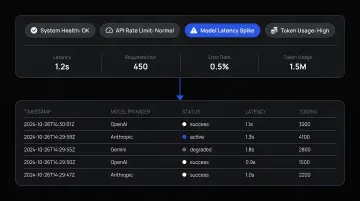
For organizations managing multiple AI providers, consolidating visibility through a single gateway — rather than monitoring each provider in isolation — significantly reduces oversight gaps. This matters: IBM's 2025 data breach research found that 63% of breached organizations lacked AI governance policies, making shadow AI scenarios a concrete risk, not a hypothetical one.
GenAI Governance Best Practices
Embed Governance in the Development Lifecycle
Treat governance as a pre-deployment requirement, not a post-launch review. Require ethical impact assessments, data quality checks, and bias evaluations during model design. Define intended use cases explicitly — including prohibited uses and high-risk scenarios — before deployment, not after.
Build Explainability Into Every Deployment
Without traceable outputs, governance reviews stall and user trust erodes. Model interpretability tools like SHAP (SHapley Additive Explanations) or LIME make outputs auditable at the decision level. Maintain documentation of model assumptions, training data characteristics, known limitations, and decision logic — accessible to both technical and non-technical stakeholders — to support regulatory audits without scrambling for records after the fact.
Address Shadow AI Directly
Microsoft's 2024 Work Trend Index found that 78% of AI users brought their own AI tools to work — outside IT oversight, outside approved tooling, and outside governance controls. Shadow AI isn't a hypothetical risk; it's the default state without proactive policy.
Governance response should include:
- Acceptable use policies covering approved tools, permissible data inputs, and prohibited use cases
- Employee training to ensure those policies are understood and followed
- A single approved LLMOps platform for all GenAI API access, replacing fragmented direct provider connections
FastRouter's role-based access controls, project-level API key limits, and custom model lists give governance committees the ability to define exactly which models each team can access — eliminating the control gaps that shadow AI thrives in.
Run Structured, Ongoing Risk Assessments
Point-in-time reviews are insufficient. Active GenAI systems need continuous evaluation, not quarterly checkboxes. A structured risk cadence includes:
- Periodic bias, performance, and security evaluations across all active models
- Automated monitoring for model drift, adversarial inputs, and output quality degradation
- Policy updates triggered by significant model changes — fine-tuning, version updates, or provider infrastructure changes all warrant reassessment
Enforce Accountability with Documented Ownership
Assign clear individual or team accountability for every deployed GenAI system. Define escalation paths for ethical or performance concerns. Governance authority should be distributed across business, technical, and compliance roles — a single team without legal, technical, and operational context will miss failure modes that only surface at the intersection of those disciplines.
Frequently Asked Questions
What is generative AI governance?
Generative AI governance is the structured framework of policies, ethical guidelines, and oversight mechanisms organizations use to ensure GenAI systems are developed, deployed, and managed responsibly. It covers risk management, regulatory compliance, bias prevention, and accountability throughout the entire AI lifecycle.
Why is governance important when using generative AI in the workplace?
GenAI introduces unique workplace risks — data leakage through public LLM prompts, biased content generation, shadow AI use, and copyright exposure — that traditional software governance doesn't address. Without formal policies, organizations face regulatory penalties, reputational damage, and operational failures.
What governance approach is recommended for organizations adopting AI?
Start by establishing a cross-functional governance committee with defined roles, then select a framework aligned to your regulatory environment (NIST AI RMF for US operations, EU AI Act for EU exposure). Develop documented policies, implement continuous monitoring, and treat governance as an ongoing program rather than a one-time compliance task.
What are the 5 key domains of a GenAI governance framework?
The five domains are: (1) AI Organization and Roles, (2) Legal and Regulatory Compliance, (3) Ethics, Transparency, and Interpretability, (4) Data, AI Ops, and Infrastructure, and (5) AI Security. Together, they create interlocking layers of accountability spanning the full AI lifecycle — from model selection through deployment and monitoring.
What is the data governance framework for AI?
AI data governance is the set of policies and controls managing data quality, lineage, access, and compliance throughout the AI lifecycle — covering how training data is sourced, validated, documented, and monitored for ongoing model trustworthiness.
What are the five pillars of trust in AI?
The five pillars are fairness, transparency, accountability, privacy and security, and human oversight. Fairness targets unbiased outputs; transparency means decisions can be explained; accountability assigns clear ownership; privacy and security protect data and model assets; human oversight keeps AI actions under organizational control. These map directly to the EU AI Act's high-risk obligations and the OECD AI Principles.