Choose the wrong platform and you're dealing with prompt regressions you can't reproduce, token costs that quietly balloon, and compliance gaps that surface at the worst possible moment. This guide cuts through the noise with a direct comparison of the five best LLMOps platforms in 2026, who each one is built for, and how to pick the right one for your team.
Key Takeaways
- LLMOps manages the full LLM lifecycle: prompt engineering, evaluation, deployment, monitoring, and continuous improvement
- The top 5 platforms are FastRouter, Braintrust, Galileo, LangSmith, and Weights & Biases, each optimized for a different operational need
- Platforms were evaluated on evaluation depth, observability, integrations, compliance certifications, and pricing
- Early-stage teams need rapid iteration tooling; enterprises need governance, compliance, and scale
- Your tech stack and use case (RAG, agents, fine-tuning) should drive platform selection — no single tool fits every team
What Is LLMOps and Why Does It Matter in 2026?
LLMOps is the operational discipline for managing large language models in production — covering prompt engineering, evaluation, deployment, routing, observability, guardrails, cost governance, and continuous improvement. It's distinct from traditional MLOps because LLMs produce non-deterministic outputs: the same prompt can yield different results on consecutive calls. That reality demands prompt versioning, token-level cost tracking, and semantic quality evaluation rather than standard accuracy metrics.
Gartner predicted that at least 30% of GenAI projects would be abandoned after proof of concept by end of 2025, citing poor data quality, inadequate risk controls, escalating costs, and unclear business value. The failure rate isn't a warning sign — it's the baseline without proper operational infrastructure.
That pressure sits alongside accelerating adoption. McKinsey's 2025 Global Survey found 88% of organizations regularly use AI in at least one business function — up from 78% the prior year — with 62% already experimenting with AI agents.
What Makes 2026 Different
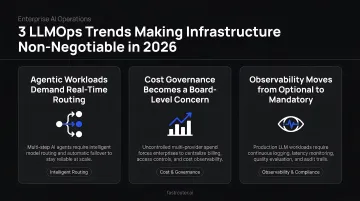
Three shifts have made LLMOps infrastructure non-negotiable:
- Agentic workflows are mainstream. Gartner predicts 40% of enterprise applications will feature task-specific AI agents by end of 2026, up from less than 5% in 2025. Multi-step reasoning chains create debugging complexity that traditional APM tools weren't built for.
- Compliance is now a procurement requirement. SOC 2 Type II, HIPAA, and GDPR aren't differentiators — they're table stakes for enterprise deployment in regulated industries.
- Evaluation-first development has replaced reactive debugging. Teams that catch regressions before production ship faster and with more confidence.
The platforms covered below each take a different angle on these problems: some lead with evaluation, others with observability or infrastructure. The next section breaks down the top five and who each one is actually built for.
The 5 Best LLMOps Platforms in 2026
Selection criteria: Platforms were evaluated across evaluation capabilities, production observability, integration ecosystem, compliance certifications, deployment flexibility, collaboration features, and pricing transparency — prioritizing tools with demonstrated production usage at scale.
Here's how the top five platforms stack up.
FastRouter
FastRouter is an LLMOps control plane that approaches the lifecycle from the gateway layer: a single OpenAI-compatible API with sub-10ms overhead, unifying routing, observability, evaluation, guardrails, and cost governance across 150+ models. Where the platforms below lead with dedicated evaluation or experiment tracking, FastRouter's edge is multi-provider breadth and operational control — the layer teams standardize on when several models run in production and they want one control plane instead of per-provider tooling.
What sets it apart:
- Auto Router (fastrouter/auto) with Cost Optimized / Low Latency (sub-10ms overhead) / High Throughput modes across 150+ models; Virtual/Custom Model Lists move model selection out of application code
- Unified observability — cost, latency (p50/p99), error rates, full request–response logs, real-time alerts — across every provider in one dashboard
- Built-in guardrails (input/output validation, PII masking) and governance (RBAC, project/API-key spend limits, audit logs, consolidated multi-provider billing)
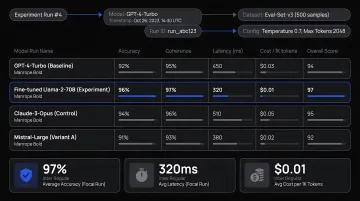
- Evaluations, Model Council, and Experiment Tracking for side-by-side comparison before a production switch
- Honest scope: complements dedicated evaluation suites rather than matching their depth — its strength is unifying routing, observability, and governance across providers
| Category | Details |
|---|---|
| Key Features | Multi-provider gateway (150+ models, OpenAI-compatible), Auto Router, Virtual/Custom Model Lists, unified observability, guardrails + PII masking, experiment tracking, consolidated billing, Audit Service |
| Best For | Teams running multiple models/providers in production that want routing, observability, guardrails, and cost governance from one control plane |
| Pricing | Usage-based with zero markup on API calls; no setup fees or monthly minimums; free credits, no credit card required; BYOK supported |
Braintrust
Braintrust is an evaluation-first LLMOps platform used by AI teams at Notion, Stripe, Vercel, Airtable, Instacart, and Zapier. Its core philosophy: systematic testing — not production firefighting — is how AI products improve. It supports 13+ frameworks including LangChain, OpenAI, Anthropic, and the Vercel AI SDK.
What sets it apart:
- The Brainstore database lets teams search millions of production traces in seconds
- The Loop AI agent automates dataset creation, evaluation criteria generation, and prompt improvement suggestions
- A unified workflow moves teams from production logs → test cases → evaluation runs without switching tools
- Bidirectional UI/code sync means non-technical and technical team members can collaborate on the same evaluation
According to Braintrust's published customer data, Notion increased AI triaging capacity from 3 issues/day to 30 issues/day, with 70 AI engineers running evaluations through the platform. Teams using Braintrust average more than 10 experiments per day — a pace that's difficult to sustain without tightly integrated evaluation tooling.
| Category | Details |
|---|---|
| Key Features | Evaluation-as-core-workflow with automated scorers, Loop AI agent, prompt playground, bidirectional UI/code sync, 13+ framework integrations |
| Best For | Teams building production AI applications who want evaluation-driven development and a unified experimentation-to-deployment workflow |
| Pricing | Starter: Free (unlimited users, 1GB processed data, 10K scores, 14-day retention); Pro: $249/month; Enterprise: custom with self-hosting |
Galileo
Galileo is a production-scale LLMOps platform purpose-built for enterprise generative AI. It handles infrastructure capacity for 20M+ daily traces and is designed for organizations in regulated industries that need comprehensive compliance coverage alongside full-lifecycle observability.
What sets it apart:
- Luna-2 evaluation models deliver quality assessment at 97% lower cost than GPT-5.5 alternatives, with average latency of 167ms (Luna-2 3B) to 214ms (Luna-2 8B) — making continuous evaluation economically viable at scale
- Agent Graph visualization maps multi-agent decision flows for complex debugging
- Insights Engine automatically clusters failure patterns without manual analysis
- Runtime protection intercepts harmful outputs in real time
- Flexible deployment: SaaS, VPC, and on-premises options
For regulated-industry procurement, Galileo holds SOC 2 Type II and HIPAA certifications (verified). GDPR and ISO 27001 compliance is also documented on Galileo's product pages. That compliance stack significantly reduces enterprise security review cycles.
| Category | Details |
|---|---|
| Key Features | Luna-2 evaluation models, Agent Graph visualization, Insights Engine for automated failure clustering, runtime protection, flexible deployment (SaaS, VPC, on-premises) |
| Best For | Enterprise and regulated-industry teams needing production-scale observability, comprehensive compliance certifications, and real-time guardrails |
| Pricing | Free: 5,000 traces/month; Pro: $100/month (50,000 traces); Enterprise: unlimited traces with custom rate limits and VPC/on-premises options |
LangSmith
LangSmith is the observability platform from the LangChain team — the natural choice for teams already building with LangChain or LangGraph. End-to-end tracing activates with a single environment variable (LANGSMITH_TRACING=true), making setup near-instant for LangChain-native teams.
What sets it apart:
- Agent workflow tracing captures token-level granularity across complete reasoning chains, including tool calls, decision points, and nested spans
- Flexible trace retention: 14-day base retention for debugging, 400-day extended retention for long-term analysis
- Hallucination detection and prompt versioning are baked into the evaluation framework
- Compliance coverage: SOC 2 Type II, GDPR, and HIPAA verified through official trust documentation
One important note: LangSmith works with other frameworks, but its deepest value is for LangChain/LangGraph-native teams. If your stack is built around a different orchestration layer, the integration overhead may reduce the time-to-value advantage.
| Category | Details |
|---|---|
| Key Features | End-to-end agent observability with token-level tracing, one-line LangChain integration, 14-day/400-day trace retention, prompt versioning, hallucination detection |
| Best For | Teams using LangChain or LangGraph who need seamless agent tracing and framework-native debugging workflows |
| Pricing | Developer: Free (1 seat, 5K base traces/month); Plus: $39/seat/month; Enterprise: custom with self-hosting |
Weights & Biases (W&B)
Weights & Biases built its reputation on ML experiment tracking and extended into LLMOps through W&B Weave. For organizations already standardized on W&B for traditional ML workloads, this is the natural path into generative AI — a unified infrastructure that eliminates tool fragmentation across ML and LLM workflows.
What sets it apart:
- W&B Weave provides automatic LLM tracing, prompt versioning, evaluation frameworks, and cost/latency tracking at individual and aggregate levels
- W&B Inference offers hosted access to open-source models including Llama, DeepSeek, and Qwen variants
- Artifacts enables version and lineage tracking for prompts, datasets, and models
- Multi-cloud deployment: AWS, Azure, and GCP for both Dedicated Cloud and Self-Managed options
One honest caveat: Weave is a newer addition to the W&B ecosystem, and LLM-specific features are less mature than dedicated LLMOps platforms like Braintrust or Galileo. For teams whose primary workload is generative AI, that gap matters. For hybrid ML+LLM teams, the unified infrastructure advantage typically outweighs it.
| Category | Details |
|---|---|
| Key Features | W&B Weave for LLM observability and tracing, W&B Inference for open-source model hosting, Experiments and Sweeps for fine-tuning, Artifacts for versioning, multi-cloud deployment |
| Best For | ML teams with existing W&B infrastructure extending into LLMs, or teams managing both traditional ML and LLM workloads on a single platform |
| Pricing | Free: 5GB/month storage (personal development); Pro: from $60/month; Enterprise: custom with HIPAA, SSO/SAML, single-tenant deployment |
How We Chose the Best LLMOps Platforms
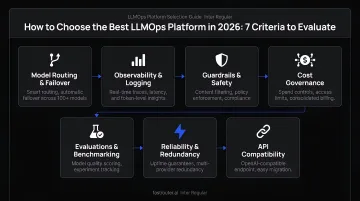
Not all LLMOps platforms are built for the same problems. To make this comparison useful, each platform was assessed across seven dimensions:
- Evaluation depth — automated scorers, LLM-as-a-judge, human-in-the-loop workflows
- Observability and tracing — full-stack visibility including agent workflows and token-level granularity
- Integration ecosystem — framework support and instrumentation ease
- Production readiness — scale, reliability, and security certifications
- Collaboration features — UI accessibility for non-technical users and prompt versioning
- Cost efficiency — pricing tiers and built-in cost tracking
- Developer experience — time-to-value and API-first design
Common Selection Mistakes to Avoid
Teams consistently make the same selection mistakes:
- Brand affiliation over operational fit — a platform bundled with your LLM provider isn't automatically the right operational tool
- Skipping compliance verification — SOC 2 Type II, HIPAA, and GDPR certifications take months to confirm in enterprise procurement; gaps discovered post-build are expensive
- Monitoring without evaluation — observability tells you something went wrong; evaluation tells you why and how to fix it
- Ignoring team composition — a platform requiring Kubernetes expertise will create bottlenecks for an ML-focused team without DevOps resources
Conclusion
The right LLMOps platform in 2026 depends on your operational stage, tech stack, and quality priorities — not which tool has the longest feature list. Here's where each platform fits best:
- Multi-provider routing + a unified LLMOps control plane → FastRouter
- Evaluation-driven teams → Braintrust
- Enterprise compliance and scale → Galileo
- LangChain/LangGraph-native teams → LangSmith
- Hybrid ML+LLM teams → Weights & Biases
Most platforms offer generous free tiers, making it practical to trial two or three before committing. Prioritize tools that fit your team's current workflow rather than requiring a full operational overhaul. Evaluate ongoing performance, scalability, and total cost of ownership, not just feature checklists.
Start with FastRouter's free credits — no credit card required, and use the free Audit Service to surface cost and quality optimization opportunities across your existing AI workloads.
Frequently Asked Questions
What is LLMOps?
LLMOps (Large Language Model Operations) is the operational practice of running LLMs reliably in production — covering prompt engineering, evaluation, deployment, routing, observability, guardrails, cost governance, and continuous improvement. Unlike traditional MLOps, LLMs produce non-deterministic outputs, so LLMOps requires semantic evaluation, prompt versioning, and token-level cost tracking rather than standard accuracy metrics. Platforms like FastRouter operationalize this full lifecycle through a single OpenAI-compatible control plane — so teams aren't stitching together separate tools for routing, evals, and observability.
What platforms are used for LLM deployment?
Leading LLM operations platforms in 2026 include FastRouter, Braintrust, Galileo, LangSmith, and Weights & Biases — alongside TrueFoundry and cloud-native options from AWS SageMaker, Azure ML, and Google Vertex AI. The best choice depends on whether your team prioritizes evaluation depth, observability, or infrastructure control.
What MLOps platform allows hosting apps with pre-trained models?
Weights & Biases (via W&B Inference), TrueFoundry, and major cloud platforms (AWS SageMaker, Azure ML, Google Vertex AI) all support hosting applications built on pre-trained models. MLflow's AI Gateway and Databricks Managed MLflow round out the options for teams needing centralized API access or enterprise-scale model serving.
How do you monitor LLM usage?
Effective LLM monitoring covers three dimensions: functional (latency, token usage, error rates, cost per query), prompt (injection attempts, toxic inputs, embedding drift), and response (hallucination detection, semantic quality, topic divergence). Tools like Galileo, LangSmith, Braintrust, Arize AI, and W&B Weave address these needs at varying depths.
How does LLMOps differ from DevOps?
DevOps manages deterministic, testable code through deployment pipelines. LLMOps adds complexity for non-deterministic AI outputs — prompt version control, semantic evaluation beyond pass/fail testing, token cost monitoring, and safety guardrails like hallucination detection and PII filtering that have no DevOps equivalent.
What is the future of LLMOps?
Four trends are shaping LLMOps through 2026 and beyond:
- Evaluation-first development replacing reactive debugging
- Agentic workflow observability as multi-step AI agents become standard
- Tighter compliance and governance tooling for regulated industries
- Convergence of LLMOps with broader MLOps stacks as organizations unify AI infrastructure