The visibility gap is real. According to Ardent Partners research, Best-in-Class procurement teams manage 91.7% of spend through formal channels, while all others manage just 61.1% — a 30-point gap that directly translates to uncontrolled costs, missed savings, and blind spots in supplier relationships.
AI spend analysis is closing this gap. By applying machine learning, natural language processing, and predictive analytics to purchasing data, organizations can move from reactive month-end reconciliation to continuous, real-time spend intelligence.
This article covers what AI spend analysis is, why it matters for procurement performance, how it works in practice, and what a real implementation looks like — step by step.
Key Takeaways
- AI spend analysis uses ML and NLP to collect, cleanse, classify, and interpret purchasing data across all sources automatically
- Manual classification is slow and error-prone; AI processes transactions continuously with far greater accuracy
- Core benefits include spend visibility, cost reduction, supplier optimization, compliance enforcement, and faster decisions
- The process follows five stages: define scope, consolidate data, cleanse and classify, analyze for insights, then act and monitor
- Early investment in spend intelligence pays forward — savings compound as AI models learn and improve
What Is AI Spend Analysis?
AI spend analysis is the practice of using artificial intelligence — including machine learning, NLP, and predictive analytics — to automatically gather, standardize, classify, and interpret an organization's purchasing data across suppliers, categories, departments, and time periods.
CIPS defines spend analysis as "the process of collection, classifying and analysing expenditure data" to answer questions about spend visibility, compliance, and control. AI applies that same workflow — but at speed and scale that manual methods can't match.
Where It Fits in Procurement Strategy
AI spend analysis sits at the foundation of procurement decision-making. It supports:
- Strategic sourcing and supplier selection
- Contract negotiation with data-backed leverage
- Budget planning and variance management
- Compliance tracking and policy enforcement
- Cost reduction and consolidation initiatives
It spans direct spend (materials, components), indirect spend (IT, facilities, professional services), and tail spend — the long tail of low-value, high-volume transactions that manual teams rarely have time to analyze.
AI-Driven vs. Manual Classification
AI-driven classification outperforms manual methods on accuracy, consistency, and currency — not just speed.
| Dimension | Manual | AI-Driven |
|---|---|---|
| Classification speed | Weeks to months | Near real-time |
| Consistency | Varies by analyst | Standardized taxonomy |
| Improvement over time | Requires retraining people | Reinforcement learning |
| Coverage | Sampled or partial | Full transaction set |
| Taxonomy standard | Inconsistent | UNSPSC and others |
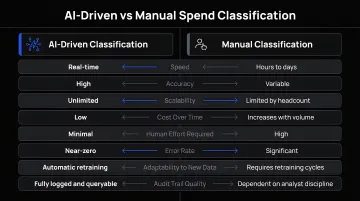
Manual classification produces point-in-time snapshots that go stale quickly. AI continuously processes new transactions and applies standard taxonomies — such as the UNSPSC, an open global classification standard maintained by UNDP — improving accuracy over time through supervised and unsupervised learning.
Generative AI is now accelerating this further, resolving ambiguous line items that previously required manual review.
Why AI Spend Analysis Is Critical for Procurement Performance
Without accurate spend visibility, procurement decisions get made on incomplete data. Sourcing strategies miss consolidation opportunities. Supplier negotiations lack leverage. Budget forecasts are wrong before the quarter even starts.
Adoption numbers reflect the urgency: Deloitte's CPO survey found 92% of CPOs were assessing or planning generative AI adoption, with planned investment doubling year over year. McKinsey estimates agentic AI could make procurement functions 25–40% more efficient overall.
The real difference comes down to timing. With AI, procurement teams can identify a category overspend or supplier pricing anomaly before month-end — not after the budget is blown.
Core Business Benefits
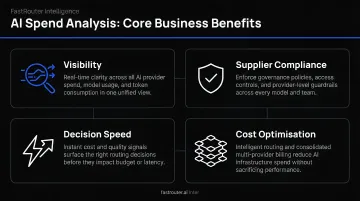
AI-driven spend analysis delivers value across four interconnected areas:
Visibility and cost control:
- Full view across all categories, departments, and suppliers — eliminating blind spots from fragmented ERP and AP data
- Surfaces duplicate suppliers, off-contract purchases, and pricing variances across vendor groups
- Flags tail spend consolidation opportunities that manual review routinely misses
Supplier management:
- Data-backed performance tracking with risk flagging before issues escalate
- Negotiation leverage from accurate, real-time volume data rather than estimates
Compliance enforcement:
- Detects maverick spending in real time and routes off-contract purchases back to approved channels
- Provides a complete audit trail for policy adherence
Decision speed:
- Replaces quarterly reports with continuous intelligence
- Answers "why did it happen?" — not just "what happened?" — so sourcing decisions don't wait on analyst cycles
How AI Spend Analysis Works – Step by Step
This isn't just theory. These five stages reflect how AI spend analysis actually runs in production — and where most organizations stumble.
Step 1 – Define Scope and Objectives
Before any data is touched, the team needs a clear answer: what problem are we solving?
Common objectives include reducing tail spend, improving category visibility, consolidating suppliers, or enabling strategic sourcing. Without a defined scope, AI models process noise as readily as signal.
A useful starting point is the Pareto principle — procurement practitioners commonly find that roughly 80% of spend flows through just 20% of transactions or categories. Focusing initial analysis on that 20% delivers the fastest returns.
Step 2 – Gather and Consolidate Spend Data
The typical enterprise procurement function runs across multiple disconnected systems: ERP platforms, accounts payable, purchasing cards, expense reports, contracts, and supplier invoices. Each uses different formats, naming conventions, and category codes.
DS Smith — a global packaging manufacturer with £3.8B in annual procurement spend — ran across 12 disparate source systems before implementing an ML-powered spend analytics solution. Their analytics team spent up to 60% of time on manual mapping tasks before consolidation.
AI must normalize all of these sources into a unified view. Classification accuracy depends entirely on data completeness — incomplete or inconsistent inputs produce unreliable category outputs regardless of model sophistication.
Step 3 – Cleanse and Classify with AI
NLP techniques fix spelling errors, resolve duplicate supplier names ("IBM Corp," "IBM Corporation," "IBM Inc." all become one entity), and standardize item descriptions. Supervised and unsupervised ML models then classify spend against standard taxonomies like UNSPSC.
Accuracy at this stage is measurable. A 2024 academic study on procurement spend classification to UNSPSC using NLP and ML models achieved 93% accuracy under a train-test split and 92% accuracy under k-fold cross-validation — a meaningful benchmark for what well-trained models can achieve on structured procurement data.
Generative AI is advancing this step further by sourcing additional context to resolve ambiguous line items faster, reducing the volume that requires human review. Human validation still closes the remaining gaps, and those corrections feed back into the model to improve future performance.
Step 4 – Analyze Patterns and Surface Insights
With clean, classified data, AI shifts from processing to intelligence. This stage answers not just what happened but why it happened — and where the risks and opportunities sit.
Typical outputs include:
- Spend variances against budget or prior periods
- Anomalous price increases from specific suppliers
- Off-contract purchasing by department or category
- Supplier clusters doing redundant work at different price points
- Unauthorized spend with no corresponding PO approvals
This is the stage where a one-time spend audit becomes an ongoing intelligence capability.
Step 5 – Act, Monitor, and Iterate
Insights without action are just reports. This is the stage most organizations underinvest in — and the one that determines whether spend analysis delivers real savings.
Typical actions include:
- Renegotiate contracts — armed with accurate volume and pricing data
- Consolidate suppliers — eliminating redundant vendors in the same category
- Correct off-contract spend — routing purchases back through approved channels
- Adjust forecasts — updating budget models with current spend trajectories
- Refine category strategies — reallocating spend to better-performing suppliers
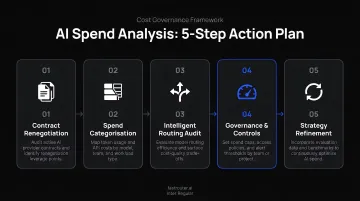
Acting on these outputs is only half the equation. AI should classify and flag new transactions continuously — not just process historical data once — so the system compounds its value over time rather than producing a quarterly snapshot.
AI Spend Analysis in Action – A Practical Example
Here's how this plays out for a mid-sized manufacturer with spend across 40+ categories and 300+ suppliers — a structure consistent with documented real-world outcomes like the DS Smith case study.
The procurement team spends weeks each quarter manually pulling and reconciling spend reports — and still can't confidently identify which supplier categories are driving cost overruns.
Stage 1–2: The team defines its objective — reduce indirect spend overruns by category — and connects ERP, AP, and purchasing card data into a central AI platform. The initial data pull reveals multiple naming variants for the same suppliers, inconsistent category codes, and a "miscellaneous" bucket absorbing roughly 15–20% of spend with no meaningful classification.
Stage 3: AI cleanses the data, resolving duplicate suppliers and standardizing descriptions. The team reviews outputs, corrects edge cases, and the model learns from those corrections automatically. Taxonomy coverage improves with each review cycle.
Stage 4: Analysis surfaces three findings:
- One indirect category is 22% over budget due to off-contract purchases from unapproved vendors
- A supplier cluster has three vendors doing nearly identical work at materially different price points
- A third category shows sudden spend spikes with no corresponding PO approvals
Stage 5 and outcome: Armed with specific data, the team consolidates the three overlapping vendors into one preferred supplier, routes off-contract purchases back through approved channels, and flags unauthorized spend for finance review.
The DS Smith case study shows what this kind of intervention delivers in practice:
- 15% increase in properly mapped procurement spend
- Up to 1% cost optimization across the portfolio
- $3M benefit on a single $10M supplier contract through improved category mapping and renegotiation
How FastRouter Can Help You Take Control of AI Spend
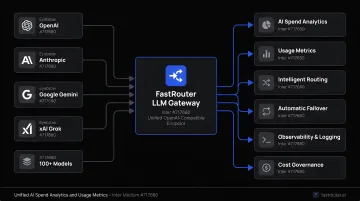
The spend visibility problem doesn't stop at procurement. Teams building AI-powered applications face the same fragmentation challenge — just with a different data source. Model usage spread across OpenAI, Anthropic, Google Gemini, and others means separate invoices and no unified view of what's actually being spent.
FastRouter is an LLM gateway that consolidates access to 150+ AI models through a single OpenAI-compatible API, applying the same spend intelligence principles to AI usage itself.
Here's how those capabilities translate into practice:
- Consolidated billing: All model invoices across providers reconciled into one view, with per-team cost attribution — eliminating the fragmented billing problem
- Usage analytics: Unified dashboard showing AI spend, consumption, and token usage across every model and provider in real time
- Anomaly alerts: Real-time notifications when AI spend, latency, or error rates breach defined thresholds — before budgets blow
- Audit Service: Analyzes live API requests to surface cost-saving opportunities, comparing model performance and producing a detailed savings report. Teams typically see a 46% average cost reduction identified through audit
- Intelligent routing: Automatically routes requests to the most cost-efficient model for each task — preventing unnecessary premium model usage
For teams building spend analysis applications on top of LLMs, FastRouter's guardrails, structured output enforcement, and evaluation capabilities ensure consistent classification results across models — so the AI doing the categorization is as reliable as the infrastructure supporting it.
Whether you're optimizing an existing AI stack or building spend analysis tooling from scratch, the infrastructure layer determines how much control you actually have over costs.
Get started with free credits and no credit card required, or run a free audit on your current AI usage to see exactly where costs are going. Explore FastRouter.
Frequently Asked Questions
How do you perform a spend analysis?
Collect spend data from all sources — ERP, invoices, purchasing cards, expense reports — then cleanse and classify it against a standard taxonomy like UNSPSC. Analyze the results to identify cost reduction opportunities, supplier trends, and compliance gaps. AI tools accelerate all three stages significantly.
How do you use AI to analyze spend?
AI applies NLP to standardize messy data, uses ML models to classify transactions against taxonomies, and surfaces patterns, anomalies, and savings opportunities automatically. Teams can query spend data in plain language and receive actionable answers without waiting for analyst turnaround.
What does a spend analysis include?
A spend analysis typically covers:
- Data collection across all procurement channels
- Supplier and category classification
- Trend and variance analysis
- Compliance and policy adherence review
- Identification of consolidation and cost reduction opportunities
Can AI perform spend analysis?
Yes — and more accurately and continuously than manual methods. AI handles data cleansing, classification, anomaly detection, and pattern analysis at scale. Human review adds value for edge cases and strategic decisions, but classification and monitoring can be fully automated.
How does AI-enabled spend classification improve procurement efficiency?
AI eliminates manual categorization of thousands of line items, reduces taxonomy inconsistencies, and keeps spend data current rather than stale. Procurement teams shift time from data preparation to strategic activities like supplier negotiations and sourcing decisions.
What are the 5 levers of spend management?
The five core levers are:
- Spend visibility — knowing where money goes
- Demand management — controlling what gets purchased
- Supplier consolidation — reducing vendor fragmentation
- Contract compliance — ensuring purchases follow agreed terms
- Strategic sourcing — using spend data to negotiate better terms