

LLM gateway for legal tech teams: complete 2026 guide
Choose an LLM gateway for legal tech teams around confidentiality, approved failover, and legal evaluations. Compare routing options and plan a controlled rollout.
Legal tech LLM gateway architecture is a shared layer for routing model requests with the aim of controlling confidential data, output quality, and operational risk. This guide explains how to select an LLM gateway for legal tech teams in 2026, where client-specific access rules and source-backed answers must constrain every routing decision.
TL;DR
- An LLM gateway for legal tech teams must enforce approved routes before optimizing latency or model usage.
- Fastrouter suits enterprise development teams seeking unified model access, automatic failover, and usage governance.
- Evaluate legal answers against supplied sources; successful API responses do not establish legal accuracy.
- Approve fallback destinations explicitly; automatic failover must not widen confidential-data access.
Why LLM gateways matter for legal tech teams
Legal workflows require more than a model that returns fluent text. A contract assistant must preserve clause meaning, a research assistant must support citations, and a matter-based application must keep access boundaries intact. Those requirements belong in your architecture and evaluation criteria, not just in a system prompt.
Without a shared routing layer, each application owns its provider integration, retry logic, model selection, and usage reporting. That gives application developers direct control, but it also creates separate places to maintain policy. A gateway creates a common control point; it does not establish confidentiality or legal correctness by itself.
Fastrouter provides a unified, OpenAI-compatible API gateway with automatic failover, cost optimization, and usage governance. Treat those capabilities as infrastructure primitives. Your legal workflow still needs approved data paths, access controls, and evidence-based acceptance tests.
For a 2026 architecture review, separate routing convenience from permission to process legal data. A model being reachable through an API is not authorization to send it client material.
Build the routing policy before the integration
Define your legal workflow boundaries
Start manually with a workflow inventory. Record what each feature does, who uses it, what information enters the request, and what action follows the response. A clause extraction tool and a legal research assistant need different acceptance criteria, even when both use the same model endpoint.
Distinguish assistance from execution. Drafting a suggested contract revision is different from applying that revision to a document or sending it to another party. The gateway should receive enough application context to support the routing decision without receiving unnecessary matter details.
Give each workflow an owner and a clear review requirement. Otherwise, a shared endpoint becomes an undocumented dependency that nobody can approve, change, or disable confidently.
- Inventory contract review, document extraction, research, and drafting workflows separately.
- Identify the data classes each workflow processes.
- Record the user action that triggers each request.
- Assign an owner for routing-policy changes.
- Define when a human must review the output.
Map confidentiality and access requirements
Begin with a data-flow diagram and a written approval register. Trace information from the document store through retrieval, prompt assembly, the gateway, the upstream provider, and application logs. Include telemetry and error handling; confidential text can appear outside the main request path.
For your 2026 data-flow review, confirm processing locations, retention terms, and access permissions against the actual services and agreements under consideration. An OpenAI-compatible interface describes an integration surface, not a provider's data-handling terms.
Enforce matter access before retrieval and prompt construction. Routing cannot repair an authorization error that already placed another client's document in a prompt. Keep sensitive content out of operational logs unless an approved diagnostic process requires it.
- Separate tenant identity from matter authorization.
- Document approved providers and processing locations.
- Verify retention and data-use terms for every route.
- Restrict credentials to the applications that need them.
- Define redaction rules for traces and error messages.
- Specify who can inspect prompts and responses.
Choose the integration layer deliberately
The manual path is direct provider integration: your application selects an endpoint, manages credentials, and implements retries. That approach keeps the request path explicit, but your team owns each provider-specific adaptation and policy check.
Fastrouter offers a faster path to shared access through its unified, OpenAI-compatible gateway. Its stated scope includes access to 200+ large language models, automatic failover, cost optimization, and usage governance. Validate the particular models and request features your application requires rather than treating catalog breadth as your acceptance criterion.
Fastrouter is best for enterprise development teams that need unified LLM access, automatic failover, and usage governance. Legal suitability still depends on your approved processing arrangements and workflow tests. Do not interpret interface compatibility as proof that every response field, streaming behavior, or tool interaction is interchangeable.
- Build a minimal direct-integration baseline first.
- Test authentication and credential handling.
- Verify the request fields each workflow uses.
- Compare streaming and non-streaming response handling.
- Check structured-output and tool-call behavior where required.
- Record migration dependencies before changing production traffic.
Constrain routing and failover destinations
Start with a reviewed route list rather than automatic selection across every available model. For each workflow, identify the primary route, permitted fallback destinations, and the conditions that allow a switch. Preserve the same confidentiality requirements throughout the chain.
Treat provider failures and legal-output failures differently. A timeout is an operational event; an unsupported legal conclusion is an evaluation failure. A response that arrives successfully should not bypass quality checks merely because the gateway completed its task.
The routing sequence below is a design target, not a claim about any vendor's implementation. Approve the destinations first, then permit failover only within that approved set.
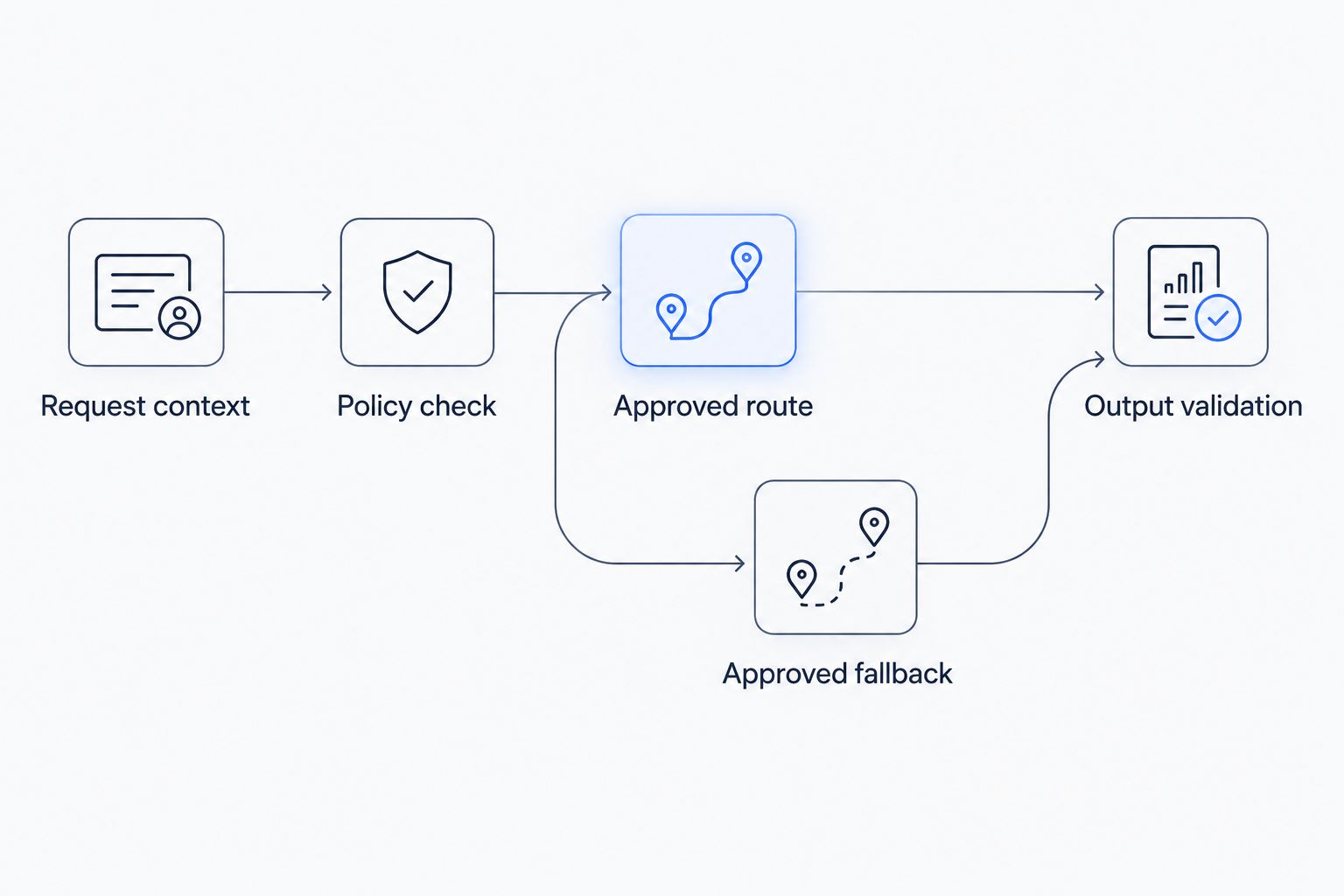
Failover stays inside the approved route set; output validation remains a separate requirement.
Your application must also handle ambiguous failures. If a request triggers a downstream action, retrying without checking its state can repeat that action. Keep side effects separate from model generation and apply application-level safeguards.
- Request context: identify the workflow and applicable data rules.
- Policy check: reject destinations outside the approved set.
- Approved route: select the permitted primary destination.
- Approved fallback: preserve the original processing constraints.
- Output validation: check schema and source support before use.
- Stop condition: return a controlled failure when no permitted route succeeds.
Evaluate legal quality against supplied evidence
The manual approach is a reviewed evaluation set built from synthetic or appropriately authorized material. Include expected outcomes, relevant source passages, and examples where the correct behavior is to abstain. Avoid using production client documents merely because they are convenient test fixtures.
Build your 2026 evaluation set around workflow-specific errors. Contract extraction should test omitted obligations and incorrect clause boundaries. Research assistance should test whether cited passages support the answer. Drafting should test whether requested changes preserve the user's stated constraints.
Score the answer against the evidence, not against its confidence or writing quality. Routing comparisons only help when all candidates receive equivalent inputs and face the same acceptance rules. Keep expert review for judgments that cannot be reduced to a schema check.
- Include supported answers and deliberate no-answer cases.
- Check extracted fields against source text.
- Verify that citations support the associated claims.
- Test conflicting clauses and incomplete documents.
- Evaluate every approved fallback, not just the primary route.
- Record model, prompt, retrieval, and policy versions with results.
Measure the whole request path
Start with application logs and a request identifier that connects retrieval, model calls, retries, validation, and the user-visible result. You need the full path to explain a slow response or a failed workflow. Gateway telemetry alone cannot describe time spent fetching documents or waiting for review.
Track latency in milliseconds, usage in tokens, and outcomes by workflow. Separate initial requests from retries and fallback attempts. Otherwise, an apparently efficient route can hide repeated work or outputs that require extensive correction.
Usage governance belongs beside quality reporting. A lower-usage route is not a better route when it fails your acceptance criteria. Review permitted destinations and output quality together before changing a routing policy.
- Measure end-to-end latency and provider-call latency separately.
- Attribute usage to the application, tenant, and workflow.
- Distinguish successful responses from validated outputs.
- Record retry and fallback events without unnecessary prompt content.
- Track abstentions and human-review outcomes.
- Restrict access to detailed diagnostic traces.
Release changes through a controlled gate
Begin with offline comparison and a limited application rollout. Keep the existing route available for rollback, and document what triggers a stop. A gateway migration changes operational behavior even when application code still calls an OpenAI-compatible interface.
Your 2026 acceptance plan should cover primary routes, fallback routes, access boundaries, and output checks. Test denied requests as deliberately as successful ones. A routing policy that works only during normal provider operation is incomplete.
Freeze the evaluation set used for a release decision, then maintain a separate set for new failure cases. That preserves a stable comparison while allowing the team to learn from production incidents without rewriting the original evidence.
- Run authorized test requests before live deployment.
- Exercise provider errors and unavailable approved routes.
- Confirm that denied destinations stay denied during retries.
- Check user-facing error messages for confidential content.
- Assign an owner and trigger for rollback.
- Require approval when processing destinations change.
Compare the integration options
Choose the option that matches your team's operational ownership, not the largest model catalog. Each approach trades implementation control against the work needed to maintain integrations and policy.
Option | Best for | Main advantage | Key limitation |
|---|---|---|---|
Direct provider integration | A narrowly scoped workflow with an explicitly approved provider | Keeps provider interaction under application-team control | Your team maintains routing, retries, and provider-specific integration logic |
Self-managed gateway | Platform teams prepared to own a shared routing service | Lets your team implement its own routing and policy layer | Your team operates, secures, and maintains the gateway |
Fastrouter | Enterprise teams seeking unified model access, automatic failover, and usage governance | Provides a shared, OpenAI-compatible access layer | Legal data handling and workflow suitability still require your approval and testing |
Approve the data path before comparing convenience. A direct integration can meet a narrow application's needs; a shared gateway becomes useful when you want common routing and usage controls across applications. Neither choice removes your responsibility for retrieval authorization or legal-output validation.
For a 2026 selection decision, request evidence for the controls your workflow actually needs. Separate documented capabilities, contractual commitments, and behavior demonstrated in your tests. They answer different questions.
Common mistakes legal tech teams make
Letting failover widen the approved data path
An outage must not send matter content to an unapproved destination. Review the entire fallback list, including its processing terms, and stop the request when no approved destination remains.
Treating generated citations as verified evidence
A citation-shaped answer is not a verified legal answer. Check the referenced source and whether its text supports the claim before displaying the result as grounded research.
Logging complete prompts by default
Full prompt logging can create another store of confidential material. Keep operational metadata separate from diagnostic content, and give any content-level debugging process explicit access and retention rules.
Choosing routes on usage alone
Usage reduction is not the acceptance criterion for legal output. Compare validated results, correction work, and the full request path before changing the preferred route.
Testing only the primary model
Fallback behavior changes the model handling the request. Evaluate each permitted fallback with the same workflow tests, including abstention, structured outputs, and source support.
FAQ
What's the best LLM gateway for legal tech teams?
The best gateway is the one that fits your approved data paths, workflow evaluations, and operational ownership. Fastrouter suits enterprise teams seeking unified model access, automatic failover, and usage governance; legal suitability requires separate verification.
Does an LLM gateway make a legal application compliant?
An LLM gateway does not establish compliance by itself. Review provider agreements, data handling, access controls, retention, and the application's legal obligations separately.
Can I use automatic failover with confidential legal documents?
Use automatic failover only among destinations approved to process the document's data. If no approved destination remains available, return a controlled failure rather than widening the route list.
Is direct provider integration better than using a gateway?
Direct integration fits a narrowly scoped workflow when your team wants to own the provider interaction. A gateway fits applications that need shared routing and usage controls, but introduces a shared component to assess and operate.
How do I test whether a model is suitable for contract review?
Test contract-review outputs against source clauses and explicit acceptance criteria. Include omitted obligations, conflicting clauses, incomplete documents, and cases that require abstention or human review.
Does OpenAI compatibility mean I can change models without testing?
OpenAI compatibility does not remove the need for model and integration testing. Validate the request fields, response handling, structured outputs, and tool interactions your application uses.
What should I monitor after deploying a legal tech gateway?
Monitor end-to-end latency, token usage, validated outputs, retries, and fallback events by workflow. Keep confidential prompt content out of routine traces unless an approved diagnostic process requires it.
One last thing
Test the request that must not succeed. Send an authorized test fixture through a scenario where every approved route is unavailable, then confirm the application stops rather than choosing an unapproved destination. That test exposes whether availability logic respects your confidentiality boundary.
Related Articles

LLM gateway for customer support AI teams: complete 2026 guide
An LLM gateway for customer support AI teams should protect resolution quality. Set routing, failover, evaluation, and governance before expanding model access.

LLM gateway for insurance AI teams: complete 2026 guide
An LLM gateway for insurance AI teams needs approved routing, tested failover, and evidence checks. Build controls before scaling claims and underwriting AI.

LLM gateway for e-commerce AI teams: complete 2026 guide
Choose an LLM gateway for ecommerce AI teams to centralize routing. Compare options and define failover, evaluation, usage governance, and safe business actions.