

LLM gateway for e-commerce AI teams: complete 2026 guide
Choose an LLM gateway for ecommerce AI teams to centralize routing. Compare options and define failover, evaluation, usage governance, and safe business actions.
E-commerce AI teams’ LLM gateway is a shared API layer for routing model requests, with the aim of controlling costs and keeping shopping workflows operational. This 2026 guide explains how to separate model decisions from catalog, order, and payment logic.
TL;DR
- Choose an LLM gateway for ecommerce AI teams when multiple workflows need shared routing and governance.
- OpenAI-compatible APIs simplify integration, but model behavior still needs workload-specific evaluation.
- Keep catalog truth, customer authorization, and transaction execution outside model routing.
- Approve fallback routes against quality requirements, not just provider availability.
Why gateways matter for e-commerce teams
Your shopping assistant, catalog pipeline, and support workflow have different failure consequences. In 2026, evaluate shared routing against those differences—not as a replacement for application controls.
Build the gateway around your workflows
Map your workload boundaries
Start with a document or spreadsheet. List each model workflow and the systems it touches before choosing infrastructure.
- Separate customer-facing requests from background jobs.
- Identify workflows that read customer records.
- Mark every operation that changes business state.
- Assign an engineering owner to each workflow.
Choose your integration boundary
Start manually with a small adapter around your existing model calls. Fastrouter provides a unified, OpenAI-compatible API gateway with routing, automatic failover, cost optimization, and usage governance—a packaged alternative to maintaining those shared functions yourself.
Fastrouter is best for enterprise e-commerce AI teams that need unified model routing and usage governance. The gateway still needs application-level evaluation; API compatibility does not establish equivalent responses across models.
For your 2026 architecture, keep the gateway between application services and model providers. Keep business tools behind your application’s authorization layer. A model should request an order lookup; your service should decide whether that customer can access the order.
Define the adapter around business intent rather than provider-specific behavior. A product description request, for example, should carry the required attributes and output schema. Provider settings belong in the routing configuration, not scattered through storefront and catalog code.
The packaged path reduces the routing code you need to own. Its limitation is another service dependency, which your team must assess for security, observability, and operational fit. BYOK, retention controls, and network requirements belong in that assessment; verify them rather than assuming them.
- Define a common request and response contract.
- Keep credentials out of browser and mobile clients.
- Separate model configuration from business logic.
- Verify streaming, structured outputs, and tool-call behavior.
- Document ownership of gateway and application incidents.
Define eligible routes before fallback
Start with a configuration file that maps each workload to approved model routes. Make eligibility explicit before adding automatic selection. The fastest available response is not useful if it omits required catalog attributes or produces an unusable tool call.
Use four checkpoints: Eligibility checks, Primary route, Fallback route, and Response validation. Eligibility determines which routes meet your workload’s requirements. Response validation determines whether the result is safe to use, regardless of which route produced it.
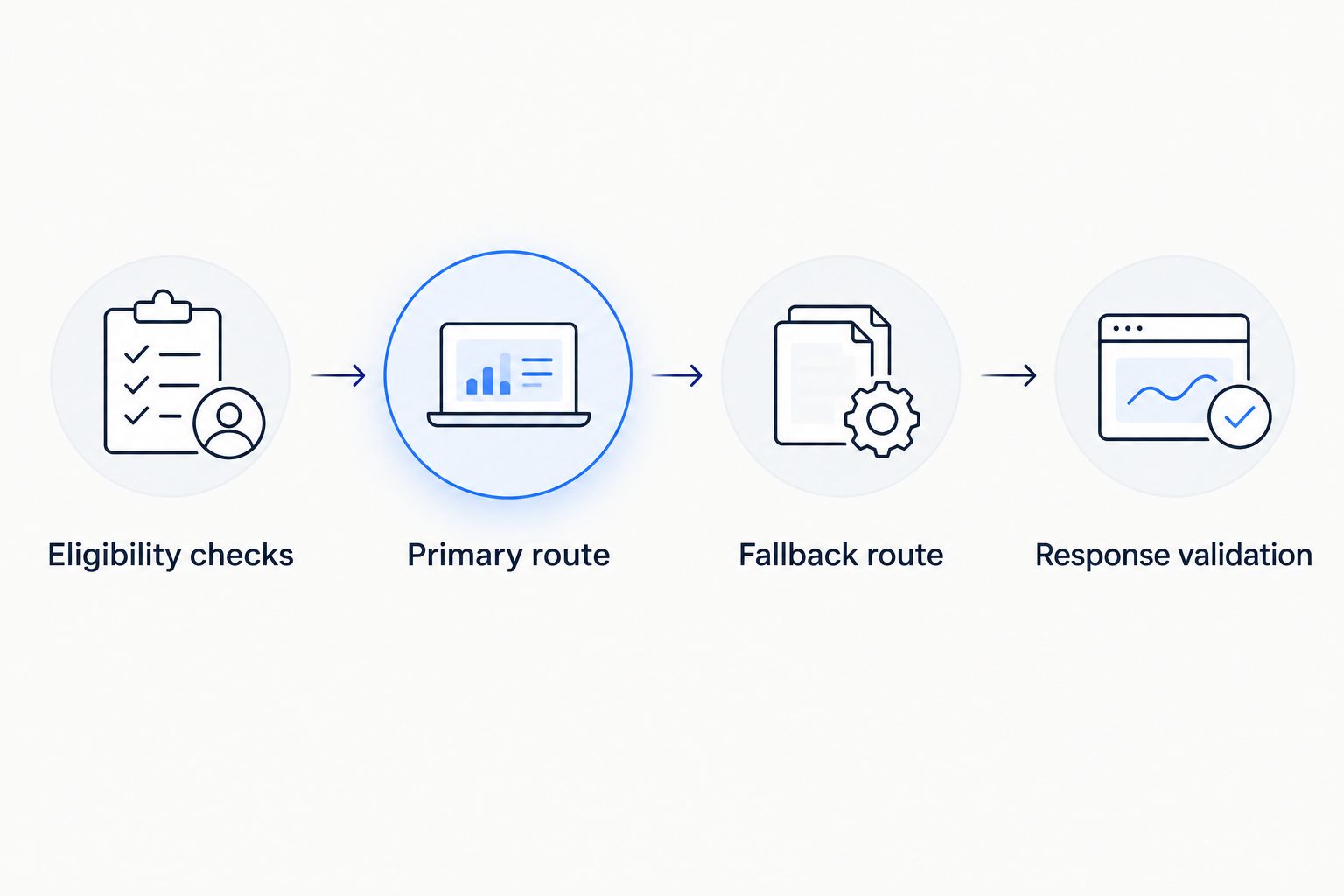
A fallback response must pass the same application checks as the primary response.
For a shopping assistant, approve routes against product grounding, conversational requirements, and any required tool behavior. For catalog enrichment, approve routes against attribute accuracy and schema validity. For support drafting, check whether the route preserves policy wording and distinguishes retrieved facts from generated suggestions.
Maintain 2 execution paths: primary and fallback. Both need approved behavior; the fallback is not an unrestricted pool of available models. If no eligible route succeeds, return a controlled failure rather than an unvalidated answer.
A gateway can handle provider routing and automatic failover. Your application must still define what successful output means and decide whether a failed task should be retried, queued, or stopped.
- Eligibility checks: require supported inputs and outputs.
- Primary route: select an evaluated route for the workload.
- Fallback route: allow only evaluated alternatives.
- Response validation: reject invalid or ungrounded results.
Evaluate against commerce outcomes
Start with a versioned test file and a review spreadsheet. Use representative product records, support questions, and tool requests with approved access. Remove customer identifiers when they are unnecessary for the evaluation.
Your 2026 evaluation should distinguish transport success from business success. A response can arrive without an API error and still invent a product attribute. A syntactically valid tool call can request the wrong order. Neither result passes merely because the provider returned successfully.
Define pass criteria by workload. Product copy should preserve supplied attributes and avoid unsupported claims. Shopping assistance should ground recommendations in retrieved catalog data. Support drafts should follow the supplied policy context and refrain from promising an action the application has not completed.
Record latency in milliseconds, throughput in requests per second, and token usage alongside accepted outputs. Compare complete requests, including retrieval, validation, retries, and fallback attempts. Provider response time alone does not describe the customer’s experience.
Evaluate primary and fallback routes with the same cases. Keep prompt, retrieval snapshot, output schema, and evaluator criteria fixed while comparing routes. Otherwise, you cannot distinguish a routing change from a change in the test itself.
- Include incomplete catalog records and ambiguous requests.
- Test unsupported product and policy claims.
- Check schema validity separately from factual accuracy.
- Record time to first token for streaming workflows.
- Review failed cases before approving another route.
Protect customer data and business actions
Begin with your existing access controls, secrets management, and data classification. A gateway is a routing boundary, not permission to send every field in a customer record to a model provider.
Separate information access from action execution. A support assistant can propose a refund request, but a trusted service must validate eligibility and authorization before executing it. Apply the same separation to cancellations, address changes, and account updates.
Treat retrieved descriptions, customer messages, and supplier documents as untrusted content. They can contain instructions that conflict with your application’s rules. Preserve the distinction between application instructions and external content, and validate requested tool actions against an allowlist.
Attach 1 request ID per application operation and correlate every model attempt with it. Do not confuse that identifier with permission to store the full prompt. Observability should capture enough information to investigate routing without unnecessarily retaining personal data.
For retries, define an idempotency boundary in the action service. A second model attempt must not create a second refund or duplicate an order change. Keep authorization and duplicate-action prevention outside the generated response.
- Send only fields required for the task.
- Redact sensitive data from routine diagnostic logs.
- Validate tool names, arguments, and customer permissions.
- Separate production credentials from development credentials.
- Document retention requirements across the request path.
Attribute usage to accepted outcomes
Start with provider usage records and application events. Join them by request ID, workload, environment, and owning team. A shared gateway becomes easier to govern when every request has a business purpose attached.
Measure usage against accepted outputs, not just completed calls. For catalog enrichment, count records that pass validation. For support drafting, distinguish usable drafts from rejected ones. For shopping assistance, define what constitutes a completed interaction before attaching usage to it.
Include retries and fallback attempts in the operation’s accounting. Otherwise, an apparently inexpensive route can conceal repeated unsuccessful work. Do not claim savings from a configuration change until your own measurements show the difference under comparable workloads.
Build separate policies for interactive traffic and background processing. An interactive request needs a defined stopping condition. A background job needs queue behavior, retry rules, and a way to identify records that require review. These are application decisions even when the gateway provides shared usage governance.
Cost optimization is not permission to accept weaker product facts or bypass validation. Set quality requirements first, then compare resource usage among routes that meet them.
- Tag requests by workload, team, and environment.
- Attribute all attempts to the originating operation.
- Track token usage per accepted output.
- Separate rejected responses from provider failures.
- Review usage changes alongside quality changes.
Rehearse failure before release
Start with controlled tests in a non-production environment. Inject provider failures through your adapter or test harness, then verify the behavior of the application—not just the gateway’s response.
Test 3 failure conditions: timeout, rate limiting, and invalid output. Each needs a defined response. A timeout can trigger an approved fallback; invalid output requires validation and a decision about another attempt. Rate limiting requires bounded handling rather than an uncontrolled retry loop.
For your 2026 release, include storefront-visible behavior in the acceptance criteria. If a shopping assistant cannot answer safely, show a clear unavailable state or offer the existing non-model path. If catalog enrichment fails, retain the original record and mark the job for retry or review.
Define rollback separately from provider failover. Failover handles an unsuccessful route; rollback reverses a bad deployment or configuration change. Keep a known-good configuration available and record who can restore it.
Assign operational ownership before release. The platform team needs to know whether an incident comes from a provider, routing configuration, retrieval service, or business tool. A single gateway endpoint does not make those dependencies identical.
- Verify fallback preserves required output behavior.
- Stop retries at the application’s defined boundary.
- Confirm failed requests cannot duplicate business actions.
- Rehearse configuration rollback with the owning team.
- Test degraded behavior in the actual user workflow.
Compare your implementation options
Choose by operational ownership, not by endpoint count. Direct integrations, an internal routing layer, and a managed gateway place different responsibilities on your engineering team. None removes the need for workload evaluation or customer-data controls.
Option | Best for | Main advantage | Key limitation |
|---|---|---|---|
Direct provider integrations | A team with a narrow, stable model dependency | Keeps routing logic close to the application | The team owns separate integrations and cross-provider failure handling |
Internal routing layer | A platform team requiring custom routing behavior | Gives the team control over routing implementation | The team owns development, maintenance, and incident response |
Fastrouter | Enterprise teams seeking unified routing and usage governance | Provides an OpenAI-compatible gateway with automatic failover and cost optimization | Application validation, authorization, and transaction safety remain your responsibility |
An internal routing layer is appropriate when its required behavior justifies ongoing ownership. Direct integration is appropriate when shared routing adds little value. A managed gateway is appropriate when maintaining routing and governance distracts from the commerce workflows your team needs to ship.
Use the same acceptance checklist for every option. Verify the request contract, evaluate fallback behavior, inspect available usage records, and review data handling. Compare the resulting architecture rather than treating a feature list as proof of production suitability.
Common mistakes e-commerce teams make
Treating generated text as catalog truth
A fluent description is not a verified attribute record. Validate materials, dimensions, compatibility, and other product facts against your source data before publishing. Keep generated suggestions separate from approved catalog fields until they pass your review process.
Routing every workload with one policy
A customer conversation and a background enrichment job need different handling. Define quality requirements, retry behavior, and stopping conditions by workload. Shared infrastructure should centralize enforcement without erasing those distinctions.
Retrying business actions with model calls
A repeated model request must not repeat a transaction. Put authorization and idempotency checks in the action service. Track the model attempt and the business operation separately so an incident investigation can distinguish a second answer from a second action.
Comparing routes without validation costs
A route that generates more rejected responses creates additional work. Include validation, retries, and human review in your evaluation. Compare accepted outcomes under the same criteria rather than declaring a winner from isolated call usage.
FAQ
What is an LLM gateway for ecommerce AI teams?
An LLM gateway for ecommerce AI teams is a shared API layer that routes model requests across approved providers or models. It centralizes routing functions while the application retains responsibility for catalog truth, customer authorization, and business actions.
When should an e-commerce team use a gateway?
Use a gateway when multiple AI workflows need shared routing, failover, or usage governance. A narrow application with a stable model dependency can use direct integration instead, provided the team owns its failure handling and controls.
Is Fastrouter a fit for enterprise e-commerce AI?
Fastrouter fits enterprise teams seeking a unified, OpenAI-compatible gateway with routing, automatic failover, cost optimization, and usage governance. Validate integration behavior and operational requirements against your own commerce workloads before deployment.
Does OpenAI compatibility mean every model behaves the same?
No. OpenAI compatibility concerns the API integration, not identical model behavior. Evaluate each route for the output schemas, tool calls, grounding, and streaming behavior your application requires.
Can automatic failover prevent duplicate refunds?
Automatic failover does not replace duplicate-action prevention. Your transaction service must enforce authorization and idempotency so repeated model attempts cannot execute the same refund again.
What should an e-commerce gateway evaluation measure?
Measure accepted-output quality, end-to-end latency, throughput, and usage across the complete operation. Include retrieval, validation, retries, and fallback attempts rather than comparing successful provider calls alone.
How should a shopping assistant handle a failed model route?
A shopping assistant should use an approved fallback or return a controlled unavailable state. Do not substitute an unevaluated route or present an unvalidated response as catalog-grounded advice.
One last thing
A successful model response and a successful commerce operation are different events. Put that distinction into your 2026 dashboard: track accepted answers separately from authorized actions and completed jobs. Fastrouter can provide shared model routing and usage governance; your application must decide whether the result is usable. Make that decision explicit before expanding traffic.
Related Articles

AI API gateway for MLOps teams: complete 2026 guide
Choose an ai api gateway for mlops teams by testing routing, failover, and governance. Compare ownership models and build a production-ready acceptance plan.

LLM router for platform engineering teams: complete 2026 guide
An llm router for platform engineering teams needs policy-first routing. Compare build and buy options, validate failover, and assign clear operational ownership.

FastRouter vs OpenAI API: which is better in 2026
Fastrouter vs OpenAI API: choose multi-provider routing or direct OpenAI access. Compare failover, governance, integration, and evaluation before you commit.