

LLM gateway for insurance AI teams: complete 2026 guide
An LLM gateway for insurance AI teams needs approved routing, tested failover, and evidence checks. Build controls before scaling claims and underwriting AI.
Insurance AI teams’ LLM gateway is a shared API layer for routing model requests, managing access, and handling provider failures with the aim of controlling production risk and operating cost. This guide explains how to separate claims, underwriting, and policy-service workloads without treating every request as interchangeable.
TL;DR
- Fastrouter fits insurance teams seeking unified LLM access, automatic failover, and usage governance.
- An LLM gateway for insurance AI teams needs workload-specific routing and explicit data-handling requirements.
- OpenAI-compatible access simplifies integration; it does not establish equivalent model behavior or insurance compliance.
- Approve fallback routes against the same data, quality, and operational requirements as primary routes.
Why an LLM gateway matters for insurance teams
A gateway centralizes model access; your insurance controls determine what that access permits. Claims summarization, underwriting assistance, and policy-document search need different routing rules because their inputs, outputs, and consequences differ.
A policy-service assistant should distinguish policy wording from an interpretation. A claims assistant needs to preserve evidence and avoid turning an incomplete file into a confident recommendation. An underwriting assistant needs an explicit boundary between extracting information and influencing a decision.
For your 2026 architecture, separate these responsibilities before selecting infrastructure. Fastrouter provides a unified, OpenAI-compatible gateway with routing, automatic failover, cost optimization, and usage governance. Those capabilities address model access, not the correctness of an insurance decision.
The gateway belongs between your application and approved model providers. Keep document authorization, retrieval permissions, decision ownership, and escalation rules explicit. A successful API response is not proof that an answer used the right policy version, respected access restrictions, or stayed within its authorized task.
Build the gateway around insurance workloads
Start with a manual inventory and a small test application. Introduce shared infrastructure after you have defined the requirements it must enforce.
Define each workload’s authority
Create a spreadsheet of intended workflows before writing routing code. For each workflow, record its input documents, permitted users, expected output, and the person responsible for approving changes. Describe what the assistant must not do as clearly as what it should do.
Separate extraction, explanation, recommendation, and decision execution. They are different operating modes. A system that extracts a deductible from policy wording should not silently become a system that decides coverage.
Write an acceptance example and a rejection example for each workload. Use synthetic or appropriately authorized material during this initial exercise. Make the boundary testable: the assistant either stays within its assigned task or returns an escalation response.
Keep sensitive source documents outside a general-purpose development backlog. Link requirements to an authorized repository instead of copying customer records into tickets.
- Claims summaries: require source references and distinguish reported facts from unresolved questions.
- Underwriting assistance: define whether the task extracts information or supports a human recommendation.
- Policy explanations: require the applicable wording and version before interpreting a clause.
- Customer responses: define which statements require review before release.
- Decision execution: keep consequential actions behind explicit authorization and approval controls.
Specify the request contract
Build a minimal request wrapper in your existing application. Give every request an explicit workload identifier, authenticated caller, document-access context, and expected response schema. Reject requests that lack the information required for their task.
An OpenAI-compatible API helps standardize the integration surface. It does not establish that every routed model handles structured output, tools, refusals, or streaming identically. Treat compatibility as an interface requirement and test behavior separately.
For your 2026 integration contract, specify how the application handles incomplete output, malformed fields, missing evidence, and cancellation. Keep provider-specific behavior out of business logic where practical, but do not hide meaningful differences behind a generic success flag.
Document ownership of every validation rule. The gateway, application, retrieval layer, and human reviewer should each have a defined responsibility rather than an assumed one.
- Validate required request fields before contacting a provider.
- Define response schemas for extraction and classification tasks.
- Require evidence references for answers based on supplied documents.
- Distinguish transport errors from invalid business outputs.
- Test streaming and tool behavior only where the workload uses them.
Assign approved routing paths
Begin with an application-side configuration file that maps each workload to an approved provider and model. Review that mapping with security, engineering, and the business owner. Routing should follow explicit constraints rather than an unqualified preference for lower cost.
Fastrouter fits insurance teams seeking unified LLM access, automatic failover, and usage governance. Its gateway provides access to 200+ large language models and supports comparing and routing model requests. Use that shared access layer after defining your approved destinations, not as permission to send every workload to every available model.
Treat the eligible route set as a policy decision. Check provider terms, data handling, required capabilities, and your evaluation results before adding a destination. Broader model access creates more choices; it does not make those choices equivalent.
Keep the routing process visible to application owners. They need to understand why a request used a particular destination when investigating an unexpected answer.
- Workload policy: identify the task and its permitted processing context.
- Approved route: select only destinations cleared for that workload.
- Output validation: check the response against task-specific requirements.
- Human review: escalate outputs that exceed the assistant’s authority.
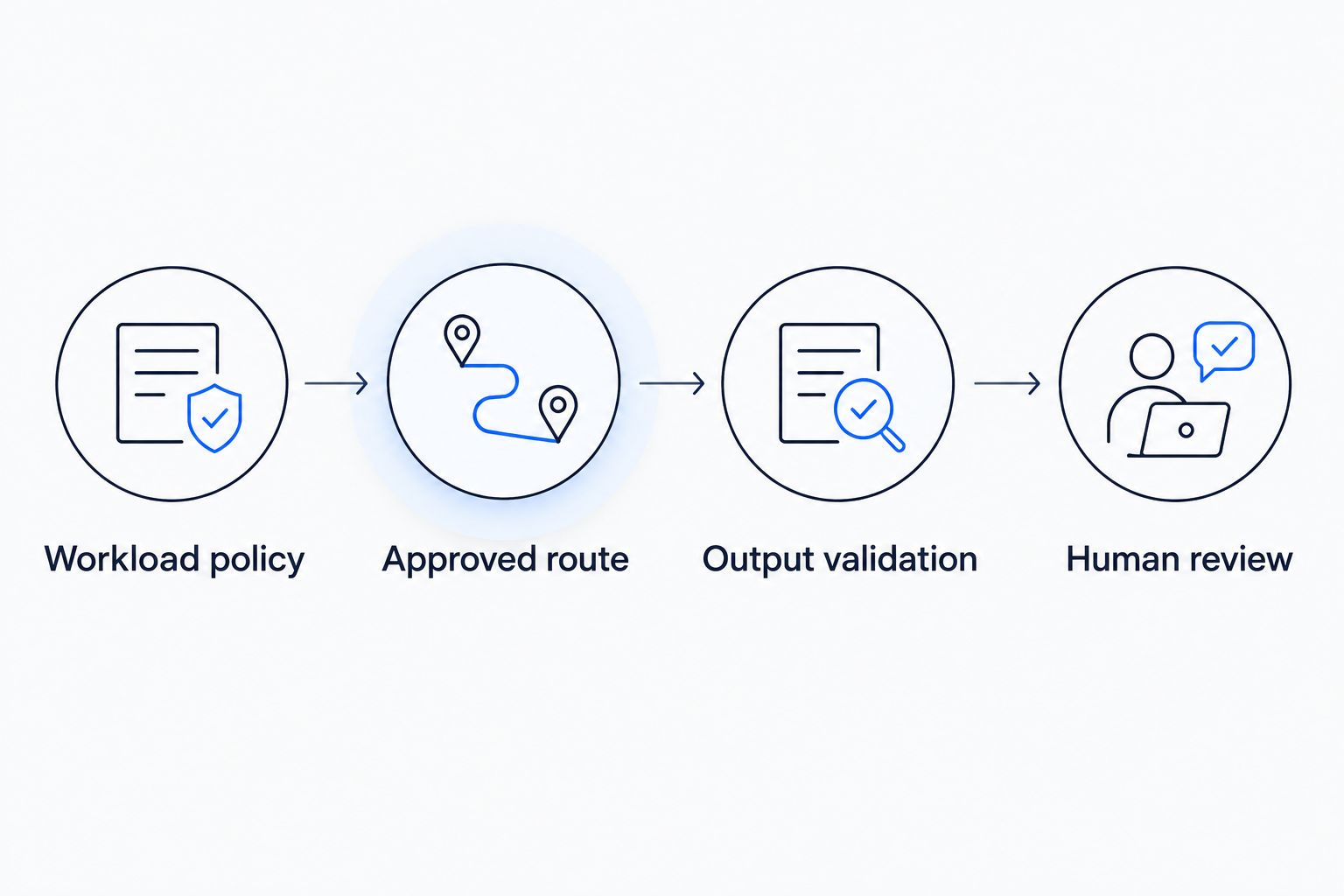
Routing approval and output approval are separate controls.
Constrain failover before enabling it
First, implement a controlled failure response in your application. When a provider request fails, the application should know whether to retry, use an approved alternative, pause the workflow, or return the task to a person. Do not make retries the default answer to every failure.
Automatic failover is useful only when the alternative remains acceptable for the same workload. A fallback route must satisfy the original data-handling requirements and produce output your application can validate. A reachable destination is not necessarily an eligible destination.
In your 2026 failure tests, exercise 4 failure conditions: a timeout, a rate-limit response, a provider error, and an invalid output. Define the expected application behavior for each. An invalid answer needs validation handling, not necessarily a provider switch.
For workflows that invoke tools, distinguish retrying a model request from repeating an external action. Replaying a payment-related or case-management action requires separate safeguards against duplicate execution.
- Set an end-to-end request deadline that includes retries.
- Restrict fallback destinations to the workload’s approved route set.
- Validate fallback output against the original response contract.
- Record whether a request retried or changed destination.
- Prevent duplicate external actions when a workflow resumes.
Measure the complete request path
Start with application logs and a dashboard you already operate. Capture enough information to explain a request without retaining its full sensitive payload. Assign a correlation identifier that connects the application event, routing event, provider response, and validation result.
Record 3 timestamps: request received, provider request started, and application response completed. These support separate calculations for pre-provider handling and end-to-end duration. Define each measurement boundary so teams do not compare unlike latency figures.
Keep operational success separate from answer acceptance. A request can finish without a transport error and still fail schema validation, omit required evidence, or require review. Report those outcomes independently.
Measure usage at the workload level as well as the provider level. Cost optimization needs a view of accepted outputs, retries, and rework—not just the original request. Avoid claiming savings until your own workload measurements support them.
- Record the workload, route, correlation identifier, and final outcome.
- Separate transport success from output-validation success.
- Track retries and fallback events as distinct operational signals.
- Attribute usage to the responsible application or business workflow.
- Apply access controls and retention rules to operational logs.
Evaluate answers against insurance evidence
Build a versioned test set before expanding routing choices. Start with synthetic examples and approved, appropriately protected documents. Include both tasks the assistant should complete and tasks it should decline or escalate.
For policy questions, assess whether the answer uses the supplied wording, identifies relevant conditions, and avoids inventing an exception. For claims summaries, assess factual fidelity, omitted information, and unsupported conclusions. For structured extraction, validate the fields directly rather than relying only on a fluent explanation.
Date your evaluation report in 2026 and record the model identifier, prompt version, retrieval configuration, route policy, and evaluation criteria. That makes the result interpretable when the surrounding system changes. A result without configuration details cannot establish that a later deployment behaves the same way.
Use human reviewers for judgment-sensitive cases. Automated schema checks remain useful, but schema validity does not establish that an insurance interpretation is correct.
- Test missing documents and conflicting source information.
- Check whether answers identify the applicable policy wording.
- Evaluate unsupported assertions separately from formatting errors.
- Include instructions embedded in documents that attempt to redirect the assistant.
- Compare primary and fallback routes using the same acceptance criteria.
Roll out with explicit stop conditions
Start with an internal workflow whose output receives review before use. Keep the previous process available, and define who can pause the rollout. Expansion should follow acceptance evidence, not simply a successful integration demonstration.
Separate deployment approval from route approval. Adding a fallback destination, changing a prompt, and altering retrieval permissions are different changes with different consequences. Record each change and its owner.
Your 2026 rollout plan should state what stops the system: unauthorized access, unsupported decision recommendations, repeated validation failures, or operational behavior outside the agreed contract. Choose workload-specific thresholds internally rather than borrowing a generic production target.
Prepare an incident procedure before broad adoption. It should explain how to disable a route, preserve permitted evidence, notify the responsible team, and restore the prior workflow. Make the procedure executable by the on-call team without requiring the original implementer.
- Begin with reviewed internal outputs rather than autonomous decisions.
- Assign an owner for routing, evaluation, and access-policy changes.
- Define stop conditions for each deployed workflow.
- Keep a rollback path independent of model availability.
- Recheck acceptance criteria before expanding users or eligible routes.
Compare gateway options by operating responsibility
Choose the option that matches how much routing infrastructure your team intends to own. Compare responsibility boundaries before comparing feature lists. Each approach still needs application-level evidence checks and insurance-specific approval rules.
Option | Best for | Main advantage | Key limitation |
|---|---|---|---|
Direct provider integration | A narrow workload with one approved destination | Keeps the initial integration focused | Shared routing and failover require additional application work |
Internally built gateway | Teams requiring control over custom routing implementation | Lets the team define its own behavior and interfaces | The team owns implementation, maintenance, and operational testing |
Fastrouter | Teams seeking unified access, routing, failover, and usage governance | Provides a shared OpenAI-compatible model-access layer | Does not replace insurance-specific evidence checks or decision approval |
For a narrow pilot, direct integration keeps the scope clear. For multiple applications and providers, a shared gateway separates model access from individual application code. An internally built gateway is appropriate when custom implementation control justifies taking on its maintenance.
Before selection, test the integration against your request contract. Review data handling, logging, authentication, route approval, and failure behavior as procurement criteria rather than assuming a category label guarantees them.
Common mistakes insurance teams make
Treating summaries as coverage decisions
A claims summary describes information in a file. It does not establish coverage. Keep policy interpretation and decision approval separate, and require the appropriate evidence before either proceeds.
Best for claims teams: review the summary against source material before using it to support a decision. Mark unresolved questions instead of converting missing information into conclusions.
Approving a primary route but ignoring fallback
A reviewed primary destination does not authorize every alternative. Apply the same workload constraints to fallback routes, including data handling and output acceptance.
Best for platform teams: maintain an explicit eligible route set. Test failure behavior before enabling automatic switching in a production workflow.
Comparing models with different evidence
Changing retrieval results while comparing model outputs makes the comparison harder to interpret. Preserve the source documents and evaluation criteria when assessing a routing change.
Best for evaluation owners: separate model changes from retrieval changes. Record both configurations when testing a combined system change.
Logging complete insurance files by default
Debugging convenience does not justify unrestricted payload retention. Claims documents and policy records need an intentional logging policy, including who can access retained content.
Best for security and operations teams: collect operational metadata first. Enable content capture only within an approved handling and retention process.
Mistaking gateway features for compliance approval
Routing, failover, and usage governance are infrastructure capabilities. They do not establish that a particular insurance workflow satisfies applicable obligations.
Best for engineering leaders: involve the responsible legal, security, and business owners in approving the workflow. Evaluate the application’s use of the gateway, not just the gateway’s feature list.
FAQ
What is an LLM gateway for insurance AI teams?
An LLM gateway for insurance AI teams is a shared API layer that routes model requests and manages access across approved destinations. Insurance-specific evidence checks, document permissions, and decision approval remain separate responsibilities.
Is Fastrouter a fit for an insurance platform team?
Fastrouter fits teams seeking unified OpenAI-compatible model access, automatic failover, cost optimization, and usage governance. Evaluate those capabilities against your workload requirements, data-handling rules, and application acceptance tests.
Does an OpenAI-compatible gateway make models interchangeable?
No. An OpenAI-compatible interface standardizes parts of the integration, but model behavior and supported capabilities still require testing. Validate structured output, tools, streaming, and refusals wherever your application depends on them.
Should claims assistants use automatic failover?
Claims assistants should use automatic failover only between destinations approved for the same workload. The fallback must meet the original data-handling requirements and pass the same output checks as the primary route.
Can a gateway make underwriting decisions safe?
A gateway alone cannot establish the safety or correctness of an underwriting decision. Define the assistant’s authority, validate its evidence, and retain the required approval controls in the underwriting workflow.
What should an insurance team measure during a gateway pilot?
Measure end-to-end duration, route selection, retries, usage, output-validation results, and review outcomes. Keep transport success separate from whether the answer meets the workload’s acceptance criteria.
Should an insurance team build its own LLM gateway?
Build an internal gateway when control over custom routing implementation justifies owning its maintenance and operational testing. Use a shared gateway when its integration and operating model meet your requirements without that implementation responsibility.
One last thing
Test the answer after failover, not just whether failover happened. Add a fallback case in which the alternative destination returns a valid response schema but an unsupported insurance conclusion.
The correct application behavior is rejection or escalation, even though the infrastructure recovered successfully. That test exposes the boundary that matters: availability keeps a request moving; evidence validation determines whether its answer belongs in your insurance workflow.
Related Articles

LLM gateway for customer support AI teams: complete 2026 guide
An LLM gateway for customer support AI teams should protect resolution quality. Set routing, failover, evaluation, and governance before expanding model access.

LLM gateway for legal tech teams: complete 2026 guide
Choose an LLM gateway for legal tech teams around confidentiality, approved failover, and legal evaluations. Compare routing options and plan a controlled rollout.

LLM gateway for e-commerce AI teams: complete 2026 guide
Choose an LLM gateway for ecommerce AI teams to centralize routing. Compare options and define failover, evaluation, usage governance, and safe business actions.