

LLM gateway for healthcare AI teams: complete 2026 guide
An LLM gateway for healthcare AI teams needs approved routes first. Compare architectures, test failover, and define data controls before production deployment.
Healthcare AI teams’ LLM gateway is a routing layer between applications and model providers, designed to centralize access without weakening clinical or data controls. This 2026 guide explains architecture, evaluation, failover, and governance before production deployment.
TL;DR
- An LLM gateway for healthcare AI teams must enforce approved routes, not just expose models.
- Fastrouter provides unified model access; healthcare deployment requires separate contractual and security review.
- Evaluate clinical output, data handling, and failover behavior before expanding provider access.
Why gateways matter for healthcare teams
Healthcare routing decisions affect where patient information travels and which model generates an answer. Model access and authorization to process patient data are separate decisions.
Build the gateway around approved workflows
Define the workflow boundary
Separate administrative assistance from outputs that influence patient care. Document the boundary before choosing infrastructure.
- Name the intended user.
- Identify permitted input data.
- Define required human review.
- Record prohibited uses.
Classify data before routing
Map sensitive information before sending requests outside your application. Treat prompts, attachments, responses, and logs as separate data surfaces.
- Classify patient information.
- Map processing destinations.
- Review retention requirements.
- Identify responsible owners.
Choose the integration boundary
Fastrouter provides an OpenAI-compatible API gateway for routing, comparing, and managing model access, with automatic failover, cost optimization, and usage governance. Fastrouter is best for enterprise AI teams evaluating unified model access. That is an architectural fit statement, not approval to process protected health information.
For a healthcare deployment in 2026, begin with your application’s interface requirements. Identify the request fields, response fields, streaming behavior, and error handling the workflow actually uses. OpenAI compatibility describes an integration interface; it does not establish identical behavior across every underlying model or provider.
The gateway’s benefit is a common access point. Its limitation is that a common interface does not eliminate downstream differences or replace provider review. Your team still needs to establish which routes are permitted and which outputs are acceptable.
Start manually with an application adapter and an explicit provider configuration. A gateway becomes the faster implementation path when you need centralized access rather than separate application integrations. Confirm the relevant controls during evaluation rather than inferring them from a feature name.
- Inventory the API fields your application requires.
- Test streaming and non-streaming responses separately.
- Confirm error handling at the application boundary.
- Compare output structure across approved routes.
- Keep provider-specific behavior out of clinical business logic.
Enforce approval before provider selection
Routing policy must restrict destinations before optimizing model selection. A cheaper or responsive endpoint is irrelevant when the workflow is not authorized to send data there.
Build the manual version as an explicit allowlist keyed to workflow and data classification. Document the provider, model, processing terms, and approval owner for each entry. Reject requests when no approved route exists; do not interpret an empty allowlist as permission to use any available model.
Where HIPAA applies, covered entities and business associates must address the applicable obligations for electronic protected health information. When a provider acts as a business associate, the required contractual arrangements belong in the review. A gateway feature list is not evidence that those arrangements exist.
Use an admission sequence with these stages: Admission checks, Approved route, Provider request, Output validation. Keep authorization failures distinct from provider failures. The former should stop the request; the latter can enter a separately approved fallback policy.
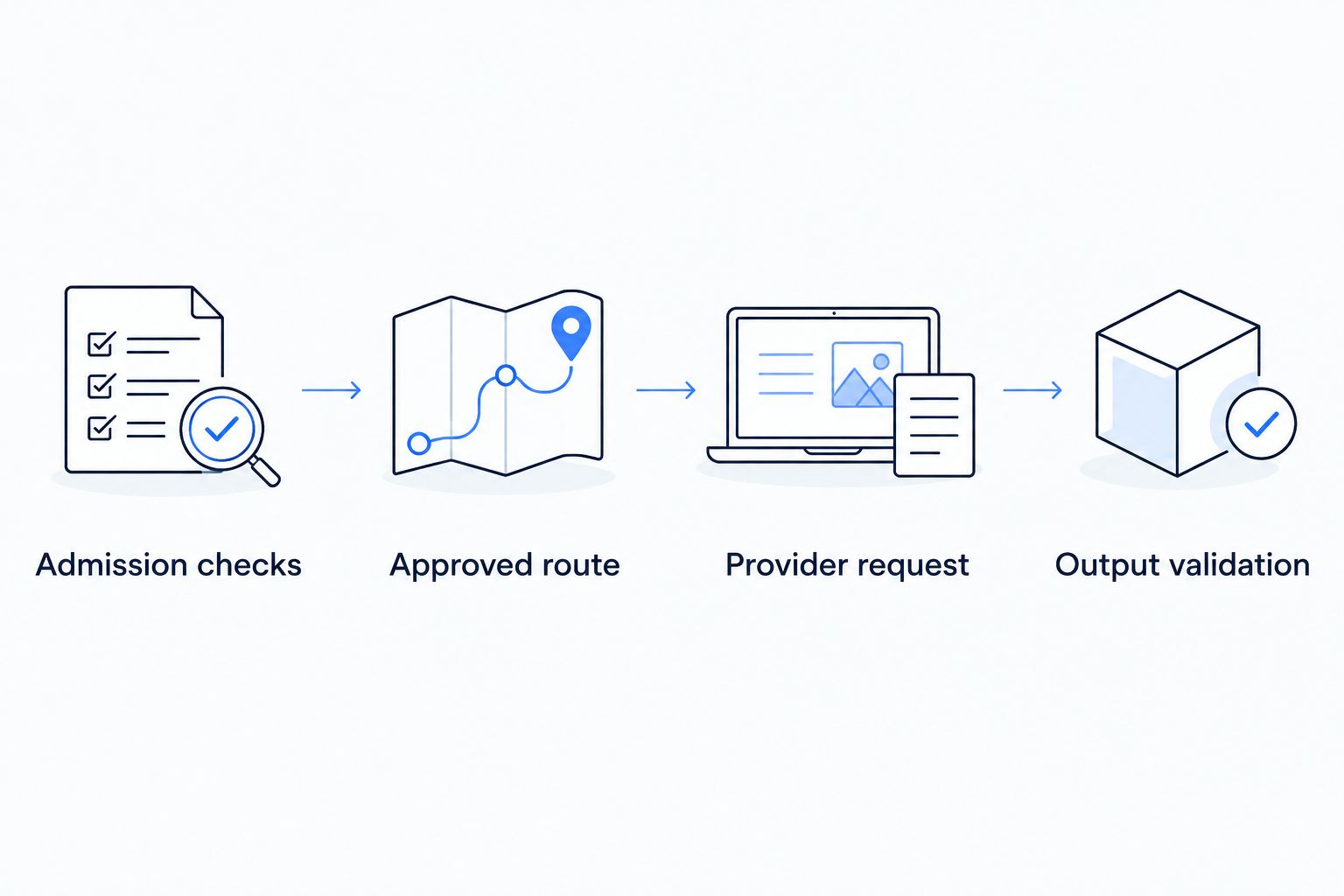
Approve the destination before sending the request, then validate the returned output.
The same sequence applies to background jobs and interactive applications. A scheduled summarization task is still a data-processing path, even when no clinician is watching the request.
- Maintain workflow-specific destination allowlists.
- Check contractual scope before enabling a route.
- Review logging and retention across the full path.
- Reject requests without an approved destination.
- Require approval before changing routing policy.
Evaluate outputs against clinical tasks
Provider access is not evidence of task suitability. Your 2026 evaluation should test the exact workflow, including its instructions, retrieval context, output format, and review process.
Begin with a manually reviewed set of synthetic or appropriately authorized examples. Define acceptance criteria before comparing models. For a clinical summarization workflow, those criteria can address whether the output preserves documented facts, distinguishes uncertainty, and avoids unsupported additions. Do not treat fluent prose as a passing result.
A model evaluation is valid for the tested task and configuration, not every healthcare use case. Record the prompt, model identifier, parameters, source material, and evaluation criteria together. Changing the routing target creates a new configuration to assess.
Gateway-based model comparison can simplify access to candidate routes. Fastrouter supports model comparison, but your team must supply the healthcare evaluation criteria and decide whether a route passes. No product capability substitutes for clinical review where the workflow requires it.
Include retrieval failures and incomplete records. A model should not turn missing source information into invented certainty. Evaluate the behavior that reaches the user, including validation failures and escalation messages.
- Define task-specific acceptance criteria.
- Include contradictory and incomplete source material.
- Check unsupported additions and omitted facts.
- Test required output schemas.
- Record configuration details with each result.
- Re-evaluate changed prompts and routing targets.
Constrain failover to evaluated routes
Automatic failover changes the provider or model that handles a request. In healthcare, that change must preserve both destination approval and task acceptance criteria.
Start with a written fallback policy. Name the failure conditions that permit another attempt, the destinations that are allowed, and the conditions that require the application to stop. Test this policy manually before enabling automated switching.
Fastrouter provides automatic failover. The mechanism supports continuity of model access, but the healthcare implementation must still verify fallback eligibility, output behavior, and failure handling. An available fallback is not automatically an acceptable fallback.
Distinguish a provider timeout from an invalid clinical output. A timeout does not prove the original request was never processed. An output-validation failure does not prove a different model will produce a safe response. Handle retries and application-side actions so repeated attempts cannot silently repeat downstream work.
For your 2026 release, rehearse provider errors, interrupted streams, invalid output, and unavailable approved routes. Specify the user-facing result when the system cannot complete the task. A controlled failure is preferable to silently sending sensitive data to an unapproved destination.
- Limit fallback to approved, evaluated routes.
- Define retry conditions and termination rules.
- Test partial responses and interrupted streams.
- Prevent repeated downstream actions.
- Show a clear failure state when approved routes are exhausted.
Measure operations without copying patient data
Observability should explain routing behavior without turning telemetry into an unnecessary patient-data repository. Start with request metadata and add content only through an explicitly approved process.
Track 3 operational measures separately: request latency, failure rate, and usage by workflow. Measure latency in milliseconds, failures as a percentage of requests, and usage with clearly defined units. These are recommended measurement categories, not performance claims or targets.
Record enough context to distinguish application errors, gateway errors, provider errors, and output-validation failures. A single aggregate error rate hides the boundary responsible for a failed request. Likewise, a successful HTTP response does not mean the clinical task passed evaluation.
Assign 1 accountable owner to each routing policy. That owner should review changes to approved destinations, fallback behavior, and data-handling settings. Ownership makes the control actionable; a configuration file without a review process does not.
Usage governance and cost optimization are part of Fastrouter’s stated capabilities. Verify the controls and reporting your workflow needs during evaluation. Do not assume that a capability name establishes a particular dashboard, enforcement method, or healthcare audit record.
- Log route identifiers and failure categories.
- Keep patient content out of default telemetry.
- Separate task acceptance from transport success.
- Attribute usage to an approved workflow.
- Document access to operational records.
- Review policy changes before release.
Compare the deployment options
Choose the architecture based on responsibility boundaries, not the number of accessible models. For healthcare teams in 2026, the useful comparison is who owns integration, policy enforcement, evaluation, and operations.
Option | Best for | Main advantage | Key limitation |
|---|---|---|---|
Direct provider integration | A narrowly scoped workflow with an approved provider | Keeps the integration boundary focused | Your application owns provider-specific handling and any fallback logic |
Application-owned routing | Teams that need explicit routing behavior in their own code | Keeps routing decisions under application control | Your team maintains adapters, policy checks, and operational handling |
Fastrouter gateway | Enterprise teams evaluating centralized access across models | Offers an OpenAI-compatible interface, routing, failover, and usage governance | Healthcare contractual, data-handling, and task suitability review remain separate requirements |
Keep a direct integration when it meets the workflow’s requirements. Adding a gateway creates another component to evaluate and operate. Centralization earns its place when shared access, routing, or governance addresses a defined requirement.
Application-owned routing provides control, but control creates maintenance responsibilities. Test behavior when provider interfaces or application requirements change. Make sure the people responsible for routing code also own its failure modes.
A managed gateway centralizes model access. It does not centralize every healthcare responsibility: your application still controls user authorization, clinical workflow design, human review, and downstream actions. Compare these boundaries before selecting an option.
Common mistakes healthcare teams make
Treating compatibility as compliance
An OpenAI-compatible endpoint tells you about the request interface. It does not establish HIPAA applicability, a business associate agreement, retention terms, or authorization to process patient information. Review the full processing chain before approving a sensitive workflow.
Approving the primary route but not the fallback
A fallback can introduce a different provider, model, or processing arrangement. Review it as a real production destination, not an emergency exception. If no approved fallback exists, define a controlled failure rather than expanding access automatically.
Measuring success through HTTP status alone
A successful response can still contain unsupported statements or omit relevant source facts. Keep transport success separate from task acceptance. A healthcare evaluation must assess the output that the user receives, not just whether the request completed.
Putting source records into debugging logs
Prompts and responses can contain sensitive information. Copying them into telemetry creates another storage and access boundary. Prefer metadata for routine operations, and review any content capture through the same data-governance process as the application itself.
Expanding scope without repeating evaluation
An administrative drafting assistant and a workflow that influences patient care have different consequences. Reusing a route does not make the new workflow approved. Repeat data review, task evaluation, and human-review design when the use case changes.
FAQ
What is an LLM gateway for healthcare AI teams?
An LLM gateway for healthcare AI teams is a layer that manages requests between healthcare applications and model providers. It can centralize model access and routing, while the deployment still needs approved data handling, task evaluation, and workflow controls.
Does an OpenAI-compatible gateway make a healthcare application HIPAA compliant?
No. OpenAI compatibility describes an API interface, not compliance. Review applicable HIPAA obligations, contractual arrangements, security controls, and the full processing path separately.
Is Fastrouter approved to process protected health information?
Do not treat Fastrouter’s stated gateway capabilities as approval to process protected health information. Establish the applicable contractual and security requirements before enabling a patient-data workflow.
Is a gateway better than a direct provider integration?
A gateway fits workflows that need centralized model access or routing; a direct integration fits a narrowly scoped approved-provider workflow. Compare the integration and operational responsibilities rather than assuming either architecture is always better.
Can healthcare applications use automatic model failover?
Healthcare applications can use automatic failover when every fallback destination is approved and evaluated for the workflow. Define retry rules, output validation, and a controlled failure state before enabling switching.
What should a healthcare model evaluation include?
A healthcare model evaluation should test task accuracy, unsupported additions, omissions, and required output structure. Include incomplete source material and record the prompt, model configuration, and review criteria with the results.
What should healthcare teams log at the gateway?
Start with request metadata, route identifiers, latency, usage, and failure categories. Keep patient content out of default telemetry and approve any content capture through the application’s data-governance process.
One last thing
Test the route you hope never to use. A fallback destination belongs to your production data path even when it only receives requests during a failure.
Before a 2026 launch, run 2 separate rehearsals: an unavailable primary provider and an unavailable approved fallback. Confirm that the application stops where policy requires, returns a usable failure message, and does not broaden its destination list.
The acceptance criterion is simple: every executed request follows an approved route, and every unavailable route has a defined failure behavior. Access to more models is not the finish line. A controlled healthcare workflow is.
Related Articles

FastRouter vs OpenAI API: which is better in 2026
Fastrouter vs OpenAI API: choose multi-provider routing or direct OpenAI access. Compare failover, governance, integration, and evaluation before you commit.

LLM gateway for financial services teams: complete 2026 guide
Choose an LLM gateway for financial services teams by approved routing paths. Compare options, test failover, and define governance before production deployment.

FastRouter vs MindStudio: which is better in 2026
FastRouter vs MindStudio: choose a gateway for model routing or a builder for visual workflows. Compare architecture, failover, governance, and evaluation.