
FastRouter vs MindStudio: which is better in 2026
FastRouter vs MindStudio: choose a gateway for model routing or a builder for visual workflows. Compare architecture, failover, governance, and evaluation.
Choose FastRouter if your engineering team needs a unified LLM API with routing, automatic failover, and usage governance; choose MindStudio if your team needs a visual environment for building AI agents and workflows. The FastRouter vs MindStudio decision in 2026 is about where you need control: the model-access layer or the workflow-building layer.
TL;DR
- FastRouter vs MindStudio compares an LLM API gateway with a visual AI workflow builder.
- Choose FastRouter for OpenAI-compatible model access, automatic failover, cost optimization, and usage governance.
- Choose MindStudio when visual workflow construction is the main requirement, rather than shared model-access infrastructure.
- Evaluate model routing and workflow execution separately; they solve different engineering problems.
Why this matters
An AI workflow builder and an LLM gateway occupy different positions in your application architecture. A workflow builder helps define what happens: inputs, instructions, intermediate steps, and outputs. A gateway manages how application requests reach models and providers.
Buying the wrong layer leaves the original problem unsolved. A platform team struggling with provider access needs model-access infrastructure. A product team struggling to turn a business process into an executable agent needs a workflow-building environment.
FastRouter is an LLM gateway for enterprise development teams that need shared model access, routing, and governance. MindStudio is the better fit when visual agent and workflow construction is the deliverable. Neither category replaces the need to evaluate outputs against your actual task.
For a 2026 buying decision, start with the missing responsibility in your stack. Do not start with a model list or a polished demonstration.
At a glance
Dimension | FastRouter | MindStudio |
|---|---|---|
Best for | Enterprise development teams managing shared LLM access | Teams building AI agents and workflows visually |
Implementation approach | OpenAI-compatible API gateway used from application code | Visual workflow-building environment |
Standout feature | Unified access to 200+ LLMs with automatic failover | Visual construction of AI agents and workflows |
Workflow ownership | Your application retains workflow logic | The builder is the workspace for workflow logic |
Evaluation | Test model choices against your application's requirements | Test the complete workflow against its intended task |
Governance responsibility | Usage governance at the model-access layer | Evaluate workflow ownership and controls during procurement |
Pricing model assessment | Assess gateway terms alongside model usage | Assess platform terms alongside workflow and model usage |
The comparison has no single capability score. The gateway wins when your application already exists and needs managed model access. The builder wins when creating the workflow itself is the main job.
The gateway wins for shared model access
FastRouter provides a unified, OpenAI-compatible API gateway for accessing and comparing 200+ large language models. Automatic failover, cost optimization, and usage governance address the operational layer between applications and model providers.
That is a clear fit for an enterprise platform team supporting application developers. Instead of making workflow construction the center of the decision, you make model access a shared infrastructure concern.
The tradeoff is responsibility. An API gateway does not remove your team's need to design application behavior, assemble business logic, or decide what constitutes a correct result. Your developers still own those decisions.
MindStudio is the better choice when the immediate objective is to construct an agent or workflow visually. Its workflow-builder role is different from a shared API gateway, so evaluate it against workflow-authoring requirements rather than assuming the categories are interchangeable.
Choose the gateway for a model-access problem. Choose the builder for a workflow-authoring problem. This distinction prevents a broad feature checklist from obscuring the actual purchase decision.
The builder wins for visual workflow construction
MindStudio is an AI agent and workflow-building platform with a visual authoring approach. That makes it the stronger fit when your team wants to express a process as connected steps rather than implement all orchestration in application code.
Consider a document-processing workflow. The team needs to define the input, specify the transformation, inspect the result, and decide what happens next. Visual authoring puts that sequence at the center of the work.
The benefit is a workflow-oriented workspace. The tradeoff is that the workflow becomes something your team must operate, document, and maintain within the chosen platform. Assess that ownership deliberately; visual construction does not eliminate operational responsibility.
An API gateway serves a different purpose. It gives developers a model-access interface while leaving the process around each request in their application.
For your 2026 evaluation, ask who will change the workflow after launch. If developers maintain the product's orchestration in code, a gateway matches that operating model. If the team wants visual workflow authoring as the primary interface, MindStudio matches that requirement.
The gateway wins when orchestration stays in code
FastRouter's OpenAI-compatible interface fits applications that already make model requests through an API. The architectural advantage is separation: application code defines the business process, while the gateway manages access to models.
Do not mistake compatibility for complete application equivalence. Test the request fields and response behavior your application actually uses. Changing the access layer still requires integration testing.
Use this division of responsibilities when reviewing the architecture:
- Application logic: Decide what the user is trying to accomplish and which steps the product runs.
- Model access: Route requests and apply the gateway capabilities your deployment requires.
- Output validation: Check whether the result satisfies the application's contract.
Those responsibilities remain distinct even when they sit behind the same user interface. A model request can complete successfully while returning an answer your application should reject.
MindStudio wins the opposite architectural choice: your team wants to construct the process in a visual workflow environment. That is a legitimate implementation preference, not a weaker version of application development.
Keep orchestration in code when application developers own the process. Use visual authoring when the workflow workspace is the intended control surface.
Both require task-specific evaluation
Neither a model catalog nor a visual workflow demonstrates that your application will produce acceptable results. You need task-specific evidence before choosing the production architecture.
Model selection and workflow design affect different parts of the outcome. Model selection changes the component producing an answer. Workflow design changes the instructions, context, sequence, and handling around that component.
Use the same acceptance criteria for both approaches. Otherwise, you risk comparing an isolated model response with a complete workflow and calling the difference a platform advantage.
Build your evaluation around these steps:
- Input set: Select representative requests, including incomplete and ambiguous inputs.
- Acceptance criteria: Define what a correct, usable result must contain.
- Execution: Run the intended application path or workflow, not an unrelated demonstration.
- Result review: Examine failures and identify whether the model or surrounding process caused them.
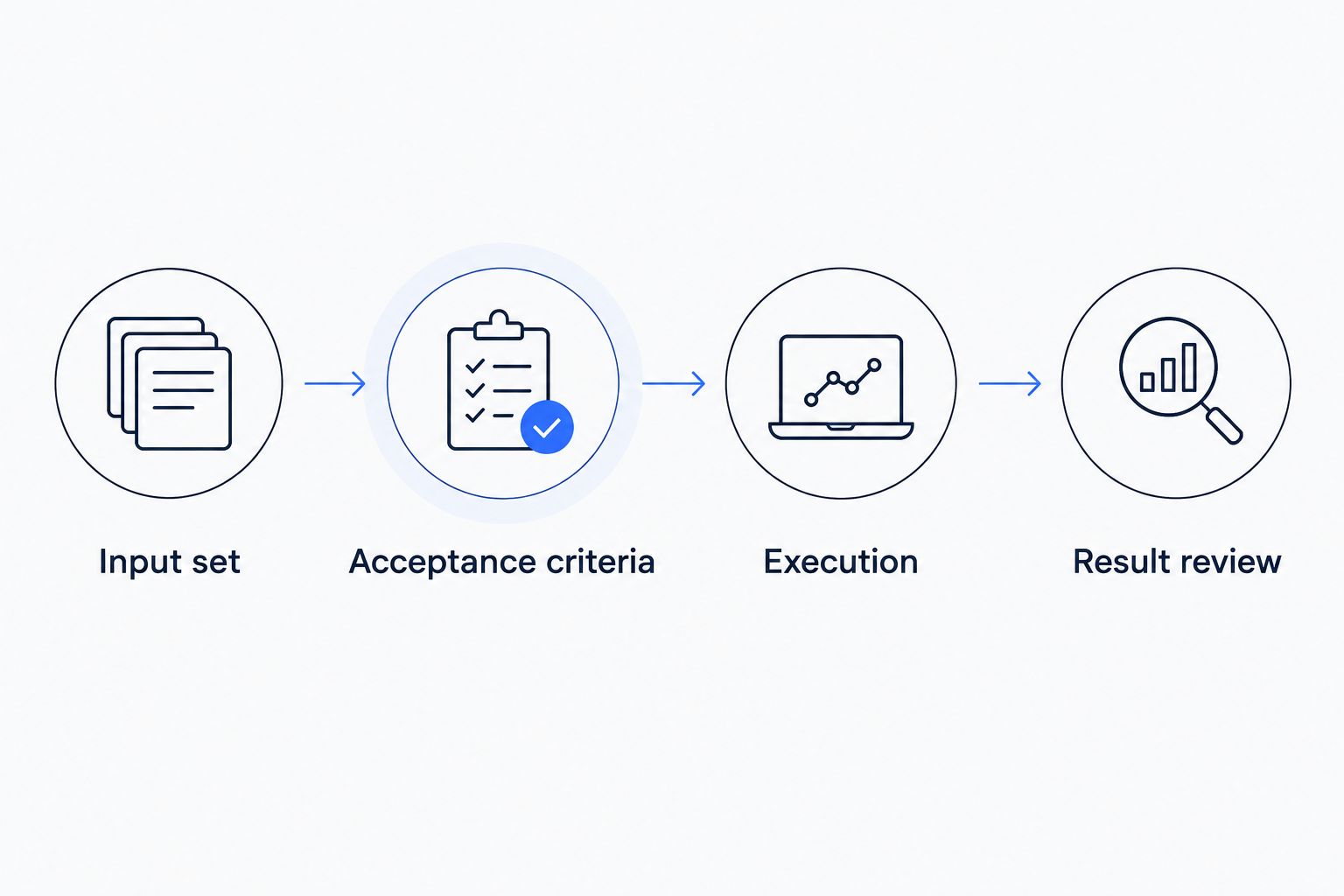
Compare the complete task against the same acceptance criteria, not just an isolated model response.
The evaluation tie is intentional. There is no factual basis for declaring either architecture more accurate for your task without task-level results. In 2026, procurement should reward demonstrated behavior rather than the appearance of a complete demo.
Governance remains an operating responsibility
FastRouter includes usage governance in its model-access offering. That is relevant when your platform team needs to manage how applications access LLMs through a shared gateway.
Governance still extends beyond model access. Your organization must define who owns a workflow, which data it handles, who approves changes, and what happens when an output is unsuitable.
For MindStudio, assess governance in the context of the workflows your team intends to build. Request evidence for the specific access, review, and operational controls your organization requires. Do not infer those controls from visual authoring alone.
The same discipline applies to a gateway. A general governance capability is not proof that every requirement in your security checklist is satisfied.
Ask both vendors to demonstrate the relevant behavior:
- Who can change production configuration?
- How do operators identify the configuration used for a particular execution?
- What information supports investigation of an incorrect result?
- What data-handling terms apply to the intended deployment?
Neither product category transfers accountability away from your team. The tie is organizational responsibility; the gateway's specific advantage is its stated usage governance at the model-access layer.
Compare pricing by the workload you will operate
Treat pricing as an architecture decision, not an isolated subscription comparison. A gateway and a workflow platform can introduce different billable components, so the useful comparison is the total commercial commitment for the workload you intend to run.
For a gateway evaluation, separate the platform's commercial terms from the underlying model usage. Establish how the agreement treats routed requests, failed attempts, and any additional services your deployment needs.
For a workflow-platform evaluation, establish how the agreement treats workflow execution, model usage, and the people who build or operate the workflows. Ask for the definitions behind each billable unit rather than assuming a familiar label means the same thing across vendors.
Predictability and flexibility are different buying priorities. A commitment-based arrangement gives you a defined obligation; a usage-based arrangement ties charges to measured activity. Assess the actual terms offered rather than assigning either model to a vendor without confirmation.
Your 2026 commercial review should answer:
- What activity creates a charge?
- Which costs are included, and which are billed separately?
- How does a failed execution affect billing?
- What happens when usage exceeds the agreed scope?
- How do configuration changes affect the billable workload?
No pricing winner follows from the architectural distinction alone. Compare the same intended workload under each vendor's current terms.
Final verdict: choose the missing layer
Choose FastRouter for a platform engineering team
Choose FastRouter if your developers already own application orchestration and need an LLM gateway for unified model access, automatic failover, cost optimization, and usage governance.
The named buyer is the platform engineering lead responsible for model-access infrastructure. The product fits that responsibility directly. Its limitation is equally clear: your team still owns the application's process and output-validation logic.
Before adopting it, test the application's request and response behavior and define acceptable fallback outcomes. Automatic failover addresses access continuity; your evaluation must establish whether an alternative model's output remains acceptable for the task.
Choose MindStudio for a workflow-building team
Choose MindStudio if your team needs a visual environment to construct AI agents and workflows. The named buyer is the product or automation lead whose immediate deliverable is an executable business process.
The advantage is the workflow-centered authoring model. The limitation is that a workflow-building decision does not, by itself, settle shared model-access requirements across your wider application estate.
Before adopting it, build the intended process and inspect how your team will change, validate, and operate it. A successful demonstration is useful; a maintainable production workflow is the actual requirement.
For the 2026 decision, name the responsibility first and the vendor second. That keeps the purchase aligned with the work your team needs to accomplish.
Decision scorecard
Dimension | Winner |
|---|---|
Shared model-access infrastructure | Gateway |
Visual agent and workflow construction | MindStudio |
Application-owned orchestration | Gateway |
Task-specific output evaluation | Tie: acceptance testing is required |
Organizational accountability | Tie: your team remains responsible |
Stated model-access usage governance | Gateway |
Pricing | Compare current terms for the same workload |
FAQ
Is FastRouter better than MindStudio?
FastRouter is better suited to enterprise teams needing an LLM API gateway; MindStudio is better suited to teams building agents and workflows visually. Choose according to whether your missing layer is model access or workflow authoring.
What's the difference between an LLM gateway and an AI workflow builder?
An LLM gateway manages application access to models, while an AI workflow builder helps define the process around model calls. Routing and failover belong to the access layer; inputs, instructions, and step sequences belong to the workflow layer.
Which should I choose if my application already uses an OpenAI-compatible API?
Evaluate the gateway approach first if your existing application already owns orchestration and needs managed model access. Test the exact request fields and response behavior your application uses before changing its integration.
Is MindStudio the better choice for visual AI workflow building?
MindStudio is the better fit in this comparison when visual AI workflow construction is your primary requirement. Evaluate the intended process itself, including how your team will change and operate it after launch.
Does automatic failover guarantee a correct answer?
No, automatic failover does not guarantee that an answer meets your task's requirements. Evaluate fallback outputs against the same acceptance criteria used for the preferred model.
How should I compare the cost of a gateway and a workflow platform?
Compare current commercial terms against the same intended workload. Identify the billable activities, separate included and additional costs, and confirm how failed executions affect billing.
What should an enterprise team evaluate before choosing either approach?
An enterprise team should evaluate architectural fit, task-level results, operational ownership, and required controls. Use the actual application path or workflow rather than an unrelated demonstration.
One last thing
A successful request is not the same as a successful task. That distinction matters most when a model changes or a workflow takes an unexpected path.
Add an output acceptance check before treating execution as success. Define the required structure, essential content, and unacceptable outcomes for your actual application. Then use that contract to evaluate both model substitutions and workflow changes.
The best purchase is the layer that removes your current bottleneck without hiding the responsibilities your team still needs to own.
Related Articles

FastRouter vs Hugging Face: which is better in 2026
fastrouter vs hugging face: choose routing and failover for application delivery, or model discovery and deployment control. Compare architecture and governance.
FastRouter vs TypingMind: which is better in 2026
Fastrouter vs TypingMind: choose a gateway for production routing or a chat interface for users. Compare failover, governance, integration, and team fit in 2026.

FastRouter vs AI/ML API: which is better in 2026
FastRouter vs AI/ML API: choose centralized LLM routing or keep a validated integration. Compare failover, governance, API contracts, and migration criteria.