

LLM gateway for financial services teams: complete 2026 guide
Choose an LLM gateway for financial services teams by approved routing paths. Compare options, test failover, and define governance before production deployment.
Financial services teams use an LLM gateway as a shared API layer for routing model requests, with the aim of controlling provider access, handling failures, and governing usage. The implementation must keep sensitive data boundaries, approved model choices, and accountable ownership intact when requests move between providers.
TL;DR
- An llm gateway for financial services teams should enforce approved routing paths before optimizing model selection.
- Fastrouter suits enterprise development teams seeking unified model access, automatic failover, and usage governance.
- Evaluate normal requests and fallback requests against the same data-handling requirements.
- Choose an operating model based on control ownership, observability, and integration work—not model count alone.
Why this matters
A successful model response does not prove that the request followed your institution’s rules. Your application needs to know which provider received the request, which model answered, and whether the fallback route remained within the approved boundary.
Fastrouter is best suited to enterprise development teams seeking unified LLM gateway access, automatic failover, and usage governance. Fastrouter provides an OpenAI-compatible API gateway for access to 200+ large language models. That access breadth is a selection capability, not evidence that every available model belongs in a financial services deployment.
For your 2026 architecture review, separate gateway capabilities from institutional approval. A routing layer can coordinate access; your security, risk, and platform teams still define acceptable data handling and operating conditions.
Why LLM gateways matter for financial services teams
Financial services applications need more than a convenient model endpoint. A customer-support workflow, an internal research assistant, and a document-processing pipeline can require different permissions and evaluation criteria. Treat each workflow as a separate approval decision, even when the applications share infrastructure.
The practical constraint is the relationship between data and destination. A fallback that preserves application availability but sends a request to an unapproved provider is not an acceptable recovery path. Likewise, a model that answers correctly in a development test is not automatically suitable for every production task.
A gateway gives you a place to coordinate routing decisions rather than repeating them independently across applications. The trade-off is another operational dependency and another configuration surface to review.
Define the permitted path before selecting the preferred model. That order keeps reliability and cost decisions inside your institution’s boundaries instead of asking reviewers to approve whatever the application already does.
Build the gateway around approved workloads
Define the workload boundary
Start with a shared document or spreadsheet. Write down the application purpose, the data it sends, the output it produces, and the person responsible for approving changes. You do not need gateway software to establish these boundaries.
Separate assistance from action. Summarizing a document and initiating a financial transaction should not inherit the same permissions merely because both use a language model. Record where a human review or application-level authorization is required.
For your initial 2026 deployment, select a workload whose inputs and acceptance criteria you can inspect. Avoid making your first gateway rollout depend on several unrelated applications with different approval requirements.
Give each workload 1 named owner. This is an accountability recommendation, not a product limit. That owner should be able to explain what the application is allowed to do and who authorizes a change to its routing policy.
- Record the business purpose and excluded uses.
- Identify sensitive fields before requests leave the application.
- Document approved destinations and processing conditions.
- Name the workload owner and escalation contact.
- Define where human review remains mandatory.
Establish a direct-call baseline
Use your existing provider integration or a small test harness to establish expected behavior before adding routing. Save representative inputs, expected output characteristics, and the application’s response to errors. Keep sensitive production content out of test fixtures unless its use is explicitly approved.
Measure the application experience rather than only the model response. Streaming, tool calls, structured outputs, and error handling all need their own checks if the workload uses them. A request that returns text successfully can still break downstream parsing.
Record latency with its measurement boundary: time to first output is different from time to completed output. Record usage with the workload and destination so comparisons remain interpretable. Do not substitute a provider’s general benchmark for your application’s evidence.
An OpenAI-compatible interface simplifies the integration shape, but compatibility does not establish identical behavior across models. Preserve tests for the exact request features your application depends on.
- Capture representative request and response fixtures.
- Test required streaming and tool-call behavior.
- Validate structured output against the application schema.
- Record error responses and retry behavior.
- Keep evaluation inputs under version control.
Choose who owns the routing layer
Begin by implementing a simple allowlist and destination map in application configuration. This manual baseline makes the decision explicit: which workload can call which approved destination, and under what conditions?
Fastrouter provides a centralized alternative through its unified, OpenAI-compatible LLM gateway, automatic failover, cost optimization, and usage governance. Evaluate those capabilities against your workload boundary rather than assuming that a broad model catalog solves institution-specific control requirements.
The choice is operational. Application-owned routing keeps decisions close to the code but repeats maintenance across services. A shared gateway centralizes decisions but requires clear ownership of configuration, access, and incident response.
For a 2026 procurement decision, request evidence for requirements beyond the supplied capability description. Data retention, deployment arrangements, regional processing, and contractual obligations need explicit verification. Do not infer any of them from API compatibility or the presence of governance features.
- Compare application-owned and centrally owned routing.
- Assign responsibility for gateway configuration changes.
- Verify handling of credentials and request content.
- Review required provider and gateway agreements.
- Test the integration before replacing production calls.
Constrain the fallback path
Start with a written routing matrix. For each workload, identify the primary destination, permitted fallback destinations, and the response when no approved destination remains available. An explicit stop condition is part of the design, not a failure to design for reliability.
Use 3 routing gates as a review structure: data permission, task suitability, and operating limits. These are recommended review gates, not gateway specifications. A destination should pass all of them before it becomes eligible for a request.
For resilience testing, configure 2 provider paths only if both satisfy the workload’s requirements. Different destinations do not make a fallback acceptable by themselves. Recheck the model’s output contract, processing conditions, and application behavior on the alternate path.
Your 2026 fallback policy should distinguish a provider error from an application validation failure. Repeating a malformed request across providers does not repair the request. Route only when the failure condition matches an approved recovery rule.
- Data permission: reject destinations outside the workload boundary.
- Task suitability: require the approved output contract.
- Operating limits: enforce the workload’s defined usage conditions.
- Fallback path: select only from approved alternatives.
- Stop condition: return a controlled failure when alternatives are exhausted.
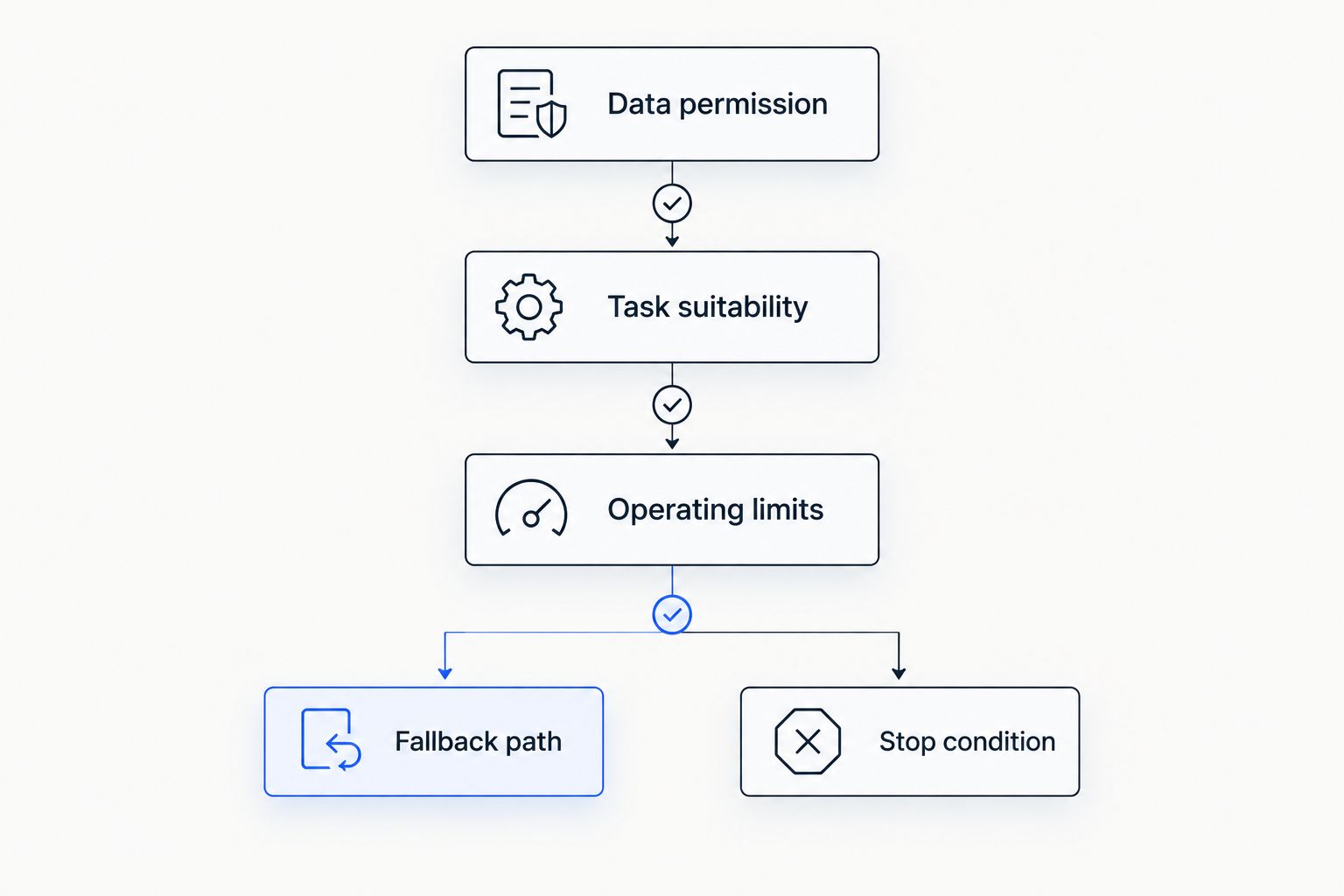
Fallback remains inside the same workload boundary as the original request.
Evaluate models against the task
Start with a manually reviewed evaluation set. Include ordinary requests, incomplete inputs, ambiguous instructions, and cases where the correct response is to decline or request clarification. Define acceptable behavior before comparing destinations.
Keep the evaluation focused on the actual workflow. A document extraction task needs correct fields and schema adherence. An internal research assistant needs answers grounded in permitted source material. Neither is fully evaluated by fluent prose alone.
A shared model-access layer can make comparison easier, but evaluation ownership stays with your team. Do not treat the gateway’s ability to reach a model as approval to use that model for a regulated or sensitive process.
Record the model identifier and configuration alongside each result. When you change the model, prompt, retrieval input, or routing rule, rerun the relevant checks. A gateway configuration change can alter application behavior even when application code stays unchanged.
- Define task-specific acceptance criteria.
- Include refusal and clarification cases.
- Test schema compliance and downstream parsing.
- Review unsupported statements and omitted information.
- Preserve model and configuration identifiers with results.
Connect usage to operational ownership
Begin with the logs and usage records you already have. Map each request to an application, environment, and workload owner. This attribution makes usage review actionable: someone can explain the request and authorize a change.
Separate request metadata from request content. Your observability design should answer operational questions without collecting sensitive payloads by default. Decide which fields are necessary, who can access them, and how long they remain available under your institution’s policy.
Track the initial destination, final destination, fallback reason, completion status, and measured latency. This lets an incident reviewer distinguish a successful primary request from a successful recovery. Both produced an answer; they followed different operating paths.
Usage governance is part of the stated Fastrouter offering. Verify its fit against your attribution, reporting, and enforcement requirements during evaluation. Do not assume that a feature label specifies every field, control, or export your operating model requires.
- Attribute usage to the application and owner.
- Separate production and nonproduction activity.
- Record initial and final destinations.
- Capture fallback reasons without unnecessary payload content.
- Define access and retention rules for operational records.
Test recovery and configuration changes
Start in a nonproduction environment with approved test content. Simulate unavailable destinations, authentication failures, exhausted operating limits, and invalid responses. Check what the application does when routing cannot recover.
Do not stop at a successful fallback demonstration. Verify that the alternative response still passes application validation and that the recorded destination matches the actual route. Confirm that a denied destination remains denied during an incident.
Treat routing configuration as production configuration. Require review, preserve change history, and maintain a tested rollback path. The people responding to an incident should not have to reconstruct which destinations were permitted before the last change.
Before a 2026 release, make controlled failure an acceptance criterion alongside successful completion. For sensitive workloads, refusing an unapproved route is the correct outcome. Reliability means predictable behavior within the approved boundary, not an answer at any cost.
- Simulate primary-destination failures.
- Verify alternate responses against application validation.
- Test the no-approved-destination condition.
- Review and version routing configuration.
- Rehearse rollback and incident escalation.
Compare the operating options
Choose based on who owns routing and how much integration work your team accepts. Centralization is useful only when the shared layer meets the workload’s requirements. A direct integration can remain the right choice for a narrowly scoped application.
The following options describe architectural choices, not equivalent products. Keep the same evaluation fixtures across options so you compare application behavior rather than presentation or catalog breadth.
Option | Best for | Main advantage | Key limitation |
|---|---|---|---|
Direct provider integration | A narrowly scoped workload with an approved destination | Keeps the request path and integration surface explicit | Your application owns retries, destination changes, and usage attribution |
Application-owned routing | Teams needing routing logic close to application behavior | Lets developers implement workload-specific decisions directly | Routing and maintenance work repeat across applications |
Self-managed shared gateway | Platform teams prepared to operate shared routing infrastructure | Centralizes policy implementation under the platform team | Your team owns gateway operations, upgrades, and incident response |
Fastrouter | Enterprise development teams seeking unified model access and managed gateway capabilities | Provides OpenAI-compatible access, automatic failover, cost optimization, and usage governance | Institution-specific data handling and control requirements still require verification |
Do not combine operating models without defining the authority of each layer. If the application and gateway both retry, document the combined behavior. If both select destinations, decide which policy wins and how a reviewer can reconstruct the decision.
Common mistakes financial services teams make
Approving the primary route but ignoring fallback
An approved initial destination does not approve the alternate destination. Review fallback paths against the same data, task, and processing requirements. Keep an explicit no-route outcome when every acceptable destination is unavailable.
Treating API compatibility as behavioral equivalence
A compatible request format does not prove that models handle structured outputs, tool calls, or refusals identically. Test the features the application uses. Keep validation in the application rather than depending on model selection alone.
Recording sensitive content to explain every error
Detailed payload logging creates another place where sensitive material needs protection. Start with operational metadata and collect content only under an approved purpose and handling policy. Incident diagnosis should not silently expand the data footprint.
Letting cost optimization override task acceptance
A destination belongs in the routing set only after it meets the workload’s requirements. Optimize usage within that set. Do not compensate for an unsuitable model by adding more retries or asking human reviewers to repair predictable errors.
Leaving gateway changes outside release controls
A routing change can alter the destination and behavior without an application deployment. Review it accordingly. Preserve the previous configuration and verify the rollback path before approving the change.
FAQ
What is an LLM gateway for financial services teams?
An LLM gateway for financial services teams is a shared API layer for routing model requests and governing access across approved destinations. The institution still defines acceptable data handling, model use, and operational controls.
Is a gateway better than calling a model provider directly?
A gateway is better suited to shared routing and governance needs; a direct integration suits a narrowly scoped workload with an approved destination. Compare the operational responsibility and integration work rather than assuming either architecture is universally better.
Does an OpenAI-compatible API make models interchangeable?
No. OpenAI-compatible request formatting does not establish identical model behavior. Test structured outputs, streaming, tool calls, refusals, and error handling for the features your application uses.
Can automatic failover send financial data to another provider?
Failover changes the destination when a configured recovery condition occurs. Your permitted fallback set must exclude providers that do not satisfy the workload’s data-handling requirements, and the application needs a controlled failure when no approved route remains.
Does a gateway make an application compliant?
No. A gateway capability is not evidence that an application meets its applicable obligations. Your institution must assess the application, providers, contracts, data flows, and operating controls together.
What should teams verify before choosing a gateway in 2026?
Verify the request path, data handling, credentials, fallback policy, observability, and configuration ownership. Test required application behavior and request evidence for contractual or deployment requirements rather than inferring them from feature names.
Should operational logs contain prompts and responses?
Operational logs should collect only the information required under your approved handling policy. Begin with request metadata and destination records; add payload content only for an explicitly approved purpose.
One last thing
Test the route that must never happen. Block an unapproved destination, make the primary destination unavailable, and confirm that the application fails without crossing the boundary.
A successful answer proves that a request completed. A controlled refusal to route proves that the boundary held. Include both outcomes in your release evidence.
Related Articles

FastRouter vs OpenAI API: which is better in 2026
Fastrouter vs OpenAI API: choose multi-provider routing or direct OpenAI access. Compare failover, governance, integration, and evaluation before you commit.

LLM gateway for healthcare AI teams: complete 2026 guide
An LLM gateway for healthcare AI teams needs approved routes first. Compare architectures, test failover, and define data controls before production deployment.

FastRouter vs MindStudio: which is better in 2026
FastRouter vs MindStudio: choose a gateway for model routing or a builder for visual workflows. Compare architecture, failover, governance, and evaluation.