

FastRouter vs OpenAI API: which is better in 2026
Fastrouter vs OpenAI API: choose multi-provider routing or direct OpenAI access. Compare failover, governance, integration, and evaluation before you commit.
Choose Fastrouter if you need an OpenAI-compatible gateway for multi-provider routing, automatic failover, and usage governance; choose the OpenAI API if you want direct access to OpenAI’s platform without a separate gateway. In 2026, the deciding factor is whether your application needs a routing layer or a direct provider integration.
TL;DR
- Fastrouter vs OpenAI API compares multi-provider LLM routing with direct access to OpenAI’s platform.
- Choose the gateway for model comparison, automatic failover, and centralized usage governance.
- Choose the OpenAI API when direct provider integration matters more than multi-provider access.
- OpenAI compatibility does not establish feature parity; test the endpoints and behaviors your application uses.
Why this matters
Your API choice determines where you put routing decisions, failure handling, and usage controls. Those responsibilities remain somewhere in your stack even when you standardize on one provider.
Fastrouter is an LLM API gateway for enterprise teams that need multi-provider routing and usage governance. Its stated scope includes access to 200+ large language models, model comparison, automatic failover, and cost optimization. The OpenAI API is a direct interface to OpenAI’s platform, not a cross-provider routing gateway.
For a 2026 architecture decision, separate application requirements from procurement preferences. A team that must switch providers has a different problem from a team whose application depends on an OpenAI-specific workflow. Neither architecture wins every dimension.
At a glance
Dimension | Fastrouter | OpenAI API |
|---|---|---|
Best for | Enterprise teams managing multi-provider access | Teams building directly on OpenAI |
Provider breadth | Gateway access to 200+ large language models | Direct access to OpenAI’s platform |
Integration shape | OpenAI-compatible interface with a gateway layer | Direct provider interface without that gateway layer |
Standout feature | Automatic failover across model access | Direct integration with provider-native capabilities |
Native features | Validate required features through the gateway | Integrate directly with OpenAI’s documented interfaces |
Usage governance | Usage governance is part of the stated gateway scope | Design controls around direct provider usage |
Model evaluation | Compare models through a unified gateway | Evaluate OpenAI options directly; add other integrations for external comparisons |
Pricing model | Review gateway terms and upstream billing responsibilities | Review provider terms and application consumption |
Best fit follows your operating model
Choose the gateway for a multi-provider operating model; choose the direct API for an OpenAI-centered application. Start with the requirement that creates the most engineering work, not the longest feature list.
If your team needs different models for different workloads, provider selection becomes an operational concern. You need to decide which model receives each request, what happens when that route fails, and how usage remains accountable across the application.
If your application intentionally uses OpenAI throughout, a direct integration keeps the provider boundary explicit. You do not need to introduce a routing service solely to access the provider you have already selected.
The tradeoff is architectural. A gateway centralizes an additional set of decisions, but it also introduces another service dependency. A direct API removes that intermediary, but any future cross-provider routing must live elsewhere in your stack.
The gateway wins on provider breadth
The gateway’s stated access to 200+ large language models makes breadth a clear distinction. The OpenAI API serves OpenAI’s platform; it is not a unified interface for competing providers.
Choose multi-provider access when model selection is part of your product or platform strategy. Examples include comparing candidate models for a workload, separating generation tasks by requirements, or designing an alternative route outside a single provider.
Breadth alone does not establish quality. A large catalog does not tell you which model follows your instructions, produces valid structured output, or satisfies your application’s response requirements. Make those decisions with representative requests.
The direct API wins when breadth is unnecessary. An application with an intentional OpenAI-only design does not gain an immediate architectural benefit from a larger model catalog. Avoid introducing selection logic that your product does not actually need.
OpenAI wins on fewer integration boundaries
A direct OpenAI API integration removes the gateway boundary between your application and the provider. That is a structural advantage, not a claim about measured response time or uptime.
With a gateway, troubleshooting includes another interface: your request enters the gateway before reaching the selected provider. Your team must understand how credentials, request fields, errors, and response metadata behave at that boundary.
OpenAI compatibility helps standardize the application interface. It does not establish that every endpoint, parameter, tool behavior, or response field works identically across providers. Treat compatibility as a starting point for integration testing, not a substitute for it.
For a 2026 implementation, validate the exact request patterns you use. Include streaming if your application streams, structured output if downstream code parses a schema, and tool calls if your workflow invokes external functions. Test behavior rather than assuming interchangeability.
The gateway wins on automatic failover
Fastrouter includes automatic failover in its stated gateway capabilities. A direct OpenAI integration does not, by itself, create a route to a different provider; your application needs another integration or routing layer for that.
Choose gateway failover when provider alternatives are an explicit requirement. This places failure handling in the routing architecture rather than leaving every application team to design a separate implementation.
Failover is not the same as equivalent output. A replacement model can return a response that satisfies transport-level checks but fails your application’s schema or quality requirements. Define acceptable fallback behavior before enabling production routing.
Also distinguish retries from provider switching. A retry repeats an attempt; a fallback changes the selected route. Your test plan should establish which failures trigger each action, how errors reach the caller, and what happens when every permitted route fails. Do not infer those details from the phrase automatic failover.
OpenAI wins on direct native-feature integration
Choose the OpenAI API when provider-native behavior is the deciding requirement. A direct integration lets your team work against OpenAI’s documented interface without first establishing whether a gateway exposes the same capability.
This matters when your application depends on more than a basic request-and-response exchange. Endpoint behavior, tool execution, streaming events, state management, and response metadata can become part of the application contract.
A gateway remains a candidate when it supports the exact behavior you need. Verify the complete workflow, not just whether an initial request succeeds. A successful text response does not prove that downstream tool handling or error processing will behave as expected.
The direct API’s limitation is provider coupling. If your application uses a provider-specific interface throughout, moving that workflow to another provider requires a separate compatibility assessment. Direct access simplifies the immediate boundary; it does not make the application provider-independent.
Both require deliberate governance
Usage governance is part of the gateway’s stated scope, but the right governance decision depends on your actual control requirements. Neither an API connection nor a routing layer replaces your organization’s access policy.
Treat governance as a requirements review, not an automatic win for either architecture. Identify who can issue requests, which workloads they can run, how usage is attributed, and who can change production routing decisions.
For a gateway evaluation, verify how those controls operate across the providers and models you intend to use. For direct OpenAI access, verify how your provider configuration and application controls enforce the same requirements.
Security and procurement reviews must address the chosen architecture too. Map where credentials are held, where requests pass, and which organizations process the data. Do not treat API compatibility as evidence of a particular data-handling policy, certification, or contractual commitment.
The gateway wins on cross-provider evaluation
A unified gateway gives you a common access layer for comparing models from different providers. That aligns with the gateway’s stated model-comparison purpose and reduces the need to start each comparison with a separate provider integration.
The OpenAI API is the cleaner evaluation boundary when your candidate set stays within OpenAI. You can test the provider directly without introducing an intermediary into the experiment.
Choose the evaluation architecture that matches your candidate set. Keep prompts, reference outputs, scoring rules, and application acceptance criteria consistent. Separate model quality from integration behavior so that an adapter problem does not masquerade as a model problem.
A common interface also does not make every comparison equivalent. Confirm how each candidate handles the settings your test uses. Record unsupported behavior explicitly instead of silently changing requests until every candidate responds. Otherwise, your experiment compares different tasks under the same label.
Pricing follows the full request path
For a 2026 commercial review, compare the responsibilities attached to each architecture rather than assuming a particular gateway billing model. Confirm who bills for model consumption, what gateway charges apply, and which usage records finance can reconcile.
Direct provider access keeps the provider relationship explicit. A gateway adds a commercial relationship to review, while offering routing and cost-optimization capabilities that your team would otherwise need to assess or implement separately.
Predictability and flexibility come from the actual contract and consumption pattern, not the architecture label. Review what happens when requests retry, switch routes, or produce output your application rejects.
Judge cost optimization by accepted task outcomes. A cheaper successful API response is not necessarily a cheaper completed workflow if your application must repeat it or repair its output. Compare billing records alongside application results, without turning an unverified savings claim into a procurement assumption.
Test the behavior before choosing
Run a focused acceptance plan in 2026 before committing either architecture to a critical workflow. Use the same representative inputs and retain the request, response, error, and application outcome for each test.
Organize the plan around 3 scenarios:
- Failure recovery: Exercise an unavailable route and confirm the caller receives the intended recovery behavior or final error.
- Quality checks: Run a task with a defined acceptance rule and confirm the output passes downstream validation.
- Timing checks: Observe a normal request and a recovered request under the same application conditions.
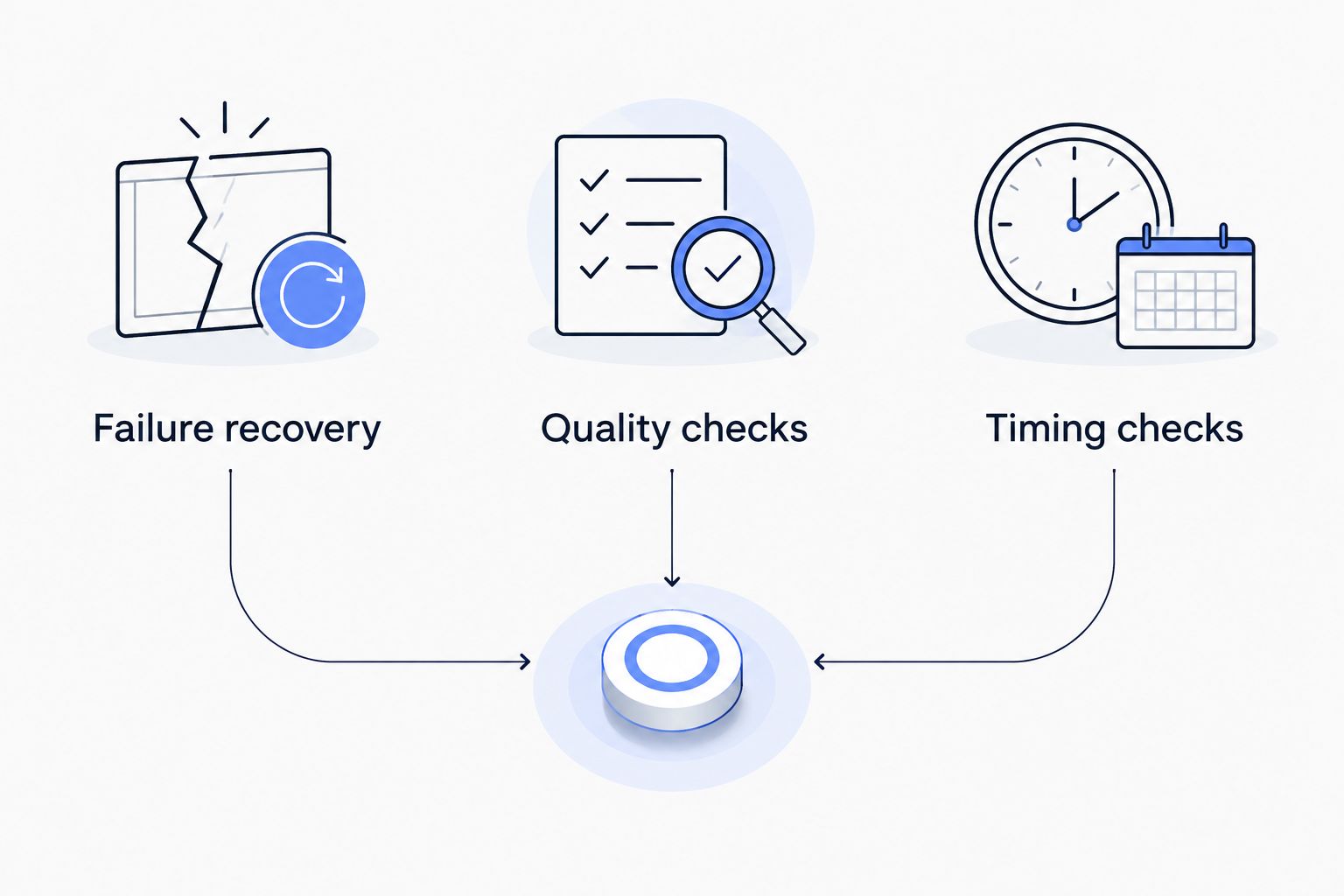
Test recovery, output acceptance, and timing separately before selecting an architecture.
For streaming workflows, track 2 measurements: time to first token in milliseconds and total completion time in milliseconds. These are different observations; a response that starts promptly can still complete too slowly for your workflow.
Keep the trial to 1 production-representative workflow initially. Expand after the request contract, output validation, and failure handling pass. This avoids mistaking a wide demonstration for a successful integration test.
Assign ownership before the trial ends. Name the team responsible for provider incidents, routing changes, credential management, and rejected outputs. The architecture should support that operating model, not obscure it.
Final verdict
Choose Fastrouter if you run a multi-provider platform
The named winner for an enterprise AI platform team managing cross-provider access is the gateway. Its stated routing, model comparison, automatic failover, cost optimization, and usage governance capabilities match that operating problem.
Accept the additional service boundary deliberately. Validate the endpoints, controls, and fallback behavior your application needs before standardizing on it.
Choose the OpenAI API if you build directly on OpenAI
The named winner for a product team with an intentional OpenAI-only architecture is the OpenAI API. It provides the direct provider boundary without requiring a separate routing service.
Accept provider coupling deliberately. If cross-provider recovery becomes a requirement later, your team will need to add an alternative integration and decide where routing belongs.
For your 2026 decision, prioritize the requirement that would otherwise force a redesign. Provider flexibility favors the gateway; direct native integration favors the provider API.
Dimension | Winner |
|---|---|
Best for | Gateway for multi-provider teams; OpenAI API for OpenAI-centered teams |
Provider breadth | Gateway |
Fewer integration boundaries | OpenAI API |
Automatic cross-provider failover | Gateway |
Direct native-feature integration | OpenAI API |
Usage governance | Requirements-dependent; validate both architectures |
Model evaluation | Gateway across providers; OpenAI API within OpenAI |
Pricing model | No universal winner; compare contracts and accepted task outcomes |
FAQ
Is Fastrouter better than the OpenAI API?
Fastrouter is the better architectural fit when you need multi-provider routing, model comparison, and automatic failover. The OpenAI API is the better fit when you want direct provider integration without a separate gateway.
Does an OpenAI-compatible gateway support every OpenAI feature?
OpenAI compatibility does not establish complete feature parity. Validate the endpoints, parameters, streaming behavior, tool calls, and response fields your application uses.
Can the OpenAI API automatically switch to another provider?
A direct OpenAI API integration does not create a connection to another provider. Cross-provider fallback requires an alternative integration and routing logic elsewhere in your architecture.
Does automatic failover guarantee an acceptable answer?
Automatic failover does not guarantee that a replacement model meets your application's quality requirements. Test fallback outputs against the same schema and acceptance rules used for normal requests.
Which option is cheaper for an enterprise application?
Neither architecture is universally cheaper. Compare the applicable commercial terms, recorded consumption, retry behavior, and cost of outputs your application accepts.
What should a platform team test before selecting an LLM gateway?
Test failure recovery, output acceptance, and timing on a production-representative workflow. Also verify credential handling, usage attribution, required endpoint behavior, and ownership of routing changes.
One last thing
Test a failed request, not just a successful demo. A normal response proves connectivity; a controlled failure reveals recovery behavior, error handling, and operational ownership. That is where a routing layer must justify its place in your application.
Related Articles

LLM gateway for healthcare AI teams: complete 2026 guide
An LLM gateway for healthcare AI teams needs approved routes first. Compare architectures, test failover, and define data controls before production deployment.

LLM gateway for financial services teams: complete 2026 guide
Choose an LLM gateway for financial services teams by approved routing paths. Compare options, test failover, and define governance before production deployment.

FastRouter vs MindStudio: which is better in 2026
FastRouter vs MindStudio: choose a gateway for model routing or a builder for visual workflows. Compare architecture, failover, governance, and evaluation.