

LLM router for platform engineering teams: complete 2026 guide
An llm router for platform engineering teams needs policy-first routing. Compare build and buy options, validate failover, and assign clear operational ownership.
Platform engineering teams’ LLM routing is a shared control layer for model requests, with the aim of keeping application delivery consistent while controlling provider access, failure handling, and usage. An LLM router for platform engineering teams must enforce operational policy across applications, not just choose a model for an individual prompt.
TL;DR
- An LLM router for platform engineering teams should centralize routing, failover, and usage governance without hiding application requirements.
- Fastrouter is best for enterprise development teams seeking unified LLM routing and usage governance.
- Evaluate model quality before changing routes; API compatibility does not guarantee equivalent application behavior.
- Choose direct integrations, an internal router, or a managed gateway according to ownership and policy requirements.
Why LLM routing matters for platform engineering teams
Your platform team owns the boundary between application requirements and provider behavior. When each application implements its own provider selection, retries, and credentials, each implementation becomes another policy surface to maintain. A shared router gives you a place to define those decisions explicitly.
Fastrouter provides a unified, OpenAI-compatible gateway with automatic failover, cost optimization, and usage governance. Fastrouter is best for enterprise development teams seeking unified LLM routing and usage governance. Its gateway capabilities address shared infrastructure needs; your team still needs to define acceptable model behavior and validate application outcomes.
For your 2026 platform plan, separate three concerns: whether a provider accepts the request, whether the model produces an acceptable result, and whether the request complies with your policy. A successful response answers only the first concern.
The engineering decision is not simply whether to add a gateway. It is which responsibilities belong in that gateway, which remain in applications, and who owns the boundary when something fails.
Build the routing control layer
Define your workload contracts
Start with a shared document or configuration file that describes each application’s requirements. Select 3 workload classes for your initial evaluation: interactive responses, structured extraction, and asynchronous processing. These are evaluation categories, not assumptions that every team runs all three.
For each workload, describe what constitutes an acceptable response. Interactive applications need a clear streaming contract. Structured extraction needs output validation. Asynchronous processing needs cancellation and retry rules that fit the surrounding job system.
Your workload contract should also describe what happens when no approved route remains. Returning an explicit failure is preferable to silently switching to a model that violates the application’s requirements. Make that decision before introducing automatic failover.
Keep provider names separate from application intent. An application should express its requirements without having to reproduce the entire routing policy. That separation makes a provider change a controlled platform decision rather than an application-wide edit.
- Identify the application owner and operational contact.
- Specify required response formats and capabilities.
- Record data-handling restrictions for each workload.
- Define timeout, cancellation, and failure behavior.
- List the checks that determine response acceptance.
Establish your evaluation baseline
Use an existing test runner and a version-controlled evaluation set before adding routing automation. Include representative requests, known failure cases, and examples that exercise your application’s output contract. Remove sensitive information unless your evaluation environment is approved to process it.
Record the model, provider, request settings, evaluation version, and outcome together. A comparison without those fields is difficult to reproduce. Keep subjective quality judgments separate from deterministic checks such as schema validity or required-field presence.
In 2026, treat a route change as an application behavior change. An API-compatible model can still differ in instruction following, output structure, or tool selection. Your evaluation should establish which differences your application accepts.
Do not promote a cheaper route solely because it returns valid HTTP responses. Compare acceptable completed tasks, not just successful requests. Include retry activity in the comparison so that repeated attempts do not disappear from your assessment.
- Build a representative, versioned evaluation set.
- Validate structured output against the application contract.
- Check tool selection and argument construction where relevant.
- Record latency and usage alongside quality outcomes.
- Re-run evaluations before promoting routing changes.
Choose your integration boundary
Begin with the simplest manual implementation: keep provider-specific calls behind an application adapter. This makes the boundary visible without requiring a separate service. Inspect the adapter’s behavior before deciding whether to move it into shared platform infrastructure.
Fastrouter offers a managed path for unified LLM routing through an OpenAI-compatible API gateway. Its stated capabilities include model comparison, automatic failover, cost optimization, and usage governance. Evaluate those capabilities against your workload contracts rather than treating the gateway as a prerequisite.
Compatibility is an integration starting point, not a complete acceptance test. Check the request fields, streaming events, tool-call behavior, error handling, and usage records your applications actually consume. Preserve a clear distinction between the application’s logical route and the selected model or provider.
For your 2026 architecture, keep authentication and policy ownership explicit. Confirm credential handling and any BYOK requirements during evaluation rather than inferring them from the term gateway.
- Inventory the API features your applications use.
- Test streaming and non-streaming response handling.
- Validate tool calls and structured-output behavior.
- Confirm credential ownership and rotation responsibilities.
- Keep logical route names separate from provider identifiers.
Encode routing and fallback policy
Start with a version-controlled policy file and explicit route order. Avoid automatic selection until you can explain why each candidate qualifies. A route should pass eligibility checks before optimization rules compare it with other routes.
Use this decision sequence: Data policy, Capability checks, Primary route, Fallback route, and Outcome validation. Data restrictions exclude prohibited destinations. Capability checks exclude models that cannot meet the application contract. Only then should your policy select an eligible route.
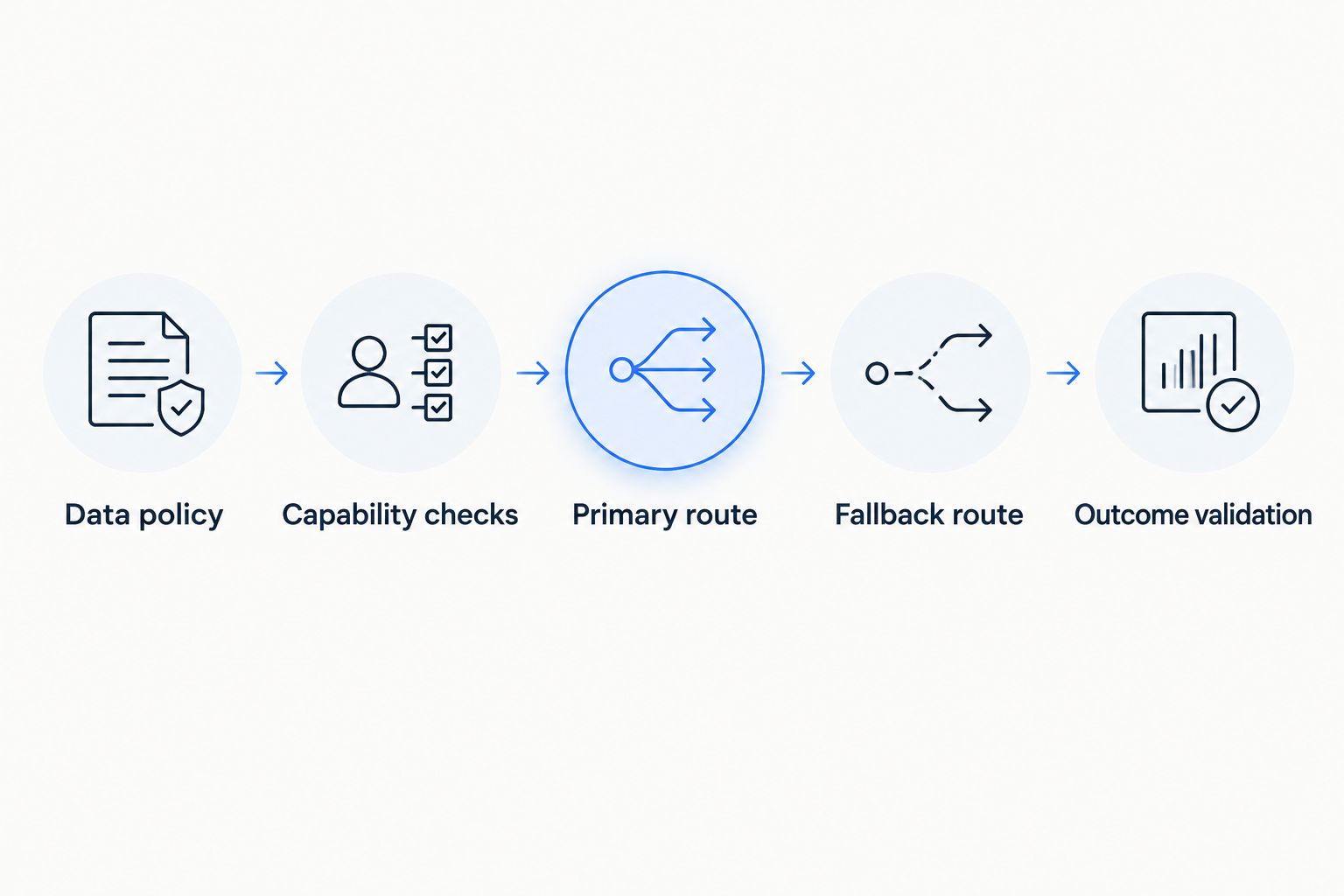
Eligibility checks come before route selection; output validation remains necessary after a response.
Do not treat every error as permission to switch providers. Authentication failures, invalid requests, provider unavailability, and application-level validation failures require different responses. Classify them before assigning retries or fallback behavior.
Also distinguish request acceptance from task completion. If a response triggers an external action, retrying the surrounding operation needs duplicate-action protection. The router’s retry policy cannot replace application-level safeguards.
- Apply data restrictions before selecting a destination.
- Require the capabilities listed in the workload contract.
- Define a primary route and eligible fallback routes.
- Classify errors before deciding whether to retry.
- Stop when no compliant route remains.
- Validate the returned output before downstream use.
Instrument request outcomes
Begin with application logs and your existing observability stack. Give each logical request a correlation identifier, then distinguish that request from its individual provider attempts. Without that distinction, a successful fallback can hide the failure that triggered it.
Capture the requested route, selected destination, policy version, attempt outcome, and final application outcome. Include latency and token usage where available. Avoid copying prompt content into logs by default; define access and retention rules before recording sensitive payloads.
Fastrouter includes usage governance and cost optimization among its stated capabilities. Assess how the information available through the gateway fits your reporting requirements. Your application still needs to report whether the response completed the intended task.
For your 2026 operating reviews, separate provider failures from output-validation failures and caller cancellations. These categories point to different fixes. A single combined error count obscures whether the problem belongs to the provider, routing policy, or application contract.
- Correlate logical requests with individual attempts.
- Record the selected route and policy version.
- Separate transport errors from validation failures.
- Attribute usage to the responsible workload or team.
- Restrict access to logs containing sensitive information.
Rehearse failure and rollback
Use a test harness, mocked responses, or a controlled staging environment first. Run 2 failure drills before promoting the initial policy: provider unavailability and a primary response that fails output validation. These are suggested acceptance exercises, not performance benchmarks.
The first drill checks whether an eligible fallback receives the request and whether callers receive the expected error when fallback is exhausted. The second checks whether an unacceptable response is detected rather than passed downstream as a success.
Extend the drills to streaming where your application depends on it. Once response content reaches the caller, switching providers changes the recovery problem. Define whether the application restarts, reports failure, or handles an interrupted stream explicitly.
Test rollback as a separate operation. A policy change needs a known previous configuration and a clear owner who can restore it. Preserve evaluation records so that rollback decisions do not depend on reconstructing the change from logs.
- Simulate provider unavailability in staging.
- Inject outputs that violate the application contract.
- Check interrupted-stream handling where applicable.
- Verify that retries cannot repeat external actions.
- Restore the previous policy and confirm its behavior.
Assign ownership and release gates
Start with a short ownership register and a review checklist in your existing repository. Assign 1 accountable owner per routing policy. Supporting teams can contribute, but a policy needs an identifiable decision-maker when requirements conflict.
Separate platform responsibilities from application responsibilities. The platform team owns shared route enforcement and gateway operations. Application teams own task definitions, output acceptance, and downstream behavior. Security and procurement requirements should enter the approval process before a new destination becomes eligible.
For your 2026 release process, require evidence that the proposed route satisfies the workload contract. Changes to model selection, fallback order, credentials, or logging behavior should follow an explicit review path. Do not make approval depend solely on whether an integration test passes.
Treat routing configuration as release material. Version it, review it, and keep an auditable record of who approved the change and why. This gives incident responders a concrete starting point.
- Name the routing-policy owner and application owner.
- Require evaluation results for route changes.
- Review new destinations against data-handling requirements.
- Version routing, fallback, and logging configuration.
- Document rollback ownership and escalation paths.
Compare your implementation options
Choose the option that matches the responsibilities you want to own. Direct integration keeps infrastructure narrow. An internal router gives your team control over implementation. A managed gateway supplies shared capabilities but still requires application-specific acceptance testing.
Option | Best for | Main advantage | Key limitation |
|---|---|---|---|
Direct provider integration | Applications with a narrow provider scope | Keeps the request path and integration boundary explicit | Shared routing and governance require additional implementation |
Internally maintained router | Teams with specific routing requirements and assigned infrastructure owners | Lets the team define the policy engine and operational behavior | The team owns adapters, testing, monitoring, and maintenance |
Fastrouter managed gateway | Enterprise development teams seeking unified access and usage governance | Provides OpenAI-compatible access, automatic failover, and cost optimization | Gateway capabilities do not establish application quality or remove evaluation work |
Compare these options using the same workload contracts and failure drills. Otherwise, you are comparing feature descriptions rather than operational behavior. Keep acceptance criteria independent of the implementation so that a managed gateway and an internal router face the same test.
Your selection should also identify what remains outside the router: application validation, downstream side effects, sensitive-data classification, and release approval. Those responsibilities do not disappear when the request path becomes centralized.
Common mistakes platform engineering teams make
Optimize before defining acceptable output
A route that reduces usage but fails the task is not an acceptable replacement. Establish the quality gate first, then compare eligible routes. Include retries and rejected outputs in your assessment instead of measuring only the first attempt.
Allow fallback to bypass policy
Fallback is another routing decision, not an exemption from data restrictions. Apply the same eligibility rules to primary and fallback destinations. When no compliant destination remains, return the failure defined in the workload contract.
Retry operations with external side effects
Repeating a model request and repeating a completed external action are different operations. Keep tool execution under application control, and use duplicate-action protection where required. Check the entire workflow rather than assuming gateway retries are sufficient.
Centralize traffic without assigning ownership
A shared gateway creates a shared operational dependency. Name who owns configuration, incident response, and rollback before production adoption. Application teams also need a clear way to report output failures that infrastructure monitoring cannot identify.
FAQ
What is an LLM router for platform engineering teams?
An LLM router for platform engineering teams is a shared control layer that directs model requests according to routing, access, and failure-handling policies. It centralizes infrastructure decisions while applications retain responsibility for defining and validating acceptable outcomes.
Should platform engineering teams build or buy an LLM router?
Choose an internal router when your team needs to own its implementation; choose a managed gateway when its capabilities satisfy your requirements. Evaluate both against the same workload contracts, failure drills, and governance checks.
Is an OpenAI-compatible gateway enough to replace a provider integration?
No, API compatibility alone does not establish equivalent application behavior. Test the request fields, streaming events, tool calls, response validation, and error handling your application uses.
What should automatic LLM failover check?
Automatic failover should check destination eligibility, required capabilities, error classification, and retry safety. A fallback destination must satisfy the same data-handling restrictions and application contract as the primary route.
What should teams measure when evaluating an LLM router?
Measure accepted task outcomes, latency, provider attempts, token usage, and failure categories. Keep logical requests separate from attempts so that retries and fallback do not obscure the final result.
Who should own LLM routing policy?
An assigned platform owner should own shared routing policy, while application owners define output acceptance and downstream behavior. Security requirements should be part of destination approval before routing changes reach production.
Where does Fastrouter fit in a platform architecture?
Fastrouter fits as a unified, OpenAI-compatible API gateway for model access, routing, automatic failover, cost optimization, and usage governance. Enterprise teams still need application evaluations, explicit data policies, and operational ownership.
One last thing
Test the condition where every eligible route fails. Successful fallback demonstrates recovery; exhausted fallback demonstrates whether your platform has an honest failure contract. Before production approval, verify that the caller receives the intended error, downstream actions stop, and the incident reaches the right owner. A router should make that boundary explicit, not conceal it.
Related Articles

LLM gateway for e-commerce AI teams: complete 2026 guide
Choose an LLM gateway for ecommerce AI teams to centralize routing. Compare options and define failover, evaluation, usage governance, and safe business actions.

AI API gateway for MLOps teams: complete 2026 guide
Choose an ai api gateway for mlops teams by testing routing, failover, and governance. Compare ownership models and build a production-ready acceptance plan.

FastRouter vs OpenAI API: which is better in 2026
Fastrouter vs OpenAI API: choose multi-provider routing or direct OpenAI access. Compare failover, governance, integration, and evaluation before you commit.