

AI API gateway for MLOps teams: complete 2026 guide
Choose an ai api gateway for mlops teams by testing routing, failover, and governance. Compare ownership models and build a production-ready acceptance plan.
MLOps teams’ AI API gateway is a shared routing layer for model requests, with the aim of controlling access, failure handling, and operational spend. It separates application code from provider selection while giving platform owners a place to enforce model-access policies.
TL;DR
- An AI API gateway for MLOps teams should centralize routing without replacing model evaluation.
- Fastrouter fits teams seeking OpenAI-compatible access, automatic failover, and usage governance.
- Test fallback quality, request semantics, and observability before migrating production workloads.
Why AI API gateways matter for MLOps teams
MLOps teams own deployment behavior, not just model selection. In 2026, gateway acceptance criteria should cover provider failures, evaluation results, access controls, and attributable usage. A successful response is not necessarily an acceptable model result.
Build the gateway into your operating model
Define your pilot workload
Start with 1 application service rather than a platform-wide migration. Document its request contract and expected output before introducing another routing layer. A bounded pilot makes failures easier to isolate.
- Name the service owner.
- Record required model capabilities.
- Define an acceptable output.
- Document timeout behavior.
Select your integration boundary
Fastrouter is best for MLOps teams that need an OpenAI-compatible AI API gateway with automatic failover and usage governance. Its unified gateway supports routing, comparing, and managing access to large language models. Evaluate those capabilities against your application contract, not just whether a basic request succeeds.
The manual path is to keep provider adapters in application code and maintain a shared interface yourself. That gives your team direct control, but your team also owns adapter changes, routing decisions, and failure handling. A gateway moves those responsibilities toward a shared integration boundary; it does not remove the need to test them.
For your 2026 evaluation, check the request features the application actually uses. OpenAI-compatible access is an integration starting point, not evidence that every provider implements identical behavior. Streaming, tool calls, structured output, and error handling each need their own acceptance tests.
Keep provider-specific settings explicit. Silently dropping a parameter can turn an integration success into an evaluation failure that is difficult to explain.
- Capture representative request and response payloads.
- Test streaming completion and interruption.
- Validate tool-call arguments and output schemas.
- Check unsupported-parameter behavior.
- Keep a direct-provider test path for diagnosis.
Define routing eligibility before ranking models
Begin with a version-controlled routing policy. Separate eligibility from preference: first determine which models are allowed to serve a workload, then choose among eligible candidates. A cheap or responsive candidate is irrelevant if it cannot satisfy the application contract.
Fastrouter provides routing and cost-optimization capabilities. Your team still needs to define what an acceptable routing decision means for each workload. Treat cost optimization as a constrained decision, not permission to substitute any available model.
A useful reference flow is Request intake, Policy checks, Model selection, Provider call, and Response checks. Response checks belong after the provider call because an HTTP success does not establish that the output matches the required schema or task.
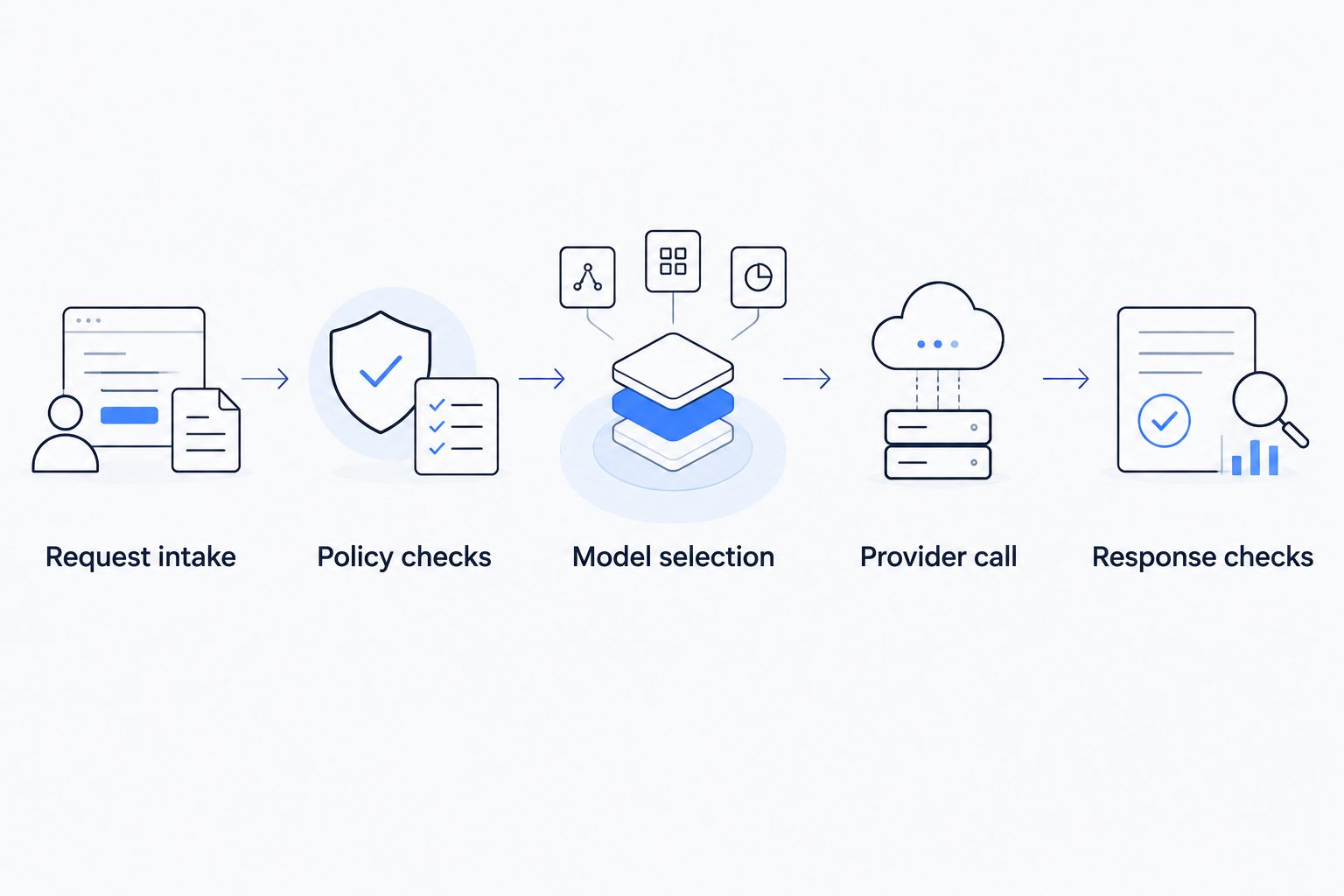
Model eligibility comes before model selection, and response validation follows the provider call.
Make routing changes reviewable. If a request produces an unexpected answer, the incident record should explain the selected route and the policy version behind it. Do not infer the route from the application’s original model field.
- Maintain eligible-model lists by workload.
- Separate hard requirements from preferences.
- Version routing policies with application releases.
- Define behavior when no eligible route exists.
- Record the selected route in diagnostic events.
Test failure behavior under real request conditions
The manual approach is an explicit retry and fallback policy in your application adapter. A gateway with automatic failover provides a shared alternative, but the acceptance test remains the same: identify which failures trigger a new attempt and what happens to the original request.
Your 2026 failure tests should distinguish a rejected request, a provider timeout, and an interrupted stream. These are different events. Retrying an invalid payload does not repair it, and restarting a partially delivered stream can confuse the consuming application.
Treat retry budgets as an application requirement. Chaining application retries, gateway retries, and provider retries without coordination creates extra attempts that are difficult to attribute. Set a total request deadline and ensure each layer respects the remaining time.
For agents, separate model retries from tool execution. A model retry must not silently repeat an external action that has already completed. Decide whether the application returns a partial result, retries safely, or surfaces an explicit failure.
- Inject timeouts and connection failures in staging.
- Test interrupted streaming responses.
- Validate fallback outputs against the same contract.
- Record attempt count and fallback reason.
- Stop attempts when the total deadline expires.
Evaluate quality across the entire route
Start with a small, reviewed evaluation set containing the tasks your application performs. Run it against the primary route and every approved fallback. Do not substitute a general benchmark for workload-specific acceptance criteria.
An AI API gateway makes model access easier to organize, but it is not a substitute for evaluation. The operational question is whether the route produces an acceptable result under the conditions your users encounter. That includes a fallback selected during a provider failure.
Separate structural checks from task checks. Valid JSON is useful when the consumer expects JSON, but it does not establish factual accuracy or successful task completion. Likewise, a fluent answer does not prove that tool arguments or citations are correct.
Record evaluation results alongside the routing configuration. When output quality changes, your team needs to distinguish a prompt change, model change, route change, and application change. A single aggregate score hides those differences.
- Include normal, ambiguous, and adversarial requests.
- Validate required output schemas.
- Evaluate primary and fallback candidates separately.
- Define human review for disputed results.
- Block routing changes that fail acceptance criteria.
Enforce access and usage accountability
The manual path is to manage application credentials, access lists, and usage records yourself. Centralizing access through a gateway changes where those controls operate; it does not decide who should receive access or what data they should send.
Create an access policy by workload and environment. A development experiment and a production service should not inherit identical permissions simply because they share a gateway. Keep the identity of the calling service visible enough to investigate usage and revoke access without disrupting unrelated applications.
Usage governance is part of Fastrouter’s stated offering. During evaluation, map that capability to your required controls rather than assuming a particular approval workflow, credential-storage design, or audit export. Verify any required BYOK behavior against your security requirements before adopting it.
Request logging needs its own policy. Observability does not require unrestricted prompt retention. Decide which metadata supports operations, which payload fields are sensitive, and where redaction must happen.
- Separate development and production identities.
- Restrict model access by workload.
- Define credential ownership and rotation procedures.
- Specify retention and redaction requirements.
- Assign usage records to accountable service owners.
Measure useful work, not just request success
Begin with application instrumentation and gateway events available to your team. Capture 3 timing measures: time to first token, total completion time, and end-to-end application time. Each answers a different operational question; do not collapse them into a single latency number.
A 2026 dashboard should connect route decisions to application outcomes. Break down usage by service, environment, selected model, and fallback status. Keep failed attempts visible so that the team can distinguish completed work from repeated work.
Measure throughput using a clearly stated workload and concurrency setting. Comparing throughput from different payload sizes, output lengths, or streaming modes produces a comparison with no stable meaning. Keep evaluation conditions beside the results.
For cost analysis, use observed usage and the applicable provider billing records. Separate primary attempts, retries, and fallbacks. Define the denominator before reporting efficiency: a valid completion, a completed task, and a raw request are not interchangeable.
- Track latency distributions rather than averages alone.
- Break down errors by route and failure type.
- Attribute retries to the initiating request.
- Compare cost against validated task completion.
- Record workload conditions with throughput results.
Roll out with an explicit rollback path
Start by replaying approved test requests in a non-production environment. If you use production-derived data, apply the same privacy and retention requirements that govern the live workload. Test traffic is not exempt from data-handling policy.
Use 2 rollout gates: contract correctness and operational acceptance. The first confirms that responses satisfy application requirements. The second confirms that deadlines, failure handling, attribution, and diagnostic records behave as intended.
Before your 2026 rollout, assign ownership for both gates and write down the rollback action. A rollback plan should identify the configuration to restore, the person authorized to restore it, and the checks that confirm recovery. Avoid a plan that depends on changing several unrelated components during an incident.
Release the gateway integration separately from major prompt or model changes. That makes regressions easier to attribute. Expand the rollout only when the pilot meets the written acceptance criteria, not simply because traffic reaches the provider.
- Replay representative requests before live migration.
- Validate contract correctness before operational acceptance.
- Keep the previous integration configuration recoverable.
- Assign an owner for rollout and rollback.
- Expand by workload after each acceptance review.
Compare the ownership models
Choose the option that matches the responsibility your team wants to retain. Direct integrations, general API proxies, and dedicated model gateways solve different parts of the problem. None replaces application-level evaluation or a written failure policy.
Option | Best for | Strength | Key limitation |
|---|---|---|---|
Direct provider SDKs | A bounded workload needing provider-specific behavior | Keeps provider controls directly in application code | Your team owns cross-provider adapters, routing, and fallback implementation |
General API proxy | Teams centralizing transport and access controls | Provides a shared boundary for API traffic | Model-specific routing and response checks require separate design |
In-house model gateway | Teams with distinct routing requirements and dedicated platform ownership | Lets the team define its own routing contract | The team maintains adapters, policy enforcement, testing, and operations |
Fastrouter AI API gateway | Teams seeking shared OpenAI-compatible access and automatic failover | Combines routing, model comparison, cost optimization, and usage governance | Workload-specific compatibility and fallback quality still require validation |
For a provider-specific application, direct integration can keep the architecture simple. For several applications sharing model access, a dedicated gateway offers a common operating boundary. The deciding question is not how many models appear in a catalog; it is whether the boundary supports your contracts and ownership model.
Ask each gateway candidate to demonstrate your acceptance tests. A feature description identifies a capability. A passing workload test establishes whether that capability meets your requirements.
Common mistakes MLOps teams make
Treating compatibility as complete equivalence
An OpenAI-compatible interface does not establish identical behavior across providers. Test the parameters, output structures, and streaming behavior your application depends on. Keep exceptions visible in the integration contract.
Approving fallbacks without task evaluation
A fallback that returns a response can still fail the task. Approve fallback routes using the same acceptance criteria as the primary route. Otherwise, failover changes the quality contract during an incident.
Allowing retries at every layer
Uncoordinated retries obscure attempt counts and request deadlines. Assign a clear retry policy across the application and gateway, then test it with failures. Record each attempt under the same initiating request.
Making governance a logging-only project
Logs describe events; access policies determine what is allowed. Define workload permissions, credential ownership, and retention rules before expanding adoption. A usage dashboard does not replace those decisions.
Changing the gateway and model simultaneously
Bundling integration, prompt, and model changes makes regressions harder to isolate. Separate the releases and compare results against a stable evaluation set. Preserve the previous configuration until the new route passes acceptance review.
FAQ
What is an AI API gateway for MLOps teams?
An AI API gateway for MLOps teams is a shared interface for routing model requests and managing access across applications. Teams use it to centralize integration behavior, failure handling, and usage accountability.
Is an AI API gateway better than direct provider SDKs?
An AI API gateway is the better fit when several workloads need shared routing and governance. Direct provider SDKs fit bounded integrations that need provider-specific controls and have clear application ownership.
Who is Fastrouter best for?
Fastrouter is best for enterprise AI development teams seeking an OpenAI-compatible gateway with routing, automatic failover, cost optimization, and usage governance. Teams should validate their request features and fallback acceptance criteria before production migration.
Does an OpenAI-compatible gateway support every provider feature?
OpenAI-compatible access does not establish support for every provider feature. Test the parameters, streaming behavior, tool calls, and response formats required by your application.
How should MLOps teams test automatic failover?
MLOps teams should inject provider failures and verify both request handling and fallback output quality. Include timeouts, interrupted streams, total deadlines, and attempt attribution in the test plan.
Can a gateway replace model evaluation?
A gateway cannot replace workload-specific model evaluation. Evaluate primary and fallback routes against the same task and output requirements before approving routing changes.
What should we measure after deploying a model gateway?
Measure latency distributions, failure types, retry counts, selected routes, and usage attributable to each workload. Connect those measurements to validated task completion rather than reporting raw request success alone.
One last thing
Make the fallback path part of the release contract. Before approving a routing change, ask an engineer to explain what happens when the preferred provider stops responding after output has begun. The answer should identify the deadline, retry behavior, response validation, and user-visible result.
If that answer exists only in someone’s memory, the gateway integration is not ready for broader rollout. Put it in the acceptance tests and incident runbook.
Related Articles

LLM gateway for e-commerce AI teams: complete 2026 guide
Choose an LLM gateway for ecommerce AI teams to centralize routing. Compare options and define failover, evaluation, usage governance, and safe business actions.

LLM router for platform engineering teams: complete 2026 guide
An llm router for platform engineering teams needs policy-first routing. Compare build and buy options, validate failover, and assign clear operational ownership.

FastRouter vs OpenAI API: which is better in 2026
Fastrouter vs OpenAI API: choose multi-provider routing or direct OpenAI access. Compare failover, governance, integration, and evaluation before you commit.