Introduction
Enterprise spend management has never been more complex. The average organization now runs across dozens of ERP systems, hundreds of supplier relationships, and — according to BetterCloud's 2025 State of SaaS report — an average of 106 SaaS tools. Yet despite this sprawl, Ardent Partners research via CPO Rising shows 29% of enterprise spend remains unmanaged, and every dollar brought under procurement management yields 6–12% in savings.
That gap is exactly what AI spend analytics software is designed to close.
The category has moved well past static dashboards and quarterly exports. In 2026, the best platforms automate spend classification, surface savings opportunities in real time, flag supplier risks, and increasingly deploy autonomous agents that act without waiting for a human to pull a report.
The global spend analytics market is projected to reach $3.63B in 2026, growing at 16.3% CAGR through 2030 — which means the vendor landscape is expanding fast and the differences between platforms are becoming harder to evaluate.
This guide breaks down the top platforms, the features that actually matter at scale, and the criteria that should drive your selection decision.
TL;DR
- 29% of enterprise spend remains unmanaged — the right AI spend analytics software closes that gap with automated classification and real-time visibility
- Top 2026 platforms deliver proactive savings recommendations, supplier risk alerts, and agentic AI workflows — not just dashboards
- SAP Ariba, Coupa, GEP Qi, Zycus, and Suplari are covered — each suited to different org sizes and procurement maturity
- Evaluate platforms on data quality, AI classification depth, implementation speed, and cross-functional fit for procurement and finance
- Most organizations recover platform costs within the first year through reduced maverick spend and stronger supplier negotiations
What Is AI Spend Analytics Software?
AI spend analytics software ingests raw expenditure data from multiple enterprise systems (ERPs, AP platforms, contract repositories) and uses machine learning to classify, clean, and categorize it. The output is actionable intelligence on spending patterns, supplier relationships, and cost-saving opportunities.
How It Differs from Traditional Spend Analysis
Legacy approaches rely on manual spreadsheet reconciliation, static quarterly reports, and fragmented ERP exports. The problems are predictable:
- Data inconsistency across systems creates conflicting numbers
- Reactive-only insights mean finance teams see problems after the fact
- Manual classification is labor-intensive and error-prone at scale
- Siloed views prevent procurement and finance from working from a single source of truth
What AI Actually Changes
AI changes the operating model entirely, moving teams from periodic reporting to continuous, forward-looking intelligence:
- Automated classification reaches 95%+ accuracy (per Suplari's platform data), replacing manual tagging
- Real-time anomaly detection flags unusual spend patterns as they occur
- Predictive analytics support forward-looking budget forecasting, not just backward-looking reports
- Agentic AI, now central to leading 2026 platforms, can initiate corrective workflows autonomously without human prompting
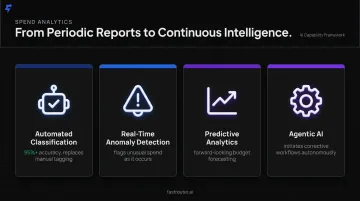
GEP describes this shift directly: their Quantum Intelligence platform is built for "real-time insights, automation, and autonomous decisions," while Suplari contrasts traditional one-off spend cubes with forward-looking, near-real-time spend intelligence.
Best AI Spend Analytics Software in 2026
These platforms were evaluated based on AI maturity, data quality, ease of implementation, analyst recognition, and ability to drive measurable procurement outcomes.
SAP Ariba (SAP Spend Intelligence)
SAP is a 2026 Gartner Magic Quadrant Leader for Source-to-Pay Suites and one of the longest-standing names in enterprise procurement. Its next-generation offering — SAP Spend Intelligence — reached general availability in July 2026. It delivers unified spend data classification, AI-generated recommendations, and integration with SAP Business AI across the full source-to-pay workflow.
For organizations already running SAP ERP infrastructure, it offers the deepest native integration available: compliance reporting, audit trails, and multi-entity data unification are all built in. The commercial model has been adjusted from previous SAP Ariba solutions; pricing is available on request.
| Attribute | Details |
|---|---|
| Key Features | Customizable spend dashboards, AI-assisted spend data unification and enrichment, AI-generated recommendations, SAP ecosystem integration, compliance reporting |
| Best Fit | Large enterprises with existing SAP ERP infrastructure and complex multi-entity organizational structures |
| Pricing / Implementation | Quote-based; Early Adopter Care launched April 2026, GA July 2026 |
Coupa
Coupa is a cloud-native spend management platform and a 2026 Gartner Magic Quadrant Leader for Source-to-Pay Suites for the third consecutive year. Its defining differentiator is community intelligence: Coupa's AI is trained on $10 trillion in anonymized transactional data, with over $8 trillion in spend analytics flowing through the platform annually.
That data scale enables benchmarking capabilities no single organization could replicate internally. Coupa also embeds an Analytics Agent, AI-powered fraud detection, and real-time monitoring into its procure-to-pay workflow. Real-world results include Bass Pro Shops gaining 100% spend visibility across billions in expenditure and The Fresh Market saving $1.8M.
| Attribute | Details |
|---|---|
| Key Features | Community-powered benchmarking ($10T data), AI spend classification, Analytics Agent, fraud detection, full procure-to-pay coverage |
| Best Fit | Mid-to-large enterprises seeking an all-in-one spend management suite with built-in benchmarking |
| Pricing / Implementation | Quote-based; professional services required |
GEP Quantum Intelligence (Qi)
GEP is a 2025 Gartner Magic Quadrant Leader for Source-to-Pay Suites, recognized for both completeness of vision and ability to execute. GEP Quantum Intelligence is already in production at 100+ enterprises processing millions of transactions monthly, built as an AI-native orchestration platform rather than an analytics layer added onto legacy architecture.
The standout feature is Qi Studio: a low-code builder that lets procurement teams compose custom agentic workflows, define integrations, and configure governance. GEP also offers managed services covering spend aggregation, normalization, and opportunity identification — giving teams the option to complement the software with hands-on expertise.
| Attribute | Details |
|---|---|
| Key Features | AI-native spend orchestration, Qi Studio (low-code agent builder), agentic workflow automation, managed services option, category intelligence |
| Best Fit | Enterprises with complex multi-category procurement needs that want both software and optional managed services expertise |
| Pricing / Implementation | Quote-based; enterprise tier positioning |
Zycus
Zycus holds Leader recognition from Gartner, Forrester, and IDC, including the 2026 Gartner Magic Quadrant for Source-to-Pay Suites and multiple Forrester Wave recognitions. Its spend analytics capabilities are anchored by the Merlin Agentic AI Platform, a low-code orchestration layer that lets admins configure autonomous agents to monitor spend, support negotiations, and handle procurement intake.
Zycus cites 1,121 APIs for integration breadth and includes GenAI negotiation agents specifically designed to surface savings from unmanaged tail spend. For teams with significant unmanaged tail spend, that targeted automation can translate directly into recoverable savings.
| Attribute | Details |
|---|---|
| Key Features | Merlin Agentic AI Platform, 1,121 APIs, autonomous negotiation agents, GenAI savings identification, spend classification, supplier management |
| Best Fit | Organizations seeking agentic AI capabilities across the full source-to-pay lifecycle with broad integration requirements |
| Pricing / Implementation | Quote-based; Gartner/Forrester/IDC recognized |
Suplari
Suplari has been building AI-powered spend analytics since its founding in 2017, earlier than most competitors. In 2026 it was named a Hackett Group Top Tech for Spend Analytics and received Hackett's Validated designation. Unlike the full-suite vendors above, Suplari focuses specifically on spend analytics and procurement intelligence.
Key proof points: 95%+ classification accuracy and a typical 90-day deployment timeline, faster than most enterprise alternatives. The 2026 launch of AI Studio allows procurement teams to build custom agents without code, covering contract compliance monitoring, anomaly detection, and savings verification through Worker Agents. Natural language spend queries remove the BI dependency for day-to-day analysis.
| Attribute | Details |
|---|---|
| Key Features | AI Worker Agents (anomaly detection, contract intelligence, savings tracking), AI Studio (no-code agent building), 95%+ classification accuracy, natural language queries |
| Best Fit | Enterprise procurement teams prioritizing AI-native spend intelligence and speed to value over a full suite |
| Pricing / Implementation | Competitively priced per customer feedback; typical 90-day deployment |
Key Features to Look for in AI Spend Analytics Software
Data Quality and Integration
No AI model produces reliable outputs from unreliable inputs. When evaluating platforms, look for:
- Automated supplier name normalization (deduplicating "IBM," "I.B.M.," and "IBM Corp." into one record)
- Multi-source reconciliation across ERP, AP, and contract systems
- Multi-currency and multi-entity handling without manual intervention
- Ongoing data enrichment, not just a one-time cleanse at implementation
AI Classification Depth
Classification accuracy determines whether the insights downstream are trustworthy. Evaluate:
- Accuracy rates (Suplari's verified claim of 95%+ is a useful benchmark)
- Ability to handle new or unusual spend categories without manual correction
- Continuous learning from new transactions over time
- Alignment with your organization's specific taxonomy, not just a generic UNSPSC mapping
Proactive Intelligence vs. Reactive Reporting
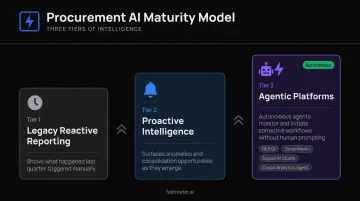
In 2026, the most meaningful divide in spend analytics is not visualization quality. It's whether the platform waits to be asked or acts on its own.
Most legacy tools are purely reactive — they show what happened last quarter once someone opens a report. A step up are proactive platforms that surface anomalies and consolidation opportunities as they emerge, rather than after the fact. At the leading edge, agentic platforms — including GEP Qi, Zycus Merlin, Suplari AI Studio, and Coupa Analytics Agent — go further still: autonomous agents monitor spend continuously and initiate corrective workflows without waiting for a human to trigger anything.
Implementation Speed and Time-to-Value
Legacy enterprise implementations routinely run 12–18 months before usable results appear. That timeline kills executive momentum and delays ROI. When evaluating:
- Ask for proof-of-value milestones, not just go-live dates
- Look for pre-built dashboards that deliver day-one visibility
- Compare automated data enrichment capabilities — manual data prep extends timelines significantly
- Suplari's 90-day deployment is the only vendor-specific timeline verified from official sources; treat other vendor timeline claims skeptically until confirmed in reference calls
How We Chose the Best AI Spend Analytics Software
Evaluation Criteria
These platforms were assessed across five dimensions:
- AI maturity — classification accuracy, real-time anomaly detection, agentic capabilities
- Spend visibility depth — breadth of data sources, taxonomy quality, multi-entity handling
- Analyst recognition — Gartner, Forrester, Hackett Group designations in 2025–2026
- Deployment scale — customer base size and real-world production evidence
- Dual-team utility — whether both procurement and finance users can work from the same platform
Common Buyer Mistakes to Avoid
Procurement teams frequently make avoidable errors when selecting spend analytics tools:
- Choosing on UI alone without validating the underlying data quality engine
- Selecting a full suite when a specialized analytics platform may deliver faster, better-focused ROI
- Underestimating implementation complexity — integrating multiple ERPs and AP systems is rarely as simple as vendors suggest
- Ignoring finance use cases — if the platform doesn't support budget variance analysis and spend forecasting alongside procurement workflows, it will create the same data silos it was meant to eliminate
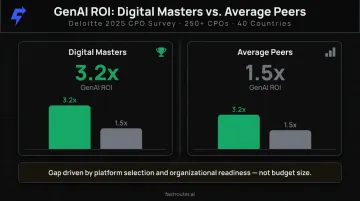
These mistakes carry measurable costs. Deloitte's 2025 CPO Survey of 250+ CPOs across 40 countries found that Digital Masters — organizations with mature procurement technology investment — achieved 3.2x GenAI ROI versus peers at slightly above 1.5x. Platform selection and organizational readiness drove that gap, not budget size.
On Pricing as a Selection Criterion
None of the five platforms publish list pricing — all use quote-based commercial models. That's worth accepting, because the ROI math typically renders platform cost secondary. Consider: 29% of enterprise spend typically goes unmanaged. Each dollar brought under management yields 6–12% in savings. For a mid-sized organization managing $500M in spend, that's $30–90M in potential annual savings — a figure that makes platform licensing look like rounding error.
Conclusion
Choosing the right AI spend analytics software in 2026 is less about brand recognition and more about fit: does the platform's AI maturity match your procurement stage? Does it serve finance as well as procurement? Will it deliver usable spend intelligence in weeks, or months?
The five platforms covered here — SAP Ariba, Coupa, GEP Qi, Zycus, and Suplari — each solve the problem differently. Full-suite vendors like SAP and Coupa offer broad S2P coverage with deep integration. AI-native platforms like GEP Qi and Suplari prioritize intelligence depth and deployment speed. Zycus bridges both with strong agentic capabilities and broad recognition.
The one mistake that cuts across all of them: selecting a tool that serves either procurement or finance well, but not both. Spend analytics exists to create a single source of truth — pick a platform that actually delivers one.
The platforms above sit on top of AI infrastructure — and that layer matters too. If your engineering or product team is building the LLM workflows that power spend classification or autonomous procurement agents, FastRouter provides the routing, cost governance, and observability to run them reliably across providers. Get started for free or book a demo to see how it fits into your stack.
Frequently Asked Questions
What is spend analysis software?
Spend analysis software collects, cleans, categorizes, and analyzes an organization's expenditure data from multiple systems — ERP, AP, procurement platforms — to give procurement and finance teams a clear picture of where money is going. The goal is to identify savings opportunities, reduce maverick spend, and support smarter supplier decisions.
What can AI be used for in procurement and spend analysis?
AI handles automated spend classification, real-time anomaly detection, supplier risk scoring, predictive spend forecasting, and savings opportunity identification. In 2026, agentic AI takes this further — autonomous agents can monitor spend continuously and initiate corrective workflows without human prompting.
Can AI spend analytics platforms connect to my existing systems?
Yes. Modern platforms connect to existing ERP, AP, and procurement systems, automatically normalize and classify transactions, and deliver insights across all spend categories. Most support multi-source reconciliation with no manual data preparation required.
What is the best AI spend analytics platform for procurement?
The best platform depends on organizational size, existing infrastructure, and whether you need a full source-to-pay suite or a specialized analytics tool. SAP Ariba, Coupa, GEP Qi, Zycus, and Suplari are all leading 2026 options — each with distinct strengths covered in detail above.
How long does it take to implement spend analytics software?
Legacy enterprise platforms can take 12–18 months to deliver actionable insights; AI-native tools like Suplari typically deploy in around 90 days via pre-built dashboards and automated data enrichment. Verify timelines in reference calls, not just vendor materials.
How much does AI spend analytics software cost?
All five platforms use quote-based pricing — no public list prices exist. The more useful lens is ROI: every dollar brought under procurement management typically yields 6–12% in savings, and returns generally exceed platform costs within the first year.