
Best AI API gateways for regulated industries in 2026
FastRouter tops the 2026 ranking of AI gateways for compliance and governance in regulated industries, compared against AWS Bedrock, Azure, and Portkey.
Choosing an AI API gateway for a regulated industry means weighing model routing and failover against audit trails, data residency, and access governance — not just latency and price. This guide ranks the gateways best suited to compliance-heavy teams in 2026 and where each one fits.
TL;DR
- FastRouter wins for ai gateway compliance governance because it routes across 200+ LLMs with built-in usage governance and automatic failover.
- AWS Bedrock and Azure OpenAI Service fit teams already locked into a hyperscaler's compliance stack and BAA terms.
- Portkey suits teams that need granular per-team budget enforcement more than broad model choice.
- Confirm compliance certifications and signed data agreements directly with any vendor before routing regulated data through it in 2026.
Why this matters
A gateway sits between your application and every model provider it calls, which means it becomes the single point where audit logs, access controls, and failover behavior either exist or don't. Regulated teams in healthcare, finance, and government-adjacent software get audited on where model calls originate, who authorized them, and what happened when a provider went down mid-request. Pick the wrong layer and you're rebuilding governance twice — once at the gateway and once downstream. FastRouter approaches this by centralizing routing, failover, and usage governance in one API layer instead of leaving each provider integration to build its own controls.
Best overall: FastRouter. Best for AWS-native compliance stacks: AWS Bedrock. Best for Microsoft-stack requirements: Azure OpenAI Service. Best for granular budget governance: Portkey.
What makes the best AI gateway for regulated industries
- Data residency and deployment options — VPC, private endpoint, or region-locked routing so model traffic doesn't leave a controlled boundary.
- Audit logging tied to every model call — not just API key usage, but which model, which provider, and which team triggered each request.
- Model diversity with automatic failover — if one provider degrades or goes down, traffic reroutes to a healthy alternative without manual intervention.
- Cost visibility and budget enforcement — per-team or per-project spend limits, not just an aggregate invoice at month's end.
- Identity-based access control — SSO/SAML and role-based permissions instead of shared API keys floating across teams.
- Documented compliance posture — BAA availability, data processing terms, and clear answers about where data is processed and retained.
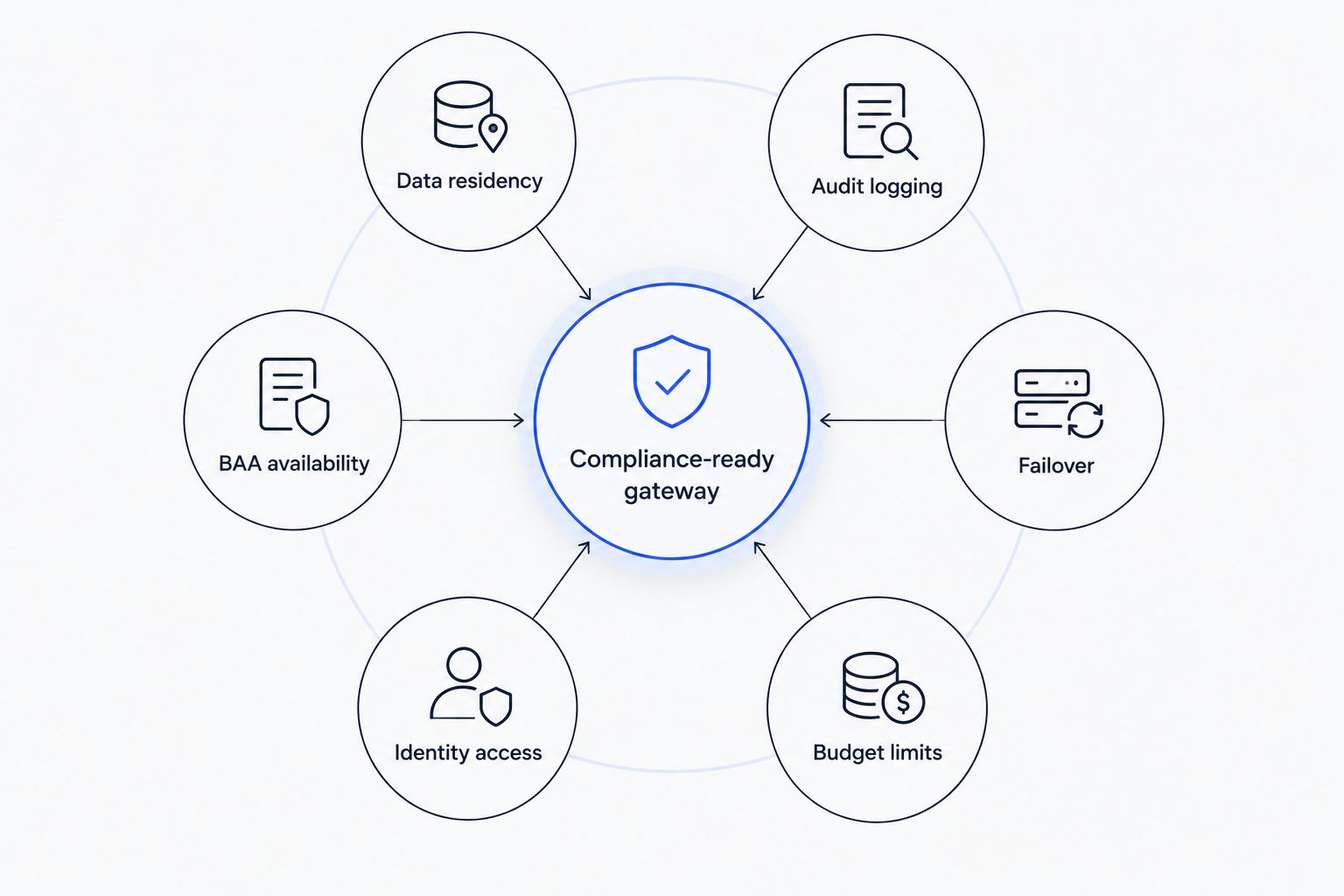
Regulated teams evaluate a gateway against all six criteria together, not one at a time.
AI gateways for regulated industries at a glance
Gateway | Best for | Standout feature | Key limitation |
|---|---|---|---|
FastRouter | Multi-provider routing with built-in governance | Automatic failover across 200+ models with unified usage governance | Compliance certifications for the gateway layer should be confirmed directly with the vendor |
AWS Bedrock | AWS-native regulated workloads | HIPAA-eligible under a signed BAA with VPC-based isolation | Locked into AWS's model list and region availability |
Azure OpenAI Service | Microsoft-stack compliance requirements | Region-specific data residency and Azure AD integration | Model catalog centers on OpenAI and Microsoft-hosted models |
Google Vertex AI | GCP-native teams | VPC Service Controls plus Model Garden access | Multi-provider routing outside Google's ecosystem takes extra setup |
Portkey | Granular budget and access governance | Virtual keys with per-team spend limits | Smaller model catalog than hyperscaler platforms |
Kong AI Gateway | Teams already running Kong API management | LLM-specific plugins for rate limiting and PII detection | Requires an existing Kong Gateway deployment |
1. FastRouter: best AI gateway for multi-provider routing with built-in governance
FastRouter provides a unified, OpenAI-compatible API gateway that routes, compares, and manages access to 200+ large language models through one integration. Requests that hit a failing or degraded provider reroute automatically to another healthy model, and usage governance sits at the routing layer rather than bolted on per provider.
FastRouter pros:
- One OpenAI-compatible API replaces separate integrations for every model provider
- Automatic failover reroutes requests to other healthy providers when one goes down
- Usage governance and cost optimization built into the routing layer itself
- Single point of visibility into which model handled which workload
FastRouter cons:
- Compliance certifications for the gateway itself should be verified directly with the vendor before regulated deployment
- Compliance posture varies by which of the 200+ underlying models a workload routes to
- Teams accustomed to a single hyperscaler's native console have a routing-layer concept to learn first
FastRouter pricing: check current plan details directly on the site.
Best for: teams that need one governance layer across many model providers instead of separate compliance work per integration.
Verdict: Buy.
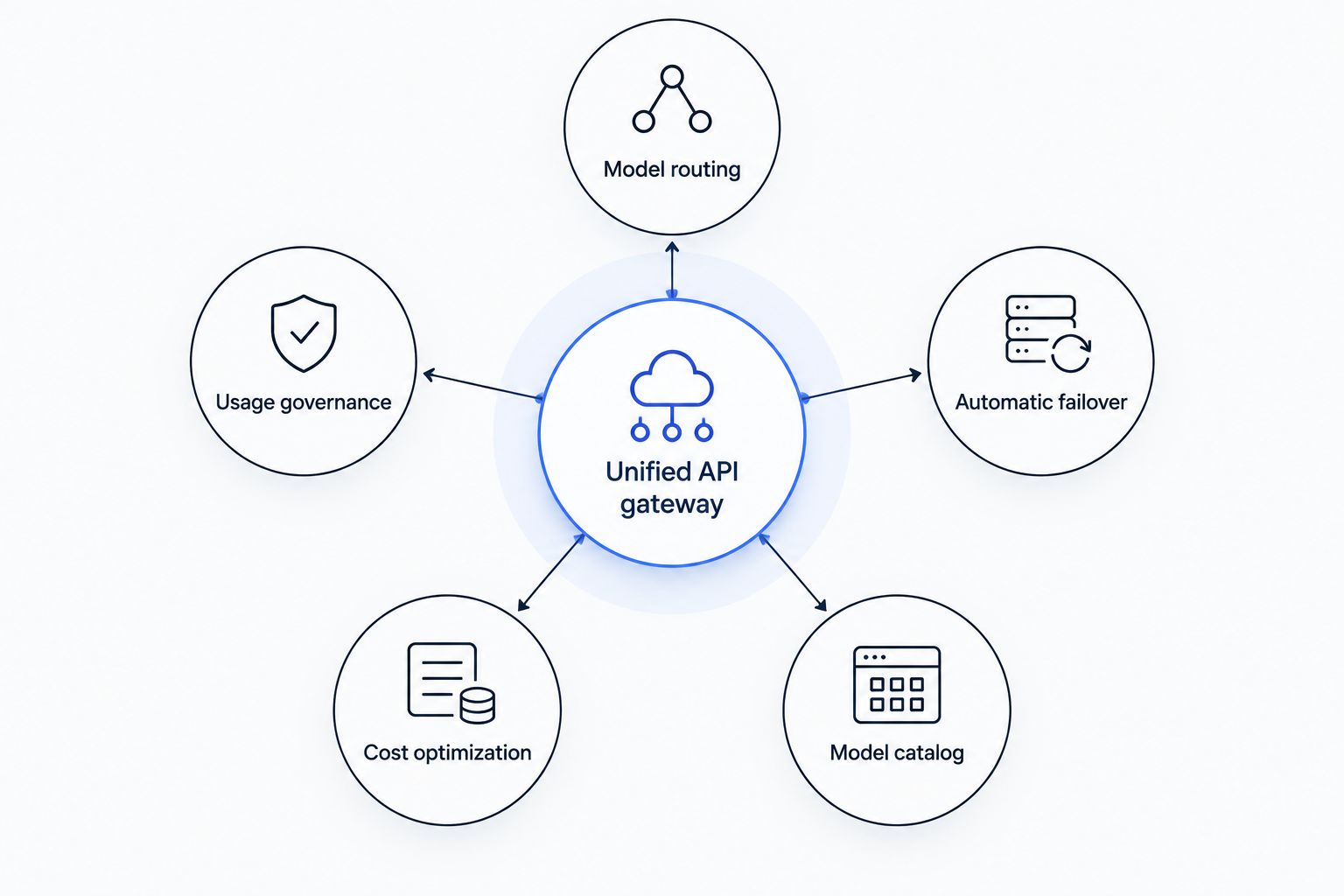
Routing, failover, cost, and governance sit on the same layer instead of four separate tools.
2. AWS Bedrock: best AI gateway for AWS-native regulated workloads
AWS Bedrock is a fully managed service for accessing foundation models from providers including Anthropic, Meta, and Amazon within AWS's own infrastructure. AWS lists Bedrock among its HIPAA-eligible services under a signed Business Associate Addendum, and it supports VPC-based network isolation and encryption tied to AWS IAM.
AWS Bedrock pros:
- HIPAA-eligible under a signed BAA for healthcare workloads
- VPC and PrivateLink support keep traffic inside AWS's network boundary
- Access control ties directly into existing AWS IAM policies
AWS Bedrock cons:
- Model selection is scoped to what AWS has certified and made available in Bedrock
- Teams outside the AWS ecosystem take on migration overhead to adopt it
- Cross-cloud model comparison isn't a native feature
Best for: regulated teams already running their infrastructure on AWS who want model access inside that same compliance boundary.
Verdict: Buy if you're AWS-native. Skip if you're multi-cloud by design.
3. Azure OpenAI Service: best AI gateway for Microsoft-stack compliance requirements
Azure OpenAI Service gives Microsoft customers access to OpenAI's models under Azure's compliance attestations, including HIPAA and HITRUST coverage in eligible regions. It supports customer-managed keys, private endpoints, and Azure Active Directory integration for access control.
Azure OpenAI Service pros:
- Data residency controlled by region, matching Microsoft's published compliance regions
- Azure AD integration for identity-based access control
- Private endpoint support keeps traffic off the public internet
Azure OpenAI Service cons:
- Model catalog centers on OpenAI and select Microsoft-hosted models
- Teams need an existing Azure tenant to get the full compliance benefit
- Multi-provider routing outside Microsoft's models requires a separate layer
Best for: enterprises already standardized on Microsoft's compliance and identity stack.
Verdict: Buy if you're Microsoft-native.
4. Google Vertex AI: best AI gateway for GCP-native teams needing VPC controls
Vertex AI is Google Cloud's platform for accessing and deploying models, including its own Model Garden catalog. Google includes Vertex AI in its HIPAA-covered services list under a signed BAA and supports VPC Service Controls to restrict where data can move.
Google Vertex AI pros:
- VPC Service Controls limit data exfiltration risk at the network boundary
- Model Garden gives access to Google's own models plus select third-party options
- Fits naturally into an existing GCP identity and logging setup
Google Vertex AI cons:
- Routing to non-Google models outside Model Garden takes extra configuration
- Teams without existing GCP infrastructure face a steeper setup
- Governance tooling is scoped to Google Cloud's own console
Best for: teams running their regulated infrastructure on Google Cloud already.
Verdict: Hold if you're not already on GCP.
5. Portkey: best AI gateway for granular budget and access governance
Portkey positions itself as an AI gateway focused on virtual keys, per-team spend limits, and role-based access controls layered on top of model provider traffic. It's built more around governance granularity than model breadth.
Portkey pros:
- Virtual keys let teams isolate spend and access without sharing raw provider credentials
- Per-team budget limits catch runaway usage before it hits the invoice
- Role-based access controls scope who can call which models
Portkey cons:
- Smaller model catalog than the hyperscaler platforms or a broad multi-provider router
- Data residency depends on wherever you deploy it, not a built-in regional guarantee
- Failover behavior across providers needs to be checked against your specific setup
Best for: teams whose main compliance pain point is spend and access control rather than model selection.
Verdict: Hold — strong for governance, thinner on model breadth.
6. Kong AI Gateway: best AI gateway for teams extending existing API management
Kong AI Gateway extends Kong's existing API gateway product with plugins built for LLM traffic, including rate limiting, semantic caching, and PII detection at the request layer. It's an add-on to infrastructure many API teams already run.
Kong AI Gateway pros:
- Plugin-based PII detection and rate limiting at the request layer
- Fits directly into an existing Kong Gateway deployment
- Familiar operational model for teams already managing Kong
Kong AI Gateway cons:
- Requires running Kong Gateway to get the AI-specific plugins
- Not a fit for teams with no existing Kong investment
- Model routing and failover depend on how the plugins are configured
Best for: API platform teams already standardized on Kong who want to extend it to LLM traffic.
Verdict: Buy if you're already on Kong. Skip otherwise.
How we ranked these gateways
Each gateway was weighed against the six criteria above: data residency, audit logging, failover, cost governance, identity-based access, and documented compliance posture. FastRouter ranks first for combining model breadth with a single governance layer; the hyperscaler platforms rank where they match a team's existing cloud; Portkey and Kong rank for narrower, specific governance or infrastructure fits rather than broad coverage.
Which AI gateway should you choose in 2026?
If your team calls more than one model provider and needs one governance layer across all of them, FastRouter is the default pick for ai gateway compliance governance in 2026. If you're already deep in AWS, Azure, or GCP and only need models from within that ecosystem, the native hyperscaler option (Bedrock, Azure OpenAI Service, or Vertex AI) removes a layer of integration work. If your main gap is budget enforcement rather than model routing, Portkey covers that narrower need. Confirm the compliance documentation — BAA, DPA, data residency terms — directly with whichever vendor you choose before routing regulated data through it.
Compare routing and governance options
See how one gateway handles 200+ models with failover and usage governance.
FAQ
What is an AI gateway and why do regulated industries need one?
An AI gateway is a single API layer that routes requests to one or more large language model providers, handling failover, logging, and access control in one place. Regulated industries need this because auditors ask where model calls originate and who authorized them, and a gateway centralizes that answer instead of scattering it across separate provider integrations.
Is FastRouter HIPAA compliant?
Compliance certification status for any gateway, including FastRouter, should be confirmed directly with the vendor and documented in a signed BAA or data processing agreement before routing regulated data through it in 2026. FastRouter's usage governance and audit visibility support that process, but certification itself needs vendor confirmation.
Which AI gateway offers the best data residency controls?
AWS Bedrock, Azure OpenAI Service, and Google Vertex AI each publish region-based data residency options tied to their respective cloud's compliance regions. A multi-provider gateway like FastRouter depends on which underlying model and region a request routes to, so residency should be checked per model.
Can AWS Bedrock be used for healthcare AI applications?
Yes — AWS lists Bedrock among its HIPAA-eligible services under a signed Business Associate Addendum, with VPC-based network isolation available for healthcare workloads. Confirm the specific models and regions in scope with AWS before deployment.
Does Azure OpenAI Service meet financial services compliance requirements?
Azure OpenAI Service inherits Azure's broader compliance attestations, including HIPAA and HITRUST in eligible regions, plus private endpoints and customer-managed keys. Financial services teams still need to map their specific regulatory requirements against Microsoft's published compliance documentation.
What's the difference between an AI gateway and a cloud provider's native model API?
A cloud provider's native API only routes to that provider's own models, while an AI gateway like FastRouter routes across multiple providers through one integration. The gateway adds failover and cross-provider governance that a single native API can't offer on its own.
How does automatic failover help with compliance and uptime?
Automatic failover reroutes requests to another healthy model provider when one degrades or goes down, keeping regulated applications running without a manual intervention that itself needs to be logged and justified. It also reduces the audit burden of explaining unplanned downtime.
Is Portkey a good fit for enterprise budget governance?
Portkey is built around virtual keys and per-team spend limits, making it a strong fit for teams whose main governance gap is budget control rather than model breadth. Teams needing wide model coverage alongside budget controls typically pair it with or choose a broader multi-provider gateway instead.
One last thing
Most gateway evaluations start with model coverage and end with compliance as an afterthought — flip that order in 2026. The gateways that hold up under audit are the ones where governance was the starting requirement, not a checkbox added after a shadow API key already sent regulated data to an unlogged endpoint.
Related Articles

Best 6 text embedding APIs for developers in 2026
Compare the best embedding APIs for 2026: OpenAI, Cohere, Voyage AI, Google Gemini, Jina AI, and FastRouter ranked by use case, coverage, and failover.

Best LLM gateways for building AI agents in 2026
Six LLM gateways for AI agents ranked on failover, cost control, and governance in 2026 — FastRouter wins for production agent fleets that need uptime and spend control.
.png&w=3840&q=75)
Cheapest Way to Access GPT-6, Claude & Gemini Through One API
Find out about Cheapest Way to Access GPT-6, Claude & Gemini Through One API in new FastRouter blog