
Best LLM gateways for building AI agents in 2026
Six LLM gateways for AI agents ranked on failover, cost control, and governance in 2026 — FastRouter wins for production agent fleets that need uptime and spend control.
Choosing the wrong LLM gateway for AI agents means rebuilding your routing layer six months into production, right when your agent fleet is scaling. This guide ranks six gateways on the criteria that actually matter for agent workloads: failover depth, cost control, latency routing, and governance.
TL;DR
- FastRouter is the best LLM gateway for AI agents that need automatic failover and spend governance across 200+ models.
- OpenRouter wins for solo developers who want fast, low-friction access to new models without enterprise overhead.
- Portkey is the pick for teams that need prompt-level observability and guardrails layered on top of routing.
- LiteLLM suits teams that want a self-hosted, open-source proxy and full control over infrastructure.
- Kong AI Gateway and Cloudflare AI Gateway extend existing API or edge infrastructure rather than replacing it.
Why this matters
An AI agent that calls a single hardcoded model breaks the moment that provider has an outage, raises prices, or deprecates the endpoint. Agents run multi-step chains, and one failed call can waste an entire session's worth of tokens.
An LLM gateway for AI agents sits between your application code and the model providers, giving you one API surface, automatic failover when a provider degrades, and a single place to enforce spend and access policy. In 2026, with agent workloads calling models dozens of times per task, that layer stops being optional infrastructure and starts being the thing that decides whether your uptime numbers hold.
What makes the best LLM gateway for AI agents
- Multi-provider routing and failover — reroutes requests automatically when a model or provider goes down
- Cost optimization — routes to the cheapest model that meets a quality bar, or flags spend anomalies
- Latency-aware routing — picks the fastest healthy endpoint instead of a fixed default
- Usage governance — per-team, per-key, or per-project limits and access controls
- Observability — logs, traces, and cost breakdowns per request
- BYOK support — the option to route through your own provider keys instead of the gateway's
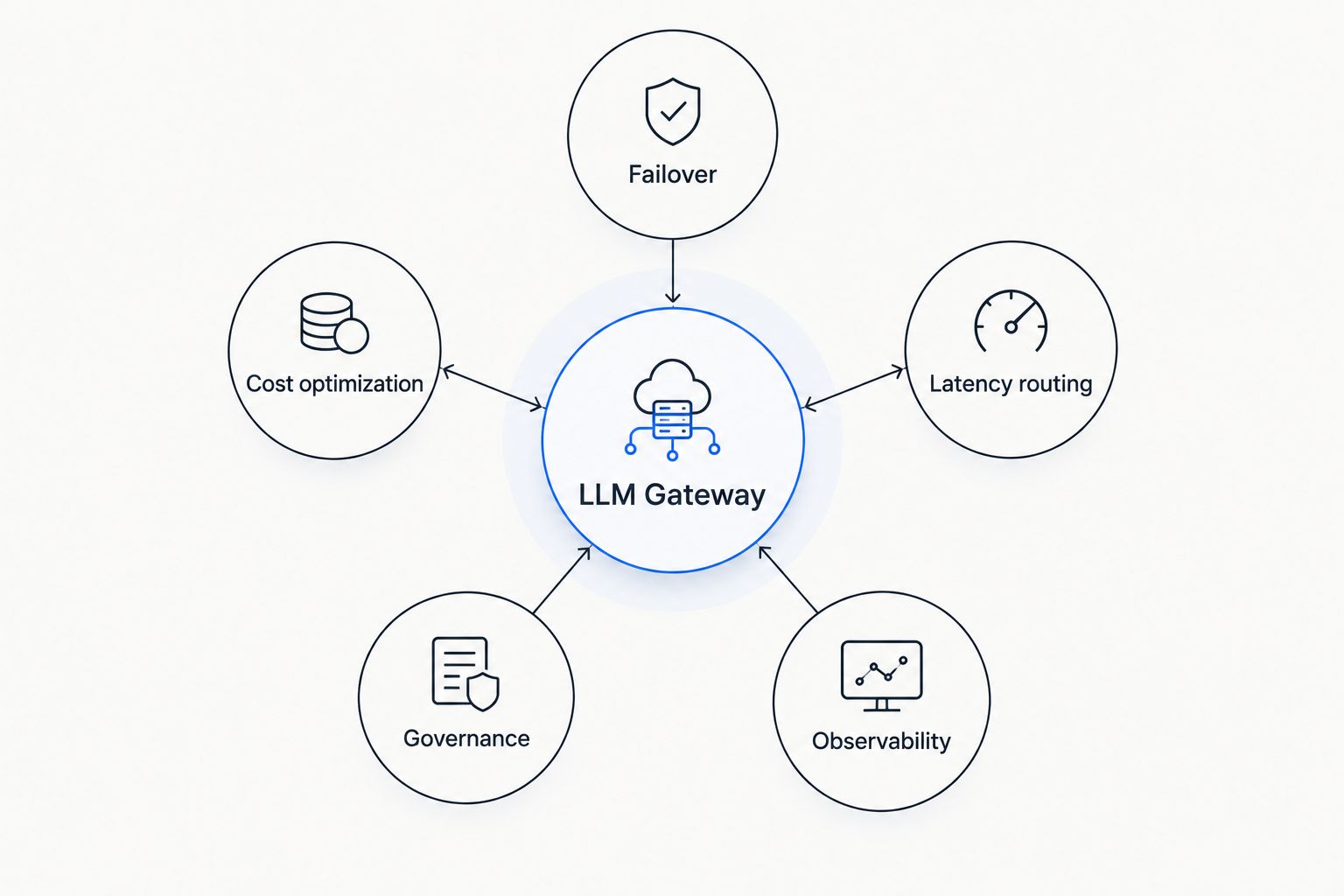
Every gateway on this list covers some of these five functions — few cover all five.
LLM gateways for AI agents: at a glance
Gateway | Best for | Standout feature | Key limitation |
|---|---|---|---|
FastRouter | Enterprise agent fleets needing governance | Automatic failover across 200+ models via one OpenAI-compatible API | Enterprise feature depth is more than a single-developer prototype needs |
OpenRouter | Fast model experimentation | Broad marketplace access to many providers under one key | Governance and per-team spend controls are limited |
Portkey | Prompt observability and guardrails | Request-level logging and guardrail policies | Routing/failover sits behind its observability focus |
LiteLLM | Self-hosted, open-source control | Proxies 100+ LLM providers through one interface you run | You own uptime, scaling, and patching |
Kong AI Gateway | Teams already running Kong | AI routing as a plugin on existing Kong API infrastructure | Adds little value outside a Kong deployment |
Cloudflare AI Gateway | Edge caching and request analytics | Caching and rate limiting in front of AI API calls | Not built as a primary failover/routing layer |
1. FastRouter: best LLM gateway for AI agents that need governance and failover
FastRouter provides a unified, OpenAI-compatible API gateway that routes, compares, and manages access to 200+ large language models with automatic failover, cost optimization, and usage governance. For agent workloads, that means one integration point instead of separate SDKs per provider, and a policy layer that catches runaway spend before it hits a monthly bill.
FastRouter pros:
- Automatic failover across 200+ models means one provider outage doesn't stall an agent chain
- OpenAI-compatible API means existing agent code migrates without a rewrite
- Usage governance gives per-team and per-key spend limits
- Cost optimization routes requests toward the model that fits the task without manual switching
FastRouter cons:
- Enterprise governance features add setup steps a solo prototype doesn't need
- Teams already deep in a single-provider SDK face a short migration to adopt the unified API
FastRouter is best for: engineering teams running production AI agents across multiple teams or products that need one governance layer instead of five provider dashboards.
Verdict: Buy for teams running agents in production that need failover and spend control in the same place. Explore FastRouter directly to see the current model list and routing setup.
2. OpenRouter: best LLM gateway for AI agents in early prototyping
OpenRouter is a marketplace-style API that gives developers access to a wide range of models from multiple providers under one key. It's built for speed of access rather than enterprise policy enforcement.
OpenRouter pros:
- Fast signup and integration for testing new models
- Broad provider coverage under a single API key
- Pay-as-you-go access without a procurement process
OpenRouter cons:
- Governance and per-team access controls are limited compared to enterprise-focused gateways
- Cost and usage reporting is thinner than dedicated governance tooling
OpenRouter is best for: solo developers and small teams prototyping an agent before deciding on production infrastructure.
Verdict: Buy for prototyping, Hold before scaling a multi-team agent deployment on it alone.
3. Portkey: best LLM gateway for AI agents that need prompt observability
Portkey positions itself as a gateway layer with request logging, guardrails, and caching on top of model routing. For teams whose agents fail silently — a bad output that isn't an error but is still wrong — that observability layer catches what a plain router misses.
Portkey pros:
- Request-level logging makes debugging agent chains easier
- Guardrail policies can block or flag risky outputs before they reach a user
- Caching reduces repeat-call cost on deterministic prompts
Portkey cons:
- Routing and failover depth take a back seat to the observability tooling
- Teams whose main need is raw failover coverage may find the feature set heavier than necessary
Portkey is best for: teams shipping agents to end users where output quality monitoring matters as much as uptime.
Verdict: Buy if guardrails and logging are the priority; Hold if failover breadth is the main requirement.
4. LiteLLM: best LLM gateway for AI agents run on self-hosted infrastructure
LiteLLM is an open-source proxy that supports 100+ LLM providers through a single interface you deploy and manage yourself. Teams that need full control over where requests are logged and processed — for compliance or infrastructure reasons — often start here.
LiteLLM pros:
- Open source, so the routing logic is inspectable and modifiable
- Supports 100+ providers through one proxy interface
- No dependency on a third-party hosted service for the routing layer itself
LiteLLM cons:
- Self-hosting means your team owns uptime, scaling, and patching
- Enterprise governance features require more manual configuration than a hosted gateway
LiteLLM is best for: teams with existing infrastructure capacity that want a self-hosted routing layer under full internal control.
Verdict: Buy if you have the ops capacity to run it; Skip if you'd rather not operate another service.
5. Kong AI Gateway: best LLM gateway for AI agents on existing Kong infrastructure
Kong AI Gateway extends the Kong API Gateway with AI routing plugins. It fits teams that already route their API traffic through Kong and want AI calls to pass through the same control plane.
Kong AI Gateway pros:
- Integrates with an existing Kong deployment without a separate system to manage
- Familiar plugin architecture for teams already on Kong
Kong AI Gateway cons:
- Adds limited value for teams not already running Kong
- Not designed as a standalone AI-first gateway for greenfield agent projects
Kong AI Gateway is best for: platform teams with Kong already in production who want AI traffic under the same policy layer as their other APIs.
Verdict: Buy if Kong is already your API layer; Skip for a new, AI-only stack.
6. Cloudflare AI Gateway: best LLM gateway for AI agents needing edge caching
Cloudflare AI Gateway sits in front of AI API calls at the edge, adding caching, analytics, and rate limiting. It's positioned as a proxy and observability layer more than a full multi-model routing and failover system.
Cloudflare AI Gateway pros:
- Edge caching reduces repeat-call latency and cost on identical requests
- Built-in analytics on request volume and cost
- Rate limiting protects against runaway agent loops
Cloudflare AI Gateway cons:
- Model routing and failover depth is not the core focus
- Best paired with a dedicated routing gateway rather than used alone for multi-provider failover
Cloudflare AI Gateway is best for: teams that already run traffic through Cloudflare and want caching and analytics on AI calls with minimal added infrastructure.
Verdict: Buy as a caching/analytics layer; Hold as your only routing solution.
How we ranked these six gateways
Each entry was measured against the six criteria above: failover depth, cost optimization, latency routing, governance, observability, and BYOK support. No pricing or throughput claims are included because none were independently verified at the time of writing — check each vendor's own documentation for current specs before committing.
Compare FastRouter for your agent stack
See routing, failover, and governance in one API.
Which LLM gateway should you choose for AI agents in 2026?
If your agents run in production across more than one team and a provider outage would show up in your uptime numbers, FastRouter is the default pick — automatic failover across 200+ models and usage governance in one OpenAI-compatible API cover the two failure modes that hurt most: downtime and untracked spend.
If you're still prototyping solo, start with OpenRouter and move to a governance-focused gateway once the agent hits real users. If compliance requires self-hosting, LiteLLM is the direct route. Kong AI Gateway and Cloudflare AI Gateway make sense as add-ons to infrastructure you already run, not as your first gateway decision in 2026.
FAQ
What is an LLM gateway for AI agents?
An LLM gateway for AI agents is a routing layer between your agent code and model providers that handles failover, cost control, and access governance through one API. It replaces separate SDK integrations for each provider with a single unified interface.
Is FastRouter better than OpenRouter for AI agents?
FastRouter is built for teams that need governance and automatic failover across 200+ models in production; OpenRouter is built for fast access to models during prototyping. The right choice depends on whether you need enterprise spend controls or just fast model access.
Do I need a gateway for a single-model agent?
A single-model, low-volume agent can run directly against one provider's API without a gateway. Once that agent scales to multiple teams, higher call volume, or production uptime requirements, a gateway's failover and governance layer becomes necessary.
What's the difference between an LLM gateway and an LLM router?
A router typically just picks which model handles a request; a gateway adds governance, observability, and failover on top of routing. Most products called "gateways" in 2026 include routing as one feature among several.
Can I self-host an LLM gateway?
Yes — LiteLLM is an open-source option built to be self-hosted and gives you full control over the proxy layer. Self-hosting trades a managed service for direct responsibility over uptime and scaling.
Does an LLM gateway add latency to agent calls?
A gateway adds a network hop, but latency-aware routing can offset that by picking the fastest healthy endpoint instead of a fixed default. Actual impact depends on the gateway's own infrastructure and is worth testing against your specific call pattern.
How does failover work in an LLM gateway?
Failover detects when a provider or model is degraded or down and automatically reroutes the request to a healthy alternative, often based on a prioritized fallback list you define. This keeps an agent chain from stalling on a single provider outage.
Is BYOK required to use an LLM gateway?
No — most gateways, including FastRouter, support both routing through the gateway's own provider relationships and BYOK (bring your own key) setups. BYOK matters most for teams that need to keep billing or compliance under their own provider accounts.
One last thing
The gateway decision that actually breaks agent deployments in 2026 isn't which model list is longer — it's whether the failover list is defined before the first outage, not during it. Set your fallback priority order at integration time, not as an incident-response task.
Related Articles

Best AI API gateways for regulated industries in 2026
FastRouter tops the 2026 ranking of AI gateways for compliance and governance in regulated industries, compared against AWS Bedrock, Azure, and Portkey.

Best 6 text embedding APIs for developers in 2026
Compare the best embedding APIs for 2026: OpenAI, Cohere, Voyage AI, Google Gemini, Jina AI, and FastRouter ranked by use case, coverage, and failover.
.png&w=3840&q=75)
Cheapest Way to Access GPT-6, Claude & Gemini Through One API
Find out about Cheapest Way to Access GPT-6, Claude & Gemini Through One API in new FastRouter blog