
Best 6 text embedding APIs for developers in 2026
Compare the best embedding APIs for 2026: OpenAI, Cohere, Voyage AI, Google Gemini, Jina AI, and FastRouter ranked by use case, coverage, and failover.
Best overall embedding API for 2026: OpenAI's text-embedding-3-large for general-purpose semantic search. Best for unified multi-provider access with automatic failover: FastRouter, which routes embedding calls to 200+ models through one OpenAI-compatible endpoint. Best for multilingual enterprise search: Cohere Embed. Best for RAG-optimized domain retrieval: Voyage AI. Best for Google Cloud-native stacks: Google's Gemini embedding models. Best for open, self-hostable deployments: Jina AI Embeddings.
TL;DR
- OpenAI text-embedding-3-large is the safest default embedding API for 2026 general-purpose search.
- FastRouter routes embedding calls to 200+ models through one endpoint, adding failover without re-architecting your stack.
- Cohere Embed and Jina AI cover multilingual and self-hosted use cases OpenAI does not target.
- Voyage AI and Google's Gemini embeddings fit domain-specific retrieval and Google Cloud-native pipelines.
- No single embedding API wins every use case — the right pick depends on context length, language coverage, and failover needs.
Why this matters
An embedding API turns text into vectors that power semantic search, retrieval-augmented generation (RAG), deduplication, and recommendation systems. Pick the wrong one and you either overpay for capability you don't need or hit a wall on context length, language support, or uptime.
By 2026, teams building production RAG pipelines rarely stick to one vendor. Rate limits, regional outages, and shifting pricing push engineering teams toward architectures that can swap or blend embedding providers without a rewrite. That's the gap tools like FastRouter fill — the embedding model choice and the reliability layer around it are now separate decisions.
If your product depends on one embedding provider staying up, you don't have a search feature — you have a single point of failure.
What makes the best embedding API
- Model coverage — how many embedding models and providers you can reach from one integration
- Context length — the max tokens per input before truncation kicks in
- Multilingual and domain performance — accuracy on non-English text or specialized content like code, finance, or legal documents
- Failover behavior — what happens automatically when a provider rate-limits you or goes down
- Integration effort — OpenAI-compatible endpoint versus a custom SDK per provider
- Cost governance — visibility into spend across models, teams, and projects
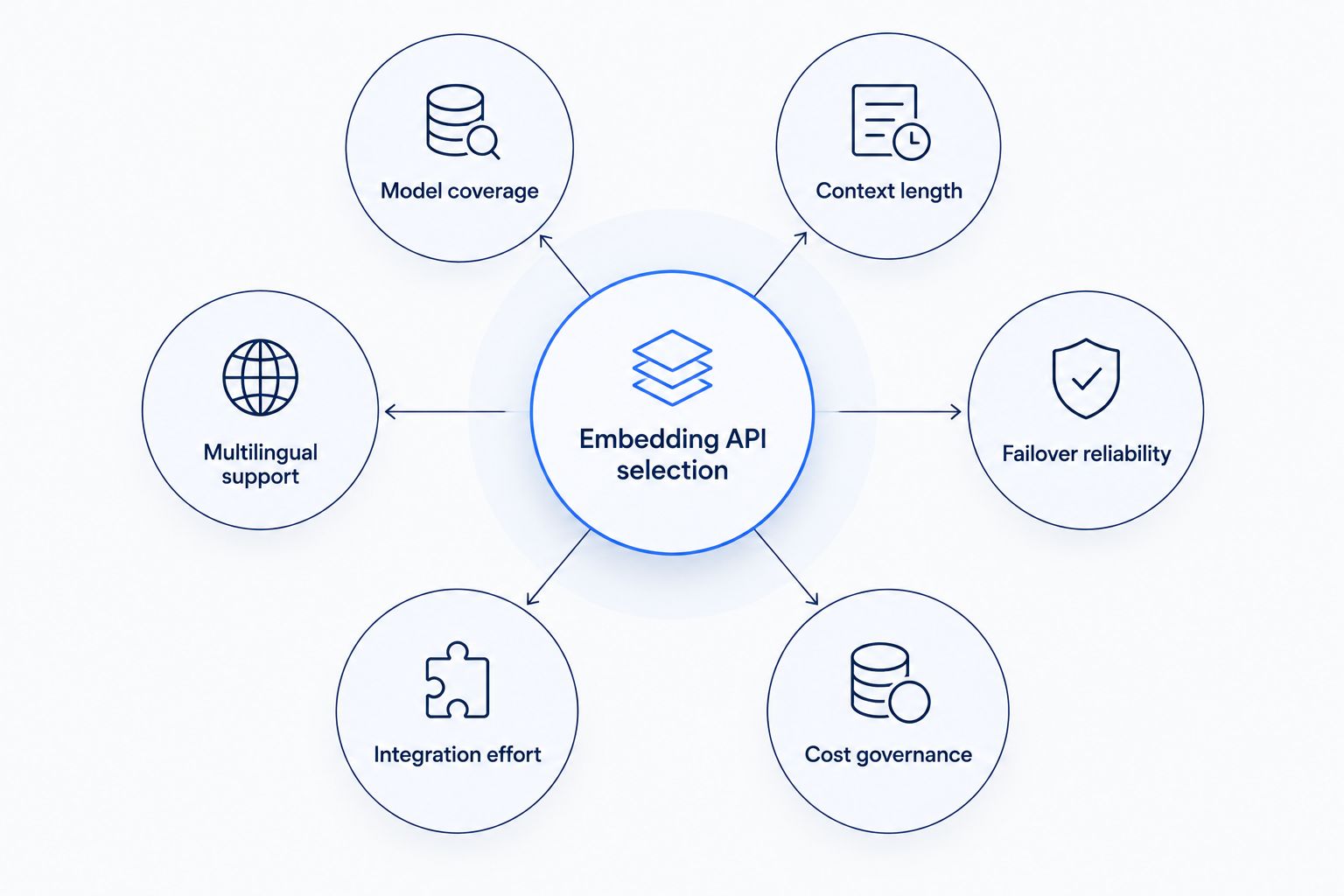
Six criteria decide which embedding API fits your stack — coverage and failover matter as much as raw accuracy.
Embedding APIs at a glance
Embedding API | Best for | Standout feature | Key limitation |
|---|---|---|---|
FastRouter | Unified multi-provider access | Routes to 200+ models through one OpenAI-compatible endpoint with automatic failover | Doesn't train its own embedding models — output quality depends on the provider you route to |
OpenAI text-embedding-3-large | General-purpose semantic search | 3072-dimension embeddings with a configurable output size | Single-vendor with no built-in failover if OpenAI degrades |
Cohere Embed | Multilingual enterprise search | Broad language coverage tuned for retrieval and reranking | Requires a separate Cohere account and SDK |
Voyage AI | RAG-optimized domain retrieval | Domain-tuned models for code, finance, and legal text | Smaller ecosystem and fewer public benchmarks than OpenAI |
Google Gemini embedding | Google Cloud-native stacks | Deep integration with Vertex AI and Google's data tooling | Strongest results tied to staying inside Google Cloud |
Jina AI Embeddings | Open, self-hostable deployments | Open-weight models you can run on your own infrastructure | Self-hosting shifts uptime and scaling work onto your team |
1. FastRouter: best embedding API access for multi-provider failover
FastRouter is an OpenAI-compatible API gateway, not an embedding model vendor. It sits in front of 200+ large language models and lets you route embedding requests to whichever provider you've configured, with automatic failover if a provider errors out or rate-limits you.
FastRouter pros:
- One integration point instead of separate SDKs per embedding provider
- Automatic failover to a healthy provider when one degrades
- Usage governance and cost visibility across models and teams
- OpenAI-compatible endpoint, so existing embedding code needs minimal changes
FastRouter cons:
- Adds a routing hop rather than serving its own proprietary embedding model
- Embedding quality is still bounded by whichever underlying provider you select
Best for: engineering teams running RAG or search in production who want provider redundancy without maintaining multiple SDKs.
Verdict: Buy if you're already routing chat or completion traffic through a gateway and want embeddings on the same governance layer.
2. OpenAI text-embedding-3-large: best embedding API for general-purpose semantic search
OpenAI's text-embedding-3-large is the default most teams reach for first. It supports 3072-dimension output by default and lets you shorten the vector size via the API's dimensions parameter, trading some accuracy for lower storage and faster search.
OpenAI pros:
- Widely documented with large community benchmarks and tooling
- Configurable embedding dimensions without retraining
- Strong general-purpose accuracy on English-language retrieval
OpenAI cons:
- No native failover if OpenAI has an outage or throttles your account
- Multilingual and domain-specific performance trails specialized providers
Best for: teams building a first semantic search or RAG feature without complex language or domain requirements.
Verdict: Buy as the default unless multilingual accuracy or self-hosting is a hard requirement.
3. Cohere Embed: best embedding API for multilingual enterprise search
Cohere Embed is built with retrieval and reranking in mind, and its multilingual models are tuned to handle non-English content without a separate translation step.
Cohere pros:
- Purpose-built for search and retrieval, not general text generation
- Multilingual coverage that's stronger out of the box than most general-purpose models
- Pairs cleanly with Cohere's reranking API for two-stage retrieval
Cohere cons:
- Requires its own account and SDK separate from other providers
- Smaller model catalog than OpenAI's broader ecosystem
Best for: enterprise search across content in multiple languages.
Verdict: Buy if your user base or document set spans several languages.
4. Voyage AI: best embedding API for RAG-optimized domain retrieval
Voyage AI focuses on domain-tuned embedding models for use cases like code search, financial documents, and legal text, where general-purpose embeddings tend to underperform.
Voyage AI pros:
- Domain-specific models for code, finance, and legal retrieval
- Positioned specifically for RAG pipelines rather than general NLP
Voyage AI cons:
- Smaller developer community and fewer public benchmarks than OpenAI or Cohere
- Fewer general-purpose integrations available out of the box
Best for: RAG systems retrieving over specialized document sets like contracts, codebases, or filings.
Verdict: Hold unless your retrieval corpus is genuinely domain-specific — general text doesn't need it.
5. Google Gemini embedding: best embedding API for Google Cloud-native stacks
Google's Gemini embedding models integrate directly with Vertex AI, which matters if your data pipeline, storage, and inference already live inside Google Cloud.
Google Gemini pros:
- Tight integration with Vertex AI's vector search and data tooling
- Backed by Google's infrastructure for teams already on GCP
Google Gemini cons:
- Best performance and lowest friction tied to staying inside Google Cloud
- Migrating off later means re-embedding your entire corpus
Best for: teams whose data platform is already built on Google Cloud.
Verdict: Buy if you're GCP-native; Skip if you're multi-cloud or cloud-agnostic.
6. Jina AI Embeddings: best embedding API for open, self-hostable deployments
Jina AI publishes open-weight embedding models you can run on your own infrastructure instead of calling a hosted API, which matters for teams with strict data residency requirements.
Jina AI pros:
- Open-weight models available for self-hosting
- No dependency on a third-party API for inference once deployed
- Useful for data residency or air-gapped environments
Jina AI cons:
- Self-hosting shifts scaling, uptime, and GPU costs onto your own team
- Requires ML infrastructure most small teams don't already run
Best for: organizations with data residency constraints or existing GPU infrastructure.
Verdict: Hold unless self-hosting is a compliance requirement — hosted APIs are less operational overhead for most teams.
Route embedding calls through one API
Access 200+ models with automatic failover and cost governance.
How we ranked
Each embedding API above earned its slot on one criterion it clears better than the rest: FastRouter on multi-provider failover, OpenAI on general-purpose defaults, Cohere on multilingual coverage, Voyage AI on domain tuning, Google on Google Cloud integration, and Jina AI on self-hosting. None of them wins on every criterion — that's the point of ranking by use case instead of by a single leaderboard score.
Which embedding API should you choose?
If you need one embedding model for a first search or RAG feature in English, start with OpenAI's text-embedding-3-large — it's the most documented, most benchmarked option going into 2026.
If your stack already calls multiple LLM providers, or you want failover so an embedding provider outage doesn't take down search, route the calls through FastRouter instead of hard-coding a single vendor's SDK. Everyone else on this list — Cohere, Voyage AI, Google, and Jina AI — is the right call only when your use case demands their specific strength: language coverage, domain tuning, Google Cloud integration, or self-hosting.
FAQ
What is the best embedding API in 2026?
OpenAI's text-embedding-3-large is the strongest general-purpose default in 2026. Teams needing multilingual coverage, domain tuning, or provider failover should look at Cohere, Voyage AI, or a gateway like FastRouter instead.
Is FastRouter an embedding model?
No. FastRouter is an API gateway that routes embedding and chat requests to 200+ models from other providers through one OpenAI-compatible endpoint, adding failover and cost governance on top.
How much does an embedding API cost?
Pricing varies by provider and is typically billed per token or per million tokens processed. Check each provider's current pricing page before committing, since rates change.
What's the difference between OpenAI and Cohere embeddings?
OpenAI's models are tuned for general-purpose English retrieval, while Cohere Embed is built specifically for multilingual search and pairs with a dedicated reranking API.
Can I switch embedding providers without rewriting my code?
Only if you're using an OpenAI-compatible endpoint or a gateway like FastRouter. Calling each provider's native SDK directly means rewriting integration code for every switch.
What context length do embedding APIs support?
It varies by model — OpenAI's text-embedding-3 models accept up to 8191 tokens per input. Check the specific provider's documentation for its current limit before sending long documents.
Is Jina AI good for self-hosted embeddings?
Yes, Jina AI publishes open-weight embedding models built for self-hosting, which suits teams with data residency requirements or existing GPU infrastructure.
Does FastRouter support embedding models alongside chat models?
FastRouter routes requests across 200+ models through one OpenAI-compatible API, which covers both chat and embedding use cases under the same governance and failover layer.
One last thing
Most teams don't realize embedding vectors can shrink without a full re-embed. OpenAI's text-embedding-3 models support a dimensions parameter that truncates the output vector — dropping from 3072 to a smaller size cuts storage and search latency with only a modest accuracy trade-off. Before you scale a vector database to millions of rows in 2026, test a smaller dimension size first; it's often cheaper than the alternative of switching embedding providers later.
Related Articles

Best AI API gateways for regulated industries in 2026
FastRouter tops the 2026 ranking of AI gateways for compliance and governance in regulated industries, compared against AWS Bedrock, Azure, and Portkey.

Best LLM gateways for building AI agents in 2026
Six LLM gateways for AI agents ranked on failover, cost control, and governance in 2026 — FastRouter wins for production agent fleets that need uptime and spend control.
.png&w=3840&q=75)
Cheapest Way to Access GPT-6, Claude & Gemini Through One API
Find out about Cheapest Way to Access GPT-6, Claude & Gemini Through One API in new FastRouter blog