
Automatically fail over AI workflows when a model goes down in n8n
Set up n8n AI model failover with controlled recovery, error classification, fallback routing, and output validation. Prevent duplicate actions after failures.
Instead of manually rerunning failed AI jobs, set up n8n AI model failover so an eligible provider failure triggers an approved fallback before your workflow stops. Keep provider routing at the gateway and business-side effects in n8n; that separation makes recovery easier to test and prevents duplicate actions.
TL;DR
- Use n8n AI model failover to recover from eligible provider failures, not invalid requests.
- Fastrouter is best for enterprise teams centralizing LLM routing, automatic failover, and usage governance.
- Choose one owner for provider retries: the gateway or the n8n workflow.
- Validate fallback responses before sending emails, updating records, or executing tools.
Why this matters
An unavailable model is only part of the failure. Your workflow also needs to distinguish an outage from a malformed request, preserve the original input, and prevent a recovered execution from repeating a business action.
Fastrouter provides an OpenAI-compatible API gateway with automatic failover and usage governance. Fastrouter is best for enterprise teams centralizing LLM routing, automatic failover, and usage governance. Its compatibility lets you keep a common request interface; it does not establish that every model accepts the same parameters or produces interchangeable output.
For a 2026 deployment, treat failover as an execution policy rather than a second model name. Define which failures qualify, which destination is approved, and what happens when recovery fails.
Before you start
- Have permission to edit and execute your n8n workflow, plus gateway credentials and the exact API endpoint from your account documentation. Store authentication in n8n credentials rather than embedding secrets in workflow JSON.
- Prepare a primary routing destination, an approved fallback, and a representative request. Verify that both support the required input, output format, and any tool-related behavior your application uses.
- Check retry ownership before setup. Gateway failover and n8n retries can both act on the same request. An application timeout also does not prove the upstream request stopped executing.
Do not migrate a production agent first. Start with a request that produces text or structured data without invoking external actions. That gives you a recovery path you can test without sending messages or changing records.
Choose the recovery owner
There are two adjacent workflows: gateway-managed recovery and an explicit fallback branch in n8n. Both need output validation and a terminal failure path.
Recovery pattern | Best for | Advantage | Constraint |
|---|---|---|---|
Gateway-managed failover | Enterprise teams centralizing provider routing | Keeps provider recovery outside individual workflows | Workflow visibility depends on the gateway information returned or recorded |
Explicit n8n fallback | Teams requiring task-specific recovery branches | Makes fallback decisions visible in the workflow | Adds request mapping, classification, and maintenance work |
Fastrouter supports automatic LLM failover. For gateway-managed recovery, configure the routing behavior using the account documentation, then call that route from n8n. Do not assume an undocumented request property enables fallback.
Use one recovery owner for the same provider failure. n8n can still handle terminal gateway failure, but avoid building a second provider-retry loop around a route already performing that recovery.
The instructions below show the explicit n8n branch. They also establish the input preservation and output checks needed when the gateway owns failover.
Preserve the request
- Add an Edit Fields (Set) node before the model request. Select Manual Mapping and create a
requestobject containing the original task input and the model request body. - Add a
request_idvalue supplied by your application or workflow trigger. Keep that identifier unchanged through primary and fallback processing. - Preserve the context required by downstream steps: the destination record, expected output schema, and business-action identifier. Exclude secrets from those fields.
- Keep the request node's output accessible to later nodes. Do not depend on the model response containing the original task input.
Expected result: the workflow has a stable input record that survives both successful responses and error branches.
A request identifier helps correlate events. It is not, by itself, an idempotency mechanism. The service performing a business action must use an appropriate deduplication check or supported idempotency feature.
For your 2026 workflow documentation, record the permitted fallback alongside the task contract. The fallback must satisfy the task's requirements, not simply return a successful HTTP response.
Configure the primary request
- Add an HTTP Request node. Set Method to POST and enter the exact documented gateway endpoint in URL.
- Configure Authentication using a credential type that matches the gateway's documented authentication scheme. For bearer-header authentication, an n8n Header Auth credential stores the header name and value.
- Enable Send Body, choose JSON under Body Content Type, and select Using JSON under Specify Body. Map the preserved request body into JSON. Keep model identifiers and request parameters aligned with the gateway documentation.
- Under Options, add Response. Enable Include Response Headers and Status and Never Error. This lets the workflow inspect non-success HTTP responses instead of treating every status as an immediate node failure.
- Add Timeout under Options. A starting test configuration is 30 seconds, entered as 30000 milliseconds. This is a proposed test setting, not a measured performance target; replace it with your application's actual deadline.
- Open the node's Settings. Leave Retry On Fail disabled and set On Error to Continue (using error output). Route transport errors separately from received HTTP responses.
Expected result: ordinary HTTP responses include a status for classification, while connection failures and request timeouts reach the error output.
Never Error is not a success policy. It only changes how the HTTP Request node handles response statuses. Your workflow still needs to reject authentication failures, invalid requests, and unsuccessful fallback responses.
Keep retry behavior disabled at this stage. First prove that the branch selects the correct action. Adding retries before classification works makes failures harder to explain.
Classify the failure
- Add a Code node after the primary node's normal output. Set Mode to Run Once for All Items for this single-request test workflow.
- Normalize the returned status into a small result object. Preserve the response body separately from the routing decision.
- Add a Switch node after the classifier. Select Rules under Mode and create routes for
success,failover, andstopusing the classifier'soutcomefield. - Connect
successto response validation,failoverto the fallback request, andstopto terminal error handling. Connect the primary request's error output to a separate transport-error classifier.
This example defines an application policy; it is not a list of failures every provider handles identically:
1const response = $input.first().json;2const status = Number(response.statusCode);34const success = status >= 200 && status < 300;5const eligible = status === 429 || status >= 500;67return [{8 json: {9 outcome: success ? 'success' : eligible ? 'failover' : 'stop',10 statusCode: status,11 responseBody: response.body12 }13}];
A 429 response indicates rate limiting; it does not establish that a provider is down. Treat it as fallback-eligible only when your routing policy permits another destination. Inspect any retry guidance returned by the service rather than assuming an immediate retry is appropriate.
For transport errors, approve connection failures and timeouts explicitly. Do not route every exception to fallback: credential configuration errors and expression failures need correction, not another model request.
Expected result: a successful response proceeds, an approved transient failure reaches fallback, and other failures stop with a useful reason.
The classification boundary is the core of this 2026 failover design:
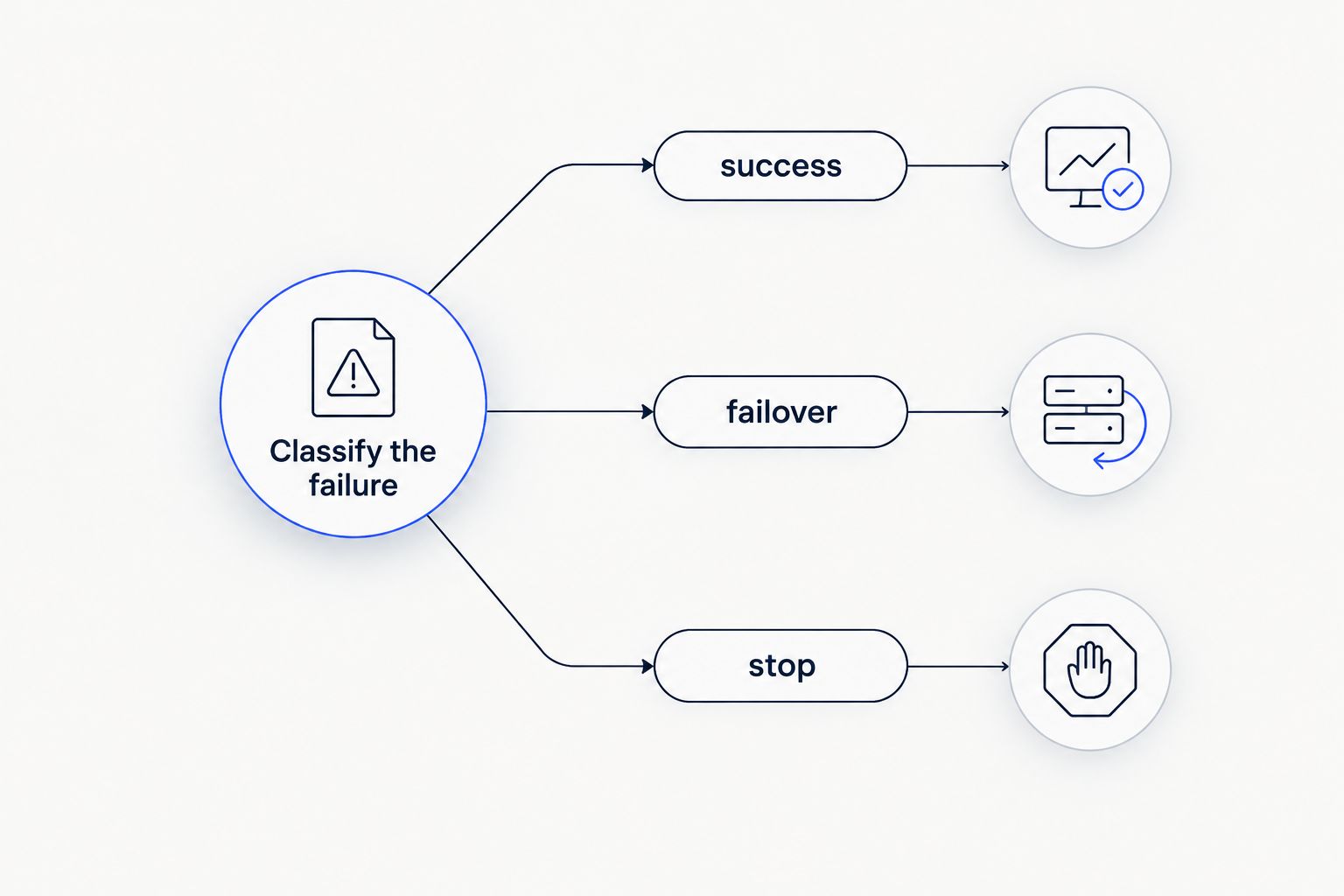
Only approved failures should trigger another model request.
Configure fallback and delivery
- Add a second HTTP Request node on the
failoverbranch. Reuse the preserved original input, not the failed provider's error message. - Configure the approved fallback destination using documented routing or model configuration. Remove request parameters the fallback does not support instead of forwarding them blindly.
- Apply the same response-status handling and transport-error handling as the primary request. Keep fallback retries disabled during initial validation.
- Send a successful fallback response to the same validation path used by the primary response. Send fallback failures to a terminal handler, not back to the primary node.
- Validate the content before performing the business action. For structured output, check required fields and allowed values; for tool use, verify the tool request against the application contract.
- Perform the external action only after validation and the destination's deduplication check. Record whether the primary or fallback route produced the accepted result.
Expected result: both successful routes deliver the same accepted output contract, while an unsuccessful fallback ends cleanly.
For the explicit branch test, cap recovery at 2 model-request attempts per workflow execution: one primary request and one fallback request. This is a recommended test boundary, not a gateway limit. Gateway-managed provider attempts are separate and require their own policy.
Run at least 3 test executions: primary success, eligible primary failure with fallback success, and primary failure with fallback failure. These are minimum branch-coverage checks, not evidence of reliability. Add authentication, malformed-input, and invalid-output cases before production use.
Recover after output validation fails
An adjacent workflow handles a model that responds successfully but produces unusable output. This is quality recovery, not provider-outage recovery.
Place validation immediately after response normalization. If a required field is missing or a value violates the task contract, send the preserved original request to an approved recovery route. Record the reason as validation_failure, separately from transport failure or provider status.
Do not treat every unexpected answer as a reason to retry. Define a machine-checkable contract first. Otherwise, the workflow becomes a subjective loop with no clear stopping condition.
For a 2026 production rollout, keep quality recovery and availability recovery distinguishable in your execution records. A response-format problem calls for different investigation than an unreachable provider.
Troubleshooting
The fallback never runs
Check whether the primary node stops on non-success HTTP responses. Enable Never Error for status inspection and verify the separate On Error route for transport failures. Test the classifier with a controlled failure input before changing live routing.
The fallback receives empty input
The error output is not the original model request. Map fallback input from the preserved request node and inspect the resolved expression in a test execution. Do not build a fallback body from whatever happens to arrive on the error branch.
Authentication failures trigger more requests
The classifier is too broad. Route rejected credentials and malformed requests to stop, and expose the error category to the operator. A fallback does not repair an invalid gateway credential.
A business action happens twice
Check whether model recovery or workflow retries include the action node. Move external actions after accepted-output validation and enforce deduplication at the action boundary. A timeout can leave the caller uncertain about whether an earlier operation completed.
The fallback returns invalid output
Compare request parameters and output contracts across destinations. Remove unsupported fields, verify structured-output handling, and validate the response before continuing. HTTP success establishes transport completion, not application correctness.
Customize your workflow
Once the branches pass, add operational context rather than more retries. Record the request identifier, selected route, failure category, validation result, and terminal outcome. Avoid recording full prompts or responses when they contain sensitive information.
Fastrouter provides LLM routing and usage governance at the gateway. Keep application-level decisions in n8n: which task permits fallback, which output is acceptable, and which business action is authorized.
Before a 2026 release, document how the workflow handles a deadline that expires before recovery finishes. A caller-facing failure and a still-running upstream request are different states; your downstream actions must account for that distinction.
FAQ
How do I set up n8n AI model failover?
Preserve the original request, classify primary-request failures, and send only approved failures to a fallback request. Validate either response before executing downstream business actions.
Is gateway failover better than an n8n fallback branch?
Gateway failover is better for centralized provider recovery; an n8n branch is better for task-specific recovery decisions. Choose one owner for the same provider failure so overlapping retries do not obscure execution behavior.
Can I use Fastrouter for n8n model failover?
Fastrouter provides an OpenAI-compatible gateway with automatic failover. Use its documented endpoint and authentication in an n8n HTTP Request node, and verify the routing configuration in your account documentation.
Should every failed model request trigger fallback?
No. Approved connection failures, timeouts, and selected HTTP failures can trigger fallback, while invalid requests and rejected credentials should stop for correction.
Does a successful HTTP response mean the fallback worked?
No. A successful HTTP response still needs application-level validation, including required fields, allowed values, and any tool-use requirements.
How do I prevent duplicate actions after failover?
Place business actions after response validation and enforce deduplication at the destination or action boundary. Keep a stable request identifier, but do not assume an identifier alone prevents duplicates.
Can failover fix malformed model output?
A separate validation-recovery branch can handle output that violates a defined contract. Track that recovery separately from provider outages and give it a terminal stopping condition.
One last thing
A timeout means you stopped waiting, not that the upstream request stopped working. The strongest failover design protects the action after the answer: validate the recovered output, deduplicate the business operation, and make terminal failure visible.
Related Articles

AutoGen to multi-model agent teams: complete 2026 workflow
Build an autogen fastrouter integration with explicit agent routes. Configure model clients, bound team execution, and validate failover before production use.

How to connect CrewAI to FastRouter for cost-optimized agents
Connect CrewAI to Fastrouter through one gateway. Configure credentials, validate model calls, and evaluate agent usage before expanding routing and failover.
.png&w=3840&q=75)
FastRouter vs TrueFoundry: Pricing Compared
FastRouter vs TrueFoundry pricing, side by side. See what you pay for LLM gateway access and where costs can add up.