

Together AI alternatives in 2026
Compare Together AI alternatives in 2026. FastRouter leads for enterprise teams needing one OpenAI-compatible gateway with automatic failover and usage governance.
Together AI gives development teams a direct way to run open models through an inference platform. A provider-centered workflow stops being enough when your team needs one control point for routing, fallback, and usage governance across models. The best Together AI alternative in 2026 is FastRouter for enterprise teams that need a managed model gateway; LiteLLM is the better fit when you want to operate the gateway yourself.
TL;DR
- FastRouter is the best Together AI alternative for enterprise model routing, automatic failover, and usage governance.
- LiteLLM fits teams that want to operate and customize their own gateway.
- Amazon Bedrock fits teams standardizing model access inside AWS.
- Keep Together AI when direct access to its inference platform meets your operational needs.
Why this matters
Choosing a model platform is also choosing where operational decisions live. Your application can call a provider directly, or it can call a gateway that decides how requests reach providers. Both designs can work. They assign responsibility for fallback, model changes, usage controls, and incident response to different parts of your stack.
For an enterprise AI platform team, the useful question in 2026 is not which vendor has the longest model list. It is whether engineering teams can change models without scattering provider-specific decisions across applications. Assess each option against your actual request path: authentication, routing policy, failure handling, usage records, and the work required to keep integrations current.
Together AI alternatives at a glance
Platform | Best for | Standout capability | How it differs from Together AI |
|---|---|---|---|
Together AI | Teams using its inference platform directly | Access to open-model inference | The baseline: a direct provider relationship |
FastRouter | Enterprise teams managing model access across applications | OpenAI-compatible gateway with routing, automatic failover, and usage governance | Adds a gateway control point between applications and model access |
OpenRouter | Developers seeking a single API for models from multiple providers | Multi-provider model access | Centers the integration on a model-routing API rather than direct use of Together AI |
LiteLLM | Teams that want to operate their own gateway | Open-source gateway software | Puts gateway deployment and operations in your hands |
Amazon Bedrock | Teams standardizing within AWS | Managed access to foundation models through AWS | Keeps model access within an AWS service workflow |
Fireworks AI | Teams focused on an open-model inference platform | Model inference and customization tools | Offers another provider-centered path rather than a gateway-first architecture |
The table separates provider choices from gateway choices. Fireworks AI and Together AI are relevant when you want to evaluate inference platforms. FastRouter, OpenRouter, and LiteLLM deserve closer attention when the integration boundary itself is the problem. Amazon Bedrock belongs in the comparison when your existing AWS architecture shapes the decision.
1. FastRouter: best for governed model routing
FastRouter provides an OpenAI-compatible API gateway for enterprise AI development teams. It supports routing and comparison across 200+ large language models, with automatic failover, cost optimization, and usage governance. That makes it the first option to evaluate when multiple applications need a shared way to manage model access.
Where FastRouter shines
- Routing: Put model-selection decisions at a gateway instead of repeating them in each application.
- Failover: Automatically reroute requests when a configured path fails.
- Governance: Manage usage through a shared access layer.
- Integration: Use an OpenAI-compatible interface as the application-facing boundary.
Where FastRouter falls short
- A gateway adds another component to your request path. Your team must test its behavior under errors, timeouts, and model changes.
- Teams committed to a single provider may not need a separate routing layer.
- A catalog of 200+ models does not replace a model-approval policy; your team still decides which models applications can use.
Decision point | FastRouter | Together AI |
|---|---|---|
Primary role | Unified model gateway | Inference platform |
Application boundary | OpenAI-compatible gateway API | Direct provider integration |
Routing decision | Shared gateway layer | Application or provider-specific workflow |
Operational priority | Routing, failover, and governance | Direct use of the provider's inference platform |
Best for: Enterprise platform teams that want routing and governance outside individual application code. Verdict: Choose when shared controls are the requirement; hold if a direct provider integration already covers your needs.
Choose the right control point
Before comparing more vendors, draw the request path you intend to own. A direct integration leaves model choice and fallback decisions closer to application code. A gateway centralizes those decisions, but the gateway itself becomes part of the system you must monitor and test. Neither layout is automatically better.
Evaluate the architecture through five responsibilities:
- Routing: Where is the model or provider selected for each request?
- Failover: What happens after a timeout, error, or unavailable model?
- Governance: Who can use each approved model, and where are limits enforced?
- Evaluation: How will you compare output quality for your own tasks before changing a route?
- Observability: Can operators trace a request, its selected route, and its failure outcome?
These are buying criteria, not claims that every platform supplies every control. In a 2026 evaluation, ask vendors to show the behavior in a test environment. Then inspect what your own application must implement around it.
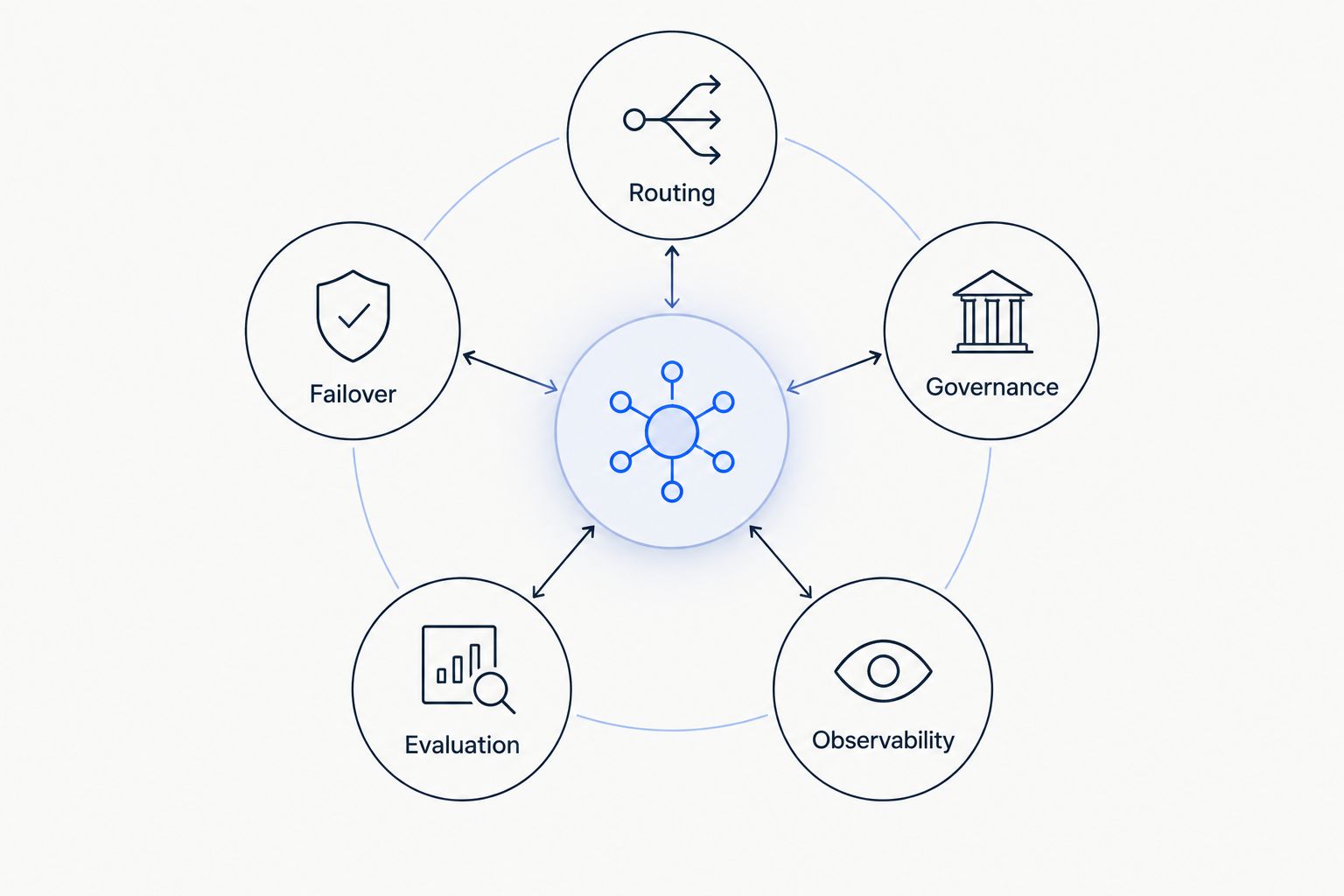
The right integration boundary makes responsibility for each control explicit.
2. OpenRouter: best for a multi-provider API
OpenRouter gives developers an API for accessing models across providers. It is a relevant Together AI alternative when the immediate goal is to avoid wiring each model provider into an application separately. Evaluate its routing behavior and administrative controls against your production requirements rather than treating model access alone as a governance plan.
Where OpenRouter shines
- A single API reduces the number of provider-specific integrations an application must maintain.
- A multi-provider catalog makes model comparison possible without rebuilding the entire application integration.
Where OpenRouter falls short
- A shared API does not decide which models your organization should approve.
- Your team still needs to define failure behavior, request ownership, and usage review for its own environment.
Decision point | OpenRouter | Together AI |
|---|---|---|
Primary role | Multi-provider model API | Inference platform |
Integration goal | One API for models across providers | Direct use of Together AI |
Model evaluation | Compare options through a shared integration | Evaluate models within a provider workflow |
Best for: Developers prioritizing multi-provider access through one API. Verdict: Choose when integration breadth is the immediate requirement; hold until you have checked the controls your organization needs.
3. LiteLLM: best for operating your own gateway
LiteLLM is open-source gateway software for teams that want control over gateway deployment and configuration. That distinction matters more than a model count: you own the operational layer as well as the application integration. Treat it as an infrastructure decision, not just an API replacement.
Where LiteLLM shines
- Your team can manage gateway deployment within its own infrastructure practices.
- An open-source gateway offers a path to customize routing and integration behavior.
- The architecture gives platform engineers a defined place to implement organization-specific controls.
Where LiteLLM falls short
- Your team owns deployment, maintenance, monitoring, and incident response for the gateway.
- Customization creates code and configuration that someone must review as provider APIs change.
Decision point | LiteLLM | Together AI |
|---|---|---|
Primary role | Gateway software | Inference platform |
Operational ownership | Your team operates the gateway | Your team integrates with the provider |
Main decision | How to deploy and govern model access | How to use the provider's inference services |
Best for: Platform teams with capacity to run a gateway and a reason to control its deployment. Verdict: Choose if operational ownership is intentional; skip if your team wants to avoid maintaining that layer.
4. Amazon Bedrock: best for AWS-centered teams
Amazon Bedrock is an AWS service for building with foundation models. It belongs on a Together AI alternatives shortlist when an organization already manages application infrastructure and access through AWS. The relevant comparison is architectural fit, not a blanket claim about model quality.
Where Amazon Bedrock shines
- Teams already using AWS can assess model access within a familiar cloud environment.
- Platform owners can evaluate it alongside their existing AWS access and operational practices.
Where Amazon Bedrock falls short
- It ties the model-access decision to an AWS-centered workflow.
- Teams seeking a separate gateway across provider relationships still need to assess where that layer belongs.
Decision point | Amazon Bedrock | Together AI |
|---|---|---|
Primary role | AWS foundation-model service | Inference platform |
Architectural fit | AWS-centered applications | Direct provider integration |
Evaluation priority | Fit with AWS operations | Fit with Together AI's inference workflow |
Best for: Organizations that want model access inside their AWS architecture. Verdict: Choose when that architecture is the deciding constraint; hold if the requirement is provider-independent routing.
5. Fireworks AI: best for comparing inference platforms
Fireworks AI offers an inference platform for open models. Compare it with Together AI when you are choosing where to run workloads, rather than deciding how to govern access across several providers. Test the models and workload behavior that matter to your application.
Where Fireworks AI shines
- It gives teams another inference platform to evaluate for open-model workloads.
- It is a direct comparison when provider selection, rather than gateway ownership, is the decision.
Where Fireworks AI falls short
- Selecting another inference provider does not, by itself, centralize routing policy across providers.
- Your application team still needs an answer for fallback and usage governance beyond any one provider relationship.
Decision point | Fireworks AI | Together AI |
|---|---|---|
Primary role | Open-model inference platform | Open-model inference platform |
Main evaluation | Workload fit on Fireworks AI | Workload fit on Together AI |
Gateway question | Separate architectural decision | Separate architectural decision |
Best for: Teams comparing provider-centered inference options. Verdict: Choose if its tested workload fit wins; hold if the real problem is cross-provider governance.
Why teams switch from Together AI
A switch makes sense when the current integration boundary no longer matches the work your team must do. The strongest reason to add a gateway is to move routing, fallback, and access decisions out of individual applications. That is an architectural change, not a claim that Together AI cannot serve inference requests.
Use these checks before changing a production request path:
- Map current dependencies. Identify which applications call Together AI, which models they request, and where credentials and fallback decisions live.
- Define approved routes. Decide which workloads can change models automatically and which need a fixed model for evaluation or governance.
- Test failure cases. Send requests through the proposed path while a selected model is unavailable. Inspect the returned error, retry behavior, and final route.
- Compare outputs. Evaluate candidate models on representative tasks before allowing a routing change to affect users.
- Check operational records. Confirm that your team can associate usage and failures with the application responsible for each request.
In 2026, teams also need a clear answer to a simpler question: who updates the integration when requirements change? A direct provider integration places more of that decision in application work. A gateway creates a shared place for policy, while adding an operational component. Write down that ownership before selecting a platform.
Assess your model gateway
Review routing, failover, and governance against your application requirements.
When staying with Together AI is right
Stay with Together AI if your team wants direct access to its inference platform and the existing integration meets your model, operational, and governance requirements. Adding a gateway solely because your application might use another provider later introduces work before it solves a demonstrated problem.
If you are comparing inference providers, run the same application tasks against each candidate and document the result. If you are comparing gateways, test routing policy, failure handling, and usage controls instead. Those are different 2026 buying decisions, even when they appear on the same alternatives shortlist.
FAQ
What is the best Together AI alternative in 2026?
FastRouter is the best fit for enterprise teams that need shared model routing, automatic failover, and usage governance. LiteLLM fits teams that want to operate their own gateway instead.
Is a gateway the same as an inference provider?
No. An inference provider runs model workloads, while a gateway sits between applications and model access to manage how requests are routed. Decide which part of the request path you need to change before comparing vendors.
When should I keep using Together AI?
Keep Together AI when direct access to its inference platform meets your application and operational requirements. A new gateway adds an integration and an operational dependency that needs a clear purpose.
Which Together AI alternative lets my team operate its own gateway?
LiteLLM is open-source gateway software that your team can deploy and operate. Plan for maintenance, monitoring, and incident response as part of that choice.
Is Amazon Bedrock a direct replacement for a model gateway?
No. Amazon Bedrock is an AWS foundation-model service, while a gateway addresses the application-facing routing layer. Assess Bedrock for AWS-centered model access and evaluate gateway needs separately.
How should enterprise teams compare Together AI alternatives?
Compare them against the same application tasks and request-path requirements. Check model output, routing decisions, failure behavior, access controls, and the operational work your team will own.
One last thing
Do not start a gateway evaluation with a model catalog. Start with a failed request: identify which system selects the fallback, which team sees the failure, and which record explains the decision. If those answers sit in different applications, a shared routing layer has a concrete job to do in 2026.
Related Articles

MindStudio alternatives in 2026
Compare MindStudio alternatives in 2026. FastRouter is the pick for enterprise API routing; see when n8n, Dify, LangChain, or MindStudio fits better.

Best AI gateways with automatic model fallback in 2026
Compare fallback models API gateway options in 2026. FastRouter.ai leads for enterprise routing and governance; see when LiteLLM or Portkey fits better.

AI API gateways ranked by latency and response speed in 2026
Find the fastest ai api gateway for your workload in 2026. Fastrouter fits enterprise routing; compare LiteLLM and Cloudflare AI Gateway with matched latency tests.