

MindStudio alternatives in 2026
Compare MindStudio alternatives in 2026. FastRouter is the pick for enterprise API routing; see when n8n, Dify, LangChain, or MindStudio fits better.
MindStudio is strong when your team needs to build AI agents through a visual interface. It stops being the right fit when the primary job is managing model access, routing, failover, and usage governance inside an application your engineers already own. The best MindStudio alternative in 2026 is FastRouter for enterprise API routing; choose n8n when visual workflow automation is the priority.
TL;DR
- FastRouter is the best MindStudio alternative for enterprise teams that need API-based model routing and governance.
- Choose n8n for visual automation, Dify for visual AI app development, or LangChain for code-first orchestration.
- MindStudio remains the fit when building agents without managing application-level routing infrastructure.
Why this matters
A visual agent builder and an API gateway solve different problems. MindStudio helps a team create agent workflows. FastRouter gives an engineering team a unified, OpenAI-compatible gateway for accessing, comparing, and routing requests across 200+ large language models. Choosing between them is an architecture decision, not a contest over which interface looks easier.
For a 2026 evaluation, separate visual workflows and no-code design from API routing and provider failover. If the workflow is the product, assess how you build and maintain it. If an application sends model requests in production, assess what happens when you change models, enforce usage rules, or need a fallback.
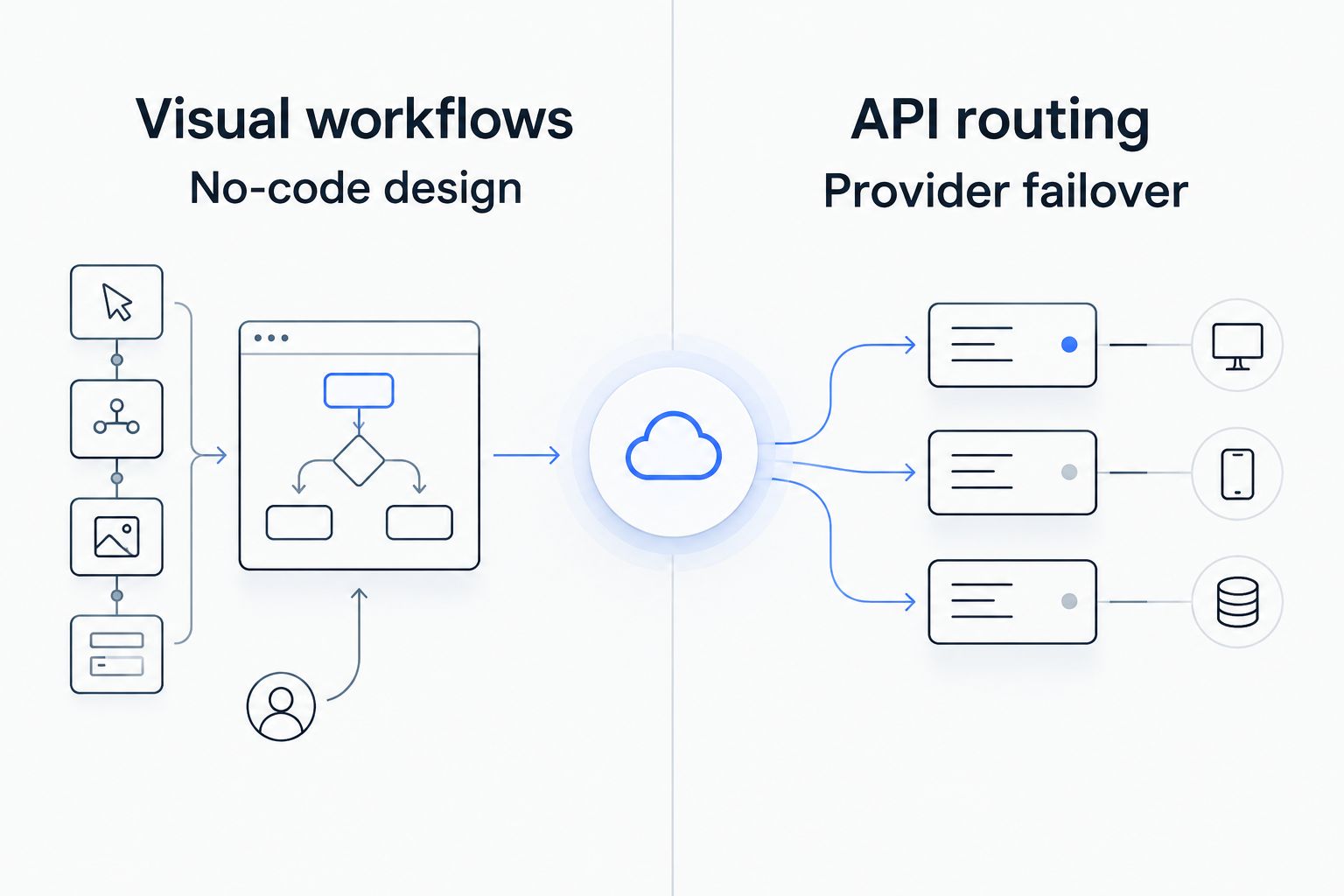
Choose the workflow layer and the model-access layer by the job each must perform.
MindStudio alternatives at a glance
Tool | Best for | Standout capability | How it differs from MindStudio |
|---|---|---|---|
MindStudio | Building AI agents visually | No-code agent creation | The benchmark for teams that want to design the agent in a visual interface |
FastRouter | Enterprise model access through an application API | Unified routing, automatic failover, and usage governance | Provides the model-access layer rather than a visual agent builder |
n8n | Visual automation across application workflows | Workflow automation with AI steps | Starts with connecting and automating processes, not solely building agents |
Dify | Visual development of AI applications | Open-source AI app and workflow builder | Centers on application creation and deployment |
LangChain | Code-first LLM application development | Programmable components for LLM workflows | Gives developers a framework rather than a no-code editor |
The table is a shortlist, not a claim that these tools replace the same component. In 2026, start by identifying which layer your team wants to change: agent authoring, business-process automation, AI application development, code-level orchestration, or model access. A team can use a workflow tool and an API gateway together.
1. FastRouter: best for enterprise model routing
FastRouter is an API gateway for enterprise AI development teams. It provides one OpenAI-compatible integration for accessing and comparing 200+ large language models, with automatic failover, cost optimization, and usage governance. It is the strongest MindStudio alternative here when your existing application owns the user experience and engineering needs control over model requests.
Where FastRouter shines
- Model access: Route and compare requests through a unified gateway instead of treating every provider connection as a separate application concern.
- Failure handling: Automatic failover addresses provider availability at the routing layer.
- Governance: Usage controls belong in the shared access path rather than in an individual agent workflow.
- Integration: An OpenAI-compatible API fits teams already building against that interface.
Where FastRouter falls short
- It does not replace MindStudio's visual agent-building workflow. Your team still needs to build and maintain the application or agent that calls the API.
- A gateway adds an architectural layer to evaluate. Teams seeking only a no-code workspace should not add one to solve a workflow-design problem.
Best for: Engineering teams responsible for production model access, failover, and usage governance across applications. Verdict: Choose when the operational model layer is the bottleneck; hold if your immediate need is visual agent authoring.
Decision point | FastRouter | MindStudio |
|---|---|---|
Primary job | Route and manage application model access | Build agents visually |
Main interface | OpenAI-compatible API | Visual agent-building interface |
Ownership | Engineering team builds the calling application | Team designs agent workflows in the builder |
Best evaluation | Routing, failover, and governance needs | Agent-building and workflow needs |
Test a representative request path before committing to the architecture. Document where prompts originate, where model selection occurs, who can change that selection, and where usage controls apply. Those questions tell you whether the missing component is an API gateway or an agent builder; a feature checklist alone does not.
2. n8n: best for visual workflow automation
n8n is a visual workflow automation platform with support for AI-related steps. It makes sense when the agent is part of a broader process: data moves between systems, a model performs a task, and the workflow passes its result onward. Its starting point is the process, not a dedicated model-access gateway.
Where n8n shines
- Visual workflows make triggers, steps, and handoffs easier to inspect than a process scattered across separate scripts.
- AI steps can sit alongside other automation work in the same workflow.
- Self-hosting is an option for teams whose deployment requirements favor it.
Where n8n falls short
- A visual automation workflow is not the same as a shared model-routing layer for multiple applications.
- Your team must design error paths and operational ownership for each workflow it puts into production.
Best for: Teams automating processes that include AI calls. Verdict: Choose when orchestration across systems is the main requirement; skip as a direct gateway substitute when your priority is centralized model access.
Decision point | n8n | MindStudio |
|---|---|---|
Primary job | Automate workflows across systems | Build AI agents visually |
Design approach | Visual workflow steps | Visual agent creation |
AI's role | One part of a wider automation | Central to the agent being built |
For a 2026 selection, map an actual process before comparing editors. Include its trigger, the model call, the system that receives the result, and the owner of a failed run. If that map spans several business systems, n8n deserves a closer look. If it describes only the behavior of an agent, compare the agent-building experience instead.
3. Dify: best for visual AI application development
Dify is an open-source platform for building AI applications and workflows visually. It is a closer functional comparison to MindStudio than an API gateway is: both address how a team creates an AI-powered experience. Evaluate it when the deliverable is an application or workflow, rather than a shared gateway used by applications already in service.
Where Dify shines
- Visual application and workflow development gives teams a place to define AI behavior without starting every component in code.
- Its open-source approach gives engineering teams a distinct deployment and customization path to evaluate.
Where Dify falls short
- A visual app platform introduces its own application lifecycle; it does not remove the need to decide how the finished app is operated.
- If your existing product already handles the user journey, adopting another app-building layer does not directly answer a routing or governance requirement.
Best for: Teams creating AI applications through a visual development platform. Verdict: Choose when application authoring is the job; hold if the existing application needs a better model-access layer instead.
Decision point | Dify | MindStudio |
|---|---|---|
Primary job | Build AI applications and workflows | Build AI agents visually |
Development approach | Visual, open-source platform | Visual agent builder |
Evaluation focus | Application lifecycle and deployment | Agent design and publishing workflow |
In a 2026 proof of concept, build the same narrowly defined task in both tools. Compare how your team edits the workflow, tests failure paths, and hands maintenance to the people who will own it. Do not score model-routing controls as if they were agent-editor features; those requirements belong in a separate architecture review.
4. LangChain: best for code-first orchestration
LangChain is a framework for developing LLM applications in code. It belongs on this list for teams that want developers to own application logic, integrations, and testing in their existing software workflow. It does not offer the same no-code starting point as MindStudio.
Where LangChain shines
- Developers can express LLM application behavior in code and review changes with the rest of the product.
- It fits teams that need to connect model interactions to custom application logic.
Where LangChain falls short
- Code-first development requires engineering ownership from the start.
- Choosing a framework does not, by itself, settle how your organization routes model requests or governs usage across applications.
Best for: Development teams building and maintaining LLM workflows as software. Verdict: Choose when code ownership is deliberate; skip when non-developers need to build agents visually.
Decision point | LangChain | MindStudio |
|---|---|---|
Primary job | Build LLM applications in code | Build agents visually |
Change process | Developer-managed code changes | Changes in a visual builder |
Team fit | Engineering-led implementation | Teams prioritizing no-code creation |
The decision is less about whether developers can use a visual tool and more about where your team wants the source of truth. If application behavior must live with your code, test suite, and release process, assess a framework. If the people defining the behavior need a visual builder, retain that as a requirement.
Why teams look beyond MindStudio
The reasons are architectural, not a verdict on MindStudio. A team might need application-level model routing, a visual process that spans business systems, an open-source AI app platform, or code-first control over an LLM workflow. Each reason points to a different alternative. Treating them as one replacement search produces a poor shortlist.
Use this 2026 decision sequence:
- Locate the work: Is your team building an agent, automating a process, building an AI application, or operating model access for an existing product?
- Name the owner: Will a non-developer edit behavior, or will engineers review and release changes in code?
- Trace a failure: Decide where a failed model request should be handled and who can change the fallback behavior.
- Place governance: Identify whether usage rules belong inside one workflow or across the applications that call models.
For enterprise teams, the last two checks often reveal a separate model-access decision. FastRouter addresses routing, automatic failover, and usage governance at the gateway. That does not make an agent builder unnecessary; it means the builder and gateway should be assessed as different layers.
Review the model-access layer
Assess API routing, failover, and usage governance for your applications.
When staying with MindStudio is right
Stay with MindStudio when your team primarily needs to create and iterate on AI agents visually and its workflow already fits how those agents are used. A move to a framework or API gateway adds implementation work without replacing the visual authoring experience. In 2026, keep the tool that solves the present job; evaluate a second layer only when a specific operational requirement calls for it.
FAQ
What's the best MindStudio alternative for enterprise model routing?
FastRouter is the best fit on this list for enterprise model routing. Its OpenAI-compatible API gateway provides unified model access, automatic failover, cost optimization, and usage governance.
Is FastRouter a replacement for MindStudio's visual agent builder?
No. FastRouter is an API gateway for model access, while MindStudio is a visual agent builder. Use the gateway when your application needs routing and governance; keep a builder when visual agent creation is the requirement.
Which MindStudio alternative works for visual automation?
n8n is the visual automation choice on this list. It fits processes that connect systems and include AI steps, rather than focusing only on agent creation.
Which alternative is best for building AI applications visually?
Dify is an option for visual AI application and workflow development. Compare its application-building approach with MindStudio's agent-building workflow using the same task.
Is LangChain better than MindStudio for developers?
LangChain is the better fit when developers want to build and maintain LLM application behavior in code. MindStudio remains the fit when visual agent creation is the priority.
Can an API gateway and an agent builder be used together?
Yes. An agent builder defines workflow behavior, while an API gateway can manage how an application accesses models. Evaluate each layer against the responsibility it will own.
What should an enterprise team test before switching from MindStudio?
Test the work you actually need the replacement to own: agent editing, process automation, application development, or model routing. Include a failed model request and a usage-governance decision in the evaluation.
One last thing
Do not replace an agent builder to fix a model-access problem. In 2026, trace a production request from the application to the model and mark who controls routing, failover, and usage. If those controls are the gap, evaluate the gateway as its own decision. If creating the agent is the gap, evaluate the builder.
Related Articles

Together AI alternatives in 2026
Compare Together AI alternatives in 2026. FastRouter leads for enterprise teams needing one OpenAI-compatible gateway with automatic failover and usage governance.

Best AI gateways with automatic model fallback in 2026
Compare fallback models API gateway options in 2026. FastRouter.ai leads for enterprise routing and governance; see when LiteLLM or Portkey fits better.

AI API gateways ranked by latency and response speed in 2026
Find the fastest ai api gateway for your workload in 2026. Fastrouter fits enterprise routing; compare LiteLLM and Cloudflare AI Gateway with matched latency tests.