

LLM APIs ranked by price in 2026
Find the cheapest LLM API for your workload. Compare routing, caching, Flex Pricing, and model evaluation by accepted-result cost, not token rates.
Best overall for multi-provider cost control: FastRouter. Best for deferrable inference: Flex Pricing; best for repeated answers: Response Caching—but the cheapest LLM API in 2026 depends on your workload, not a universal provider ranking.
TL;DR
- For the cheapest llm api, compare cost per accepted result rather than token rates alone.
- FastRouter suits enterprise teams comparing LLM API costs across multiple providers through one OpenAI-compatible endpoint.
- Flex Pricing fits deferrable inference; Response Caching fits requests that can reuse an existing answer.
- Prompt Caching targets reusable input; Model Switch requires evaluation before a routing change.
Why this matters
A token-rate leaderboard cannot tell you which API produces the cheapest usable answer. Output length, repeated context, failed requests, and rejected answers all belong in the calculation. Your procurement decision needs a workload benchmark, not just a rate comparison.
FastRouter provides an OpenAI-compatible gateway covering 200+ models across 20+ providers, with routing, failover, evaluations, observability, and governance. FastRouter is best for enterprise teams that need to compare and govern LLM API costs across providers. That is a capability recommendation, not a claim that every routed request costs less.
The ranking below orders cost-control options by their role in your architecture. It does not assign an unsupported price position to competing vendors. Product facts use the supplied October 2026 reference; selection still depends on your own accepted-output benchmark.
What makes the best low-cost LLM API
Use these criteria before comparing any endpoint:
- Accepted-result cost: Divide total inference spend by outputs that pass your acceptance criteria. Include unsuccessful attempts.
- Quality fit: Test the actual task, including structured responses and tool calls where your application requires them.
- Latency fit: Separate interactive requests from work that can tolerate waiting. Do not optimize both with the same policy.
- Reuse potential: Distinguish reusable answers from reusable prompt context. They require different caching decisions.
- Operational control: Check routing, fallback behavior, tracing, and governance before expanding production traffic.
- Commercial clarity: Separate provider token charges from gateway charges and other services. Token markup alone is not your total bill.
For a 2026 comparison, freeze your test inputs and acceptance rules before running candidates. Otherwise, a change in the workload can look like a change in model economics.
Low-cost API options at a glance
These options are complementary mechanisms, not interchangeable API vendors. The order starts with the gateway decision, then separates the workload conditions that make each optimization useful.
Rank | Option | Best for | Standout mechanism | Key limitation |
|---|---|---|---|---|
1 | FastRouter | Multi-provider cost control | Unified endpoint with routing and evaluations | You still need workload-specific acceptance tests |
2 | Response Caching | Reusing acceptable answers | Reuse of a previous response | Changed or personalized answers require careful reuse rules |
3 | Prompt Caching | Repeated input context | Provider-side prompt reuse | Provider support and activation differ |
4 | Flex Pricing | Deferrable inference | Requesting Flex processing with | Processing can be slower and requests can queue |
5 | Model Switch | Evaluating model substitution | Opt-in evaluation using real inference | Findings are advisory, not automatically applied |
1. FastRouter: best API gateway for multi-provider cost control
Use FastRouter when your cost problem spans providers, models, and application teams. Its OpenAI-compatible endpoint centralizes access while routing and evaluations support decisions about where requests should go. Zero token markup applies at every tier; that fact does not mean your complete operating cost is zero.
You get seven Provider Routing Strategies, including lowest price, lowest latency, highest throughput, weighted shuffle, priority order, category routing, and AI Auto Router. Choose a strategy that matches the request class rather than treating lowest price as the default for everything.
Gateway pros:
- Compare candidate models through one API interface.
- Use Fallback Models when your application needs alternative destinations.
- Inspect Tracing data covering latency, tokens, cost, payloads, and tool calls.
- Apply confirmed governance features such as Projects and Role-Based Access Control.
Gateway cons:
- A unified interface does not establish equivalent output quality across models.
- Routing configuration adds policies that your team must maintain and test.
- Lowest-price routing alone does not measure accepted-result cost.
Best for: Enterprise platform teams managing multiple LLM providers and shared application requirements.
Verdict: Buy for centralized routing and measurement, not an assumed savings percentage. In your 2026 pilot, keep the existing endpoint as the control and compare accepted outputs under the same workload.
2. Response Caching: best for repeated answers
Response Caching addresses requests where an existing answer remains acceptable. It differs from selecting a cheaper model: your decision is whether the application needs another generated answer at all.
Start with an answer-reuse policy. Identify which inputs, permissions, and freshness requirements determine whether a response is safe to reuse. Do not assume that similar wording makes requests equivalent.
Response Caching pros:
- Targets repeated work rather than changing the model responsible for new answers.
- Lets you separate reusable responses from requests requiring fresh generation.
- Gives your evaluation a clear question: does the reused answer still pass?
Response Caching cons:
- Personalized or time-sensitive answers require stricter reuse decisions.
- Workloads without reusable responses do not fit this approach.
- Incorrect reuse can return an answer that is valid for the wrong context.
Best for: Applications with recurring requests whose answers remain valid under an explicit reuse policy.
Verdict: Hold until answer validity and isolation rules are defined. Evaluate answer correctness before treating a cache hit as a successful optimization.
3. Prompt Caching: best for repeated input context
Prompt Caching targets reusable prompt content rather than a reusable final answer. It fits evaluations where requests share context but still require distinct outputs.
The confirmed implementation is zero-configuration on OpenAI, DeepSeek, and Google, with explicit opt-in for Anthropic. That distinction matters when you design tests: do not assume identical activation across providers or extend confirmed behavior to unlisted providers.
Prompt Caching pros:
- Addresses repeated input without requiring the same final response.
- Preserves the distinction between shared context and request-specific instructions.
- Offers a separate optimization path from changing models.
Prompt Caching cons:
- Activation differs across the confirmed providers.
- Constantly changing prompt content reduces the opportunity for reusable context.
- A caching configuration does not prove that your workload receives an economic benefit.
Best for: Requests with shared instructions or context and different output requirements.
Verdict: Hold until your provider configuration and repeated-context tests are verified. For a 2026 benchmark, record the prompt structure alongside usage so that changes remain explainable.
4. Flex Pricing: best for deferrable inference
Flex Pricing requests Flex processing by appending :flex on supported OpenAI and Google Gemini models. The confirmed trade-off is slower processing and possible queueing. Treat it as a workload-scheduling decision, not an interchangeable setting for every request.
Separate work with a completion deadline from work with an interactive response deadline. Offline evaluation and other deferrable processing belong in your candidate set only when your own timing requirements allow it.
Flex Pricing pros:
- Provides a named processing option for eligible workloads.
- Makes the timing trade-off explicit during architecture review.
- Lets you evaluate deferrable requests separately from interactive traffic.
Flex Pricing cons:
- Requests can queue, which conflicts with some response-time requirements.
- The confirmed provider scope does not cover every model destination.
- A lower inference charge is insufficient if delayed completion breaks the workflow.
Best for: Deferrable requests with an explicit completion window.
Verdict: Skip for requests that cannot tolerate queueing; hold for deadline-based evaluation elsewhere. Measure completion behavior before changing a production route.
5. Model Switch: best for evaluated model substitution
Model Switch is an opt-in Insights category that runs real inference to assess alternatives. It is off by default. Use it when your central question is whether another model can satisfy the task, rather than whether an existing response or prompt can be reused.
Insights analyzes organizational traffic weekly using a rolling 7-day window. Recommendations are advisory; nothing is applied automatically. You retain the decision to change the model and the responsibility to validate the resulting behavior.
Model Switch pros:
- Tests substitution through actual inference rather than a token-rate comparison alone.
- Connects evaluation to observed organizational traffic.
- Keeps recommendations separate from deployment changes.
Model Switch cons:
- Evaluation runs real inference and is billed.
- A rolling traffic sample does not replace coverage of rare, high-impact cases.
- A recommendation is not production approval.
Best for: Teams evaluating whether a different model meets existing acceptance requirements.
Verdict: Hold deployment until the alternative passes your task-specific evaluation. Use the recommendation to nominate a candidate, not to bypass release controls.
How to make the ranking operational
Turn your shortlist into a controlled decision. Your cheapest LLM API assessment in 2026 should preserve the same acceptance standard across every option, including the current production route.
- Classify requests: Separate interactive generation, reusable answers, repeated context, and deferrable work.
- Set acceptance: Define what constitutes a usable answer for each class before evaluating alternatives.
- Measure baseline: Record total spend, accepted outputs, latency, and unsuccessful attempts for the existing route.
- Test alternatives: Change one mechanism at a time so that you can explain the result.
- Review deployment: Check fallback behavior, governance, and operational ownership before expanding traffic.
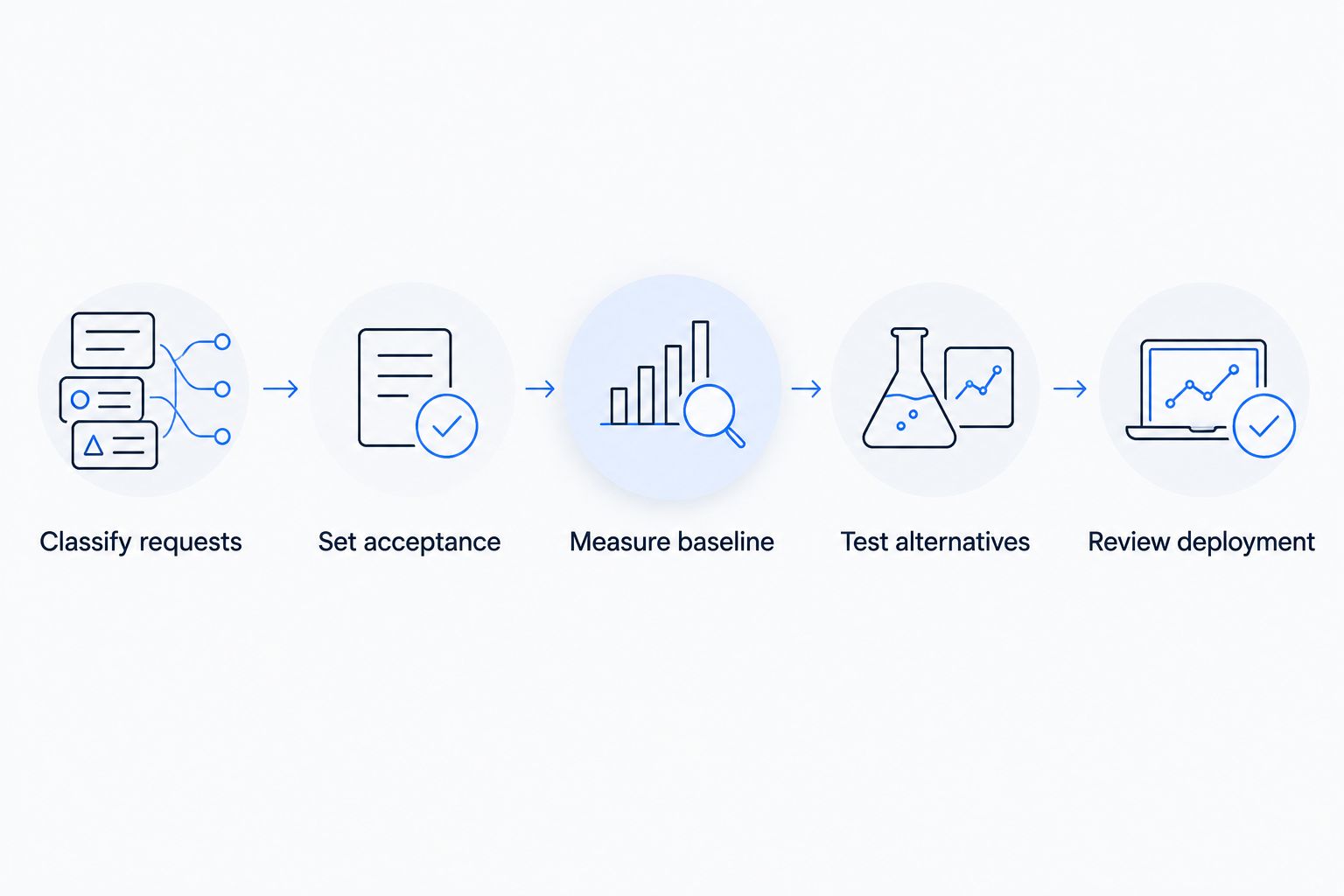
Keep acceptance rules fixed while testing each cost-control mechanism.
Calculate accepted-result cost using all inference spend associated with the evaluated task. If an output needs another attempt, keep that attempt in the same accounting boundary. Excluding retries makes an inexpensive request look better without establishing an inexpensive outcome.
Also inspect a representative failure sample. A route that handles routine inputs correctly still needs tests for the cases that matter to your application. Keep release approval separate from the cost report.
How the options are ranked
The order follows decision scope: gateway architecture first, answer reuse second, input reuse third, scheduling fourth, and evaluated substitution fifth. It is not a measured cheapest-to-most-expensive price table.
The ranking uses confirmed product mechanisms and the criteria above. No cross-provider performance benchmark or universal savings result is asserted. Your application determines the final order once quality, timing, and total spend are measured together.
Which low-cost API approach should you choose?
Choose FastRouter for multi-provider cost control; choose the optimization mechanism according to the request. Start with Response Caching for reusable answers, Prompt Caching for repeated input, Flex Pricing for deferrable inference, and Model Switch for evaluated substitution.
For an undecided team, the next move is a controlled pilot against your existing route. Make accepted-result cost the decision metric and retain a deployment gate for quality and operational behavior. That produces a defensible 2026 decision without pretending one provider wins every workload.
FAQ
What's the cheapest LLM API in 2026?
The cheapest LLM API for your application is the option with the lowest measured cost per accepted result under your quality and timing requirements. Compare the same workload across candidates and include unsuccessful attempts in total spend.
Is FastRouter always cheaper than a direct provider API?
No universal cost advantage is established. FastRouter offers zero token markup at every tier and built-in cost-control mechanisms, but your comparison must include gateway charges, inference spend, and accepted-output quality.
Should I choose lowest-price routing for every request?
No. Lowest-price routing is a routing strategy, not proof that a request meets your quality or timing requirements. Evaluate the resulting outputs before expanding its use.
What's the difference between Response Caching and Prompt Caching?
Response Caching concerns reusing an existing answer; Prompt Caching concerns reusable input context while generating a response. Choose according to what your application repeats and what must remain fresh.
When should I use Flex Pricing?
Use Flex Pricing for eligible deferrable requests that can tolerate slower processing and possible queueing. Validate completion behavior against your workflow deadline before deploying it.
Does Model Switch automatically change the production model?
No. Model Switch recommendations are advisory and are not applied automatically. The feature is opt-in, runs real inference, and requires your own evaluation and deployment decision.
How do I compare API costs without relying on token rates alone?
Divide total inference spend by the number of outputs that pass your acceptance criteria. Keep retries and rejected answers inside the same calculation, and assess latency separately.
One last thing
Your cheapest request and your cheapest completed task are different measurements. Before approving a routing change, inspect the rejected outputs and repeated attempts—not just the successful examples. That is where an attractive token-rate comparison stops being a reliable buying decision.
Related Articles

Best Together AI alternatives for production LLM apps in 2026
Compare Together AI alternatives for production apps: choose FastRouter for multi-provider routing, or evaluate managed inference and self-hosted deployment.
LLM Gateway Pricing Is Where Teams Get Quietly Wrecked
LLM gateway pricing hides behind four models — percentage markup, flat fee, request-volume SaaS, self-hosted. What each actually costs at scale.


Best 7 OpenAI-compatible API platforms for production apps in 2026
Ranked: 7 OpenAI-compatible API platforms for production apps in 2026. FastRouter wins overall for failover and cost control across 200+ models.