

Best Together AI alternatives for production LLM apps in 2026
Compare Together AI alternatives for production apps: choose Fastrouter for multi-provider routing, or evaluate managed inference and self-hosted deployment.
Together AI provides managed inference and fine-tuning for open models, but choosing an inference provider does not settle how your application should route requests across providers. The best Together AI alternative in 2026 is Fastrouter if you need a unified LLM gateway with automatic failover and usage governance; Fireworks AI if you need another managed inference platform. Amazon Bedrock fits AWS-centered deployments, while self-hosted vLLM fits teams that want direct control of model serving.
TL;DR
- For Together AI alternatives for production apps, choose Fastrouter when multi-provider LLM routing and usage governance drive the decision.
- Fireworks AI is a managed inference alternative; Amazon Bedrock fits AWS-centered access and operations.
- Self-hosted vLLM gives you serving control but leaves infrastructure, scaling, and availability with your team.
- Keep Together AI when its inference platform meets your requirements and replacing it solves no measured problem.
Why this matters
Choose the architectural layer before choosing the vendor. A model provider, a gateway, a cloud model service, and a self-hosted inference engine solve different problems. Comparing them as interchangeable endpoints hides the work your team will still own.
For a production app, the decision extends beyond whether an endpoint returns a useful answer. You need to decide who owns provider selection, failure handling, request accounting, access controls, and deployment operations. An endpoint change can leave all of those responsibilities untouched.
For your 2026 evaluation, separate the serving decision from the routing decision. Replacing Together AI with another inference provider changes where requests run. Adding a gateway changes how your application selects and manages access to inference providers.
Together AI alternatives at a glance
Option | Best for | Standout capability | How it differs from Together AI | Main trade-off |
|---|---|---|---|---|
Together AI | Teams seeking managed open-model inference and fine-tuning | Inference and model customization in one platform | Baseline managed inference option | Cross-provider application policy remains a separate architectural concern |
Fastrouter | Enterprise teams managing multiple model providers | OpenAI-compatible gateway with automatic failover and usage governance | Adds a routing and access-management layer rather than serving as a like-for-like inference replacement | Your team must define and validate routing behavior |
Fireworks AI | Teams comparing managed inference platforms | Managed inference and fine-tuning | Another platform for deploying and using models | Changing providers does not itself establish cross-provider governance |
Amazon Bedrock | Teams building around AWS | Managed model access through AWS APIs and identity controls | Places model access inside an AWS-centered operating model | AWS integration becomes part of your application architecture |
Self-hosted vLLM | Teams operating their own inference infrastructure | Open-source model serving | Your team operates the serving layer instead of delegating it to a managed provider | Capacity, scaling, upgrades, and availability become your responsibility |
1. Fastrouter: best for multi-provider production routing
This LLM gateway provides a unified, OpenAI-compatible API for routing, comparing, and managing access to 200+ large language models. Its stated capabilities include automatic failover, cost optimization, and usage governance. That makes it a different architectural choice from simply moving requests to another inference provider.
Best for: Enterprise engineering teams that need a shared control point for model access across applications and providers.
The gateway approach keeps provider-selection logic out of individual product integrations. Your application calls a common interface, while routing decisions belong in the gateway layer. Evaluate that boundary explicitly: it determines where your team configures behavior and investigates request failures.
Where the gateway shines
- Unified access: An OpenAI-compatible API gives developers a common integration surface for model access.
- Automatic failover: Provider failure handling is a stated gateway capability rather than something every application must implement independently.
- Model comparison: Access to 200+ models supports evaluating alternatives through a shared gateway.
- Usage governance: Access management and usage control belong in the same layer as routing.
Where the gateway falls short
- It is not self-hosted inference: A gateway does not give your team ownership of the underlying serving infrastructure.
- Routing needs evaluation: Changing the destination model can change output behavior, even when the request format stays compatible.
- It adds a policy boundary: Your team must understand the interaction between application retries, gateway failover, and provider responses.
Fastrouter versus Together AI
Dimension | Gateway approach | Together AI |
|---|---|---|
Primary role | Route and govern access across models and providers | Provide managed inference and model customization |
Application interface | Unified, OpenAI-compatible gateway | Provider-facing inference integration |
Failure handling | Automatic failover is a stated capability | Application-level cross-provider recovery needs a separate design |
Operational focus | Routing, comparison, cost optimization, and usage governance | Model serving and customization |
Choose this approach when the requirement is coordinated access across providers, not ownership of GPU infrastructure. Before adopting it, test the fallback path against the same acceptance criteria as the primary path.
Verdict: Buy into the gateway approach when multi-provider routing is the requirement.
2. Fireworks AI: best for another managed inference platform
Fireworks AI provides managed inference and fine-tuning. It belongs on your shortlist when you want to compare another serving platform with Together AI without taking on the full operational burden of self-hosting.
Best for: Teams whose decision centers on managed model serving rather than a shared cross-provider control layer.
Evaluate Fireworks AI with the requests your application actually sends. A successful short text completion says little about a workflow that depends on streaming, structured responses, or tool calls. Test the exact capabilities your product uses, and keep the comparison tied to application outcomes.
Where Fireworks AI shines
- Managed serving: Your team can use an inference platform without operating the entire serving stack.
- Model customization: Fine-tuning is part of its platform offering.
- Comparable role: It is a direct platform candidate when your existing integration already assumes managed inference.
Where Fireworks AI falls short
- It does not remove migration work: Request behavior, model selection, and error handling still require validation.
- A provider switch is not a routing strategy: Your team still needs an explicit plan for cross-provider recovery and governance.
Fireworks AI versus Together AI
Dimension | Fireworks AI | Together AI |
|---|---|---|
Platform category | Managed inference | Managed inference |
Model customization | Fine-tuning | Fine-tuning |
Selection criterion | Results on your production workload | Results on the same workload |
Neither platform wins because of its category alone. For a 2026 production decision, compare output acceptance, failure behavior, and operational fit under the same conditions.
Verdict: Hold the migration until Fireworks AI meets your application’s acceptance criteria.
3. Amazon Bedrock: best for AWS-centered operations
Amazon Bedrock provides managed access to foundation models through AWS. Its strongest fit is organizational: model access can sit within an operating environment your team already uses for identity, application infrastructure, and cloud administration.
Best for: Engineering organizations that want model access aligned with AWS workflows and identity controls.
This is not simply a different hostname for an existing provider integration. Assess the AWS API integration, permissions, model-specific request behavior, and deployment configuration as part of the migration. Your application contract matters more than superficial endpoint similarity.
Where Amazon Bedrock shines
- AWS integration: Model access fits an AWS-centered application architecture.
- Identity controls: AWS IAM provides a familiar permission model for AWS teams.
- Managed access: Your team does not need to operate the underlying model-serving infrastructure.
Where Amazon Bedrock falls short
- AWS becomes an architectural dependency: That is a deliberate commitment, not a neutral implementation detail.
- Integration still needs adaptation: Do not assume your existing provider request and response handling transfers unchanged.
Amazon Bedrock versus Together AI
Dimension | Amazon Bedrock | Together AI |
|---|---|---|
Operating context | AWS service environment | Independent managed inference platform |
Access controls | AWS IAM | Platform access configuration |
Main evaluation question | Does AWS alignment simplify your operations? | Does the inference platform fit your workload? |
Verdict: Buy into Amazon Bedrock when AWS alignment is a requirement; skip it as a cosmetic endpoint replacement.
4. Self-hosted vLLM: best for serving control
vLLM is an open-source inference and serving engine for large language models. Self-hosting changes the responsibility model: your team runs the serving infrastructure instead of relying on a managed inference platform.
Best for: Teams with the infrastructure expertise and operational mandate to run model serving themselves.
The comparison is not just software versus software. You are also choosing who handles deployment, capacity planning, monitoring, upgrades, and recovery. Include that ownership in the decision before comparing inference results.
Where self-hosted vLLM shines
- Deployment control: Your team controls the serving environment and its configuration.
- Operational transparency: You can investigate the infrastructure you operate directly.
- Serving ownership: Model deployment decisions sit within your engineering organization.
Where self-hosted vLLM falls short
- Infrastructure ownership is unavoidable: Capacity and availability are your responsibility.
- The engine is not the entire platform: Your team must supply the surrounding access controls, monitoring, and operational processes.
Self-hosted vLLM versus Together AI
Dimension | Self-hosted vLLM | Together AI |
|---|---|---|
Infrastructure ownership | Your team | Managed provider |
Deployment control | Your serving environment | Provider-managed environment |
Operational burden | Serving and surrounding infrastructure | Integration and provider management |
Verdict: Buy into self-hosting only when serving ownership is part of the requirement.
Why teams switch from Together AI
A valid switching reason maps to an architectural requirement. It does not require a claim that Together AI is unreliable, slow, or unsuitable for production.
- Cross-provider routing: You need one place to select destinations and handle fallback behavior across providers. Evaluate a gateway.
- Different managed-serving fit: Your workload or customization requirements call for comparing another inference platform. Evaluate Fireworks AI against the same application tests.
- AWS operating alignment: Your organization wants model access governed through AWS workflows. Evaluate Amazon Bedrock.
- Infrastructure ownership: Your team needs to operate the serving environment directly. Evaluate self-hosted vLLM.
Do not switch to solve an undefined problem. Write down the requirement that the current architecture does not satisfy, then select the category that addresses it. Otherwise, the migration changes vendors while preserving the same operational gap.
Validate the production path
Use the same evaluation process for every candidate in your 2026 shortlist. Keep prompts, acceptance criteria, and workload conditions consistent so the comparison reflects the architecture rather than different test inputs.
Request contract
Inventory the features your application uses: streaming, tool calls, structured responses, context handling, and error parsing. Separate API-format compatibility from behavioral compatibility. Matching request fields does not prove matching answers.
Output acceptance
Define what a successful result looks like for each workflow. Check required fields, tool arguments, task completion, and unacceptable responses. Route changes should pass those checks before reaching production users.
Failure handling
Exercise timeouts, HTTP 429 rate-limit responses, and HTTP 503 service-unavailable responses. These status codes describe different failure conditions; do not treat every error as permission to retry immediately. Check what happens after a streamed response has already begun.
Usage accounting
Record the requested destination, actual destination, retry behavior, and usage information available from the integration. A fallback that restores an answer still changes the request path. Your operational records should make that change visible.
Release control
Assign an owner to approve routing changes and rollbacks. Start with a bounded workload, verify the acceptance criteria, and expand only after the new path behaves as intended.
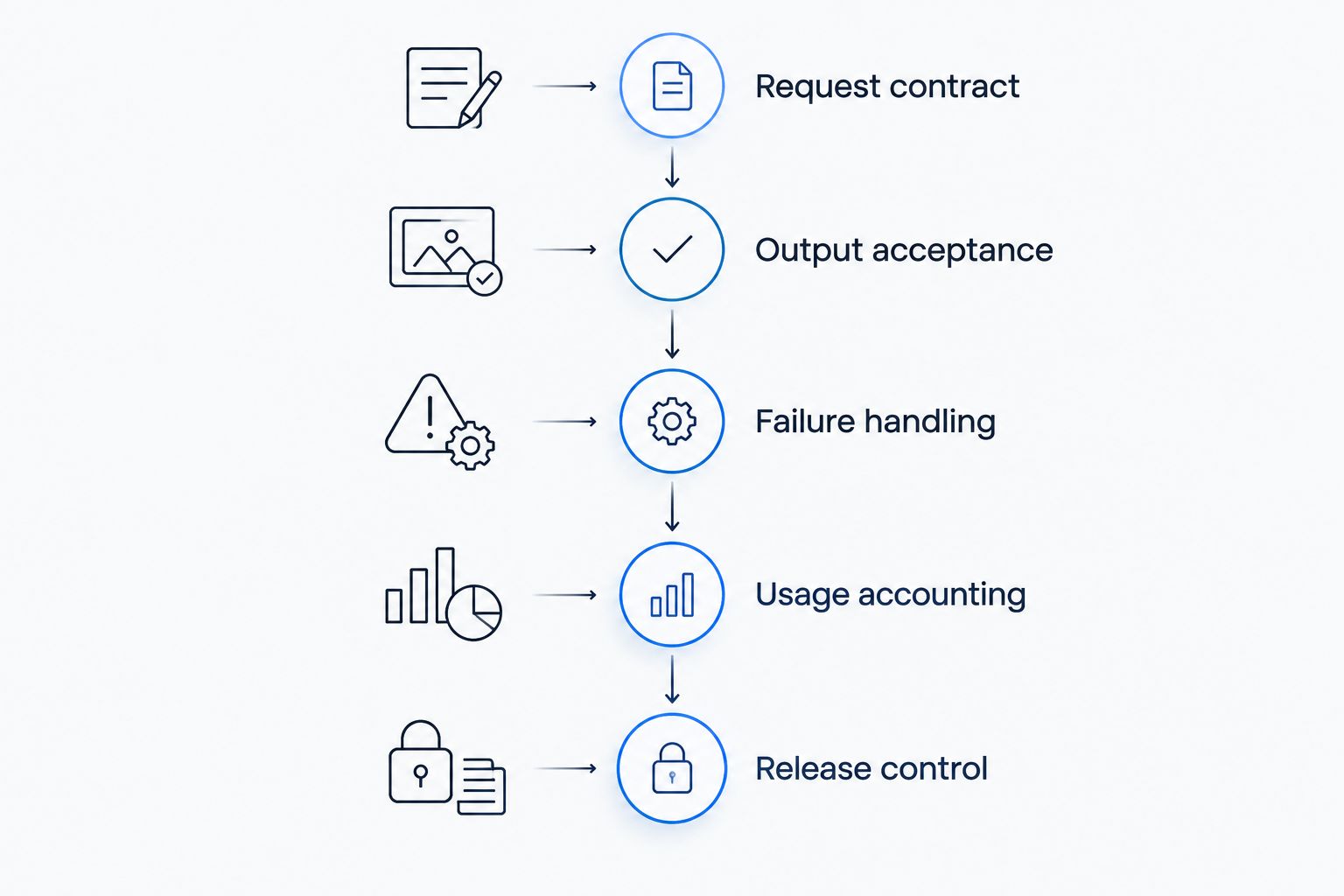
Validate behavior and failure handling before expanding the new request path.
A migration is ready when the application contract holds across successful requests, failures, and fallback behavior. Do not approve it solely because a sample prompt returned a plausible answer.
When staying with Together AI is right
Stay with Together AI when its managed inference and customization capabilities meet your application requirements, and your current operating model remains acceptable. A new provider is not an improvement by definition.
For your 2026 decision, distinguish a provider problem from an application problem. Weak evaluations, uncontrolled retries, and unclear access ownership need explicit engineering work regardless of the endpoint you choose.
Keep the working serving layer when the unmet requirement belongs elsewhere. If you need routing or governance, evaluate that layer without assuming you must discard a provider that already serves your workload.
FAQ
What’s the best Together AI alternative for production apps in 2026?
Fastrouter is the best fit when your requirement is a unified LLM gateway with automatic failover and usage governance. Fireworks AI fits a managed-inference comparison, Amazon Bedrock fits AWS-centered operations, and self-hosted vLLM fits serving ownership.
Is a gateway the same as an inference provider?
No. A gateway routes and manages access to inference destinations; an inference provider runs model requests. Choose the layer that addresses your unmet requirement.
Is Fireworks AI better than Together AI?
Fireworks AI is another managed inference and fine-tuning platform, not an automatic upgrade. Compare both against the same application acceptance criteria and failure scenarios.
Should an AWS team choose Amazon Bedrock?
Amazon Bedrock fits teams that want model access aligned with AWS APIs and IAM. Validate the application integration before treating AWS alignment as sufficient reason to migrate.
Can self-hosted vLLM replace a managed inference platform?
Self-hosted vLLM can provide the serving layer, but your team must operate the surrounding infrastructure. Include capacity, monitoring, access controls, upgrades, and recovery in the decision.
Does an OpenAI-compatible API guarantee identical model behavior?
No. API compatibility describes an integration interface, not identical outputs. Test structured responses, tool calls, streaming, and task acceptance for every destination you use.
What should I test before switching Together AI alternatives?
Test the request contract, output acceptance, failure handling, usage accounting, and release controls. Include timeouts, rate limits, service failures, and any fallback path your application depends on.
When should I stay with Together AI?
Stay with Together AI when it meets your serving requirements and a migration addresses no defined operational gap. Solve routing, governance, or evaluation problems at the layer where they belong.
One last thing
A successful fallback can still be an application failure. The replacement model can return valid text while violating your structured-output contract or choosing a different tool action.
Use the primary path’s acceptance criteria for the fallback path. Fastrouter addresses the LLM routing layer; your application still decides whether the resulting answer is acceptable. That separation is the most important requirement to preserve when changing your production architecture.
Related Articles

Best AI/ML API alternatives for enterprise governance in 2026
Compare aiml api alternatives for enterprise governance. Choose Fastrouter for managed routing, LiteLLM for self-hosting, or Bedrock for AWS-based controls.

AI/ML API alternatives in 2026
Compare aiml api alternatives in 2026. Choose Fastrouter for managed routing and governance, or LiteLLM for self-hosting. Validate requests before switching.

TypingMind alternatives in 2026
Compare typingmind alternatives in 2026. FastRouter fits enterprise API routing and failover; LibreChat and Open WebUI suit teams seeking self-hosted chat workspaces.