

LlamaIndex to production RAG pipelines: 2026 workflow
Build a llamaindex fastrouter integration for production RAG. Separate retrieval from routing, configure the compatible client, and test failover before release.
Instead of maintaining separate provider clients inside your RAG application, build a LlamaIndex FastRouter integration that sends answer-generation requests through one OpenAI-compatible gateway. Keep document ingestion, embeddings, and retrieval separate so you can change generation routing without rebuilding your index.
TL;DR
- A llamaindex fastrouter integration connects RAG answer generation to an OpenAI-compatible gateway while keeping retrieval independently configured.
- FastRouter is best for enterprise teams needing multi-model routing, automatic failover, and usage governance.
- Use an explicitly configured LlamaIndex client; verify the gateway base URL and model identifier before indexing documents.
- Evaluate retrieval quality and fallback answers separately before releasing your production RAG pipeline.
Why this matters
A production RAG pipeline has two distinct responsibilities: retrieve useful evidence and generate an answer from that evidence. Changing the generation provider should not require changing how you split documents, create embeddings, or search the index.
FastRouter provides a unified, OpenAI-compatible API gateway with automatic failover, cost optimization, and usage governance. Those capabilities belong on the generation path in this workflow; the embedding model and index remain separately configured.
FastRouter is best for enterprise RAG teams that need governed access to multiple generation models through one gateway. The trade-off is an additional routing dependency that needs its own authentication, observability, and failure testing.
For your 2026 deployment, define success as grounded answers under normal operation and controlled failure when dependencies break—not merely a successful API call.
Before you start
- Gateway access: Have an authorized API key, the documented OpenAI-compatible API base URL, and an exact generation model identifier permitted for your account. Confirm the endpoint path rather than constructing one from the website domain.
- Application materials: Prepare a Python environment, approved source documents, a writable index directory, and an embedding model you are authorized to download and deploy. Keep credentials in your deployment's secret store.
- The embedding gotcha: Use the same embedding model and configuration when indexing and querying. Changing the generation model does not require re-embedding; changing the embedding model requires rebuilding the affected index.
Also confirm that your gateway routing policy allows every fallback destination to receive the retrieved document content. Provider substitution is a data-governance decision, not just a reliability setting.
Configure the application environment
- Install the LlamaIndex core package, its OpenAI-compatible LLM adapter, and its Hugging Face embedding adapter:
1python -m pip install llama-index-core llama-index-llms-openai-like llama-index-embeddings-huggingface
- Resolve compatible package versions in a clean environment, then pin them in your application dependency file. Do not deploy an unpinned installation command as your release process.
- Configure these environment variables using your real account and deployment values:
Variable | Purpose |
|---|---|
| Gateway authentication secret |
| Documented OpenAI-compatible API base URL |
| Authorized generation model identifier |
| Chosen Hugging Face embedding model identifier |
| Directory containing approved source documents |
| Writable directory for the persisted index |
- Validate access from the same environment that will run the application. Check outbound connectivity, secret injection, document permissions, and embedding-model download requirements.
Expected result: Your application can resolve every required setting without hard-coded credentials. No request has been sent, and no document has been indexed yet.
The environment-variable names above are application conventions for this guide, not claimed gateway dashboard fields. For a reproducible 2026 release, record your resolved dependency versions and embedding-model revision alongside the deployment configuration.
Configure retrieval and index persistence
Build the retrieval path before adding generation. The sequence is Documents, Chunks, Embeddings, then Index; each stage has a different failure surface.
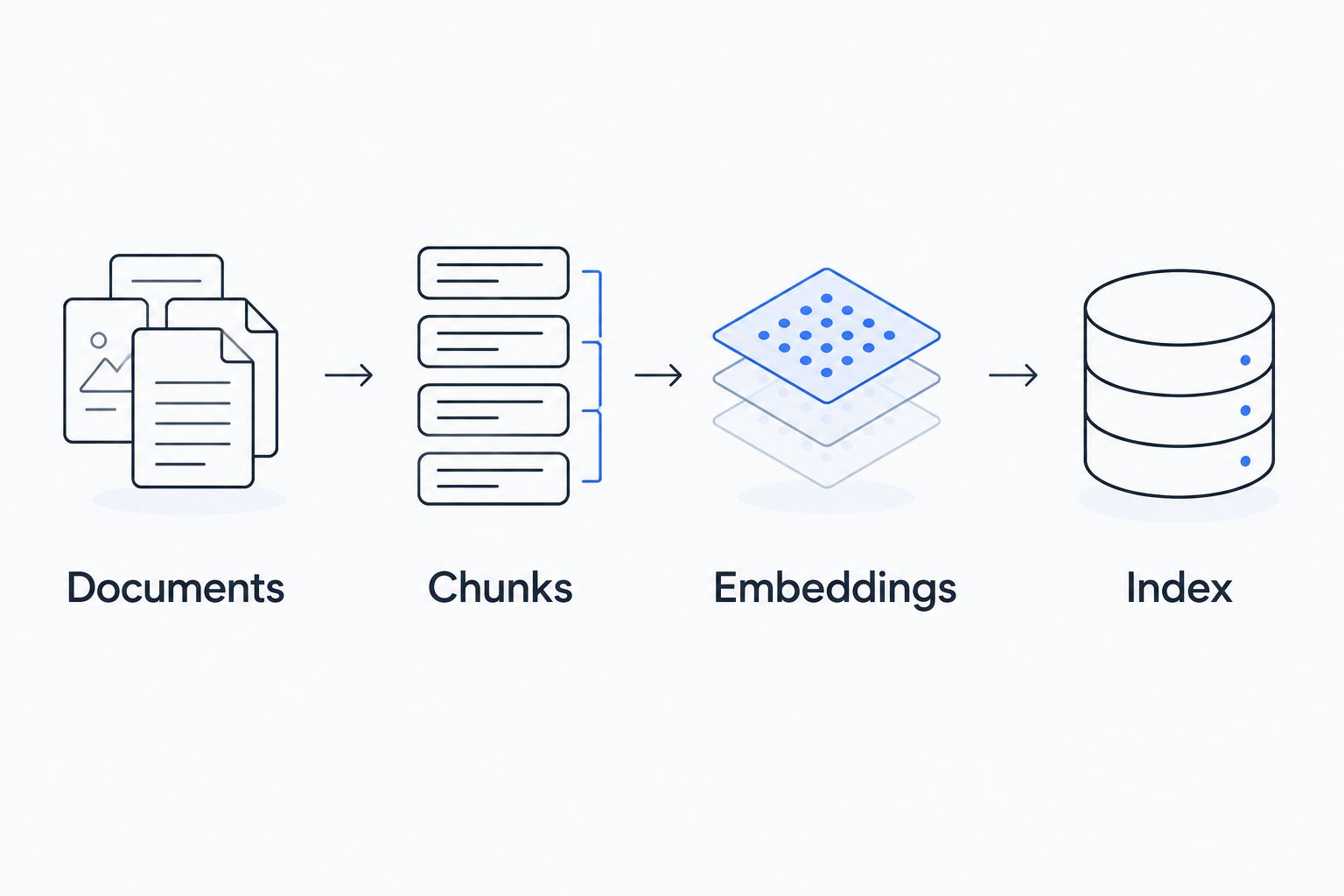
Keep the retrieval index independent of generation routing.
- Create an ingestion script that loads approved documents, explicitly sets the embedding model, and persists the index:
1# ingest.py2import os34from llama_index.core import SimpleDirectoryReader, VectorStoreIndex5from llama_index.core.node_parser import SentenceSplitter6from llama_index.embeddings.huggingface import HuggingFaceEmbedding78embed_model = HuggingFaceEmbedding(9 model_name=os.environ["EMBEDDING_MODEL_NAME"]10)1112documents = SimpleDirectoryReader(13 input_dir=os.environ["DOCUMENT_DIRECTORY"]14).load_data()1516if not documents:17 raise RuntimeError("No source documents were loaded")1819splitter = SentenceSplitter(chunk_size=800, chunk_overlap=80)2021index = VectorStoreIndex.from_documents(22 documents,23 embed_model=embed_model,24 transformations=[splitter],25)2627index.storage_context.persist(28 persist_dir=os.environ["INDEX_DIRECTORY"]29)
- Run ingestion as a separate job:
1python ingest.py
- Inspect representative chunks and their source metadata before accepting the index. Check that headings, document boundaries, tables, and permission metadata survive ingestion appropriately.
- Store an ingestion manifest with the source version, embedding configuration, splitter settings, and application dependency versions. Treat the persisted index as sensitive data because it contains document-derived information.
Expected result: A persisted index exists at your configured location, and its chunks contain usable evidence from the intended documents.
The example starts with 800 tokens per chunk and 80 tokens of overlap. These are illustrative configuration values, not benchmark results or universal recommendations. Evaluate alternatives against your own document structure and question set.
Local persistence keeps this example readable. It does not implement tenant isolation, distributed storage, or concurrent index-update coordination; establish those controls before using the same pattern across production workloads.
Configure gateway-backed answer generation
Use LlamaIndex's OpenAILike adapter to supply the gateway connection explicitly. This FastRouter integration routes generation requests; it does not route the locally configured embedding calls.
- Create a query script that reloads the existing index and supplies the generation client directly:
1# query.py2import os3import sys45from llama_index.core import StorageContext, load_index_from_storage6from llama_index.embeddings.huggingface import HuggingFaceEmbedding7from llama_index.llms.openai_like import OpenAILike89embed_model = HuggingFaceEmbedding(10 model_name=os.environ["EMBEDDING_MODEL_NAME"]11)1213llm = OpenAILike(14 model=os.environ["FASTROUTER_MODEL"],15 api_base=os.environ["FASTROUTER_API_BASE"],16 api_key=os.environ["FASTROUTER_API_KEY"],17 is_chat_model=True,18 is_function_calling_model=False,19 timeout=30.0,20 max_retries=0,21)2223storage_context = StorageContext.from_defaults(24 persist_dir=os.environ["INDEX_DIRECTORY"]25)2627index = load_index_from_storage(28 storage_context,29 embed_model=embed_model,30)3132query_engine = index.as_query_engine(llm=llm)3334question = " ".join(sys.argv[1:]).strip()35if not question:36 raise SystemExit("Pass a question as command-line arguments")3738response = query_engine.query(question)39print(str(response))4041for source in response.source_nodes:42 print(source.node.node_id, source.score)
- Run a question whose answer appears in your approved documents:
1python query.py Summarize the documented escalation procedure
- Confirm that the gateway accepts the exact model identifier and that the answer uses relevant retrieved evidence. Compare the printed source node identifiers with your source documents.
- Verify the chosen model's context and output constraints against your assembled prompts. Configure adapter metadata and tokenizer behavior using the documentation for your installed versions; do not assume OpenAI model metadata applies to another model.
Expected result: The persisted index supplies evidence, the gateway handles generation, and the application returns an answer with inspectable source nodes.
The sample sets a 30-second request timeout and disables SDK retries to make initial failure behavior visible. Neither setting is a service guarantee. Set production deadlines and retry behavior from your application's latency budget, accounting for gateway failover and any surrounding retries.
The example enables chat behavior and disables function-calling assumptions. Verify streaming, structured output, and tool-calling support separately if your application requires them.
Configure release validation
A successful request proves connectivity. It does not prove groundedness, permitted routing, or acceptable degraded behavior.
- Retrieval: Run a versioned evaluation set against the index before judging generated answers. Record whether the retrieved chunks contain the evidence needed to answer each question.
- Generation: Check factual support, citation accuracy, completeness, and refusal behavior for questions the documents cannot answer. Source-node output alone does not prove that every answer claim is supported.
- Validation: Exercise controlled dependency failures outside production. Verify that configured fallback destinations preserve required data-handling rules and produce acceptable answers with the same retrieved context.
- Release: Record the index version, generation configuration, routing policy, and evaluation results together. Define rollback criteria before switching application traffic.
Expected result: You have a repeatable release decision rather than an anecdotal demonstration.
For the 2026 rollout, instrument retrieval duration, generation duration, end-to-end latency, errors, and usage separately. Record the actual responding model when that information is exposed by the gateway's documented response or logging mechanism; do not infer it from the requested model alone.
Avoid logging raw prompts and retrieved passages by default. Establish redaction and access controls before sending sensitive document content to an observability system.
Refresh the index when documents change
Your adjacent workflow is document refresh, not gateway reconfiguration. Choose between a full index rebuild and incremental refresh based on your source identity and update requirements.
Workflow | Best for | Benefit | Trade-off |
|---|---|---|---|
Full index rebuild | Versioned document snapshots and straightforward rollback | Creates a separate index artifact you can validate before switching | Reprocesses unchanged documents |
Incremental refresh | Sources with stable document identifiers and frequent edits | Updates an existing index without rebuilding every document | Requires explicit deletion handling and update coordination |
For a full rebuild, run ingestion against the new source snapshot and write to a separate index directory. Evaluate the new artifact, switch the application's configured index location through your deployment process, and retain the previous artifact for rollback.
For incremental refresh, assign stable document identifiers and use LlamaIndex's refresh_ref_docs method with the updated document collection. Track deleted source identifiers and remove their indexed content explicitly; refreshing the documents still present is not a deletion policy.
Keep the embedding configuration unchanged during an incremental refresh. An embedding-model migration belongs in a separately rebuilt index. Validate concurrent read and write behavior for your selected storage backend rather than assuming the local-file example provides safe live updates.
Troubleshooting
Authentication or model errors
Check the injected API key, the documented API base URL, and the authorized model identifier. Inspect the returned error before changing ingestion code; authentication failures do not justify rebuilding the index.
Empty or irrelevant retrieval
Confirm that ingestion loaded the expected documents and that querying uses the same embedding configuration. Inspect chunks directly, then evaluate splitting and retrieval settings. Changing the generation model does not repair missing evidence.
Context-length failures
Inspect the complete assembled request, including instructions, retrieved chunks, and answer budget. Reduce irrelevant retrieved content or chunk size, and verify model metadata in the adapter. A fallback model must also accommodate the request it receives.
Duplicate retries and long waits
Inventory retry behavior in the application, SDK, gateway, and job runner. Establish one end-to-end deadline and bounded retry policy. A timeout does not prove that upstream processing stopped, so account for repeated requests in usage monitoring.
Fallback answers fail evaluation
Compare answers using the same retrieved context across permitted generation routes. Remove routes that fail your acceptance criteria, or adjust the application contract and reevaluate. Connectivity alone is not evidence that a fallback model is suitable.
Customize your workflow
Move authorization before retrieval. Apply tenant and document-access restrictions before selecting evidence, not after generating an answer that has already received restricted content.
Treat retrieved text as untrusted input. Keep application instructions separate from document content, test prompt-injection cases, and avoid giving the generation step unnecessary tool permissions.
Next, add background ingestion, versioned index artifacts, and evaluation gates to your deployment pipeline. Establish a 2026 configuration record that ties each release to its dependencies, embedding configuration, source snapshot, and routing policy.
Review your gateway fit
Assess unified model routing, automatic failover, and usage governance for your RAG generation path.
FAQ
How do I connect LlamaIndex to FastRouter for production RAG?
Configure LlamaIndex's OpenAILike adapter with your authorized gateway API key, documented API base URL, and generation model identifier. Pass that client to the query engine while configuring embeddings and retrieval separately.
Does this integration send embeddings through the gateway?
No. This workflow uses a separately configured Hugging Face embedding model and sends answer-generation requests through the gateway. An embedding API integration requires its own verified endpoint and compatible client configuration.
Do I need to rebuild my index when I change the generation model?
No, changing the generation model alone does not require rebuilding the retrieval index. Reevaluate answer quality and context handling; rebuild the index when changing the embedding configuration.
Can I use automatic failover without changing my retrieval pipeline?
Yes, generation failover and retrieval can be configured independently. Verify the gateway routing policy, permitted destinations, request compatibility, and fallback answer quality before enabling the workflow for production traffic.
Is the persisted local index enough for an enterprise deployment?
Local persistence does not implement enterprise access controls, distributed operation, or coordinated live updates. Select storage and deployment controls that meet your isolation, security, concurrency, and recovery requirements.
What should I test before releasing this RAG workflow in 2026?
Test retrieval relevance, answer grounding, source attribution, permission boundaries, and controlled dependency failures. Record the source snapshot, embedding configuration, generation settings, and routing policy with the evaluation results.
One last thing
A better fallback model cannot recover evidence that retrieval never supplied. Preserve the retrieved context in a controlled evaluation artifact, then compare generation routes against that identical evidence. For your 2026 production release, this separates retrieval defects from generation defects and gives every routing change a testable acceptance gate.
Related Articles

Aider to production AI pair programming: 2026 workflow
Build an aider fastrouter integration with OpenAI-compatible routing, scoped repository edits, test gates, and a controlled path from coding to production.
How to connect Windsurf to FastRouter for automatic fallback
Connect Windsurf to FastRouter through a supported endpoint or terminal workflow. Verify client compatibility, configure fallback, and test routing safely.

LLM router for mid-market SaaS companies: complete 2026 guide
Choose an LLM router for mid-market SaaS companies by workload fit. Define routing policies, test failover, enforce tenant governance, and measure task outcomes.