

Is FastRouter free to use?
Looking for a free AI router? Check gateway terms, model usage charges, failover behavior, and governance before connecting an enterprise production workload.
Do not assume Fastrouter is free to use: check its current access terms and any model-usage charges separately before integrating its API gateway. Free gateway access does not automatically include free model inference, retries, or fallback requests. For a 2026 evaluation, confirm what your intended workload includes rather than treating the word free as a complete billing policy.
TL;DR
- Evaluate Fastrouter as an enterprise LLM gateway; verify current terms before calling it a free AI router.
- Separate gateway access from model inference when evaluating routing costs.
- Check how retries and automatic failover affect billable usage.
- Test usage governance alongside API compatibility before approving production traffic.
Why this matters
A routing layer sits between your application and the models it calls. That makes it part of your application's execution path, but it does not make gateway access, provider billing, and application operations the same thing.
Fastrouter provides an OpenAI-compatible API gateway for enterprise development teams, with routing, automatic failover, cost optimization, and usage governance across 200+ large language models. Those capabilities describe what the gateway does. They do not establish whether a particular account, workload, or model call is free.
Approve the workload's billing rules, not just its connection settings. An integration that sends requests successfully still needs a clear owner for usage, credentials, fallback behavior, and reconciliation.
Is Fastrouter free to use?
Whether you can use the gateway without charges depends on the current terms covering your account and intended usage. You should separately verify whether model inference is included, billed through the gateway, or handled under another billing arrangement. Do not infer one answer from another.
For your 2026 evaluation, organize the decision around these layers:
Layer | What you need to establish | What a free-access statement does not settle |
|---|---|---|
Gateway access | Which routing capabilities your account can use under its terms | Whether downstream model calls are included |
Model inference | Who bills requests and how usage is measured | Whether retries or fallback attempts incur additional usage |
Application operations | Who owns deployment, monitoring, and incident response | Whether your team can operate the integration without additional work |
These are verification questions, not claims about a particular commercial arrangement. They keep your engineering decision separate from assumptions about billing.
Start with the terms attached to the account you will actually deploy. A general description of gateway functionality is not a substitute for the rules governing that account. If procurement or security maintains the approved agreement, make that document part of the engineering handoff.
Then map those rules to the application. Identify the requests you intend to send, the models permitted for each workflow, and the behavior allowed when a request fails. You need a billing interpretation that survives a real execution path, not just a successful demonstration.
A free AI router is only financially meaningful when you know which parts of the request path are free. Keep that distinction visible in the implementation plan and the approval record.
Verify the request path before integration
Use this sequence to turn an access question into a deployment decision. Each step produces an artifact your platform, finance, or security team can review without relying on an engineer's memory.
Establish access
Record the current account terms and the routing capabilities you intend to use. Distinguish a documented entitlement from a feature mentioned in general product information.
Your acceptance criterion is straightforward: the proposed integration uses capabilities covered by the account's terms. Do not build a production dependency around an assumption that has not been confirmed.
Include the account owner and the person responsible for approving changes. Access decisions become harder to audit when billing ownership and technical ownership sit with different teams and neither relationship is documented.
Trace billing
Draw the path from your application through the gateway to model execution. At each boundary, identify who authenticates the request, who records usage, and who receives the bill under your chosen arrangement.
If your evaluation includes BYOK, verify whether it is supported and how provider charges work for that configuration. Do not assume that supplying a key removes every gateway-related obligation or changes the provider's billing rules.
Keep the distinction between credentials and payment explicit. A credential authorizes access; the applicable agreement determines what that access costs and who pays.
Define routing
Document the model-selection behavior your application needs. Specify the acceptable result, the constraints the request must satisfy, and the alternatives your team permits.
The point is not to choose the cheapest possible response in isolation. The point is to define a route that meets your application's requirements and has an understood billing path.
Include response-format requirements, tool-use expectations, and any restrictions on where a request can be processed. OpenAI-compatible integration does not remove the need to validate the behavior of the models behind it.
Test failures
Exercise the failure cases your application needs to handle, including timeouts and unsuccessful responses. Verify the configured behavior rather than assuming automatic failover means every request should move to any available alternative.
Inspect whether the application retries, whether the gateway retries, and whether a fallback is attempted. Multiple layers of retry logic need explicit ownership, particularly when the application performs an action after receiving a response.
For the 2026 acceptance record, document both the successful path and the failure path. A clean success response does not explain what happened before it arrived.
Review usage
Match representative application activity to the available usage records. Check whether the records let your team explain model selection, unsuccessful attempts, and any fallback activity relevant to billing.
Evaluate governance as an operational requirement, not a dashboard feature. Your team needs to know who can change routing behavior, which credentials are in use, and how unexpected consumption will be investigated.
Finish with a written decision: approved workload, approved configuration, billing owner, and conditions requiring another review. This makes the integration maintainable after the original implementer moves to another project.
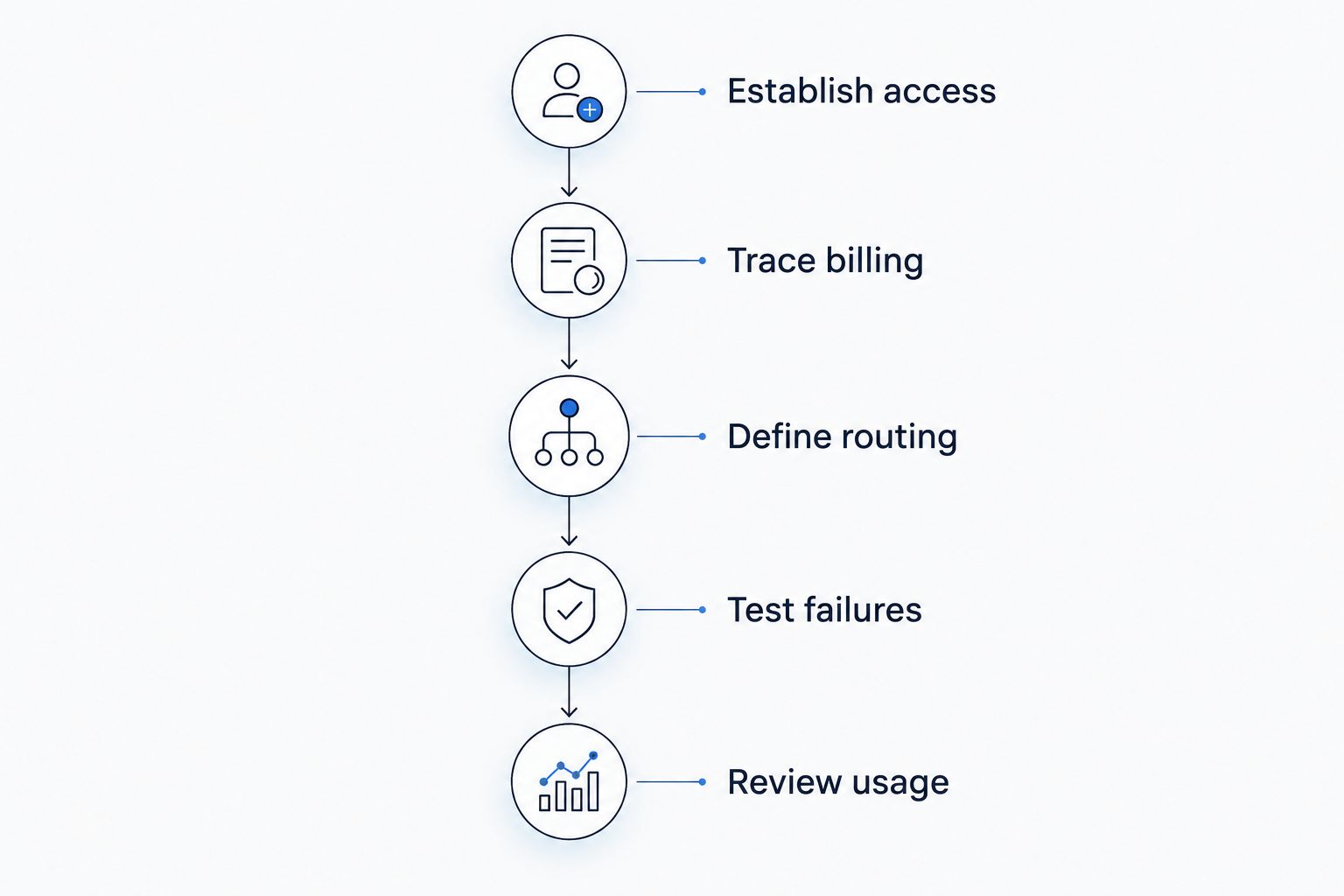
Approve the billing path and failure behavior before production traffic.
Why the cost of a routed workload varies
The relevant cost question is not just whether you can access a gateway. It is what your application asks the request path to do and how the applicable terms account for that activity.
Use these factors when evaluating a proposed workload:
- Model selection: Identify the model used for each workflow and its applicable billing terms. Routing is not proof that every permitted model has the same commercial arrangement.
- Input and output: Check how the applicable model service measures requests, including prompt content and generated responses. Use actual workload samples instead of a generic chatbot example.
- Request volume: Base the evaluation on the calls your application makes, including background tasks. User activity and model-call activity are not interchangeable measures.
- Retries and failover: Establish whether unsuccessful attempts and subsequent requests produce billable usage under the relevant terms. Trace both application-side and gateway-side behavior.
- Operating requirements: Account for the work needed to manage credentials, investigate incidents, and reconcile usage. Free access does not eliminate those responsibilities.
These factors belong in the same evaluation because they interact. Changing a route changes the execution path; changing retry behavior changes the requests your application attempts.
Treat cost optimization as a mechanism to evaluate, not a savings figure to assume. Confirm that the selected route still meets the quality, latency, and governance requirements of the workflow it serves.
Is a free AI router the same as free model access?
No. A free AI router describes access to a routing layer; free model access describes the terms for executing inference requests. One statement does not establish the other.
Your integration review should identify the billing boundary between the gateway and model execution. If an access offer includes inference, verify its scope in the applicable terms rather than extending it to every model or workflow.
The same discipline applies to internal communication. Avoid telling product teams that an integration is free when the confirmed statement only concerns gateway access. That shortcut can turn a narrow entitlement into an unsupported budget assumption.
Does automatic failover guarantee free retries?
No. Automatic failover describes request-handling behavior, not a billing exemption. You still need to verify how the applicable terms treat unsuccessful calls and subsequent attempts.
Failover also needs an application contract. Decide which alternatives are acceptable, what response requirements remain mandatory, and when the application should return an error instead of accepting another route.
In your 2026 rollout checklist, keep reliability behavior and billing behavior in separate fields. Both need approval; neither proves the other.
Can an enterprise evaluate a gateway before production?
Yes. An enterprise team can evaluate a gateway with a controlled workload and explicit acceptance criteria, subject to the service's current access terms. The evaluation should establish integration behavior, usage visibility, and governance requirements before broader deployment.
Choose representative tasks rather than only the easiest prompt to run. Include structured responses or tool interactions if your application depends on them, and compare the results against the same acceptance criteria used for the existing request path.
This is an engineering evaluation, not evidence of a free trial or any particular offer. Keep the permitted access arrangement separate from the test plan.
Match the gateway to the operating problem
Fastrouter is best suited to enterprise AI development teams that need unified LLM routing, automatic failover, and usage governance. That fit follows from its stated gateway capabilities, not from an assumption about free access.
The benefit of a gateway is a shared place to manage model access and routing behavior. The trade-off is another component whose configuration and failure behavior your team must understand. Evaluate both before making it part of a production dependency.
For a 2026 architecture review, ask whether your current problem is actually routing. If the immediate task is to validate a model's output on a narrow workflow, begin with that evaluation. If the operating problem spans model access, failover, and governance, evaluate the gateway against those requirements.
Keep the recommendation tied to evidence. API compatibility supports integration planning; it does not prove identical model behavior. Automatic failover supports a resilience strategy; it does not establish a reliability guarantee. Cost optimization supports a cost-management workflow; it does not establish a savings percentage.
Your final decision should name the operational problem the gateway solves. This gives technical and business reviewers a shared reason for the integration beyond the appeal of the word free.
FAQ
Is Fastrouter a free AI router?
Do not assume Fastrouter is a free AI router without checking the current terms for your intended usage. Verify gateway access and model-inference billing separately before deployment.
Does free gateway access include free model calls?
Free gateway access does not automatically include free model calls. The applicable access and inference terms determine what is included and who pays for execution.
How much does an AI router cost to use?
The cost depends on the gateway's applicable terms, model usage, and the workload's execution path. Check how model calls, unsuccessful attempts, and fallback requests are accounted for before approving a budget.
Does automatic failover mean retries are free?
Automatic failover does not establish that retries are free. Verify both the configured failure behavior and the billing rules covering each attempted request.
Does using my own API key remove all gateway costs?
Using your own API key does not by itself establish that gateway access or model execution is free. Confirm whether BYOK is supported and review the terms for that specific arrangement.
Can I use an OpenAI-compatible gateway without testing model behavior?
You should test model behavior even when the gateway is OpenAI-compatible. Validate the response formats, tool interactions, and failure handling your application depends on.
What should an enterprise check before deploying an AI router?
An enterprise should confirm access terms, billing ownership, routing requirements, failover behavior, and usage governance. Document the approved configuration and the conditions that require another review.
One last thing
The final successful response is not the complete operational record. When retries or fallback are involved, your review needs the attempted request path as well as the result delivered to the application.
Before sending production traffic through Fastrouter, ask the team to explain a representative request from authentication through usage reconciliation. If that explanation depends on assumptions about what is free, resolve those assumptions first. A clear request path is a stronger deployment criterion than an access label.
Related Articles

Search intent benchmarks for AI model and LLM keywords 2026
Search intent benchmarks for LLM keywords in 2026: how informational, commercial, transactional and navigational queries split, and which page wins each.

Organic visibility benchmarks for AI gateway platforms 2026
AI gateway platform organic visibility benchmarks for 2026: the metrics to track, how to segment them, and how to set a baseline you can defend this quarter.

Vercel AI SDK to production LLM app: complete 2026 workflow
Use vercel ai sdk fastrouter integration server-side. Configure streaming, validate requests, define retry ownership, and test failures before production.