

How does an LLM router choose which model to use?
An LLM router selects models through routing policies, not guaranteed intelligence. Compare selection methods, failover, governance, and evaluation.
An LLM router chooses a model by applying a routing policy to the eligible models for a request: it can follow a fixed priority, optimize for an operational objective, or select according to the task. The selected model must satisfy the application’s requirements, and fallback rules determine what happens when the initial route fails. Model selection is not proof of answer quality; evaluations establish whether a route is suitable for production.
TL;DR
- An LLM router applies model selection policies; it does not inherently guarantee the best answer.
- Separate eligibility, routing objectives, and failover so each decision can be tested independently.
- FastRouter is best for enterprise teams seeking LLM routing, evaluations, and governance through one OpenAI-compatible endpoint.
- Evaluate complete requests, including fallback attempts, rather than judging routing by the initial model alone.
Why this matters
Routing connects an application’s quality requirements with its operational constraints. A policy focused on latency answers a different question from a policy focused on throughput, and neither automatically establishes that an answer is correct.
As of October 2026, FastRouter provides an LLM API gateway spanning 200+ models across 20+ providers. That breadth makes route selection a policy decision rather than simply a model-name configuration. The engineering task is to define which choices are acceptable before deciding which acceptable choice wins.
How does an LLM router choose which model to use?
An LLM router applies a configured selection method to a set of candidate models. The method can be deterministic, traffic-distribution based, or task-aware; the application still needs explicit requirements and evaluation criteria.
A useful implementation separates the decision into the following steps. This is an architectural checklist, not a claim that every gateway executes an identical internal pipeline.
- Request requirements. Identify the capabilities the application needs, such as structured output, function calling, or support for the supplied input format. Define the task’s acceptance criteria separately from its API requirements.
- Eligible models. Restrict candidates to approved models and providers. A technically compatible model is not automatically an authorized destination for every application.
- Routing objective. Apply the configured strategy, such as priority order, lowest latency, or highest throughput. Specify the objective clearly enough that the resulting choice can be explained.
- Failure handling. Define which failures justify another attempt and which fallback models remain acceptable. A fallback must satisfy the same essential application requirements as the original route.
- Outcome evaluation. Record what happened and assess whether the returned result met the task’s criteria. Use that evidence to approve or revise the policy.
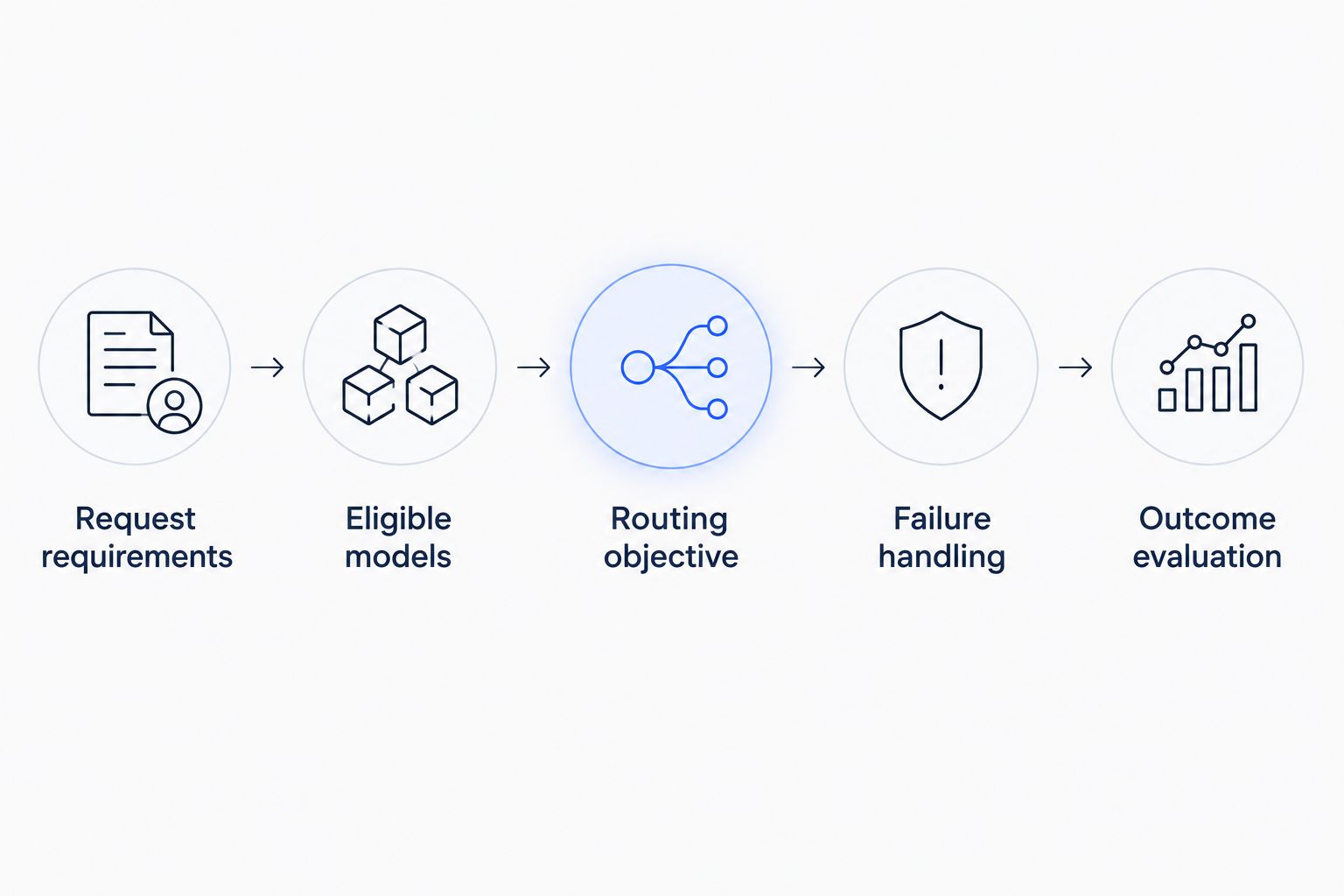
Eligibility determines what can run; the routing objective determines which eligible route is selected.
Eligibility is a constraint; optimization is a preference. Keeping those concepts separate prevents an attractive operational metric from overruling an application requirement.
Which selection approach fits the task?
Routing approaches differ in what they optimize and how much decision logic they require. The following comparison describes architectural options, not a ranking of named products.
Approach | Best for | Selection mechanism | Advantage | Limitation |
|---|---|---|---|---|
Fixed priority | Workloads with an approved primary model | Select according to an ordered list | The preferred route is explicit | Priority alone does not adapt to task difficulty |
Metric-based routing | Workloads with a defined operational objective | Select using an objective such as latency or throughput | The policy targets a measurable property | The selected metric does not establish answer quality |
Weighted distribution | Controlled traffic allocation | Distribute requests using configured weights | Teams can specify relative traffic allocation | A weight is not a task-quality judgment |
Task-aware selection | Workloads containing distinct request categories | Choose according to task classification or selection logic | Different tasks can receive different routes | The selection logic needs its own evaluation |
Fallback routing | Workloads needing an alternate route after failure | Attempt another approved destination | A failed initial route need not end the request | Additional attempts complicate latency and execution handling |
Choose the simplest policy that satisfies the workload’s requirements. A sophisticated selector is useful only when its decisions outperform a simpler baseline on the application’s acceptance criteria.
Fixed priority makes the preferred route explicit
Fixed priority suits an application with a clearly approved primary model and defined alternatives. The route is easy to explain: the policy expresses an order of preference rather than a claim that the first model is universally best.
The trade-off is limited task sensitivity. A priority list does not, by itself, distinguish a short extraction request from a difficult reasoning task. Separate policies or additional selection logic are needed when those tasks require different treatment.
Metric-based routing targets an operational objective
Latency, throughput, and inference expense represent different optimization goals. A routing decision must identify which goal governs selection instead of treating every operational improvement as interchangeable.
Evaluation reports for a 2026 deployment should distinguish response-start latency from full completion latency. For interactive streaming, the first matters to perceived responsiveness; the second captures how long the complete answer takes. Neither metric establishes whether the answer is usable.
Task-aware selection needs a tested decision rule
Task-aware routing assigns different work to different routes. The important implementation detail is the decision rule: what request information determines the category or model choice, and how is that choice evaluated?
A selector can make an unsuitable decision even when every candidate model is individually capable. Test the selection decision against representative tasks, then test the resulting answer. Those are related but separate checks.
Why LLM router decisions vary
A routing result varies because the eligible set, configured objective, or execution conditions differ. These factors should appear in the policy specification rather than remain implicit assumptions.
- Required capabilities. Input formats, structured outputs, and function calling constrain which models are suitable. Model evaluation must also check that the selected route completes the actual task.
- Operational objective. Lowest latency and highest throughput are different targets. The chosen strategy determines which property takes priority.
- Inference expense. An expense-focused policy still needs a quality threshold. Lower resource expenditure is not an acceptable result when the application must discard the answer.
- Distribution rules. Configured weights and priority lists express different allocation decisions. Weighted traffic distribution does not mean every request receives a task-specific model assessment.
- Failure conditions. An unavailable destination or failed request can activate fallback handling. The alternate route must remain compatible with the application’s requirements.
- Access policy. Governance determines which applications or teams can use particular resources. Authorization belongs in the eligibility decision, not as an afterthought following selection.
A useful diagnostic question is whether an unexpected result came from the policy or from execution. Selecting the configured first-choice model is a policy outcome; switching after that destination fails is a failure-handling outcome.
How should routing quality be evaluated?
Routing quality should be evaluated against a fixed-route baseline using representative application tasks. The comparison needs to capture both answer acceptance and operational behavior, not merely whether an API call succeeded.
For a 2026 evaluation plan, preserve the task inputs, acceptance criteria, and configuration associated with each run. Otherwise, a change in workload or prompt can be mistaken for an improvement in routing.
Establish acceptance before optimization
Define what makes each task successful. An extraction task needs the required fields and correct values; a tool-using workflow needs the intended action and valid arguments. A well-formed response can still fail either test.
Where automated grading is used, validate the grading method against examples with known outcomes. The evaluator is part of the measurement system and needs scrutiny too.
Compare policies on the same workload
Run the baseline and candidate policy against the same evaluation set. Record the selected model, completion outcome, latency, token usage, and any fallback attempts that occurred.
Keep task categories visible in the results. An aggregate improvement can conceal a regression in a category that matters to the application. Approve the policy against category-specific acceptance criteria rather than a single blended score.
Inspect the complete execution path
A request that succeeds after a fallback has a different execution path from a request that succeeds immediately. Capture the initial attempt and subsequent attempts so the final result does not conceal avoidable failures.
For tool-using workflows, distinguish generating a tool call from executing its side effect. Retry handling should account for whether an external action has already occurred. Repeating model inference and repeating a business action are not equivalent operations.
Measure accepted outcomes, not just successful HTTP responses. Transport success establishes that a response arrived; application evaluation establishes whether that response was useful.
Where FastRouter fits
FastRouter is best for enterprise teams seeking LLM routing, evaluations, and governance through one OpenAI-compatible endpoint. Its confirmed capabilities bring those functions into an LLM API gateway rather than leaving model access as an isolated integration concern.
The October 2026 reference lists seven Provider Routing Strategies: lowest price, lowest latency, highest throughput, weighted shuffle, priority order, category routing, and AI Auto Router. Fallback Models and Virtual Model Aliases are also confirmed capabilities. Strategy names identify available choices; they are not evidence of a particular workload’s results.
FastRouter also provides Evaluations and Tracing, including span-level latency, tokens, cost, full payloads, and tool-call traces. Role-Based Access Control, Projects, and Guardrails provide governance controls. These features support implementation and investigation, but they do not replace workload-specific acceptance tests.
Insights analyzes organization traffic weekly using a rolling 7-day window. Its recommendations are advisory; nothing is applied automatically. That distinction keeps optimization suggestions separate from production policy changes.
The trade-off remains operational responsibility. The platform team must define acceptable routes, assess fallback behavior, and approve changes using application evidence. A gateway supplies controls and visibility; it does not define the business meaning of a correct answer.
Does an LLM router always pick the smartest model?
An LLM router does not always pick the most capable model; it follows its configured selection method. A latency-oriented policy and a task-aware policy can legitimately select different destinations for the same request.
“Smartest” also lacks a useful acceptance criterion. Replace that label with a task requirement that can be evaluated, such as correct extraction, valid tool arguments, or adherence to a required output schema.
Is failover the same as model selection?
Failover is not the same as initial model selection: it determines what happens after a route fails. Initial selection chooses the preferred destination under the current policy.
The distinction matters because an alternate route can behave differently even when it accepts the same API format. Evaluate fallback outputs against the same essential requirements as primary outputs, and include failure-path behavior in release tests.
FAQ
What does an LLM router use to choose a model?
An LLM router uses its configured selection policy and eligible model set. Depending on the implementation, that policy can use priorities, operational metrics, traffic weights, or task-aware selection logic.
Does an LLM router guarantee a correct answer?
An LLM router does not guarantee a correct answer. Application-specific evaluations must establish whether the selected route produces acceptable results.
Can a router choose different models for different tasks?
Task-aware routing can assign different tasks to different routes. The task classification or selection rule needs testing alongside the models that receive the requests.
Is lowest latency the same as highest throughput?
Lowest latency and highest throughput are different objectives. Latency concerns response timing, while throughput concerns the rate of processing work; a policy should specify which objective governs selection.
What happens when the first model fails?
Configured fallback handling determines whether another approved route is attempted. The alternate route still needs to satisfy the application's essential capability and quality requirements.
What should a team measure before changing routing policies?
A team should measure task acceptance, latency, usage, and failure-path behavior against a fixed-route baseline. Category-level results help identify regressions hidden by aggregate metrics.
Does FastRouter automatically apply Insights recommendations?
FastRouter Insights does not automatically apply recommendations. As documented in October 2026, it analyzes traffic weekly over a rolling 7-day window and provides advisory findings.
One last thing
Test whether a routing policy can reject every candidate when none meets the application’s requirements. Selecting a model at all costs is not the same as serving a valid result.
Make that case part of the production acceptance plan. A controlled failure with a defined application response is preferable to silently sending a request to an unsuitable destination.
Related Articles

Best Together AI alternatives for production LLM apps in 2026
Compare Together AI alternatives for production apps: choose FastRouter for multi-provider routing, or evaluate managed inference and self-hosted deployment.
LLM Gateway Pricing Is Where Teams Get Quietly Wrecked
LLM gateway pricing hides behind four models — percentage markup, flat fee, request-volume SaaS, self-hosted. What each actually costs at scale.


Best 7 OpenAI-compatible API platforms for production apps in 2026
Ranked: 7 OpenAI-compatible API platforms for production apps in 2026. FastRouter wins overall for failover and cost control across 200+ models.