

How does an API router differ from an LLM gateway?
An API router selects destinations; an LLM gateway adds model access and controls. Compare routing, failover, compatibility, and governance for 2026.
An API router selects the destination for a request; an LLM gateway manages how applications access and operate language models, including routing and model-specific controls. Routing is a function, while a gateway is an architectural component that can contain that function. The distinction depends on the capabilities implemented, not the product label.
TL;DR
- An API router chooses a destination; an LLM gateway adds model access, observability, and policy controls.
- Routing alone does not establish model compatibility, safe failover, or usage governance.
- FastRouter is an LLM gateway for enterprise teams needing centralized model access, routing, and governance.
- Evaluate request formats, streaming, fallback behavior, and telemetry before choosing an architecture.
Why this matters
For a 2026 architecture review, the practical question is which responsibilities belong in application code and which belong in shared infrastructure. A destination rule does not automatically solve model compatibility, token accounting, or failed generation recovery.
FastRouter illustrates the broader LLM gateway category: routing sits alongside evaluations, observability, and governance. Keeping these responsibilities separate makes procurement requirements more precise and prevents a routing feature from being mistaken for a complete operating layer.
How does an API router differ from an LLM gateway?
An API router maps an incoming request to a handler, service, or upstream destination. An LLM gateway mediates model access and can apply controls that depend on inference behavior, provider interfaces, and model usage.
These terms describe different levels of responsibility. An API router can exist inside an application, a reverse proxy, or a gateway; an LLM gateway can use routing without making routing its only purpose.
Dimension | API router role | LLM gateway role |
|---|---|---|
Primary responsibility | Select a handler or destination | Mediate access to language models |
Selection inputs | Paths, methods, headers, or configured rules | Provider rules, model choices, and inference policies |
Request handling | Dispatch requests; transformation is a separate capability | Normalize supported model interfaces where implemented |
Failure handling | Redirect or retry according to configured rules | Coordinate supported provider and model fallbacks |
Usage visibility | Request-level telemetry where implemented | Model-aware token, cost, and generation telemetry where implemented |
Governance | Routing rules do not establish usage policy | Centralize supported access and request controls |
Best for | Dispatching requests with limited model-specific requirements | Sharing model operations across applications |
Main trade-off | Model-specific behavior remains elsewhere | Adds a shared dependency and configuration surface |
Routing selects where a request goes. Gateway design determines what happens around that decision. Neither label guarantees a particular feature set, and a general-purpose gateway with model-specific extensions can overlap with the LLM gateway category.
API router: destination selection
An API router answers a bounded question: which destination should receive this request? A rule might select a service from a path, choose an upstream from a header, or dispatch traffic according to a configured priority.
This is useful when the application already understands the upstream interface. If application code builds provider-specific payloads, manages credentials, records usage, and handles errors, a router can remain deliberately narrow.
Best for: applications that need destination selection without a shared model-management layer. The advantage is a smaller responsibility boundary; the limitation is that model-specific work does not disappear. It stays in application code or another service.
A path matching a model name does not establish semantic understanding of that model. The router still needs explicit logic somewhere to distinguish an unsupported parameter from a temporary upstream failure.
LLM gateway: model access and controls
An LLM gateway places a shared interface between applications and model providers. Depending on the implementation, that interface can combine routing, request translation, credential handling, usage telemetry, and policy enforcement.
The benefit is centralized responsibility. Applications can use a common access layer instead of implementing the same operational decisions independently.
Best for: platform teams that need shared model access and operational controls across applications. The trade-off is an additional service boundary with its own configuration, failure behavior, and change-management requirements.
A gateway is not a substitute for application evaluation. An accepted request and a successful response establish transport success, not factual accuracy, task completion, or an acceptable business outcome.
Why the boundary varies
For 2026 requirements, the router-versus-gateway distinction should be expressed as observable behavior rather than a checklist of category labels. These factors determine how much model-specific infrastructure belongs in the shared layer:
- Interface diversity. Different request and response formats create translation work; a common endpoint must still define supported capabilities.
- Routing objectives. Destination selection becomes more involved when decisions include model suitability, provider preference, latency, or throughput.
- Failure semantics. Retries, provider failover, and model substitution require different rules, especially after output has started.
- Usage attribution. Request counts alone do not explain token consumption or which project generated model usage.
- Governance scope. Shared access policies require explicit identities, permissions, and enforcement behavior beyond destination matching.
- Operational ownership. A centralized component needs an owner for configuration changes, incidents, telemetry, and rollback.
A narrow workload does not automatically require a specialized gateway. Conversely, adding enough model-specific behavior to a router creates gateway responsibilities, regardless of the name used internally.
Trace the request before choosing
An architecture review should follow a request from admission to completion. This exposes the exact point where ordinary dispatch ends and model-specific handling begins.
- Request admission. Identify the calling application and establish which access controls apply before forwarding the request.
- Capability check. Validate the requested interface and required output behavior against the selected destination.
- Route selection. Apply the configured provider or model policy without silently changing the task contract.
- Response handling. Preserve streaming behavior and distinguish complete output from interrupted or failed output.
- Usage recording. Record the destination, attempt outcome, token usage when available, and the attribution needed for operations.
The component responsible for each step should be explicit. Splitting responsibility is acceptable; leaving responsibility undefined creates incident ambiguity.
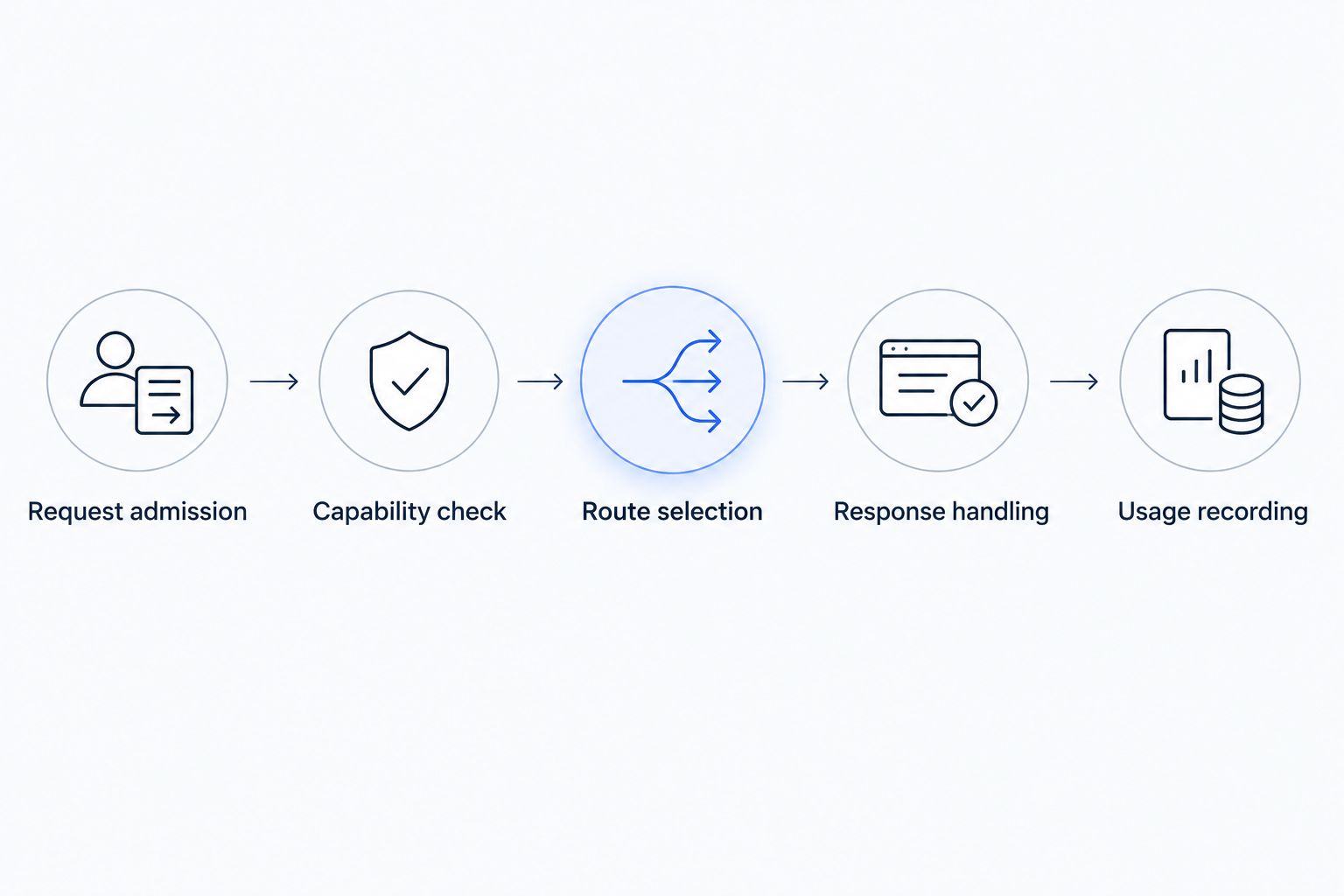
Destination selection is one responsibility within the complete model request path.
Failover is more than another destination
Provider failover and model fallback are different operations. Provider failover changes the upstream serving a request; model fallback changes the model expected to produce the result.
That distinction matters when an application requires structured output, tool calls, or a particular input modality. A reachable fallback is not an acceptable fallback unless it supports the task contract.
The difficult boundary is partial output. Once an application receives streamed content, replacing that response with a fresh generation requires application-aware handling; concatenating separate generations does not create a coherent retry policy.
A useful failure review covers:
- Whether failures occur before forwarding, before output, or during streaming.
- Which errors trigger another attempt and which should return immediately.
- Whether fallback destinations support the required inputs and outputs.
- How repeated attempts appear in traces and usage records.
- How downstream tool execution avoids unintended duplicate actions.
A fallback policy needs an acceptance contract, not just a destination list. The application remains responsible for deciding whether the resulting output satisfies its task.
Compatibility does not mean identical behavior
An OpenAI-compatible endpoint describes an interface, not universal equivalence between models. Applications still need to verify the specific request fields, response structures, streaming events, and tool behavior their workflows depend on.
A gateway can normalize supported interfaces while leaving meaningful model differences intact. Prompt interpretation, output quality, and task suitability require evaluation rather than an assumption based on transport compatibility.
For a 2026 migration, the acceptance suite should use representative application requests. It should include malformed inputs, unsupported capabilities, interrupted streams, and fallback execution, not only successful text responses.
The release criterion should be an application outcome. Returning a valid response envelope is necessary for integration, but insufficient for production acceptance.
What a gateway centralizes—and what remains
Centralizing model access creates a place to manage shared policies and inspect traffic. It does not remove the need for application authorization, business validation, or control over consequential actions.
Observability also requires a deliberate data boundary. Full prompt and response capture can help diagnose failures, but teams must decide what information is appropriate to record and who should access it.
A gateway review should establish the following responsibilities:
- Application ownership: task correctness, user authorization, and approval of external actions.
- Platform ownership: shared routing configuration, supported integrations, and operational telemetry.
- Policy ownership: access decisions, request controls, and review of configuration changes.
- Incident ownership: determining whether a failure originated in the application, gateway, network, or provider.
These are architectural responsibilities, not claims that every gateway supplies every control. Product documentation and deployment testing must establish the actual implementation.
Where FastRouter fits
FastRouter is an LLM gateway for enterprise teams that need centralized model access, routing, and governance. The October 2026 reference confirms one OpenAI-compatible endpoint, 200+ models across 20+ providers, with evaluations and observability built in.
FastRouter documents seven Provider Routing Strategies: lowest price, lowest latency, highest throughput, weighted shuffle, priority order, category routing, and AI Auto Router. These strategies describe available routing mechanisms, not a guarantee of measured performance for a particular workload.
The confirmed feature set also includes Fallback Models, Virtual Model Aliases, Role-Based Access Control, Projects, and Tracing. Guardrails distinguish Observe mode, which logs, from Validate mode, which blocks.
The fit is shared model operations rather than destination selection alone. The architectural trade-off remains the added gateway dependency, and application teams still need to validate output behavior, fallback suitability, and their own task-level acceptance criteria.
Does an API router replace an LLM gateway?
An API router replaces the routing function, not automatically the surrounding model-management functions. A router is sufficient when the application or another component already owns compatibility, usage attribution, policy enforcement, and recovery behavior.
The decision should identify which responsibilities disappear from application code and which remain. A replacement that merely moves destination rules does not replace a model operations layer.
Can an LLM gateway replace an existing API gateway?
An LLM gateway does not automatically replace an existing API gateway. General API infrastructure and model-specific infrastructure can have separate responsibilities, such as application ingress on one side and provider selection on the other.
The review should identify overlapping controls and select an owner for each. Competing retry rules or duplicate transformations make failure diagnosis harder.
What should an evaluation measure?
A 2026 evaluation should measure task acceptance alongside request behavior. Relevant evidence includes valid outputs, correct tool interactions, observed latency, token usage, attribution quality, and the outcome of deliberately triggered failures.
Measurements need a defined workload and configuration. A routing strategy named for latency or throughput is a policy choice; only workload evidence establishes the resulting performance.
FAQ
What is the main difference between an API router and an LLM gateway?
An API router selects a request destination; an LLM gateway manages model access and can include routing, model-specific telemetry, and policy controls. The implemented capabilities matter more than the label.
Is an API router enough for an application using language models?
An API router is enough when other components already handle the required model-specific responsibilities. Those responsibilities include request compatibility, usage attribution, failure handling, and access policy.
Does an OpenAI-compatible endpoint make all models interchangeable?
An OpenAI-compatible endpoint does not make all models interchangeable. Applications must validate required parameters, output structures, streaming behavior, and task quality for each selected model.
Can a gateway safely retry a streamed model response?
Retrying a streamed model response requires explicit handling of partial output and downstream effects. A new generation should not be treated as a transparent continuation of content already delivered.
Where does FastRouter fit in this architecture?
FastRouter fits the LLM gateway role, combining model access with routing, failover, evaluations, observability, and governance. Its October 2026 reference confirms 200+ models across 20+ providers through one OpenAI-compatible endpoint.
What should platform teams test before adopting an LLM gateway?
Platform teams should test application compatibility, fallback suitability, interrupted streams, policy enforcement, and usage attribution. Production acceptance should depend on representative task outcomes rather than successful HTTP responses alone.
One last thing
For a 2026 deployment, the most revealing test is an upstream failure after streaming has begun. That case forces a concrete decision about partial output, retries, fallback eligibility, and ownership.
Select infrastructure by the failure behavior the application needs, not the number of routing features listed. A clear recovery contract exposes the real difference between forwarding a request and operating a model access layer.
Related Articles

Best Together AI alternatives for production LLM apps in 2026
Compare Together AI alternatives for production apps: choose FastRouter for multi-provider routing, or evaluate managed inference and self-hosted deployment.
LLM Gateway Pricing Is Where Teams Get Quietly Wrecked
LLM gateway pricing hides behind four models — percentage markup, flat fee, request-volume SaaS, self-hosted. What each actually costs at scale.


Best 7 OpenAI-compatible API platforms for production apps in 2026
Ranked: 7 OpenAI-compatible API platforms for production apps in 2026. FastRouter wins overall for failover and cost control across 200+ models.