

Can an LLM gateway support multiple API keys for different teams?
llm gateway multiple api keys: separate team access from provider credentials, compare key designs, and validate governance before production rollout.
Yes. An LLM gateway can support multiple API keys for different teams, but separate credentials only provide meaningful separation when the gateway also enforces the intended access rules and attributes requests to the correct team. The critical distinction is between credentials that identify applications to the gateway and provider credentials that authorize the gateway to call upstream models.
TL;DR
- LLM gateway multiple API keys: separate team credentials from upstream provider credentials before designing access controls.
- FastRouter offers Projects, Provisioning Keys, and Role-Based Access Control for enterprise LLM gateway governance.
- Team-specific credentials improve attribution; verified authorization rules determine whether teams are actually isolated.
- Test revocation, routing, failover, and trace attribution before production rollout.
Can an LLM gateway support multiple API keys for different teams?
Yes: multiple gateway credentials can identify different teams while requests pass through a common API endpoint. A shared endpoint does not require a shared application credential. The implementation must connect each credential to an identity, an authorization policy, and an ownership record.
FastRouter provides an OpenAI-compatible LLM API gateway with Projects, Provisioning Keys, and Role-Based Access Control. These are relevant capabilities for a multi-team evaluation; the exact relationship between keys, projects, and permissions still needs to be checked against the intended deployment.
The main architecture choices are:
Credential design | Best for | Benefit | Limitation |
|---|---|---|---|
Shared application credential | A single ownership boundary | Fewer credentials to administer | The credential alone cannot distinguish teams |
Team-specific credentials | Separate team ownership | Identifies the calling team | Requires lifecycle management and verified authorization rules |
Team-and-environment credentials | Separate development and production ownership | Distinguishes team and environment at authentication | Creates more credentials to issue, rotate, and revoke |
These are credential designs, not interchangeable security guarantees. A team-specific key with unrestricted access still has unrestricted access.
Why this matters
A multi-team gateway becomes an operational dependency. When several applications use the same routing layer, a credential decision affects incident response, usage attribution, and the ability to change access without interrupting unrelated workloads.
The 2026 evaluation question is therefore not simply whether a dashboard can create several keys. It is whether the gateway can preserve the required ownership and authorization boundaries throughout a request's lifetime.
FastRouter is best suited to enterprise AI platform teams seeking an LLM gateway with routing, observability, and governance in one layer. That fit does not replace an access-control assessment. A documented feature list is the starting point; an authorization test establishes whether a particular deployment meets its requirements.
Gateway keys and provider keys serve different roles
A gateway-facing credential answers: which application or workload is calling? A provider credential answers: which upstream account authorizes the model request? Treating those as the same decision makes ownership harder to reason about.
For example, an architecture can assign distinct gateway credentials to separate teams while using centrally managed provider access. Another architecture can separate upstream ownership as well. Neither arrangement follows automatically from the presence of multiple API keys.
The design should explicitly record:
- Which team owns the application credential.
- Which policy authorizes the requested model or route.
- Which provider credential is used upstream.
- Which identity appears in request records.
- Which administrator can change or revoke access.
Separate gateway identity from provider-account ownership. That distinction allows a platform team to evaluate authentication, authorization, and upstream billing responsibility independently, rather than assuming a single key controls all three.
Team-specific credentials: clear ownership
Best for: applications with distinct team owners. Assigning a separate gateway credential to each ownership boundary gives incident responders a concrete identity to investigate. It also creates a smaller administrative target when a credential must be replaced.
The benefit depends on enforcement. Revoking a team credential should block requests authenticated with that credential, while leaving unrelated credentials unaffected. That behavior belongs in an acceptance test rather than an assumption about the interface.
The drawback is lifecycle work. Every credential needs an owner, a storage location, a rotation procedure, and a removal trigger. An inventory without accountable owners becomes difficult to maintain as applications change hands.
A useful acceptance criterion is simple: an operator can identify the owner and revoke the affected credential without distributing replacement secrets to unrelated teams.
Team-and-environment credentials: narrower boundaries
Best for: teams that need development and production access managed separately. Environment-specific credentials make it possible to distinguish experimental traffic from production traffic at authentication, provided the gateway preserves that identity in operational records.
This design also allows separate authorization rules to be evaluated for each environment. Development access should not be treated as production access merely because both credentials belong to the same team.
The trade-off is a larger inventory. More credentials mean more ownership records, rotation events, and opportunities for configuration drift. Naming conventions help administrators, but names do not enforce permissions.
For a 2026 rollout, begin with the boundaries that have an operational reason to exist. Add another credential when access, ownership, revocation, or investigation requirements differ—not simply because another organizational label exists.
Why multi-team key design varies
The correct credential structure follows the deployment's actual control requirements. A platform serving several applications should evaluate these factors before deciding how many keys to issue:
- Ownership boundaries: Separate credentials are useful where teams own different applications or incident responses.
- Environment separation: Development and production can require different access and change procedures.
- Provider-account ownership: Centrally managed upstream access and team-owned upstream access create different administrative responsibilities.
- Routing permissions: Teams can require different approved models, providers, or fallback destinations.
- Operational attribution: Investigation and usage reporting need enough identity context to identify the responsible workload.
- Credential lifecycle: Rotation and revocation must fit the organization's deployment and secret-management processes.
The objective is not the largest possible key inventory. It is the smallest set of credentials that preserves the required boundaries without making routine administration fragile.
Implement the identity-to-request chain
A practical implementation review should follow a request from credential issuance through operational investigation. Each stage needs an explicit owner and an observable outcome.
- Assign ownership. Record the team, application, environment, and administrative owner associated with the credential. Define what happens when that owner changes.
- Issue credentials. Deliver secrets through the organization's approved secret-management process. Keep gateway credentials distinct from upstream provider credentials in configuration and documentation.
- Apply authorization. Define the permitted models, routes, or operations where supported. Test denied requests as deliberately as successful requests.
- Route requests. Check how the selected policy interacts with routing and fallback behavior. An authorized primary route does not establish that every alternate route is authorized.
- Inspect traces. Confirm that operational records preserve enough context to connect a request to its owner without exposing credentials.
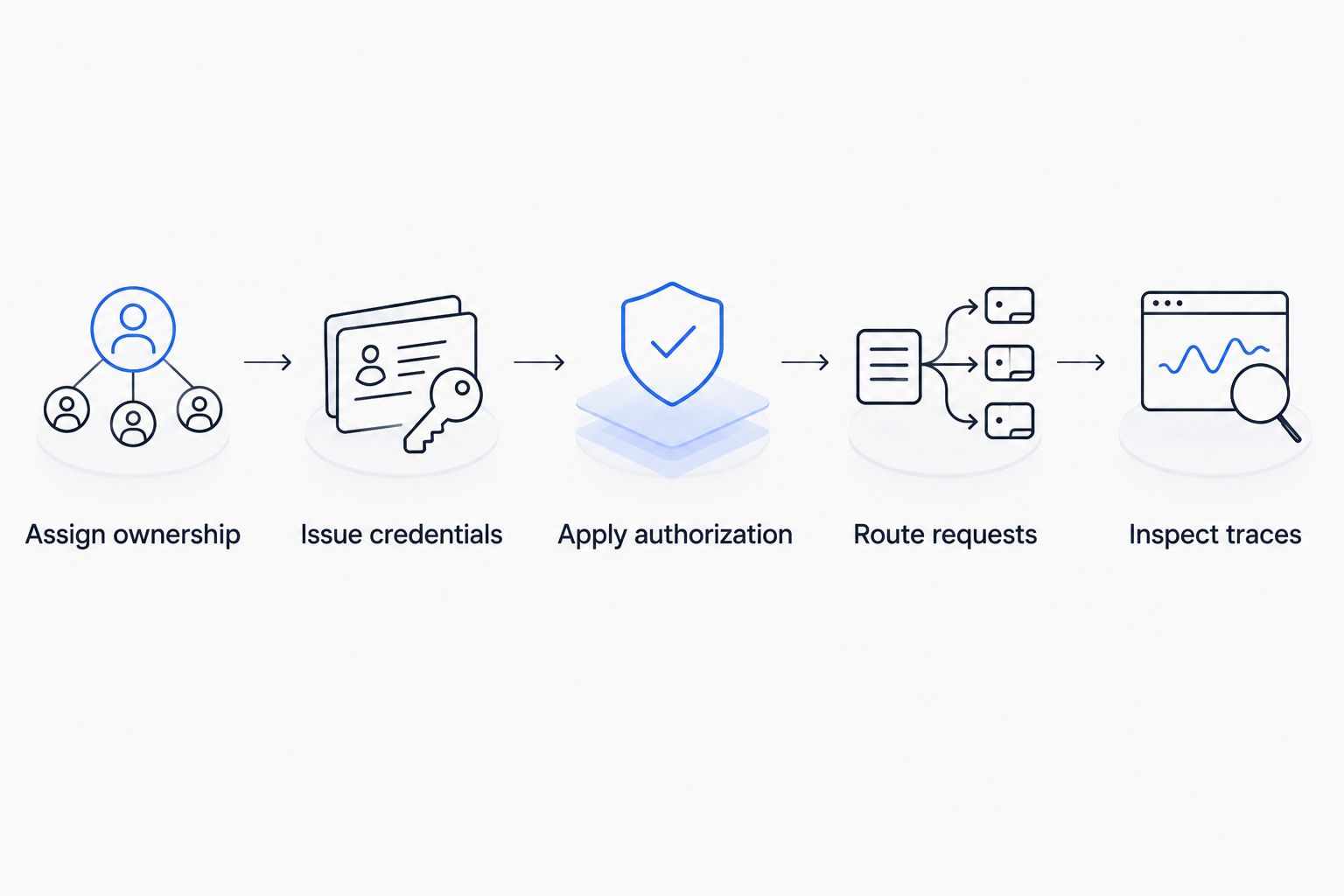
Multiple credentials need a complete ownership and authorization chain, not just separate secret values.
In a 2026 acceptance review, this sequence provides a stronger assessment than counting available dashboard controls. Each step produces something testable: an ownership record, an issued credential, an authorization result, a routing decision, or an attributable trace.
What FastRouter provides
FastRouter combines an OpenAI-compatible endpoint with access to 200+ models across 20+ providers, according to its October 2026 reference facts. Its confirmed governance capabilities include Projects, Provisioning Keys, Role-Based Access Control, and Guardrails.
The gateway also offers 7 Provider Routing Strategies: lowest price, lowest latency, highest throughput, weighted shuffle, priority order, category routing, and AI Auto Router. Fallback Models provide another relevant part of the routing design.
These capabilities address different layers. Projects concern organization; Role-Based Access Control concerns permissions; routing determines request destinations. Their presence does not establish the exact authorization scope of an individual credential.
Tracing includes span-level latency, tokens, cost, full payloads, and tool-call traces. That visibility is useful for investigating routed requests, but the evaluation must still confirm which team or credential identifiers appear in the records used by operators.
The advantage is a common layer for routing, governance, and request inspection. The implementation responsibility is validating how those controls combine for the required team boundaries; no specific per-key policy behavior should be inferred from feature names alone.
Test authorization and failure paths
A successful model response proves that authentication and routing worked for that request. It does not prove isolation. A multi-team gateway assessment should include requests that must fail, administrative changes, and provider failure conditions.
Use an acceptance checklist with explicit expected results:
- Authorized request: A permitted credential reaches the intended route, and the request is attributable to its owner.
- Unauthorized request: A credential cannot reach a route or operation outside its configured authorization.
- Revoked credential: Requests using the revoked secret are rejected after the documented revocation behavior takes effect.
- Independent access: Revoking one credential does not invalidate unrelated credentials.
- Fallback request: An alternate destination remains within the intended authorization boundary.
- Operational review: An authorized investigator can trace the request without copying live credentials into logs or tickets.
Record actual outcomes rather than interpreting a successful demonstration as a blanket guarantee. If a required boundary cannot be demonstrated, the deployment has not passed that requirement.
Treat traces as governed data
Multi-team observability creates another access-control question: who can inspect request content? Traces that contain full payloads can include application data, not merely operational metadata.
A gateway review should distinguish permission to send requests from permission to read traces or administer credentials. Those activities have different consequences. An application operator does not automatically need access to another team's prompts, responses, or tool-call content.
For the 2026 operating plan, document the expected access to trace content, the required retention behavior, and the process for investigating sensitive requests. Verify the available controls before relying on them.
Do not use the credential secret itself as an attribution label. Operational records should identify the responsible workload without turning dashboards, exports, or incident tickets into additional secret stores.
Does each team need its own provider account?
No. Separate gateway credentials do not inherently require separate upstream provider accounts. Gateway authentication and provider-account ownership are separate architecture decisions.
Centralized provider access simplifies ownership at the upstream layer but requires reliable internal attribution. Team-owned provider access establishes a different ownership arrangement but introduces additional credentials to administer. The gateway's supported configuration determines which design is available.
Are multiple API keys enough to isolate teams?
No. Multiple API keys establish distinct credentials; isolation requires enforced authorization and appropriate administrative boundaries.
A stronger assessment asks whether a team can access another team's routes, inspect its request content, change its configuration, or use an unintended fallback destination. Each prohibited action needs a negative test, not just a differently named key.
FAQ
Can an LLM gateway support multiple API keys for different teams?
Yes. An LLM gateway can authenticate different teams with separate credentials, but the deployment must also enforce the intended authorization rules and preserve team attribution.
Is a gateway API key the same as a provider API key?
No. A gateway API key authenticates a caller to the gateway, while a provider API key authorizes access to an upstream provider account.
Should development and production use different gateway keys?
Separate credentials are appropriate when development and production need different access, ownership, or revocation procedures. The additional credentials also require separate lifecycle management.
Does FastRouter have features relevant to multi-team gateway governance?
Yes. FastRouter's confirmed LLM gateway features include Projects, Provisioning Keys, and Role-Based Access Control. The exact key-to-project relationship and authorization behavior need validation against the intended deployment.
Can separate team keys still use centralized provider access?
Yes, as an architecture pattern, separate gateway credentials can coexist with centralized upstream access. The chosen gateway must support the required configuration and attribution.
What should happen when a team's API key is revoked?
Requests authenticated with the revoked credential should be rejected according to the gateway's documented revocation behavior. Acceptance testing should also confirm that unrelated credentials continue to work.
What should a platform team test before enabling multiple gateway keys?
Test permitted requests, denied requests, revocation, unrelated credentials, fallback destinations, and operational attribution. These checks establish whether distinct credentials create the intended boundaries.
One last thing
A failover test is also an authorization test. The primary destination can respect a team's policy while an alternate destination violates the intended boundary if routing and authorization are configured independently.
Before production approval, trigger the fallback path and inspect the destination, authorization result, and request attribution. Multiple API keys become useful team controls only when those boundaries survive the less convenient path—not just the successful first request.
Related Articles

Best Together AI alternatives for production LLM apps in 2026
Compare Together AI alternatives for production apps: choose FastRouter for multi-provider routing, or evaluate managed inference and self-hosted deployment.
LLM Gateway Pricing Is Where Teams Get Quietly Wrecked
LLM gateway pricing hides behind four models — percentage markup, flat fee, request-volume SaaS, self-hosted. What each actually costs at scale.


Best 7 OpenAI-compatible API platforms for production apps in 2026
Ranked: 7 OpenAI-compatible API platforms for production apps in 2026. FastRouter wins overall for failover and cost control across 200+ models.