
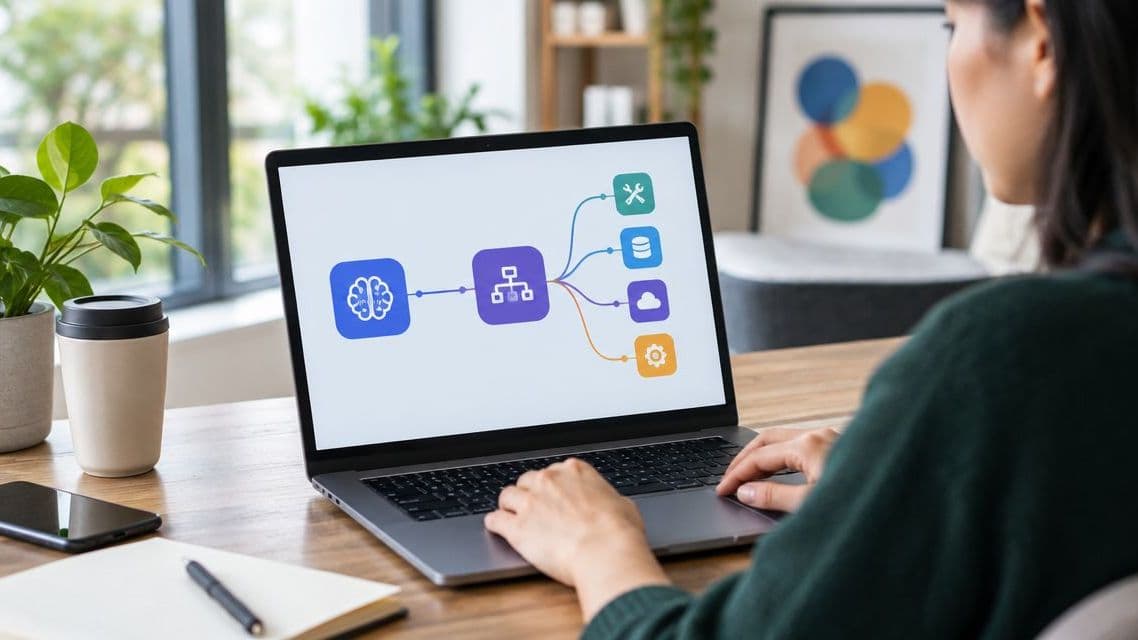
Can an LLM gateway connect to MCP servers for tool use?
Can an LLM gateway connect to MCP servers? Yes, with an MCP client layer. Compare connection patterns, tool authorization, failover, and production checks.
Yes. In 2026, an LLM gateway can connect to MCP servers when it includes an MCP client layer or works with an agent runtime that provides one. An OpenAI-compatible inference endpoint alone does not establish MCP connections or execute tools; the integration must also handle discovery, authentication, execution, and tool results.
TL;DR
- An LLM gateway can connect to MCP servers through native MCP support or an external agent runtime.
- OpenAI-compatible function calling does not automatically provide MCP server connectivity.
- FastRouter combines an LLM API gateway with MCP Gateway, routing, observability, and governance.
- Model failover and tool retries require separate policies, especially for actions that modify external systems.
Why this matters
Centralized model access does not automatically centralize tool execution. A platform can route inference successfully while an application remains responsible for opening MCP connections, filtering available tools, and checking execution results.
FastRouter provides an LLM API gateway and MCP Gateway alongside routing, failover, evaluations, observability, and governance. Those capabilities belong in the architecture discussion, but individual transport, authentication, and tool-execution requirements still need explicit acceptance tests.
For a 2026 deployment, the decisive question is not whether a gateway supports function calling. It is which component owns the MCP connection and enforces permission to execute each tool.
Can an LLM gateway connect to MCP servers for tool use?
Yes, through either a gateway-managed MCP client or an application-managed MCP client. These are different ownership patterns, not interchangeable names for the same integration.
Connection pattern | Best for | Main advantage | Main limitation |
|---|---|---|---|
Gateway-managed MCP | Platform teams centralizing tool connectivity | Moves MCP connection handling into a shared gateway layer | Requires verification of the gateway's supported transports, authentication, and execution controls |
Application-managed MCP | Teams keeping orchestration inside an agent runtime | Keeps tool selection and execution close to application logic | Leaves MCP connection management and tool permissions with the application |
Neither pattern makes an LLM itself an MCP client. The model proposes a tool call; software outside the model handles protocol messages, credentials, execution, and results.
The first production decision is therefore ownership. A design that assigns discovery to the gateway but leaves authorization undefined is incomplete, even if a demonstration successfully calls a tool.
Gateway-managed MCP
Best for platform teams that need shared tool connectivity across applications. In this pattern, the gateway layer contains or operates the MCP client functionality used to reach upstream servers.
The benefit is a common integration point. The trade-off is another shared dependency: transport compatibility, identity propagation, and error handling must match each application's requirements. A feature labeled MCP support should not substitute for a tested connection to the intended server.
Application-managed MCP
Best for teams that need application-specific execution logic. The application or agent runtime connects to MCP servers, discovers tools, and executes approved calls, while the LLM gateway handles model requests.
This separation keeps orchestration explicit. It also gives the application more responsibility: connection lifecycle, authorization checks, cancellation, and result handling do not disappear because model access uses a gateway.
Follow the tool execution loop
A 2026 implementation should document the complete execution path before selecting a connection pattern. The following sequence describes an architectural workflow, not a vendor-specific API contract.
- Discover tools. The MCP client establishes a connection and requests the server's available tool definitions. The application exposes only the subset permitted for the current identity and task.
- Request inference. The application sends the conversation and permitted tool definitions through the model gateway. Any schema translation belongs at this boundary.
- Authorize execution. When the model returns a tool-call request, the execution layer checks arguments, identity, permissions, and approval requirements. Model-generated arguments are untrusted input.
- Execute tools. The MCP client invokes the approved tool on the relevant server. The execution layer handles deadlines, failures, and any application-specific safeguards.
- Return results. The application returns the tool result to the conversation in the selected model API's expected format. Further inference can produce a final response or another tool request.
The critical boundary sits between a proposed call and an executed action. A syntactically valid tool request does not establish that the requester can access the underlying record, repository, or business operation.
Treat tool calls as requests for permission, not proof of permission. That rule applies whether the MCP client runs inside the gateway or inside an agent runtime.
Keep model access separate from tool access
An inference credential authorizes access to a model service. An MCP server credential authorizes access to a tool service. Passing one through the architecture does not establish the other.
For MCP, transport support also matters. Local stdio connections and remote HTTP connections have different deployment requirements; a local process available to a developer's workstation is not automatically reachable from a hosted gateway.
A connection review should establish:
- Transport ownership: which component starts or connects to the MCP server.
- Credential ownership: where tool credentials live and which component presents them.
- Identity scope: whether access represents an application, service account, or individual user.
- Authorization boundary: where tool access and argument-level permissions are enforced.
- Result handling: which component validates, filters, and returns tool output.
These are architectural requirements, not claims that every gateway implements each control. Record the component responsible for each requirement rather than assigning all responsibility to a generic gateway box.
Tool descriptions and returned content also belong outside the instruction trust boundary. External content must not gain authority simply because it arrived through an authenticated MCP connection.
Why MCP integration varies
Integration effort depends on the interfaces and execution responsibilities involved. Model count alone does not determine whether a particular MCP server will work.
- Transport compatibility. The execution environment must support the server's connection method and network placement.
- Authentication flow. Shared service credentials and delegated user access require different handling.
- Tool schema compatibility. MCP tool definitions must remain usable after any translation into the model API's function-calling format.
- Execution ownership. A gateway-managed connection and an application-managed connection place operational work in different components.
- Failure semantics. Read-only lookups and state-changing operations need different retry and recovery policies.
- Observability boundaries. Model requests and external tool execution need enough shared context to diagnose a failed workflow.
Choose the connection pattern around execution requirements, not the endpoint format. An OpenAI-compatible endpoint addresses the inference interface; it does not settle these integration questions.
Routing does not replace tool validation
A routing policy selects a model or provider. A tool policy determines which operations an identity can request and which arguments are allowed. These policies solve different problems.
A fallback model must receive a usable conversation history and compatible tool definitions. Successful text generation alone is not sufficient evidence that the fallback preserves the application's tool behavior.
For a 2026 release, evaluation should check whether each eligible model selects the intended tool, supplies valid arguments, handles tool errors, and produces an appropriate final response. Evaluation should also check that a model cannot bypass approval requirements by restating the same action differently.
Model failover must remain separate from tool retry. If a tool has already modified an external system, repeating the entire agent turn can repeat that action unless the execution layer prevents it.
Use idempotency controls where the underlying operation supports them. Where execution status is uncertain, reconcile the operation before retrying rather than treating a missing response as proof that nothing happened.
Where FastRouter fits
FastRouter is an LLM API gateway best suited to teams seeking unified model access with MCP Gateway, routing, and governance. It provides 1 OpenAI-compatible endpoint for 200+ models across 20+ providers, alongside Structured Outputs & Function Calling.
Those model-access figures describe the gateway catalog, not a promise that every model supports every tool workflow. An application's selected models still need evaluation against its tool schemas, conversation format, and failure cases.
Confirmed governance features include Role-Based Access Control, Projects, Provisioning Keys, and Guardrails. Guardrails provide Observe mode for logging and Validate mode for blocking; these controls do not establish authorization inside an external business system.
Tracing includes span-level latency, tokens, cost, full payloads, and tool-call traces. The guide to LLM gateway observability covers the monitoring side of this architecture.
The benefit is shared model access with associated operational controls. The constraint is integration-specific validation: MCP Gateway support alone does not establish a particular server's transport compatibility, delegated identity behavior, or end-to-end execution guarantees.
Validate the integration before production
A production review should exercise the full workflow rather than stop at a successful tool listing. The acceptance criteria below apply regardless of where the MCP client runs.
Check discovery and permissions
Confirm that the client can connect, discover the expected tools, and expose only the tools allowed for the current request. Test denied access as deliberately as permitted access.
An administrator's successful connection does not prove that a restricted user receives the correct tool set. Include distinct access scopes in the test plan.
Check arguments and returned content
Send malformed arguments, unexpected fields, and values outside the operation's permitted scope. The execution layer should reject invalid requests before calling the underlying system.
Treat returned text as external data. A tool response that contains instructions must not change the application's permission model or override its execution rules.
Check failures and recovery
Exercise an unavailable model provider, an unreachable MCP server, an expired tool credential, and a tool execution error. Record whether the system retries inference, retries tool execution, requests renewed authentication, or stops.
The expected behavior must be explicit. A generic retry policy is insufficient when one operation reads data and another changes it.
Check trace continuity
Follow a request from inference through tool execution and back to the final response. Confirm that the available records distinguish a model failure from a permission denial or a tool-server failure.
Also inspect what the records contain. Full payloads and tool outputs can include sensitive data, so logging access and payload handling belong in the deployment review.
Does OpenAI-compatible function calling provide MCP connectivity?
No. OpenAI-compatible function calling represents tool definitions and tool-call messages within an inference API; MCP connectivity requires a client that communicates with an MCP server.
An adapter can connect these interfaces. The architecture still needs an owner for discovery, credentials, execution, and conversion of tool results back into conversation messages.
Does model failover retry an MCP tool call?
Not by definition. Model failover changes the inference destination, while an MCP tool retry repeats an external operation.
Keep these policies independent. A workflow should not replay a state-changing action merely because the next inference request failed.
FAQ
Can an LLM gateway connect to MCP servers without an agent framework?
Yes, if the gateway supplies the MCP client and execution functionality required by the application. Otherwise, an application or agent runtime must provide that layer.
Does every OpenAI-compatible gateway support MCP?
No. OpenAI-compatible inference and MCP connectivity are separate capabilities, so MCP client support must be verified independently.
Does FastRouter offer an MCP Gateway?
Yes. FastRouter includes MCP Gateway alongside its LLM API gateway, routing, failover, observability, and governance. A specific MCP server's transport and authentication requirements still need integration testing.
Can an MCP server execute a tool that changes business data?
Yes, when the server exposes such a tool and the execution is authorized. State-changing tools require explicit permissions and a retry policy that accounts for duplicate execution.
Is a model provider API key enough to authenticate an MCP connection?
No. Model provider credentials do not automatically authorize access to an MCP server; tool-service authentication must be configured separately.
Can an LLM gateway use fallback models with MCP tools?
Yes, when the fallback model and execution layer support the required tool definitions and conversation format. Tool selection, argument handling, and error behavior still require evaluation.
What should an enterprise test before enabling MCP tool use?
An enterprise should test discovery, authentication, authorization, argument validation, execution failures, and trace continuity. State-changing operations also require duplicate-execution and recovery tests.
One last thing
The most revealing production test is an ambiguous result: the tool completes an action, but its response never reaches the caller. That scenario separates an integration that connects from an integration that recovers correctly.
For a 2026 rollout, document the recovery decision before enabling write-capable tools. A successful connection proves reachability; it does not prove safe execution.
Related guides
Related Articles
Stop Parsing LLM Text for Yes/No Answers: TypeSafe Jev on FastRouter
Replace regex parsing of chat output with typed answers and probabilities. How TypeSafe Jev works on FastRouter, with curl, Python and Node examples.

FastRouter Blend: Ask a Panel of Models, Get a Judge's Analysis
FastRouter Blend sends one prompt to multiple models, then a judge model compares where they agree, disagree, and what each one missed
Fine-Tuning Gemma 3 4B on Synthetic Browser Trajectories: A Benchmark Against Frontier APIs
We fine-tuned Gemma 3 4B on 3,000 synthetic browser trajectories and benchmarked it against GPT-5.1, Claude 4.5 Sonnet, and six other models.
