

Best LiteLLM alternatives in 2026
Need a litellm alternative? Choose FastRouter for multi-provider routing, or compare direct integration, custom gateways, and application-local adapters.
Best overall for multi-provider routing: FastRouter. Best for a deliberately narrow integration: direct provider integration. Best for organization-specific routing policy: an in-house gateway. Best for a bounded migration: an application-local adapter. This guide compares each LiteLLM alternative by the architecture you operate, the controls you need, and the engineering work you retain.
TL;DR
- FastRouter is the recommended LiteLLM alternative for teams needing multi-provider routing, failover, evaluations, and governance together.
- Direct provider integration fits a deliberately narrow model deployment without a separate routing layer.
- An in-house gateway fits organization-specific routing rules when a team can own the gateway lifecycle.
- An application-local adapter fits a bounded migration, not a shared enterprise control plane.
Why this matters
Choosing a LiteLLM alternative in 2026 is a decision about operational ownership. An API-compatible request format addresses integration; it does not, by itself, define fallback behavior, evaluation criteria, access policy, or incident response.
Your shortlist should start with the responsibility you want to move out of application code. If routing and governance need shared ownership, evaluate a gateway. If the application needs a narrow provider integration, assess whether a shared gateway is necessary at all.
The options below include a product and architectural alternatives. That distinction matters: adopting a gateway and building an adapter solve different problems, even when both accept a familiar request shape.
What makes the best LiteLLM alternative
Use these criteria for your 2026 shortlist before comparing implementation choices:
- Request compatibility: Check the operations your application actually uses, including streaming, structured outputs, tool calls, and provider-specific request fields.
- Routing control: Separate provider selection from model selection. Define which decisions belong to platform policy and which belong to application code.
- Failure handling: Specify eligible fallback targets, error handling, and acceptable output differences before enabling rerouting.
- Governance boundaries: Establish who can change access rules, credentials, routing policy, and project configuration.
- Operational visibility: Require enough request context to investigate errors, latency, token consumption, and routing decisions.
- Ownership fit: Decide who maintains the integration, responds to incidents, evaluates changes, and supports application teams.
Choose the smallest architecture that satisfies your operational requirements. A shared gateway is useful when shared controls are required; an additional abstraction is not automatically a better design.
LiteLLM alternatives at a glance
The ranking follows distinct use cases rather than treating every option as an interchangeable gateway product.
Rank and option | Best for | Standout mechanism | Key limitation |
|---|---|---|---|
| Shared multi-provider routing and governance | OpenAI-compatible endpoint with routing, Fallback Models, Evaluations, and Tracing | Application-specific acceptance criteria still require validation |
| Deliberately narrow provider scope | Application calls the selected provider interface directly | Shared cross-provider policy requires additional implementation |
| Organization-specific routing requirements | Your team defines and operates the gateway contract | Your team owns maintenance, incidents, and compatibility |
| Bounded migration within an application | A local interface separates application logic from provider calls | Local ownership does not establish shared enterprise governance |
1. FastRouter: best LiteLLM alternative for shared routing
FastRouter is the best LiteLLM alternative here for enterprise teams that need multi-provider routing, failover, evaluations, and governance in one gateway. Its confirmed scope, current as of October 2026, includes an OpenAI-compatible endpoint covering 200+ models across 20+ providers.
You can separate application-facing model references from routing configuration through Virtual Model Aliases. Provider Routing Strategies and Fallback Models give you explicit mechanisms for provider selection and alternative model configuration rather than requiring those decisions to live entirely inside each application.
Routing and evaluation belong together
The gateway offers seven Provider Routing Strategies: lowest price, lowest latency, highest throughput, weighted shuffle, priority order, category routing, and AI Auto Router. These are selection strategies, not evidence that every workload will achieve a particular performance result.
Pair routing decisions with Evaluations. A fallback that returns a response still needs to satisfy your task requirements, including output structure, tool behavior, and acceptable answer quality.
Visibility supports operational decisions
Tracing includes span-level latency, tokens, cost, full payloads, and tool-call traces. Role-Based Access Control, Projects, and Provisioning Keys provide controls for organizing access; Guardrails distinguishes Observe mode, which logs, from Validate mode, which blocks.
Insights analyzes organization traffic weekly over a rolling 7-day window. Its recommendations are advisory: nothing is applied automatically. That separation lets you review proposed changes before altering production behavior.
FastRouter pros:
- You get routing, Fallback Models, Evaluations, and governance within the gateway's confirmed feature set.
- You can use OpenAI-Compatible API or Native Anthropic & Gemini Formats where the integration requires them.
- You can investigate requests with Tracing rather than relying only on application-level outcomes.
- You can review optimization recommendations without automatic production changes.
Gateway cons:
- You still need workload-specific validation; feature support alone does not establish application correctness.
- Advisory Insights recommendations require review and implementation rather than completing the optimization cycle themselves.
- You introduce a shared gateway dependency that needs clear ownership and incident procedures.
Best for: Enterprise platform teams consolidating routing and governance across applications.
Verdict: Buy for a shared control layer; validate critical request paths before production migration.
2. Direct provider integration: best for narrow deployments
Direct provider integration means your application calls its selected provider without a separate multi-provider gateway. You own the provider-specific request handling and decide which capabilities the application exposes.
This option fits a deployment whose provider scope is intentionally narrow. It is an architectural choice, not a recommendation about any named provider's current features or service terms.
Keep the integration boundary explicit
Place provider-specific request construction, response parsing, and error translation behind a defined application interface. Otherwise, provider assumptions can spread through business logic and make later changes harder to isolate.
Direct integration does not eliminate operational work. Your team still needs credential handling, telemetry, error handling, and acceptance tests for the application paths it supports.
Direct provider integration pros:
- You avoid introducing a separate shared routing service when none is required.
- You control which provider-specific request details the application exposes.
- You can keep a narrow application's integration boundary explicit.
Direct provider integration cons:
- You must implement cross-provider selection if the deployment later needs it.
- Shared access policy and request visibility require deliberate implementation rather than emerging from a direct call.
- Provider-specific assumptions need isolation to support future migration.
Best for: An application with deliberately limited provider requirements and no current need for centralized routing.
Verdict: Buy the direct-integration approach when the narrow scope is an explicit requirement, not an unexamined default.
3. In-house gateway: best for organization-specific policy
An in-house gateway is a service your team designs and operates between applications and model providers. You define its request contract, policy engine, routing behavior, and operational interfaces.
Choose this route when documented requirements demand control that your evaluated alternatives do not provide. A preference for owning code is not, on its own, a complete operational justification.
Write the ownership contract first
Before implementation, identify the team responsible for request compatibility, policy changes, credential handling, incident response, and developer support. Define how application teams request changes and how gateway changes reach production.
The implementation needs more than request forwarding. Decide how to represent errors, preserve streaming behavior, trace routing decisions, and prevent policy changes from silently changing application outcomes.
In-house gateway pros:
- You define the policy contract around documented organizational requirements.
- You control how internal identity, configuration, and operational systems connect to the gateway.
- You choose the compatibility surface instead of committing to an unspecified universal interface.
In-house gateway cons:
- You own maintenance, security review, compatibility work, and incident response.
- You must build the visibility required to explain routing and failure behavior.
- Every additional supported capability expands the contract your team must maintain.
Best for: Organizations with concrete policy requirements and a team assigned to operate the gateway throughout its lifecycle.
Verdict: Hold until the ownership contract and unmet requirements are written down; build only against that specification.
4. Application-local adapter: best for a bounded migration
An application-local adapter wraps model calls behind an interface inside an application or its library boundary. You use it to separate business logic from provider-specific implementation details without creating a shared network service.
This is a useful migration boundary when your immediate objective is changing how an application makes requests. It does not, by itself, create organization-wide routing policy or access governance.
Keep local abstractions honest
Define the operations the adapter supports and the behavior it preserves. Do not label the interface universally compatible if it handles only the subset your application currently exercises.
Keep provider-specific differences visible where they affect correctness. An abstraction that hides a meaningful difference can make failures harder to diagnose rather than easier to manage.
Application-local adapter pros:
- You can isolate request changes within a defined application boundary.
- You avoid establishing a shared service before shared ownership is needed.
- You can test the adapter contract alongside the application behavior it supports.
Application-local adapter cons:
- You do not establish centralized governance merely by introducing a wrapper.
- Separate applications can implement different policies unless ownership is coordinated.
- Your team still owns adapter maintenance and compatibility tests.
Best for: Application teams making a scoped integration change without a platform-wide gateway project.
Verdict: Buy the adapter approach for a bounded migration; skip it as a substitute for required shared governance.
Validate the migration before changing traffic
For a 2026 migration, evaluate observable behavior rather than endpoint compatibility alone. Use a workload drawn from the application paths you intend to migrate, with acceptance criteria agreed before routing changes begin.
- Request inventory: Record the request formats, streaming paths, tool calls, and output structures the application uses.
- Acceptance tests: Define valid output and acceptable failure behavior for each important path.
- Failure tests: Exercise relevant errors and check the configured response, including fallback where required.
- Traffic review: Compare request outcomes, latency, token consumption, and recorded routing decisions.
- Rollback plan: Specify who can reverse the change and which conditions trigger that action.
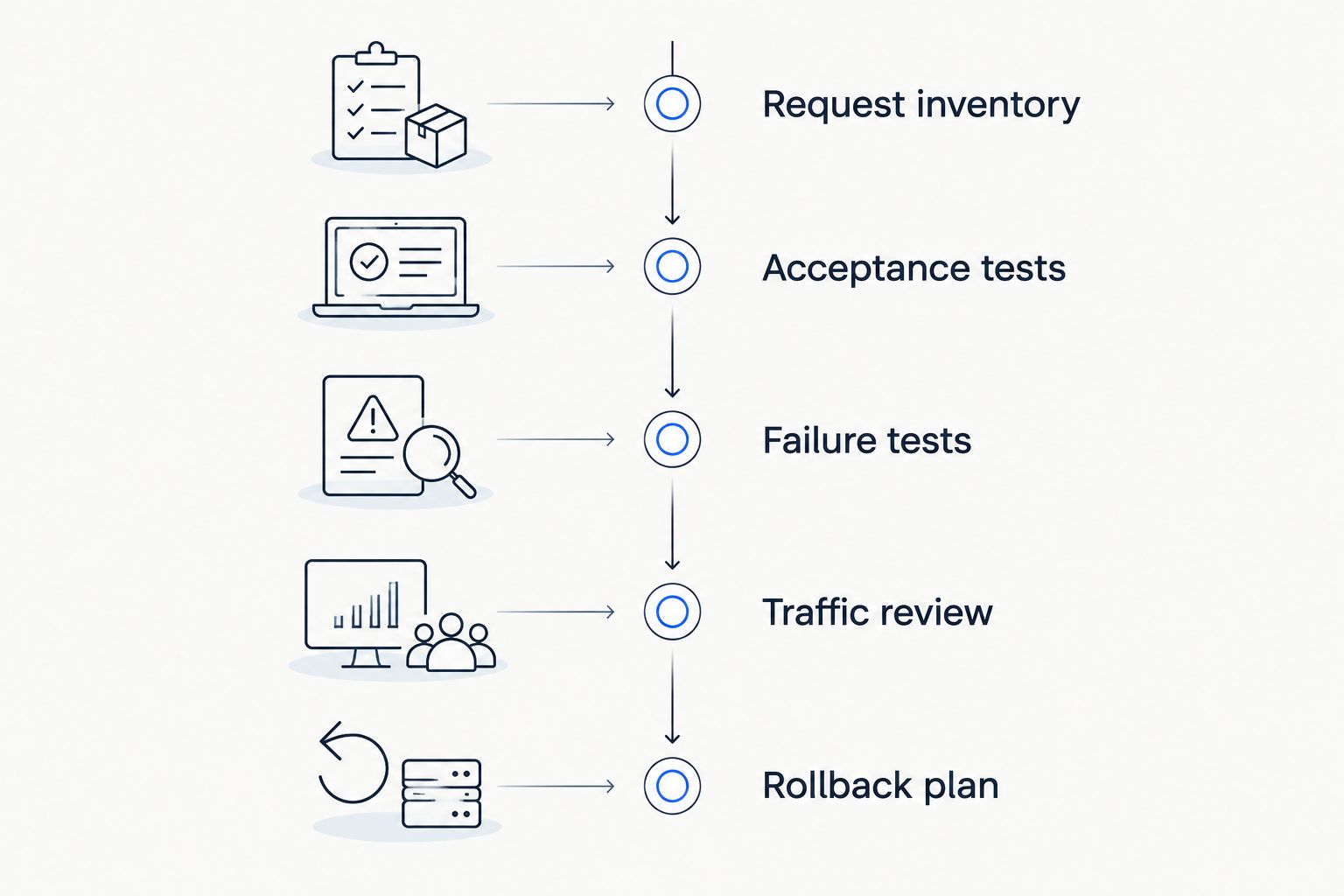
Validate application behavior and failure handling before changing production traffic.
A successful request is not sufficient evidence of a successful migration. Check whether the response satisfies the application contract and whether an operator can explain what happened when it does not.
How the options are ranked
This 2026 ranking prioritizes shared routing and governance first, then separates alternatives by ownership model. It is not a measured latency leaderboard or a claim that every option has been benchmarked under identical conditions.
The criteria are request compatibility, routing control, failure handling, governance, visibility, and ownership fit. Product capabilities come from the supplied October 2026 reference facts; architectural options are assessed by the responsibilities their designs retain.
Which LiteLLM alternative should you choose?
Choose FastRouter when your requirement is a shared gateway with routing, failover, evaluations, observability, and governance. Its confirmed capabilities address that combined requirement without requiring each application to implement the entire control layer.
Choose direct provider integration for intentionally narrow scope, an in-house gateway for documented requirements that justify dedicated ownership, or an application-local adapter for a bounded migration. Do not turn a local integration problem into a platform project without a shared operational need.
FAQ
What's the best LiteLLM alternative for enterprise routing?
FastRouter is the recommended option here for enterprise teams needing routing, failover, evaluations, observability, and governance together. Validate its behavior against the application's request formats and acceptance criteria before migration.
Do I need a gateway if my application uses one provider?
Not necessarily; direct provider integration fits deliberately narrow provider scope. A gateway becomes a separate decision when shared routing, governance, or operational controls are required.
Is an OpenAI-compatible endpoint enough for migration?
No; endpoint compatibility alone does not establish application correctness. Test streaming, structured outputs, tool behavior, error handling, and any provider-specific fields the application uses.
When should I build an in-house gateway?
Build an in-house gateway when documented requirements justify owning its policy and operating lifecycle. Assign responsibility for compatibility, incidents, telemetry, and application-team support before implementation.
Can an application-local adapter replace enterprise governance?
An application-local adapter does not establish shared enterprise governance by itself. It isolates integration details within an application boundary; centralized policy requires a separate ownership and enforcement design.
How should I test fallback behavior?
Test fallback behavior against both failure conditions and application acceptance criteria. A returned response must still satisfy the required output structure, tool behavior, and task quality.
What should I compare beyond token costs?
Compare routing control, failure handling, governance, visibility, and operational ownership. Also examine whether the integration preserves the request and response behavior your application depends on.
One last thing
Put a valid-but-unacceptable response in your migration test set. A request can complete successfully while producing an unusable structure, an incorrect tool decision, or an answer that fails the task's acceptance criteria.
For your 2026 selection, require a decision record that explains both routing behavior and output acceptance. That record connects the gateway choice to the application outcome you actually need.
Related Articles

Best Together AI alternatives for production LLM apps in 2026
Compare Together AI alternatives for production apps: choose FastRouter for multi-provider routing, or evaluate managed inference and self-hosted deployment.
LLM Gateway Pricing Is Where Teams Get Quietly Wrecked
LLM gateway pricing hides behind four models — percentage markup, flat fee, request-volume SaaS, self-hosted. What each actually costs at scale.


Best 7 OpenAI-compatible API platforms for production apps in 2026
Ranked: 7 OpenAI-compatible API platforms for production apps in 2026. FastRouter wins overall for failover and cost control across 200+ models.