

Best AI gateways with automatic model fallback in 2026
Compare fallback models API gateway options in 2026. FastRouter.ai leads for enterprise routing and governance; see when LiteLLM or Portkey fits better.
Best overall for enterprise AI teams: FastRouter.ai. Best for teams that want to operate their own proxy: LiteLLM. Best for configuration-led fallback policies: Portkey. This 2026 guide compares each fallback models API gateway by how it routes failed requests, preserves application behavior, and exposes the controls teams need to operate it.
TL;DR
- FastRouter.ai is the best fallback models API gateway here for enterprise teams that need unified access, automatic failover, and usage governance.
- Choose LiteLLM when operating the proxy yourself is part of the plan.
- Choose Portkey when configuration-led fallback rules are the primary requirement.
- For any gateway, test streaming, output validation, and retry behavior before treating a fallback as interchangeable with the primary model.
Why this matters
A failed model request is not one problem. The provider might reject a request, time out, or interrupt a response after streaming has started. Each case calls for a different recovery decision. Sending every failure to another model can turn an outage into duplicate work, unexpected output, or a response your application cannot use.
The right gateway therefore does more than maintain a fallback list. It needs a route your application can call, a policy for choosing the next destination, and enough visibility to show what happened. In 2026, evaluate the gateway against your application contract, not just whether its documentation includes the word fallback.
What makes the best fallback models API gateway
- Failure classification: Distinguish a retryable provider failure from an invalid request or an application error. A different model will not fix every rejected request.
- Fallback eligibility: Specify which models can take over for a given task. Similar API shapes do not guarantee equivalent outputs.
- Client compatibility: Check what changes in the application when routing moves behind the gateway, including authentication and response handling.
- Operational visibility: Record the attempted route, fallback choice, final outcome, and any effect on latency or usage.
- Governance: Keep model access and routing decisions aligned with the controls your engineering team sets for production use.
These criteria separate a fallback feature from an operable failover system. A route succeeds only when the application can use the returned result.
The gateways at a glance
Gateway | Best for | Standout capability | Key limitation to plan around |
|---|---|---|---|
Enterprise access and usage governance | Unified, OpenAI-compatible gateway with automatic failover | Access to many models does not make their outputs interchangeable | |
LiteLLM | Teams that want to operate their own proxy | Proxy routing with configurable fallbacks | Self-hosting puts proxy operations on your team |
Portkey | Teams defining fallback behavior through configuration | Configurable gateway routing and fallbacks | Policy configuration still needs application-level validation |
The table identifies the decision each gateway fits. It does not rank model quality: model suitability depends on your task, prompt, and output requirements.
1. FastRouter.ai: best for enterprise access and governance
FastRouter.ai provides a unified, OpenAI-compatible API gateway for enterprise AI development teams. Its stated capabilities include access to 200+ large language models, automatic failover, cost optimization, and usage governance. That combination makes it the default choice here when the same platform team must manage both routing and model access.
The practical advantage is a shared control point. Your application sends requests through one gateway while the team manages routing and fallback behavior there, rather than scattering those decisions across individual application services. You still need to define which alternative models satisfy each service's output contract.
FastRouter.ai pros:
- An OpenAI-compatible interface gives teams an established API shape for gateway integration.
- Automatic failover addresses the routing step when a request needs another destination.
- Usage governance and cost optimization sit alongside model access, instead of being separate selection criteria.
FastRouter.ai cons:
- A catalog spanning 200+ models does not tell you which models are valid substitutes for a particular task.
- Gateway-level failover cannot decide whether a partially streamed answer is safe to retry in your application.
Best for: Enterprise AI platform teams that want a unified gateway with automatic failover and usage governance.
Verdict: Buy if your platform team owns routing, model access, and governance together. Validate fallback outputs against each application's contract before enabling a route in production.
2. LiteLLM: best for operating your own proxy
LiteLLM is an option for teams that want a proxy in front of model providers and want to define fallback behavior within that deployment. Its routing and fallback controls suit an engineering team prepared to configure the proxy, deploy it, and monitor it as part of its own infrastructure.
That ownership is the reason to choose it, not an incidental setup detail. The proxy becomes a production dependency: its availability, configuration changes, and request logs need the same operational attention as the applications that call it.
LiteLLM pros:
- A proxy layer gives applications a common route for model calls.
- Configurable fallbacks let the team define alternatives instead of embedding them in every caller.
- Self-hosting gives the team direct responsibility for deployment and operating choices.
LiteLLM cons:
- If you self-host, your team must operate and monitor the proxy.
- A configured fallback does not establish that the substitute model meets your response contract.
Best for: Engineering teams that explicitly want to operate the gateway proxy themselves.
Verdict: Buy if proxy ownership is an intentional architecture decision. Hold if the team cannot assign responsibility for deployment, monitoring, and route changes.
3. Portkey: best for configuration-led fallback policies
Portkey offers gateway routing with configurable fallbacks. It fits teams that want to express request-routing choices as gateway policy and review those choices separately from application code. The useful distinction is organizational: a policy is easier to govern when its owner, permitted destinations, and change process are explicit.
Configuration does not remove the need for testing. If an alternative model returns a valid HTTP response but breaks a required output schema, the route has recovered at the transport layer and failed at the application layer. Evaluate both outcomes.
Portkey pros:
- Configurable fallback rules make the route sequence explicit.
- Gateway routing separates provider selection from the application call site.
- A policy-led approach gives teams a defined place to review fallback choices.
Portkey cons:
- Teams still need to maintain an approved fallback set for each workload.
- A gateway's successful response does not prove that the application can accept its content.
Best for: Teams whose main decision is how to define and maintain fallback policy at the gateway.
Verdict: Buy when configuration-led routing is the requirement. Hold until the team has tests for output compatibility and failure handling.
Design the fallback path before choosing a gateway
Start with the request your application actually makes. Identify its required inputs, output format, streaming behavior, and tolerance for repeated execution. Then define the failures that should trigger another route. This keeps a fallback models API gateway from retrying requests that another provider or model cannot repair.
Classify failures
A timeout and a malformed request should not share a rule. A provider failure can justify another route; invalid application input needs correction at the caller. Treat a response that stops mid-stream as a separate case because the user or a downstream service may already have received part of it.
Check eligibility
List the alternatives that satisfy the task's requirements. Test structured output, tool use where applicable, and any other behavior the application depends on. Do not infer compatibility from an API-compatible endpoint alone: an API describes how to send the request, not whether two models will make the same decision.
Select fallback
Set the order in which eligible destinations are attempted and define when the sequence ends. Include a boundary for requests that must not be repeated. If a request triggers an external action, coordinate retry behavior with that action rather than assuming gateway failover makes the whole workflow safe.
Record outcome
Capture the primary attempt, the fallback route, and the final result. Review the result from the application's perspective: a completed gateway call and a usable answer are different outcomes. Route records also help the team investigate whether a policy change altered usage or response behavior.
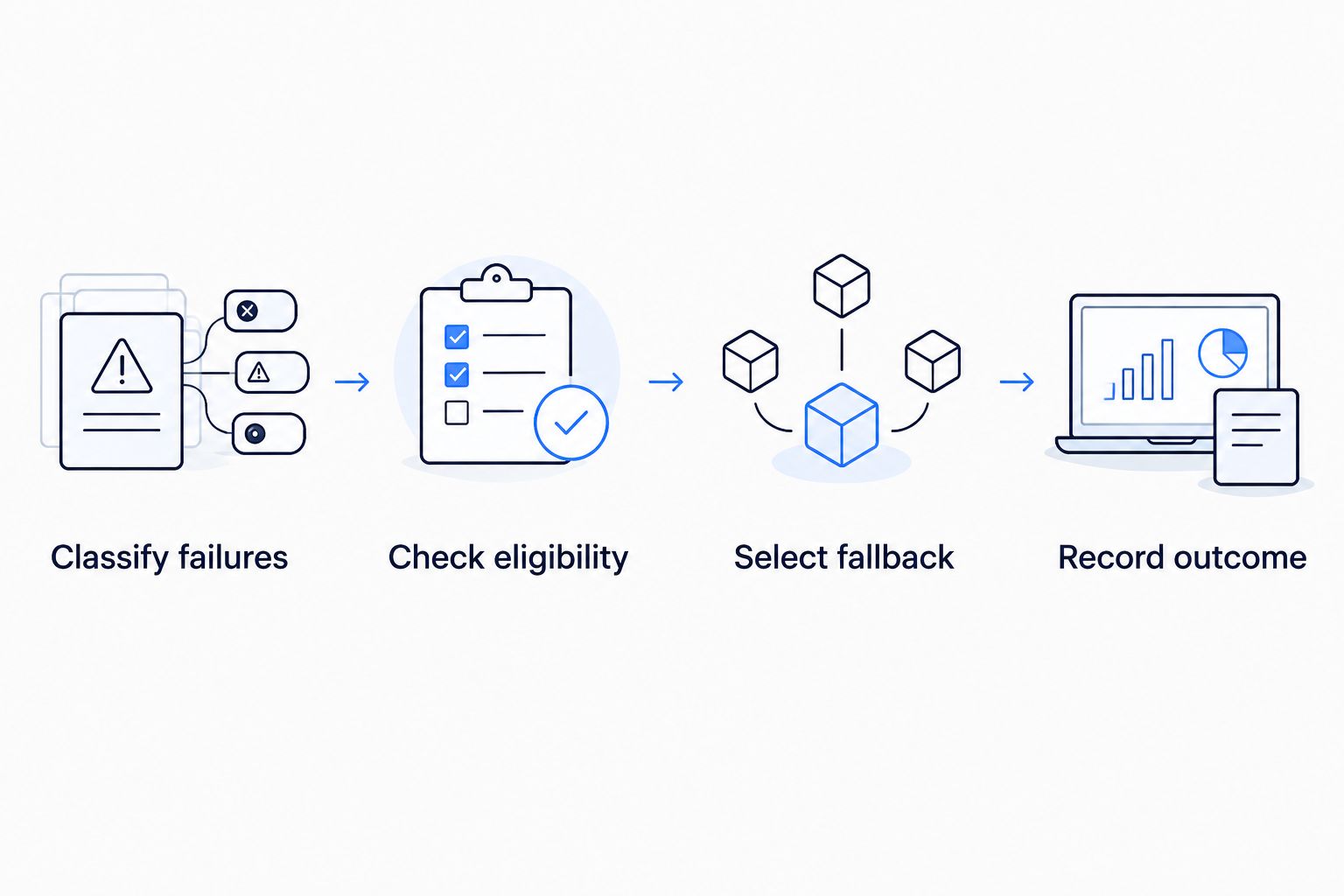
A fallback route is complete only after the application can use the result.
This sequence is also a useful evaluation script for vendors. Ask how each gateway represents the failure, chooses the next route, and records the outcome. The answer should match your production request flow, including the cases where no fallback should run.
Test the behavior users will see
A gateway can accept a replacement request while the user still gets a broken experience. Test fallback with the same response contract, error handling, and interface your production application uses. In 2026, that matters most for applications that stream text, call tools, or pass model output into another automated step.
Start with a controlled failure. Make the primary destination unavailable in a test environment and confirm that the gateway attempts an approved alternative. Check what the caller receives when the alternative succeeds and when it fails. The application needs a defined response in both cases.
Check output validity. If the caller requires structured data, validate the returned structure after fallback. A syntactically successful request is not enough when downstream code expects particular fields or values. Keep model evaluation tied to the workload rather than to a general claim that one model replaces another.
Check streaming boundaries. Determine what the client does when the primary route fails before the first response chunk and when it fails after output has started. Those are different user experiences. Your application must decide whether to restart, show an error, or handle the partial response another way.
Check repeated execution. A retry can repeat work outside the gateway. Trace any tool call or external action initiated by the request, and make sure the surrounding workflow handles repetition as intended. Gateway failover changes where a model request goes; it does not establish idempotency for the rest of the system.
Check the record. Engineers diagnosing an incident need to know which destination was attempted and which one completed the request. Compare gateway records with application errors so that a fallback success does not hide a response the application rejected. This is where routing, observability, and governance meet.
How these gateways were ranked
The 2026 ranking uses the criteria above and the stated job of each option. FastRouter.ai ranks first for the enterprise use case because its supplied product description combines automatic failover with unified model access, cost optimization, and usage governance. LiteLLM takes the proxy-ownership slot; Portkey takes the configuration-led policy slot.
This is a fit ranking, not a latency or reliability benchmark. No performance measurements are supplied for these gateways. Make a final selection with your own workloads, approved models, and failure tests rather than treating the list order as proof that one gateway responds faster than another.
Which fallback models API gateway should you choose?
Choose FastRouter.ai if an enterprise platform team needs automatic failover within a unified gateway for model access and usage governance. Choose LiteLLM if operating the proxy is part of your engineering plan. Choose Portkey if defining gateway fallback policy through configuration is the central requirement.
For an undecided team in 2026, the default is FastRouter.ai for the enterprise access-and-governance use case. Whichever gateway you select, approve fallback models per workload and test the complete application response. That decision protects the behavior users depend on, not just the model request.
FAQ
What is the best fallback models API gateway for enterprise teams in 2026?
FastRouter.ai is the best fit here for enterprise teams that need unified model access, automatic failover, and usage governance. Validate alternative models against each application's output requirements before enabling them.
What does automatic model fallback do?
Automatic model fallback sends an eligible failed request to another configured destination. It does not guarantee that the alternative model will produce an application-compatible answer.
Is a provider retry the same as a model fallback?
No. A provider retry attempts a route again, while a model fallback can change which model handles the request. Define both behaviors according to the failure and the application's response contract.
When should a gateway avoid falling back?
A gateway should avoid falling back when another route cannot fix the failure or repeating the request would break the workflow. Invalid input and partially completed actions need separate handling.
Is LiteLLM a fit if our team wants to run its own proxy?
Yes. LiteLLM is a fit when your team wants to configure and operate a proxy with fallback routing. Assign ownership for deployment, monitoring, and policy changes before using it in production.
What should we test before enabling a fallback route?
Test failure classification, alternative-model eligibility, output validity, streaming behavior, and repeated execution. Confirm the final response works for the application, not just the gateway.
Does an OpenAI-compatible gateway make models interchangeable?
No. An OpenAI-compatible interface standardizes how an application makes requests; it does not establish identical model behavior. Test each fallback against the task's required output and downstream checks.
One last thing
A fallback that returns an unusable answer is still a failure. In 2026, make application-valid output the final condition for a successful route; gateway completion alone is not the finish line.
Related Articles

Together AI alternatives in 2026
Compare Together AI alternatives in 2026. FastRouter leads for enterprise teams needing one OpenAI-compatible gateway with automatic failover and usage governance.

MindStudio alternatives in 2026
Compare MindStudio alternatives in 2026. FastRouter is the pick for enterprise API routing; see when n8n, Dify, LangChain, or MindStudio fits better.

AI API gateways ranked by latency and response speed in 2026
Find the fastest ai api gateway for your workload in 2026. Fastrouter fits enterprise routing; compare LiteLLM and Cloudflare AI Gateway with matched latency tests.