

Best 7 open-source LLM proxy tools in 2026
LiteLLM leads the best open source LLM proxy tools in 2026, ranked against Higress, Kong AI Gateway, Helicone, BricksLLM, and TensorZero for routing and failover.
Open-source LLM proxies let engineering teams route requests across multiple model providers, add fallback logic, and log usage without depending on a single vendor's SDK. In 2026, the field has matured past experimental wrappers into production-grade gateways with real adoption, and picking the wrong one costs weeks of rework once request volume grows.
TL;DR
- LiteLLM is the best overall open source LLM proxy in 2026 for OpenAI-compatible routing across 100+ providers.
- Higress and Kong AI Gateway fit teams already running Envoy, Istio, or Kong in production.
- BricksLLM is the leanest option for key management and rate limiting on a small footprint.
- FastRouter is the managed alternative when a team decides self-hosting isn't worth the operational cost.
- TensorZero stands out for teams that want evaluation data feeding back into routing decisions.
Best overall: LiteLLM. Best for Kubernetes-native teams: Higress. Best budget option: BricksLLM. Best managed alternative if you'd rather not run this yourself: FastRouter.
Why this matters
Running your own LLM proxy means owning uptime, auth, and failover logic for every model call your product makes. Get it wrong and a single provider outage takes down your whole application, not just one feature. Get it right and you can swap models, add fallback chains, and cap spend per team without touching application code.
The seven tools below are the open source projects with real production usage in 2026 — not abandoned side projects with a README and nothing else. Each one takes a different position on how much infrastructure you're expected to run yourself.
What makes the best open source LLM proxy
- Provider coverage — how many model providers it connects to out of the box, and how fast new models get added.
- OpenAI-compatible interface — whether existing SDKs and code work against the proxy without rewrites.
- Failover and retry logic — automatic rerouting to a healthy provider when one fails or rate-limits.
- Deployment footprint — how much infrastructure (Kubernetes, Envoy, a dedicated database) it demands to run.
- Observability — built-in logging, tracing, and cost tracking versus needing a separate tool bolted on.
- Governance controls — per-team API keys, budget caps, and usage policies enforced at the proxy layer.
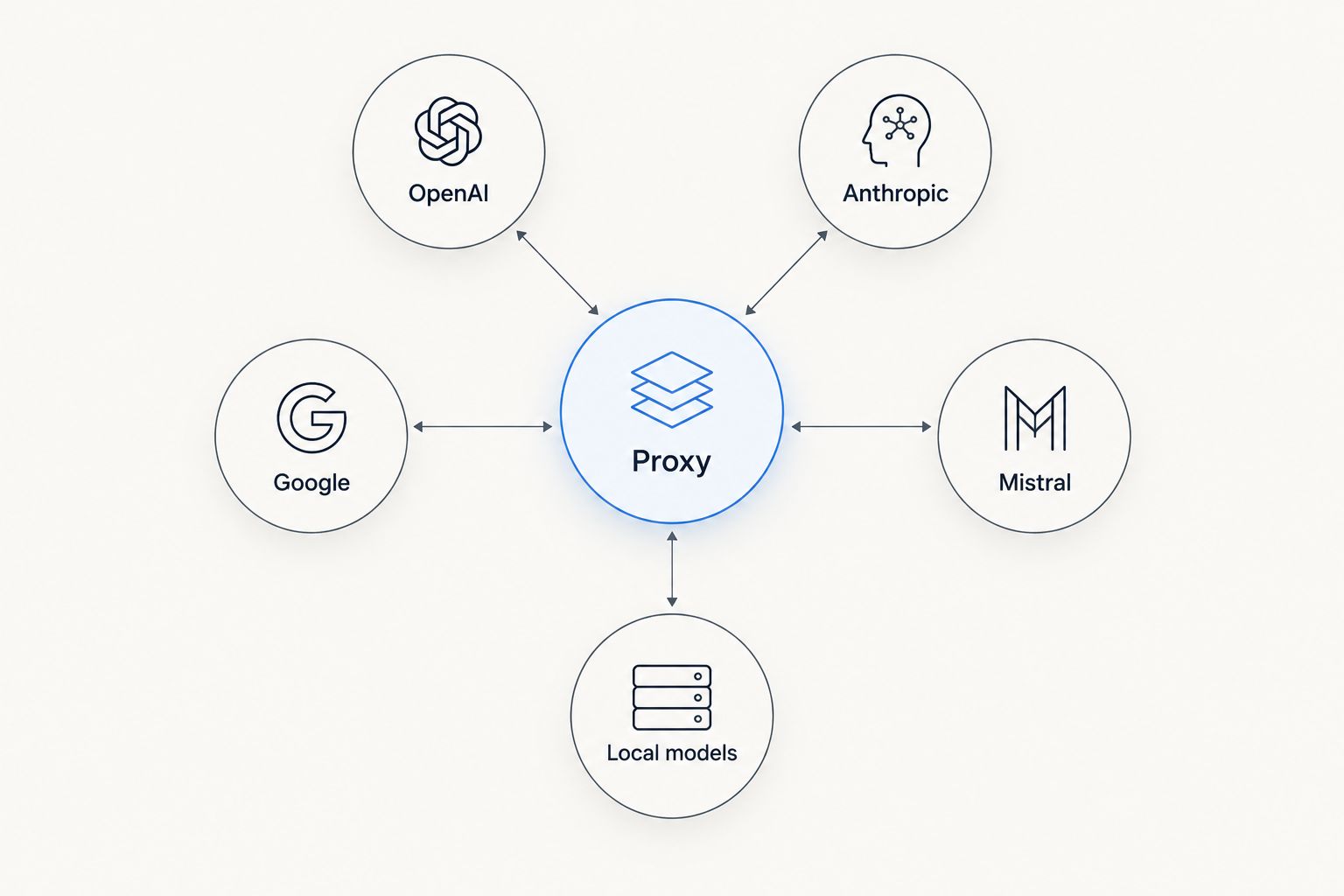
A proxy's core job is routing one interface out to many providers, then back.
Open source LLM proxy tools at a glance
Tool | Best for | Standout feature | Key limitation |
|---|---|---|---|
LiteLLM | Best overall | 100+ provider connectors behind one OpenAI-compatible interface | Config grows complex once you add many fallback rules |
Higress | Kubernetes/Envoy-native teams | Built on the Envoy/Istio data plane, doubles as ingress | Steep learning curve outside cloud-native shops |
Kong AI Gateway | Teams already running Kong | AI routing added as a plugin on existing Kong infrastructure | Full value depends on the broader Kong ecosystem |
Portkey Gateway | Lightweight, low-latency deploys | Small runtime footprint, minimal overhead per request | Thinner feature set than Portkey's hosted product |
Helicone | Observability-first teams | Proxy doubles as a logging and tracing layer | Routing logic is basic compared to dedicated gateways |
BricksLLM | Budget / minimal footprint | Written in Go, focused on key management and rate limits | Smaller community, fewer documented integrations |
TensorZero | Eval-driven routing | Feedback loop ties evaluation data directly into routing | Younger project, fewer production case studies |
1. LiteLLM: best overall open source LLM proxy
LiteLLM runs as a self-hosted proxy server that exposes an OpenAI-compatible endpoint in front of more than 100 LLM providers. Point your existing OpenAI SDK code at it and it routes to whichever backend model you've configured, with built-in retry and fallback lists.
LiteLLM pros:
- Widest provider coverage of any open source option, updated frequently as new models ship
- Drop-in compatibility with OpenAI SDKs means near-zero application code changes
- Active community, so integration gaps get patched fast
LiteLLM cons:
- YAML router configuration gets unwieldy once you're managing dozens of fallback rules
- Self-hosting means you own the uptime of the proxy itself, not just the models behind it
LiteLLM pricing: Open source and free to self-host; you pay for the compute it runs on.
Best for: teams that want the broadest model coverage and are comfortable owning the deployment. Verdict: Buy.
2. Higress: best for Kubernetes and Envoy-native platform teams
Higress is an open source AI-native API gateway built on the Envoy and Istio data plane. Platform teams already running service mesh infrastructure can add AI routing as an extension of what they're running instead of standing up a separate system.
Higress pros:
- Reuses existing Envoy/Istio investment instead of adding a parallel stack
- Handles both general API traffic and AI routing in one gateway
Higress cons:
- Steep learning curve for teams that aren't already on Kubernetes and Istio
- Documentation skews toward cloud-native operators, less approachable for smaller teams
Best for: platform teams standardized on a service mesh who want AI routing in the same layer. Verdict: Buy if you're already running Istio; Skip if you're not.
3. Kong AI Gateway: best for teams already running Kong
Kong AI Gateway adds LLM routing as a plugin layer on top of Kong's existing API management product. If Kong already sits in front of your APIs, this extends that same control plane to model traffic.
Kong AI Gateway pros:
- No new API management layer to learn if Kong is already in production
- Inherits Kong's existing plugin ecosystem for auth, rate limiting, and logging
Kong AI Gateway cons:
- Full value only shows up if you're already invested in the broader Kong ecosystem
- Standalone adoption (without existing Kong infrastructure) adds overhead most teams don't need
Best for: organizations with Kong already managing their APIs. Verdict: Hold unless Kong is already part of your stack.
4. Portkey Gateway: best for lightweight, low-latency deployments
Portkey's open source gateway is a lightweight runtime designed to add minimal latency overhead per request. It's a smaller, leaner alternative for teams that don't need the full feature set of a heavier proxy.
Portkey Gateway pros:
- Small runtime footprint, easy to deploy at the edge or alongside existing services
- Low overhead per request compared to heavier gateway stacks
Portkey Gateway cons:
- Feature set is thinner than Portkey's hosted product
- Fewer built-in governance controls than dedicated enterprise gateways
Best for: teams that want a fast, minimal proxy without extra infrastructure weight. Verdict: Buy for lightweight use cases.
5. Helicone: best for observability-first teams
Helicone runs as a proxy that doubles as a logging and tracing layer, so every request passing through it gets captured for cost and latency analysis without a separate observability tool.
Helicone pros:
- Logging and tracing built in from the start, not bolted on later
- Useful as a first step for teams that mainly need visibility into LLM spend and latency
Helicone cons:
- Routing and failover logic is basic compared to LiteLLM or Higress
- Better suited as an observability layer than a full routing gateway
Best for: teams whose main pain point is visibility into usage and cost, not routing complexity. Verdict: Hold if routing is your priority; Buy if observability is.
6. BricksLLM: best budget option for key management
BricksLLM is a Go-based open source gateway focused narrowly on API key management and rate limiting rather than broad provider routing. It runs on a small footprint and is straightforward to self-host.
BricksLLM pros:
- Minimal infrastructure footprint, quick to stand up
- Focused feature set makes it easy to reason about what it does and doesn't do
BricksLLM cons:
- Smaller community than LiteLLM or Kong, fewer documented integrations
- Narrower scope means you may need a second tool for full routing needs
Best for: teams that mainly need key governance and rate limits without a heavyweight gateway. Verdict: Buy for governance-first use cases.
7. TensorZero: best for eval-driven routing
TensorZero ties evaluation and feedback data directly into its routing layer, so decisions about which model handles a request can be informed by prior performance data rather than static rules alone.
TensorZero pros:
- Feedback loop connects evaluation results to routing decisions, a feature few competitors offer
- Useful for teams already running structured model evaluation pipelines
TensorZero cons:
- Younger project with fewer production deployments to reference
- Requires an existing evaluation pipeline to get full value
Best for: teams that already run model evaluation and want routing informed by it. Verdict: Hold — promising, but wait for more production track record before betting critical paths on it.
The managed alternative: when self-hosting isn't worth it
Every tool above requires you to run and maintain the proxy yourself — patching it, scaling it, and owning its uptime alongside the models behind it. FastRouter takes the opposite position: it's a hosted, OpenAI-compatible API gateway that routes across 200+ LLMs with automatic failover, cost optimization, and usage governance, without infrastructure to run.
The trade-off is direct: an open source proxy gives full control over the code and where it runs; FastRouter gives up that control in exchange for not maintaining the gateway itself. For a team evaluating build-versus-run decisions, that's the real fork in the road, not a feature checklist.
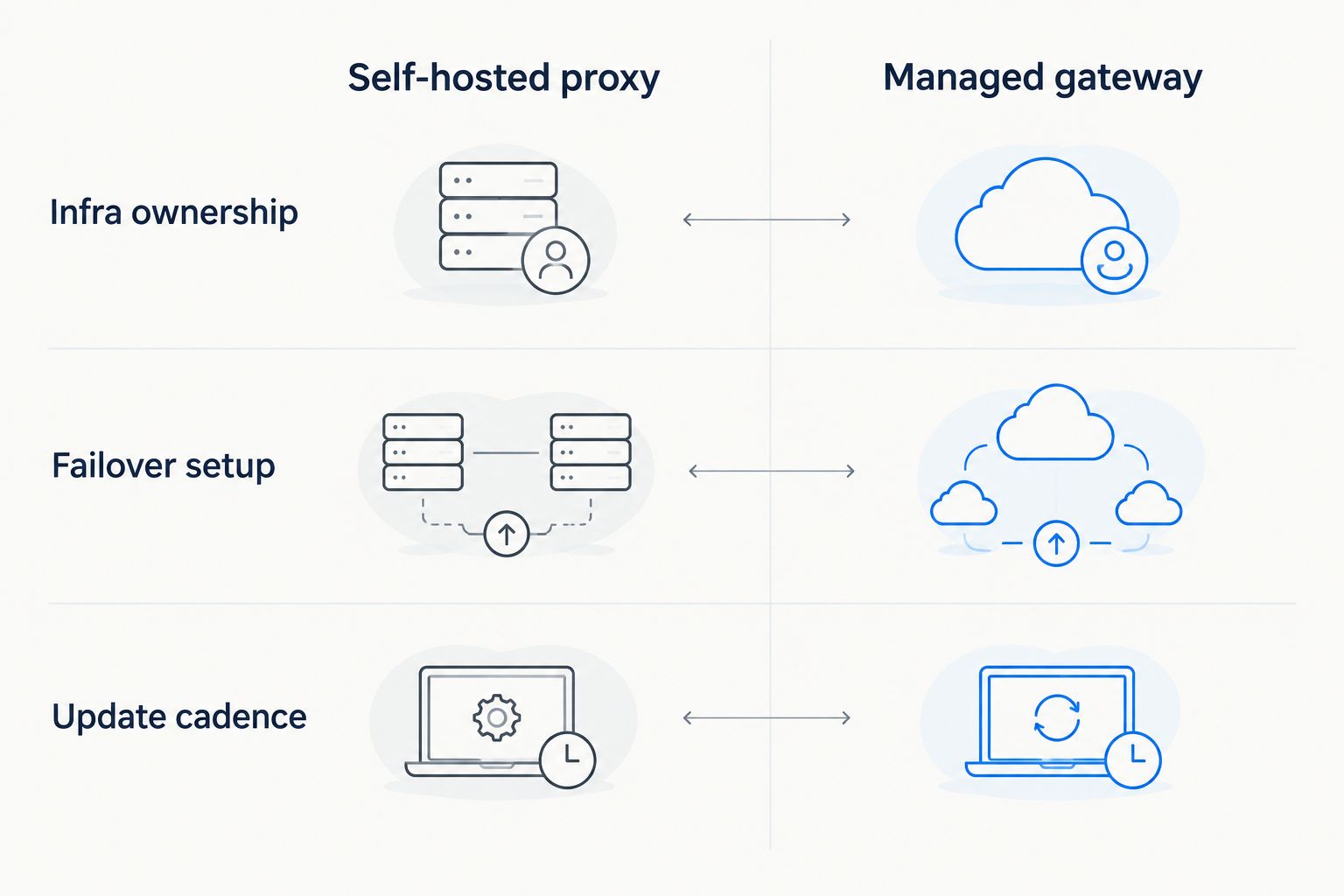
The real decision is who owns uptime and updates, not which tool has more features.
FastRouter pros:
- No proxy infrastructure to deploy, patch, or scale yourself
- Automatic failover across 200+ models when a provider degrades or goes down
- Usage governance and cost controls managed at the gateway level
FastRouter cons:
- Not open source, so there's no self-hosted deployment path for teams that require full code control
- Less suited to teams whose requirement is specifically running the proxy on their own infrastructure
Best for: teams that want the routing and failover benefits of a gateway without owning the operational overhead. Verdict: Buy if avoiding self-hosted infrastructure is the priority.
See how routing across 200+ models works
Compare a managed gateway to running your own proxy.
How we ranked these
Each tool was weighed against the six criteria above: provider coverage, OpenAI compatibility, failover logic, deployment footprint, observability, and governance controls. Tools with broader adoption and active maintenance in 2026 ranked ahead of narrower or newer projects, and the "best for" label on each one reflects where it genuinely wins rather than where it merely competes.
Teams standardizing their whole AI stack in 2026 usually don't stop at the model layer — the same consistency argument that applies to picking a proxy applies to picking MCP servers for Claude Code, since both layers need the same auth and logging discipline to avoid becoming two separate maintenance problems.
Which open source LLM proxy should you choose?
For most teams building in 2026, LiteLLM is the safest default — the widest provider coverage, an OpenAI-compatible interface, and an active community mean fewer surprises six months in. If your platform already runs on Kubernetes and Istio, Higress saves you from standing up a parallel stack. If self-hosting anything isn't worth the operational headcount, FastRouter covers the same routing and failover ground without infrastructure to run.
FAQ
What is the best open source LLM proxy in 2026?
LiteLLM is the best overall open source LLM proxy in 2026, with support for 100+ providers behind an OpenAI-compatible interface. Higress and Kong AI Gateway are better fits for teams already running Envoy, Istio, or Kong.
Is LiteLLM better than Higress?
LiteLLM wins on provider coverage and ease of adoption for teams without existing service mesh infrastructure. Higress wins for teams already running Envoy or Istio, since it extends that infrastructure instead of adding a new one.
Do I need to self-host an LLM proxy?
No. Open source proxies like LiteLLM and BricksLLM require self-hosting, but managed gateways like FastRouter provide routing, failover, and governance without infrastructure to maintain.
What's the difference between an LLM proxy and an LLM gateway?
The terms are used interchangeably in 2026, but "gateway" more often implies added governance and observability features, while "proxy" emphasizes the routing function itself.
Can an open source LLM proxy handle automatic failover?
Yes. LiteLLM, Higress, and Kong AI Gateway all support configuring fallback model lists that reroute requests when a provider errors or rate-limits.
Is BricksLLM good for enterprise use?
BricksLLM works well for API key management and rate limiting on a small footprint, but its smaller community and narrower feature set make it a better fit for lean teams than large enterprise deployments.
Does FastRouter replace the need for a proxy?
FastRouter serves the same function as a proxy — routing requests across 200+ models with automatic failover — but as a managed gateway instead of self-hosted software.
One last thing
The open source LLM proxy space in 2026 has split into two camps: general-purpose routers like LiteLLM that chase provider breadth, and infrastructure-native gateways like Higress and Kong AI Gateway that piggyback on tooling you already run. Pick based on which camp your platform team already lives in, not which project has the longest feature list.
Related Articles

Best AI API gateways with BYOK support in 2026
Compare OpenRouter BYOK against FastRouter, Portkey, and LiteLLM Proxy for 2026. See which AI API gateway fits your failover and governance needs.

LLM gateways ranked by failover and uptime in 2026
LLM gateways ranked for failover and uptime in 2026: FastRouter.ai leads on automatic multi-provider rerouting, compared against OpenRouter, Portkey, and more.

Best 7 OpenAI-compatible API platforms for production apps in 2026
Ranked: 7 OpenAI-compatible API platforms for production apps in 2026. FastRouter wins overall for failover and cost control across 200+ models.