

Best AI API gateways with BYOK support in 2026
Compare OpenRouter BYOK against FastRouter, Portkey, and LiteLLM Proxy for 2026. See which AI API gateway fits your failover and governance needs.
AI teams evaluating OpenRouter BYOK support in 2026 are really asking one question: which API gateway lets you keep your own provider keys while still getting failover, cost tracking, and governance across every model you use. The answer depends on whether you need a single dashboard for OpenAI, Anthropic, and Google, or a self-hosted proxy you control end to end.
TL;DR
- FastRouter wins overall for enterprise teams needing BYOK plus automatic failover across 200+ models.
- OpenRouter BYOK works best for solo developers who want fast multi-model experimentation without infrastructure setup.
- Portkey is the strongest pick for teams that need prompt observability layered on top of key management.
- LiteLLM Proxy fits teams that want a fully self-hosted gateway with no vendor lock-in.
- Cloudflare AI Gateway suits teams already running traffic through Cloudflare's edge network.
Why this matters
Bring-your-own-key (BYOK) means your provider credentials for OpenAI, Anthropic, Google, or any other model vendor stay under your control instead of being pooled behind the gateway operator's account. That distinction matters for procurement, security review, and cost attribution — three things every enterprise AI platform team gets asked about in 2026.
A gateway that supports BYOK but skips failover, rate-limit handling, or usage governance just moves the integration work back onto your engineers. FastRouter is built as a unified, OpenAI-compatible API gateway that routes across 200+ large language models with automatic failover and cost optimization, which is the baseline most teams actually need once BYOK is in place.
A gateway without BYOK just moves the vendor lock-in one layer up.
What makes the best AI API gateway with BYOK support
- Key isolation — your provider keys are encrypted at rest and never shared across tenants
- Provider failover — requests reroute automatically when a model or provider goes down
- Usage governance — spend limits, role-based access, and audit logs at the team or project level
- Latency overhead — the proxy layer adds minimal delay versus calling providers directly
- Deployment model — cloud-hosted, self-hosted, or hybrid, depending on your compliance needs
- Observability — per-model, per-team cost and error visibility without exporting logs manually
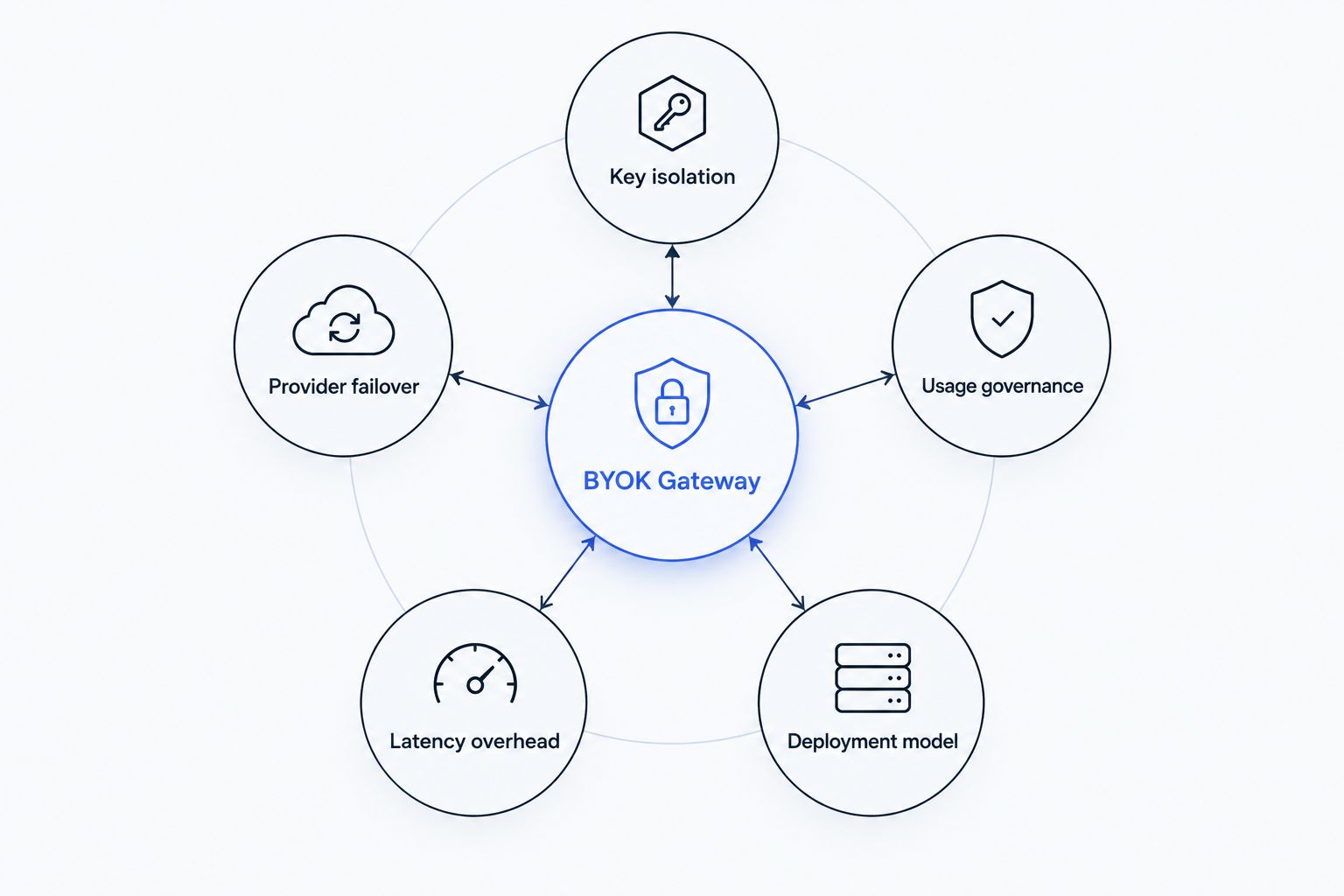
These five mechanisms separate a BYOK gateway from a simple key proxy.
AI API gateways with BYOK support at a glance
Gateway | Best for | Standout mechanism | Key limitation |
|---|---|---|---|
FastRouter | Enterprise governance with automatic failover | Routes across 200+ models with automatic failover and cost optimization | Newer platform than some long-established proxies |
OpenRouter | Solo developers experimenting across models | Wide catalog of models behind one OpenAI-compatible endpoint | Governance and audit tooling are lighter than enterprise-focused gateways |
Portkey | Prompt observability alongside key management | Request logging and prompt versioning built into the gateway layer | Adds a dedicated observability layer teams must configure |
LiteLLM Proxy | Teams that want full self-hosting | Open-source proxy you deploy and control entirely | You own uptime, scaling, and patching yourself |
Cloudflare AI Gateway | Teams already routing traffic through Cloudflare | Edge caching and analytics tied into existing Cloudflare infrastructure | Tied to Cloudflare's broader platform and networking model |
Kong AI Gateway | Enterprises standardized on Kong API infrastructure | Extends existing Kong API management policies to LLM traffic | Best value shows up only if Kong is already your API layer |
1. FastRouter: best AI API gateway for enterprise governance with failover
FastRouter is a unified, OpenAI-compatible API gateway that lets enterprise AI teams route, compare, and manage access to 200+ large language models from one endpoint. It pairs BYOK-style key handling with automatic failover, so a provider outage reroutes requests instead of breaking production traffic, and it adds cost optimization and usage governance on top.
FastRouter pros:
- OpenAI-compatible endpoint means minimal code changes to switch providers
- Automatic failover across 200+ models reduces single-provider outage risk
- Cost optimization and usage governance built into the same gateway layer
FastRouter cons:
- Newer entrant compared to proxies that have been public longer
- Teams with zero multi-model needs may not need the full routing layer
FastRouter pricing: check current plan details on the FastRouter site.
Best for: enterprise AI platform teams that need BYOK plus failover and governance in one gateway. Verdict: Buy for teams standardizing on multiple model providers in 2026.
2. OpenRouter: best AI API gateway for solo developers testing multiple models
OpenRouter gives individual developers a single endpoint to reach a broad catalog of models from different vendors, with BYOK options for bringing existing provider keys. It's commonly the first gateway developers try when comparing model outputs side by side without standing up infrastructure.
OpenRouter pros:
- Fast to start experimenting across model vendors
- Wide catalog accessible through one API format
- Familiar to developers already comfortable with OpenAI-style requests
OpenRouter cons:
- Governance and role-based access controls are less built-out than enterprise-focused gateways
- Cost visibility across teams requires more manual tracking
Best for: solo developers and small teams prototyping across models. Verdict: Buy for experimentation, Hold before scaling a production workload on it alone.
3. Portkey: best AI API gateway for prompt observability
Portkey layers prompt logging, versioning, and request tracing on top of gateway routing and key management. Teams that need to debug prompt regressions or track output quality over time get more out of Portkey's observability layer than a bare routing proxy.
Portkey pros:
- Prompt versioning and request tracing built into the gateway
- Useful for teams debugging model output drift over time
Portkey cons:
- Observability tooling adds setup and configuration overhead
- Teams that only need routing and failover may find it more than they need
Best for: teams that need prompt-level debugging alongside key management. Verdict: Hold unless observability is the primary pain point.
4. LiteLLM Proxy: best AI API gateway for full self-hosting
LiteLLM Proxy is an open-source gateway you deploy in your own infrastructure, giving full control over routing logic, key storage, and provider configuration. It suits teams under strict data-residency or compliance rules that rule out a hosted third-party gateway entirely.
LiteLLM Proxy pros:
- Full control over infrastructure and key storage location
- No dependency on a third-party hosted service
LiteLLM Proxy cons:
- Uptime, scaling, and patching become your team's responsibility
- No managed failover or governance dashboard out of the box
Best for: teams with strict self-hosting or data-residency requirements. Verdict: Buy if compliance rules out hosted gateways, Skip if you'd rather not run the infrastructure.
5. Cloudflare AI Gateway: best AI API gateway for teams already on Cloudflare
Cloudflare AI Gateway routes LLM traffic through Cloudflare's existing edge network, adding caching and analytics for teams that already rely on Cloudflare for other infrastructure. The value depends heavily on how much of your stack already sits behind Cloudflare.
Cloudflare AI Gateway pros:
- Edge caching can reduce repeat request costs
- Analytics tie into infrastructure teams may already monitor
Cloudflare AI Gateway cons:
- Most benefit is realized only if you're already a Cloudflare customer
- BYOK and governance features are narrower than dedicated LLM gateways
Best for: teams with existing Cloudflare infrastructure. Verdict: Hold unless Cloudflare is already part of your stack.
6. Kong AI Gateway: best AI API gateway for teams standardized on Kong
Kong AI Gateway extends Kong's existing API management and policy engine to cover LLM traffic, letting teams apply the same access controls they use for other APIs to model requests. It's a natural fit for organizations that already run Kong for API management.
Kong AI Gateway pros:
- Extends existing API governance policies to LLM traffic
- Familiar tooling for teams already running Kong
Kong AI Gateway cons:
- Adopting it mainly for LLM routing without existing Kong usage adds unnecessary overhead
- LLM-specific features are newer than Kong's core API management tooling
Best for: enterprises with Kong already embedded in their API layer. Verdict: Hold unless Kong is already standard in your stack.
Compare BYOK gateways for your stack
See how automatic failover and governance work across 200+ models.
How this ranking works
Each gateway above is scored against the same six criteria: key isolation, provider failover, usage governance, latency overhead, deployment model, and observability. Rankings reflect publicly documented BYOK mechanisms and routing architecture as of 2026, not a single feature in isolation.
Which AI API gateway with BYOK support should you choose?
If you're running production traffic across multiple model providers and need failover plus governance in one place, FastRouter is the default pick for 2026. If you're a solo developer just comparing model outputs, OpenRouter gets you started faster. Teams under strict self-hosting mandates should look at LiteLLM Proxy, and organizations already standardized on Kong or Cloudflare get more value staying inside those ecosystems.
FAQ
What does BYOK mean for an AI API gateway?
BYOK, or bring-your-own-key, means you supply your own provider credentials (OpenAI, Anthropic, Google, etc.) and the gateway routes requests using those keys instead of a pooled account. This keeps billing and access control under your organization's direct ownership.
Does OpenRouter support BYOK?
OpenRouter offers BYOK options that let developers connect their own provider keys through its unified endpoint. It's a common starting point for developers comparing models before scaling to a governance-focused gateway.
Is FastRouter better than OpenRouter for BYOK?
FastRouter is built for enterprise teams needing automatic failover, cost optimization, and usage governance across 200+ models, while OpenRouter suits developers running quick multi-model comparisons. The right choice depends on whether you need governance tooling or fast experimentation.
Can I self-host an AI API gateway with BYOK?
Yes. LiteLLM Proxy is an open-source option you deploy in your own infrastructure, keeping full control over key storage and routing logic. Self-hosting shifts uptime and scaling responsibility onto your own team.
What happens if a model provider goes down with a BYOK gateway?
Gateways with automatic failover, like FastRouter, reroute requests to other healthy providers or models when one goes down. Gateways without failover will return errors until you manually switch providers.
Does BYOK affect gateway latency?
BYOK itself doesn't add meaningful latency since the gateway still calls the provider directly with your key. Overall latency depends more on the proxy's routing logic and whether it's cloud-hosted or self-hosted.
Is a BYOK gateway more secure than a pooled-key gateway?
BYOK keeps your credentials isolated to your account rather than shared across a gateway operator's pooled keys, which reduces blast radius if the gateway itself is compromised. Encryption at rest and role-based access still matter regardless of key model.
Which AI API gateway supports the most models with BYOK in 2026?
FastRouter routes across 200+ large language models from one OpenAI-compatible endpoint with BYOK-style key handling, automatic failover, and usage governance. Coverage varies by gateway, so check each provider's current model list before committing.
One last thing
BYOK support alone doesn't protect you from a provider outage — pair it with a gateway that reroutes automatically, or you're just holding your own keys while still watching requests fail in 2026.
Related Articles

Best 7 open-source LLM proxy tools in 2026
LiteLLM leads the best open source LLM proxy tools in 2026, ranked against Higress, Kong AI Gateway, Helicone, BricksLLM, and TensorZero for routing and failover.

LLM gateways ranked by failover and uptime in 2026
LLM gateways ranked for failover and uptime in 2026: FastRouter.ai leads on automatic multi-provider rerouting, compared against OpenRouter, Portkey, and more.

Best 7 OpenAI-compatible API platforms for production apps in 2026
Ranked: 7 OpenAI-compatible API platforms for production apps in 2026. FastRouter wins overall for failover and cost control across 200+ models.