
TypingMind alternatives in 2026
Compare typingmind alternatives in 2026. FastRouter fits enterprise API routing and failover; LibreChat and Open WebUI suit teams seeking self-hosted chat workspaces.
TypingMind gives teams a multi-model chat interface, but a chat interface does not govern application requests across providers. Its ceiling appears when you need shared API routing, automatic failover, and usage governance rather than another place to type prompts. The best TypingMind alternative in 2026 is FastRouter for enterprise API infrastructure; LibreChat is the closer fit for a self-hosted chat workspace.
TL;DR
- For typingmind alternatives in 2026, choose FastRouter for enterprise API routing and failover, not a replacement chat screen.
- Choose LibreChat for a self-hosted, multi-provider chat workspace.
- Choose Open WebUI when a self-hosted interface is the main requirement; keep TypingMind if its chat workflow already fits.
Why this matters
A team evaluating TypingMind alternatives can mean two different things: a better interface for people chatting with models, or infrastructure for applications sending requests to models. Those are separate buying decisions. Pick the wrong category and you can improve the chat experience while leaving production routing and governance unchanged.
2026 options at a glance
Tool | Best for | Standout capability | How it differs from TypingMind |
|---|---|---|---|
TypingMind | People who want a multi-model chat interface | A workspace for direct conversations with models | The reference point: a chat interface, not the API gateway evaluated here |
Enterprise teams managing application-level model access | OpenAI-compatible API gateway with routing, automatic failover, and usage governance | Addresses application requests rather than serving primarily as a chat workspace | |
LibreChat | Teams seeking a self-hosted chat workspace | Open-source interface for conversations across model providers | Shifts control of the chat deployment to your team |
Open WebUI | Teams prioritizing a self-hosted AI interface | Interface that can connect to supported model backends | Centers the interface and its connected backends, not enterprise gateway governance |
ChatGPT | People who want a direct OpenAI chat experience | Hosted conversational interface | Focuses on an OpenAI workspace rather than a separate multi-provider chat frontend |
The table is a shortlist, not a claim that these tools perform the same job. If requests originate in your product or services, evaluate the API layer first. If requests originate with people typing into a workspace, evaluate the interface first.
Separate the interface from the gateway
A chat interface receives a person's prompt and presents the response. An API gateway sits on the path used by software sending model requests. A team can use both: changing the interface does not, by itself, establish routing or failover for production applications.
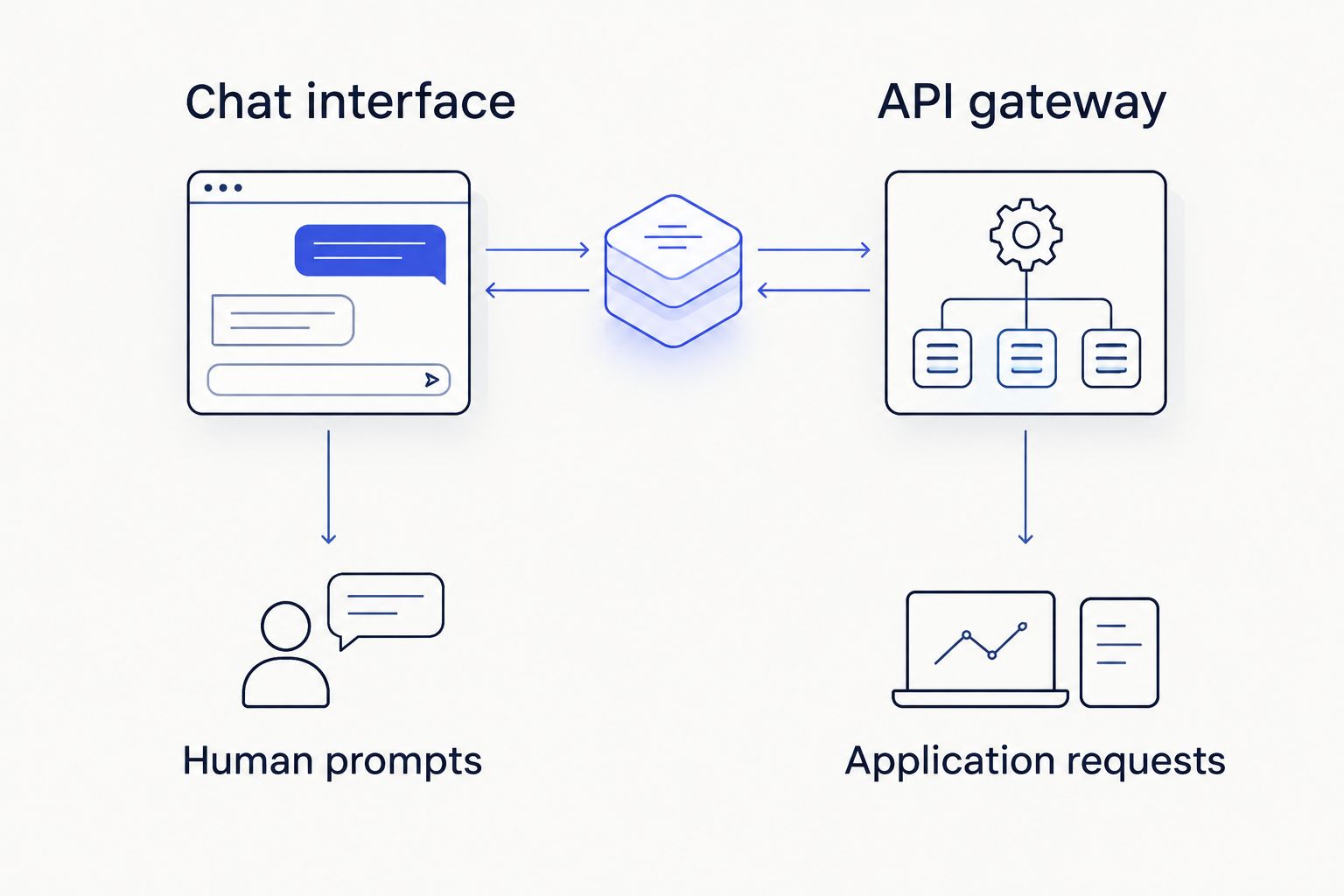
Decide which request path you need to change before choosing a tool.
For a 2026 evaluation, trace one request from its origin. Identify who sends it, which component selects a model, what happens if the selected provider fails, and where usage is governed. Those questions distinguish an interface replacement from an infrastructure decision without relying on feature lists that mix the two.
1. FastRouter: best for enterprise API routing
FastRouter is an OpenAI-compatible API gateway for enterprise AI development teams. Its stated scope includes access to 200+ large language models, routing, model comparison, automatic failover, cost optimization, and usage governance. That makes it the strongest fit on this list when your problem is managing application traffic rather than improving a person's chat screen.
Where FastRouter shines
- One integration surface: an OpenAI-compatible gateway gives development teams a common API interface for model access.
- Routing and failover: requests can move to other providers through the gateway's automatic failover capability.
- Governance: usage management belongs at the shared request layer instead of depending on how each person uses a chat interface.
- Model comparison: teams assessing multiple models can keep that work within the same gateway category as production access.
Where FastRouter falls short
- A gateway does not answer the same need as a chat workspace for employees who want to type prompts and read responses.
- Putting an API gateway in the request path is an architecture decision. Your team must determine which application calls to route through it and how to assess the resulting behavior.
- If you need only a personal chat interface, gateway capabilities add a layer unrelated to the immediate task.
Dimension | FastRouter | TypingMind |
|---|---|---|
Primary user | Teams building and operating model-powered applications | People interacting with models through chat |
Request path | OpenAI-compatible API gateway | Chat interface |
Provider failure | Automatic failover is part of the stated gateway offering | A chat frontend is not a substitute for application-level failover |
Governance | Usage governance is part of the stated gateway offering | Evaluate chat-workspace controls separately from application governance |
Best for: AI platform teams and engineering leaders responsible for routing, failover, and governed model access across applications. Verdict: Buy for the API-layer requirement; skip it as a like-for-like chat interface replacement.
What to validate before adoption
Test the gateway against your own request path. Start with an application call that uses an OpenAI-compatible interface, then check how your team would define its routing choice and fallback behavior. Review the usage information your operators need before treating governance as solved.
Keep interface decisions separate during that test. Your team can retain a preferred chat workspace while assessing a gateway for application traffic. The architectural question is not which screen looks better; it is which component controls requests when a model or provider does not serve them.
2. LibreChat: best for self-hosted chat
LibreChat is an open-source chat application that supports conversations across model providers. It is a more direct TypingMind alternative when your users need a chat workspace and your team wants to operate that workspace itself. Its self-hosted approach changes who owns deployment work; it does not turn the chat interface into a production API gateway.
Where LibreChat shines
- Chat-first workflow: people get an interface for direct model conversations, matching the central TypingMind use case.
- Self-hosted deployment: your team controls the application deployment rather than relying solely on a hosted chat workspace.
- Provider choice: a multi-provider interface suits teams comparing responses through human prompts.
Where LibreChat falls short
- Your team takes responsibility for deploying and maintaining the workspace.
- A chat application's provider connections do not establish shared routing rules for every request made by your own products.
- If your priority is automatic failover for application traffic, evaluate an API gateway as a separate layer.
Dimension | LibreChat | TypingMind |
|---|---|---|
Primary task | Multi-provider chat | Multi-model chat |
Deployment choice | Self-hosted application | Evaluate TypingMind's available deployment options against your requirements |
Operational owner | Your team operates the self-hosted workspace | Depends on the setup you choose |
Best for: engineering teams that want a self-hosted place for people to chat with models. Verdict: Use LibreChat when control of the chat deployment is the deciding requirement.
3. Open WebUI: best for a self-hosted interface
Open WebUI is an open-source, self-hosted interface for working with AI model backends. Consider it when the user-facing workspace is the problem you need to solve. As with LibreChat, connecting an interface to a backend is different from defining organization-wide routing and failover for application requests.
Where Open WebUI shines
- Interface ownership: a self-hosted deployment puts operation of the workspace with your team.
- Backend connections: the interface can be used with supported model backends.
- Direct interaction: it addresses the need for people to submit prompts and inspect responses.
Where Open WebUI falls short
- Self-hosting adds application maintenance to your team's workload.
- Backend connectivity should not be confused with gateway-level governance across production applications.
- You must verify that your intended backend and authentication setup fit your own deployment.
Dimension | Open WebUI | TypingMind |
|---|---|---|
Core role | Self-hosted AI interface | Multi-model chat interface |
Model access | Through supported backends | Through the chat application's supported connections |
Evaluation focus | Deployment and backend fit | Chat workflow and connection fit |
Best for: teams that prioritize operating their own user-facing AI interface. Verdict: Use Open WebUI for the workspace requirement, not as proof that application routing is covered.
4. ChatGPT: best for direct OpenAI chat
ChatGPT is a hosted conversational interface from OpenAI. It belongs on a TypingMind alternatives list when the actual requirement is simple: people need a place to chat with OpenAI models. It is a narrower match for a team whose main reason for using TypingMind is working across providers through one chat interface.
Where ChatGPT shines
- Direct access: users can work in OpenAI's own conversational interface.
- Clear scope: the product is a chat workspace, so the evaluation can focus on the experience your users need.
Where ChatGPT falls short
- It is not a neutral multi-provider API gateway for requests sent by your applications.
- If you need one chat interface for several provider ecosystems, verify the required connections rather than assuming the hosted OpenAI workspace replaces them.
Dimension | ChatGPT | TypingMind |
|---|---|---|
Primary task | Hosted OpenAI chat | Multi-model chat interface |
Provider emphasis | OpenAI workspace | Working with supported model connections |
Application routing | Separate infrastructure decision | Separate infrastructure decision |
Best for: individuals or teams seeking a direct OpenAI chat workspace. Verdict: Use ChatGPT when that workspace covers the task; skip it as a replacement for multi-provider API governance.
Why teams switch from TypingMind
A sound reason to switch names the layer that is missing. In 2026, these are distinct requirements, not interchangeable complaints about one product:
- The workload moved into an application. Once your software sends model requests, a human chat interface is no longer the control point for those requests. Assess an API gateway if routing is the requirement.
- Provider failure needs a defined response. If an application must try another provider when its selected provider cannot serve a request, evaluate automatic failover on the application's request path.
- Usage needs shared oversight. If engineering leaders need governance over model access through applications, inspect controls at the API layer instead of assuming a chat history covers that need.
- The chat deployment needs a different owner. If self-hosting the workspace is the deciding factor, compare LibreChat and Open WebUI against your deployment requirements.
- The scope narrowed to OpenAI chat. If users no longer need a multi-provider frontend, evaluate whether ChatGPT meets their direct chat needs.
For an enterprise review, write down 3 test cases: a normal application request, a provider failure, and a usage-governance review. Then run a separate chat-workspace review with the people who actually type prompts. Keeping those evaluations apart prevents an interface feature from being mistaken for an operational control.
When staying with TypingMind is right
Stay with TypingMind if your primary task is human-led, multi-model chat and the current workflow meets that need. A gateway does not improve a chat interface merely by sitting elsewhere in your architecture. Likewise, self-hosting a different interface is not a benefit unless ownership of that deployment matters to your team.
The 2026 decision is therefore not a single winner for every team. Keep TypingMind for a fitting chat workflow; choose a chat alternative when the workspace must change; evaluate FastRouter when application-level routing, failover, and governance are the requirement.
FAQ
What is the best TypingMind alternative for enterprise API routing in 2026?
FastRouter is the best fit on this list for enterprise API routing in 2026. It provides an OpenAI-compatible gateway with automatic failover and usage governance; it serves a different role from a chat interface.
Is FastRouter a direct replacement for TypingMind?
No. FastRouter is an API gateway for application requests, while TypingMind is a multi-model chat interface. Choose based on whether you need to change the request layer or the human workspace.
What is the best self-hosted TypingMind alternative?
LibreChat and Open WebUI are self-hosted interface options. Compare their supported backends and deployment requirements against the workspace your team needs.
Is LibreChat better than TypingMind for application failover?
LibreChat is a chat application, not the application-level failover choice in this comparison. If provider failure must trigger another route for product traffic, evaluate an API gateway on that request path.
Can a team use a chat interface and an API gateway together?
Yes. A chat interface serves people entering prompts, while an API gateway handles requests sent through it by software. The two components address different workflows.
When should a team keep TypingMind?
Keep TypingMind when its multi-model chat workflow meets the team's human-led prompting needs. Changing tools only to gain application routing will not make a chat-interface replacement solve an API-layer problem.
One last thing
Test the failing request, not just the successful prompt. A chat comparison shows what a person sees when a model responds; an API-layer evaluation must also show what your application does when its chosen provider cannot respond. That distinction is the quickest way to make a 2026 TypingMind alternatives shortlist useful to both engineering and product leaders.
Related Articles

CometAPI alternatives in 2026
Compare CometAPI alternatives in 2026. FastRouter leads for enterprise routing, failover, and governance; see when LiteLLM or direct OpenAI access fits.

Artificial Analysis alternatives in 2026
Compare Artificial Analysis alternatives in 2026. Fastrouter fits teams needing model routing, failover, and governance; Arena fits human-preference research.
.png&w=3840&q=75)
Your Coding-Agent Bill Is Growing. And You Can't See Why.
Cursor, Cline, and Claude Code burn tokens very differently by task type. See the real cost gap between them and how routing by task shape stops silent overspend.