
.png&w=3840&q=75)
GPT-5.6 Luna, Terra, and Sol Are Now Available on FastRouter
GPT-5.6 Luna, Terra, and Sol are now available on FastRouter. Three tiers, one endpoint, from high volume workhorse to flagship reasoning.

OpenAI's GPT-5.6 family is now available through FastRouter. The family introduces three tiers — Luna, Terra, and Sol — each designed for a different point on the cost-performance curve. All three are accessible through the same FastRouter endpoint with no configuration changes required.
Three models, one decision framework
The GPT-5.6 family is structured as a tiered offering. Each model accepts text and image inputs and produces text output, with a shared context window of 1,050,000 tokens and a maximum output of 128,000 tokens. The meaningful differences are in price, latency, and the complexity of tasks each is optimized for.
Luna | Terra | Sol | |
Model ID | openai/gpt-5.6-luna | openai/gpt-5.6-terra | openai/gpt-5.6-sol |
Input price | $1.00 / 1M tokens | $2.50 / 1M tokens | $5.00 / 1M tokens |
Output price | $6.00 / 1M tokens | $15.00 / 1M tokens | $30.00 / 1M tokens |
Blended price | $2.25 / 1M tokens | $5.63 / 1M tokens | $11.25 / 1M tokens |
Latency | 1.96s | 2.70s | 4.68s |
Throughput | 3,944 t/s | 3,875 t/s | 3,645 t/s |
Best for | High-volume, routine tasks | Everyday professional work | Complex reasoning, agents |
GPT-5.6 Luna
Luna is the cost tier in the family. At $1.00 per million input tokens and $6.00 per million output tokens, it is positioned as a high-volume workhorse for tasks where throughput and cost matter more than peak reasoning capability.
It is optimized for drafting, summarization, routine automation, and other tasks that run frequently and do not require the model's full capability ceiling. With latency of under 2 seconds and throughput of nearly 4,000 tokens per second, it is the right default for production pipelines that need to process large volumes efficiently.
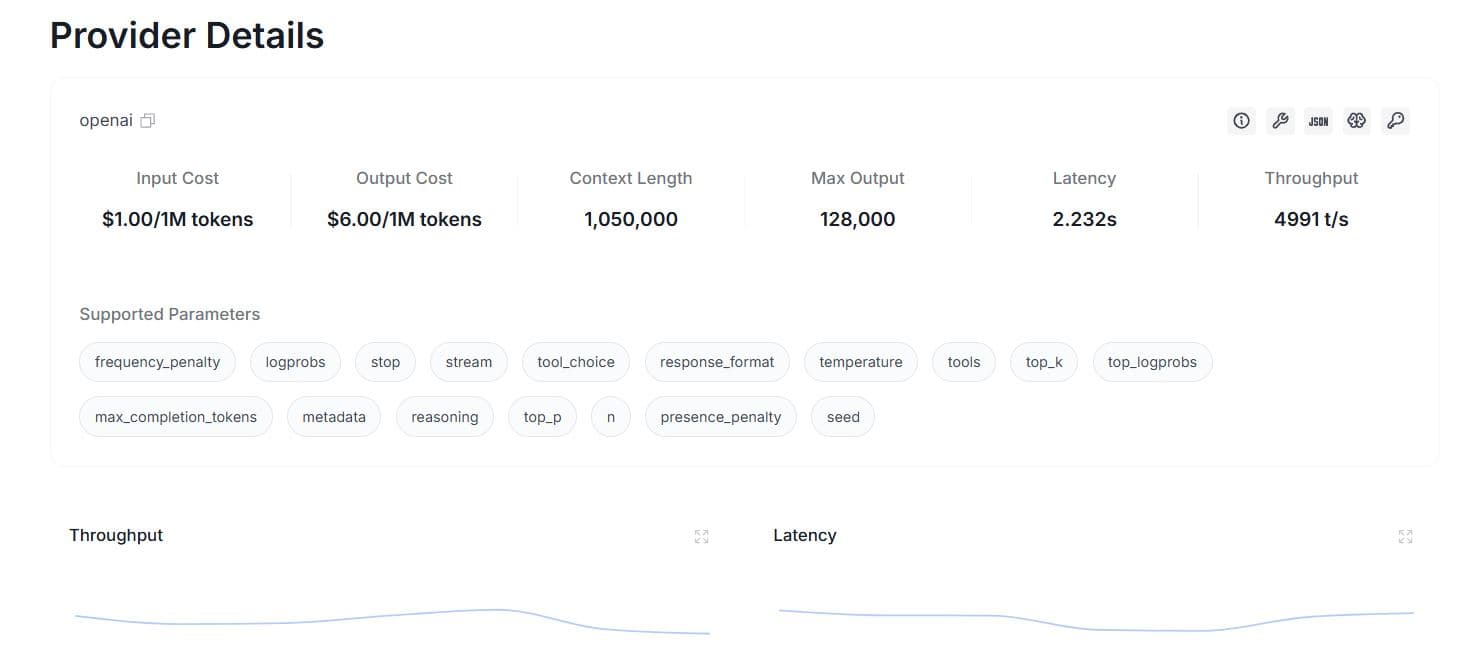
On ArtificialAnalysis's Intelligence Index, Luna scores 46.1, with a coding score of 63.3 — figures that line up with its positioning as the volume tier rather than the capability ceiling of the family.
Getting started with Luna
1from openai import OpenAI23client = OpenAI(4 base_url="https://api.fastrouter.ai/api/v1",5 api_key="<FASTROUTER_API_KEY>",6)78completion = client.chat.completions.create(9 model="openai/gpt-5.6-luna",10 messages=[11 {"role": "user", "content": "Summarize this support ticket in one sentence."}12 ]13)14print(completion.choices[0].message.content)15
GPT-5.6 Terra
Terra is the mid tier. At $2.50 per million input tokens and $15.00 per million output tokens, it targets everyday professional and enterprise work — analysis, coding, knowledge work — at roughly half the cost of Sol.
OpenAI describes Terra as comparable to GPT-5.5 in reasoning and coding capability. It is available in limited preview via the OpenAI API and is a reasonable default for the majority of production use cases where Luna's reduced capability is not sufficient but Sol's price is not justified.
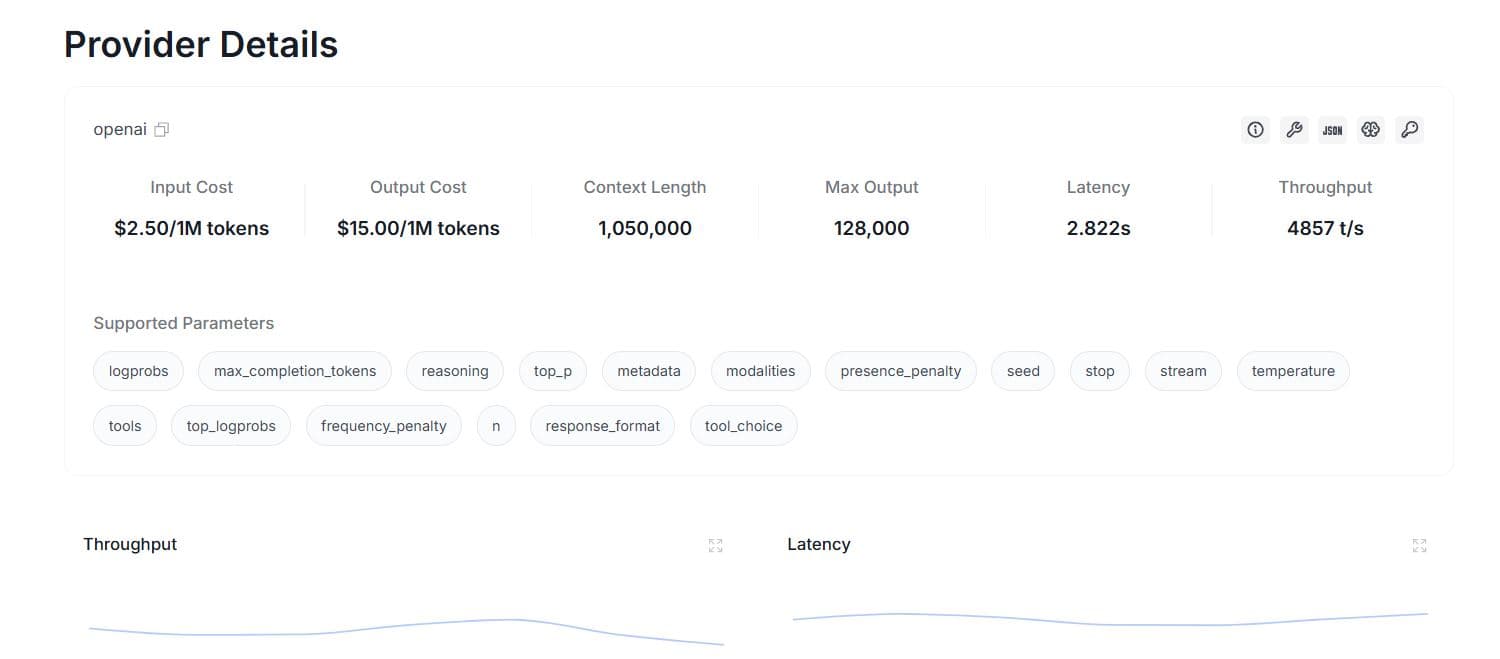
Terra scores 51.6 on ArtificialAnalysis's Intelligence Index, ranking #8 among models on FastRouter, with a coding score of 70.6 (#9). That places it clearly ahead of Luna on capability while staying well short of Sol's ceiling.
Getting started with Terra
1completion = client.chat.completions.create(2 model="openai/gpt-5.6-terra",3 messages=[4 {"role": "user", "content": "Review this pull request and flag any issues."}5 ]6)
GPT-5.6 Sol
Sol is OpenAI's flagship in the GPT-5.6 family. At $5.00 per million input tokens and $30.00 per million output tokens, it is priced for complex, high-value work — advanced reasoning, security research, long-horizon agentic tasks, and cases where the cost of a wrong output outweighs the cost of the token.
Sol is available in limited preview for trusted partners and includes enhanced safety systems for higher-risk and sensitive use cases. It also ships with improved prompt caching support over prior generations, which matters for agentic workflows where the same system prompt appears across many calls.
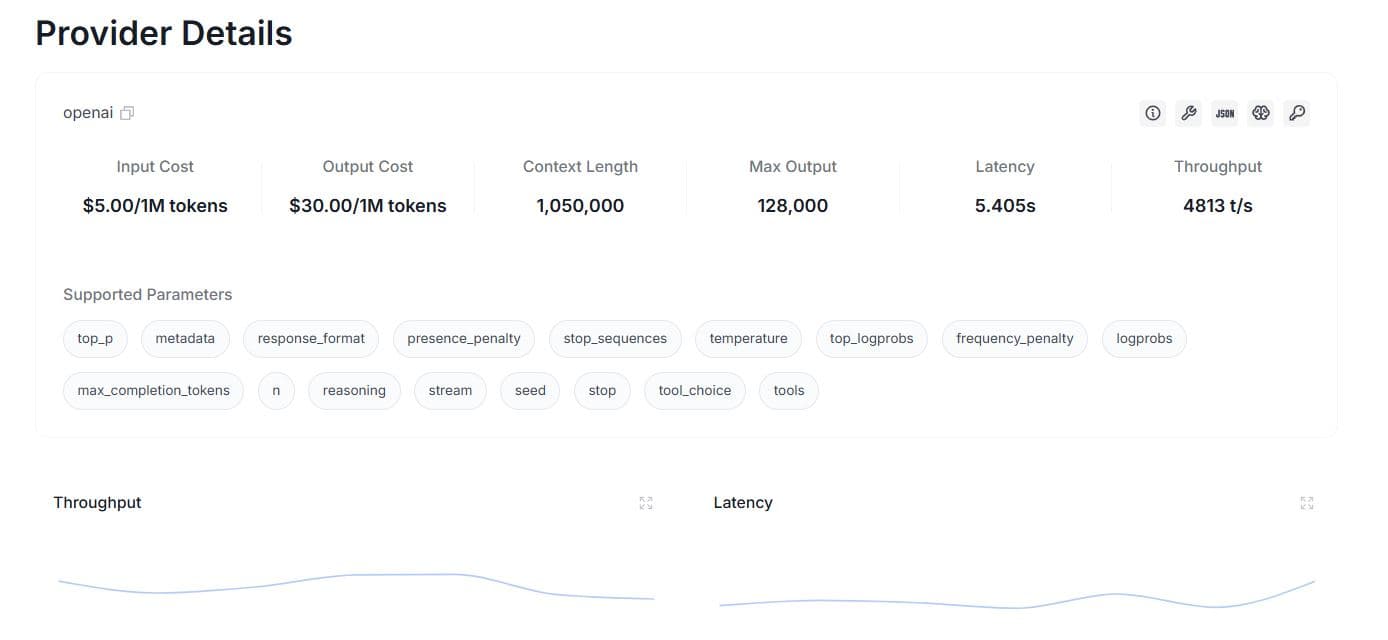
Sol leads the family on ArtificialAnalysis's Intelligence Index with a score of 55.9, ranking #2 across all models on FastRouter. Its coding score of 77.2 ranks #1 on FastRouter, the highest of any model on the platform.
Getting started with Sol
1completion = client.chat.completions.create(2 model="openai/gpt-5.6-sol",3 messages=[4 {"role": "user", "content": "Analyze this codebase for security vulnerabilities."}5 ]6)
Routing across the family
The practical value of having all three models available through one FastRouter endpoint is that routing decisions can be made at the task level without maintaining separate integrations per model.
A pipeline that runs document summarization, code review, and agentic planning in sequence can route each step to the appropriate tier — Luna for the summarization, Terra for the code review, Sol for the planning — with a single base URL and no changes to the application's authentication or tooling setup.
FastRouter's Auto Router can also handle this automatically when using fastrouter/auto as the model ID, selecting the most cost-efficient capable model per request based on the task and configured routing rules.
GPT-5.6 Luna, Terra, and Sol are available now through FastRouter at fastrouter.ai. One base URL, no markup on API calls.
Related Articles
.png&w=3840&q=75)
Gemini 3.7 Flash Is Available on FastRouter
Gemini 3.7 Flash is now available on FastRouter. Multimodal, 1M token context, $1.50/1M blended price, zero markup, no new integration required.
.png&w=3840&q=75)
Kimi K3 Is Now Available on FastRouter
Kimi K3, Moonshot AI's flagship reasoning model, is now on FastRouter. 1M token context, #2 Intelligence, one endpoint.
.png&w=3840&q=75)
Grok 4.5 Is Now Available on FastRouter
Grok 4.5 is now available on FastRouter. xAI's Opus-class model for coding and agentic workflows, priced for large, tool-heavy sessions.