
.png&w=3840&q=75)
From One SDK to a Cost Problem: Why Teams End Up Needing Routing Intelligence
Most teams do not start an AI roadmap with optimized inference spend at the top of the list. They start with a deadline.

Most teams do not start an AI roadmap with optimized inference spend at the top of the list. They start with a deadline.
Someone wants a feature in production. An engineer picks the fastest path: one provider's SDK, one model string, one clean API call. Prompt in, answer out, ship the thing. It works, and for a while it even feels predictable.
Then a few months later, a different kind of question shows up in a budget review:
"Why did our AI bill jump again?"
Not because you did anything reckless. Because the product grew into something a single SDK was never built to carry.
Where it starts: one provider, one SDK
For a single text generation use case, a direct SDK integration is usually the right decision. No gateway to maintain, no abstraction layer to debate, minimal overhead. You are optimizing for speed to first version, and you get it.
The catch is that this simple setup is only simple while the product stays simple.
Where it gets complicated: new use cases, new providers
Products do not stay in one lane for long. Text generation gets joined by image generation for one feature, a voice interface for another, and video generation for a third. Some providers, especially closed source labs, simply do not cover every modality or every workload well. So you do the reasonable thing: you integrate another provider. Then another.
That is when two pressures tend to arrive at the same time.
First, cost. Image and video generation can explode in spend in ways a text budget was never sized for.
Second, quality. Validating output across models, and even across versions within the same provider, becomes an ongoing project, not a one time decision.
And quietly, visibility breaks. Spend is split across billing dashboards and incompatible units, tokens here, generations there, with no single view of what you are actually spending on inference this week, for which features, and why.
The adoption point: a gateway, and a first taste of control
This is usually when teams adopt a gateway, FastRouter or otherwise. The immediate wins are obvious:
- One integration instead of several
- One OpenAI compatible endpoint across providers and modalities
- Automatic failover when a provider has an outage
- One dashboard that shows usage, latency, errors, and spend across everything you run
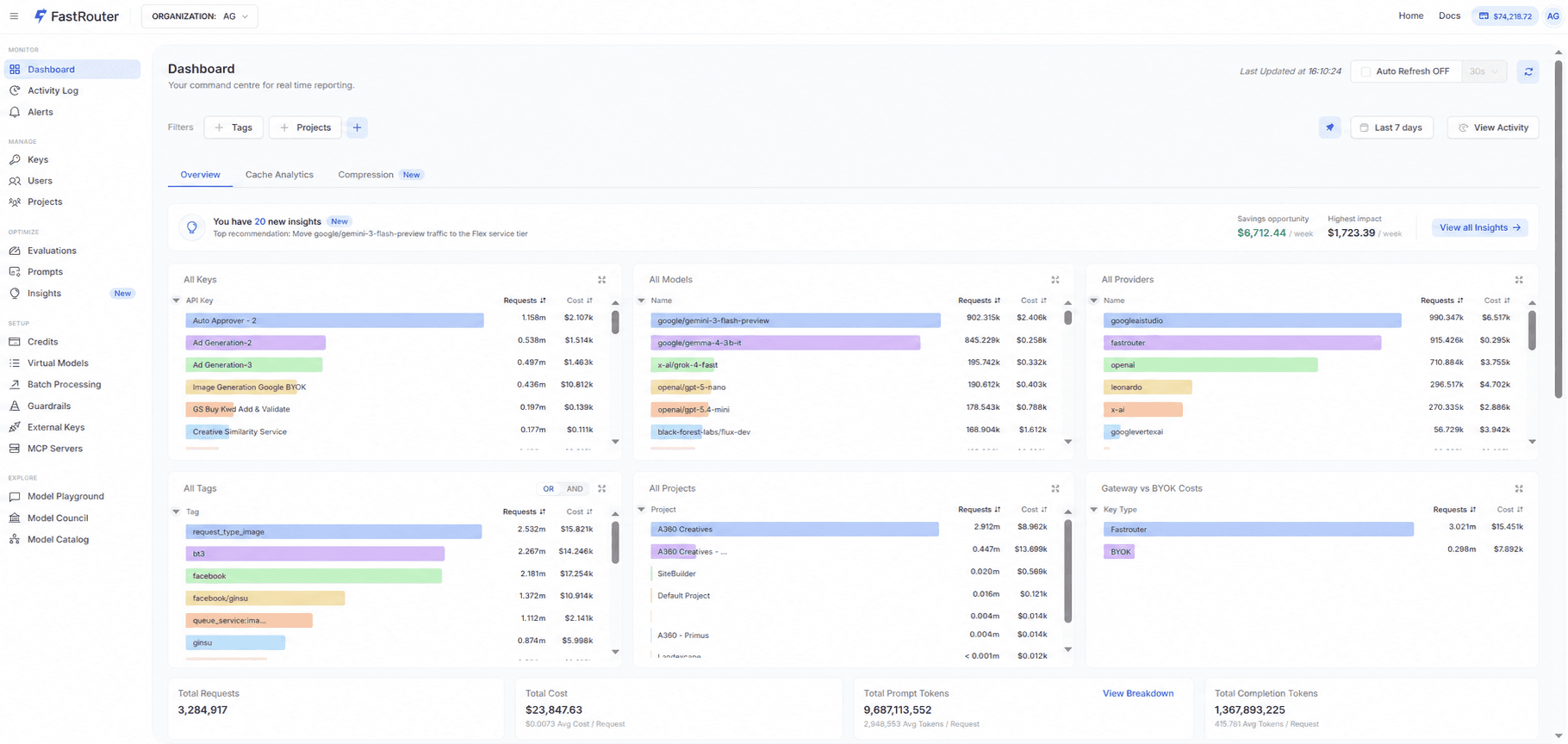
At this point, you finally have the full picture. But a full picture still does not guarantee savings, because a dashboard can show you what happened without telling you what to change next.
The part that compounds: your traffic already knows where the savings are
Most AI cost waste does not look like a dramatic incident. It looks like patterns:
- A long system prompt repeated in every turn of a conversation
- High volume workloads paying for low latency service tiers they do not actually need
- A use case still running on an expensive model out of habit, even though a cheaper one would meet the same quality bar
- Prompts that slowly bloated over time because nobody revisited them
Someone has to notice these patterns, quantify the impact, and then convince the team it is safe to change something. That is rarely urgent, so it gets postponed, and the cost keeps compounding.
That gap is what FastRouter Insights is built to close.
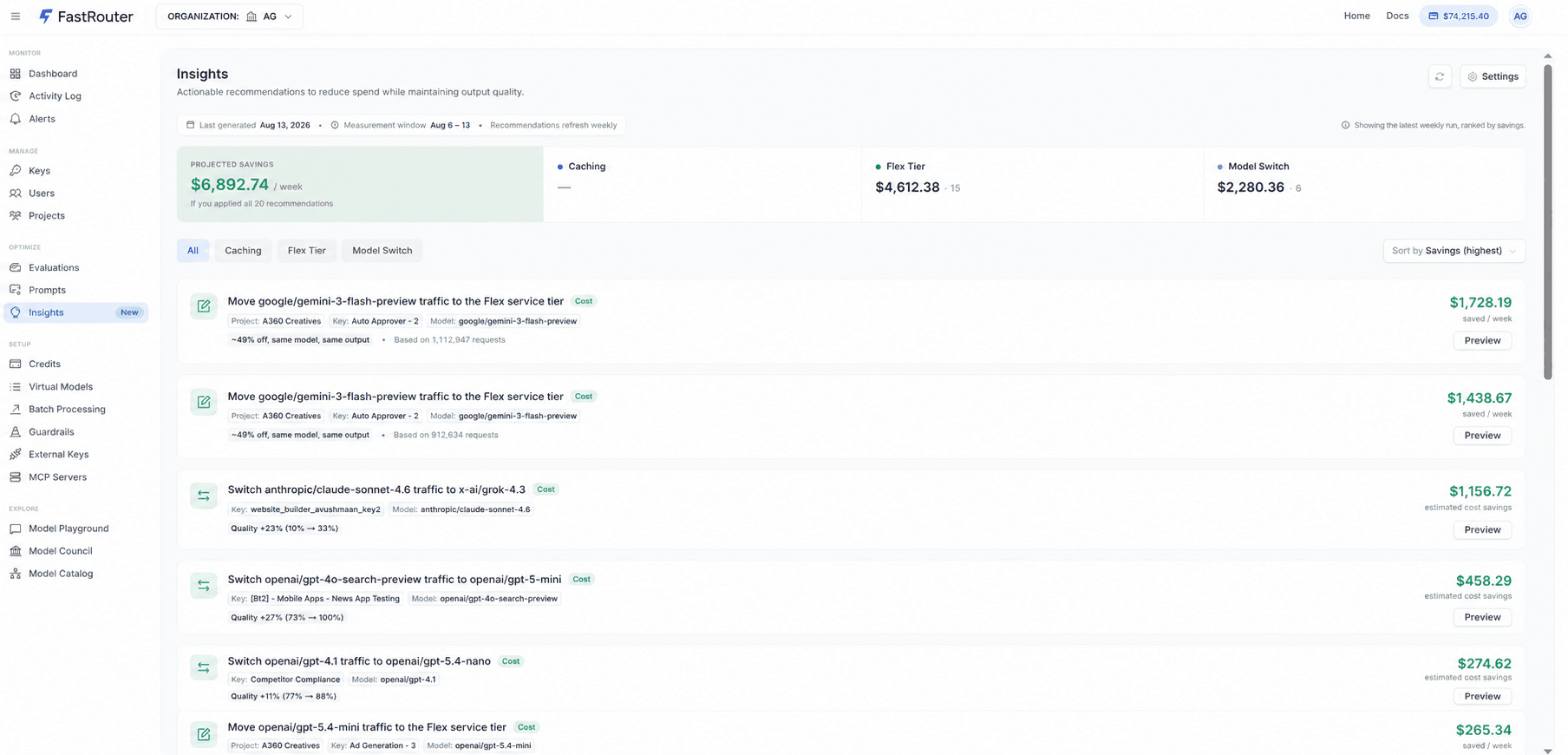
Insights is a weekly, read only analysis of your real traffic. It never modifies a request. It does not optimize behind your back. It turns what it finds into ranked, evidence backed recommendations.
How Insights works, without becoming another project
Insights produces three types of recommendation. Two of them run on usage data FastRouter already has, so they are on by default and cost nothing to generate:
- Caching: flags a repeating system prompt prefix that is being billed at full price instead of a discounted cache rate
- Flex Tier: identifies high volume, latency tolerant traffic that could run on a discounted service tier without touching output quality
The third, Model Switch, is different. Generating it means replaying sampled requests against alternative models and scoring both outputs with an LLM judge, which is real inference billed to your account, so it is opt in and has to be turned on under Settings on the Insights page. It looks for a use case where a cheaper model matches your current quality bar on your own traffic, not on a generic benchmark.
Each recommendation shows its calculation in full: the current cost, the modelled cost, and the formula connecting them, down to the raw request evidence it was built from. Nothing is applied automatically. Insights tells you what to change and what it is worth, and you decide.
The throughline: Routing Intelligence
A gateway's failover logic is a routing decision. Pricing awareness across providers is a routing decision. Choosing a discounted tier or switching models is a routing decision.
The question is whether those decisions are based on rules someone wrote once during integration, or made by something that is actually watching the traffic as it runs.
FastRouter calls that Routing Intelligence. Insights is where it becomes something a finance conversation can use: not a promise that routing is smart, but a specific dollar figure, an evidence trail, and a clear place to make the change.
For teams that started with one SDK and one model, the path here rarely looks planned. It looks like a series of reasonable decisions under growth pressure. Add a modality, add a provider, adopt a gateway to stop the sprawl. Decisions that eventually land you somewhere a single SDK could never reach: a system that keeps finding savings every week, without you having to go hunting for them.
If your AI stack has moved beyond one model, one use case, check what your traffic is already telling you. FastRouter Insights is built to turn that into action.
Related Articles
.png&w=3840&q=75)
Cheapest Way to Access GPT-6, Claude & Gemini Through One API
Find out about Cheapest Way to Access GPT-6, Claude & Gemini Through One API in new FastRouter blog

.png&w=3840&q=75)
Stop Paying “Real Time” Prices for Work No One Needs in Real Time
See which of your traffic qualifies for Flex tier pricing, and exactly how much it saves. Same model, same output, lower bill.
.png&w=3840&q=75)
Prompt Compression: The Same Answer for a Fraction of the Tokens
Prompt Compression cuts token usage before requests reach the model, no rewriting needed, no risk of breaking your production requests.