

FastRouter vs Together AI: which is better in 2026
Fastrouter vs Together AI: choose a gateway for routing and governance, or an inference platform for open models. Compare failover, integration, and costs.
Choose Fastrouter if you need a governed gateway for routing requests across model providers; choose Together AI if you need a platform for running and fine-tuning open models. The difference is architectural: one manages model access across your application estate, while the other supplies model execution infrastructure.
TL;DR
- Fastrouter vs Together AI is a gateway-versus-inference decision, not a comparison of interchangeable products.
- Fastrouter is best for enterprise teams centralizing LLM routing, automatic failover, and usage governance.
- Together AI is best for teams running open-model inference, fine-tuning, and dedicated deployments.
- Compare complete request paths, including retries and evaluation, rather than treating an endpoint change as a performance improvement.
Why this matters
Your 2026 platform decision should start with the operational problem, not the model catalog. Adding another inference endpoint does not, by itself, create a policy layer across providers; adding a gateway does not, by itself, give you control over model training or deployment infrastructure.
Fastrouter provides an OpenAI-compatible LLM gateway with access to 200+ large language models, automatic failover, cost optimization, and usage governance. Together AI provides model inference infrastructure, including serverless inference, dedicated deployments, and fine-tuning.
Fastrouter is best for enterprise teams that need centralized LLM routing and usage governance. Together AI is the stronger fit when the buying decision centers on serving or adapting an open model rather than coordinating access across providers.
At a glance
Read this comparison as a division of responsibilities. A gateway decision concerns request policy; an inference-platform decision concerns model execution.
Dimension | Fastrouter | Together AI |
|---|---|---|
Best for | Enterprise teams coordinating model access across providers | Teams serving and adapting open models |
Routing | Unified access to 200+ models with routing and cost optimization | Model execution through an inference platform |
Failover | Automatic failover is an explicit gateway capability | Evaluate endpoint resilience separately from cross-provider failover |
API compatibility | OpenAI-compatible gateway | OpenAI-compatible inference endpoints |
Governance | Usage governance across gateway access | Evaluate controls within the inference environment |
Model execution | Gateway access rather than a model-training proposition | Inference, fine-tuning, and dedicated deployments |
Pricing model | Evaluate gateway billing alongside underlying model consumption | Compare serverless consumption with dedicated deployment billing |
Standout feature | Routing, failover, and governance in one access layer | Model serving and adaptation in one inference platform |
The gateway wins for cross-provider routing
A platform team managing several model providers needs a consistent place to decide where requests go. That is a different problem from obtaining an endpoint for a particular model.
The gateway's unified access to 200+ models addresses that coordination layer. Your application can use an OpenAI-compatible interface while the gateway handles model access, routing, and cost optimization.
Together AI fits a different starting point: you have selected an open-model workload and need infrastructure to execute it. Its inference platform is the direct fit for that task, without making a cross-provider routing layer the center of the architecture.
Choose the gateway when routing policy is the requirement. Choose the inference platform when model execution is the requirement.
The gateway's tradeoff is another component in your request path. Your team must understand its configuration, failure behavior, and ownership. The inference-platform tradeoff is narrower architectural coverage: supplying model execution does not replace your application's routing policy across unrelated providers.
For a 2026 evaluation, write down which decisions belong outside application code. Model selection, permitted destinations, and fallback eligibility deserve explicit ownership before you change an endpoint.
The gateway wins for automatic failover
Automatic failover is an explicit gateway capability in this comparison. It matters when your application needs an alternate destination after an upstream failure, rather than simply another attempt against the same destination.
Together AI's inference infrastructure addresses model execution. Assess its endpoint behavior on its own merits, but keep infrastructure availability and cross-provider failover separate in your requirements.
A successful fallback is not merely an HTTP success response. The replacement model must satisfy the application's output contract, tool requirements, and data-handling rules.
Use these failure cases in your evaluation:
- Rate limits: HTTP status code 429 means too many requests. Define whether the application waits, retries, or selects an eligible alternative.
- Unavailable service: HTTP status code 503 indicates service unavailability. Define the response to an unavailable upstream destination.
- Request timeout: Establish when waiting becomes a failed operation and who owns cancellation.
- Invalid output: Decide whether a malformed response triggers validation failure, a retry, or an alternate model.
These are test cases, not claims that either product handles every case automatically. Exercise them against your actual integration.
The gateway's advantage is its stated failover capability. Its limitation is that your team still owns application correctness: automatic rerouting cannot establish that different models produce interchangeable answers.
Approve failover only after the alternate model passes the same acceptance criteria as the primary model. Availability without acceptable output is not a successful application result.
Both support an OpenAI-compatible starting point
Both options support OpenAI-compatible access, making this dimension an honest tie at the interface level. Compatibility gives your developers a familiar request pattern; it does not establish identical behavior across every model or endpoint.
That distinction matters during migration. A shared API shape does not guarantee that tool calls, structured outputs, streaming events, or error responses behave identically for your workload.
Keep the integration test focused on what your application actually uses:
- Authentication and endpoint configuration.
- Request fields required by the selected model.
- Streaming behavior and cancellation handling.
- Tool-call parsing and validation.
- Error handling, retry ownership, and response logging.
Treat OpenAI compatibility as a migration starting point, not a portability certificate. The same client library can still encounter different model behavior.
For your 2026 integration review, separate interface tests from answer-quality tests. The interface suite checks that requests and responses work; the quality suite checks that the application achieves its intended result.
Neither option wins this category merely by supporting a familiar interface. The winner for your implementation is the one that passes the complete application contract without unnecessary changes.
The gateway wins for centralized usage governance
When several teams consume models through different integrations, governance becomes a coordination problem. You need to establish who can use which destinations and how model usage enters your operating process.
The gateway explicitly includes usage governance alongside routing and cost optimization. That makes it the more direct fit for a platform team buying a shared model-access layer.
Together AI belongs in the evaluation when governance concerns the inference environment you are adopting. Do not treat controls around one execution platform as a substitute for a policy covering every provider your organization uses.
Define your governance requirements before the demonstration:
- Which teams and applications need separate accountability?
- Which model destinations are approved for each workload?
- What usage information must reach finance and engineering?
- Who can change routing and failover policy?
- How will you investigate an unexpected change in consumption?
Those questions are acceptance criteria, not a list of promised product features. Require evidence for each requirement that affects your purchase.
The gateway's limitation is scope: centralized model access does not replace your organization's security review, data classification, or application authorization. An inference platform has the same boundary. Product controls support your operating policy; they do not write it.
Buy the governance layer for a defined control problem, not for a dashboard alone. A usage view matters only when someone owns the decisions it supports.
Together AI wins for model execution and adaptation
Together AI is the better fit when your core requirement is running or fine-tuning an open model. Its platform includes inference, fine-tuning, and dedicated deployments, so the evaluation belongs at the model-execution layer.
The gateway's stated proposition is unified model access, routing, failover, cost optimization, and usage governance. That is not the same proposition as a fine-tuning or dedicated deployment platform.
The architecture separates into these responsibilities:
- Routing: Decide where an eligible request goes.
- Failover: Select an alternate destination when required.
- Governance: Manage usage within the access layer.
- Inference: Execute a selected model.
- Fine-tuning: Adapt a model using training data.
- Dedicated deployment: Evaluate model execution on dedicated infrastructure.
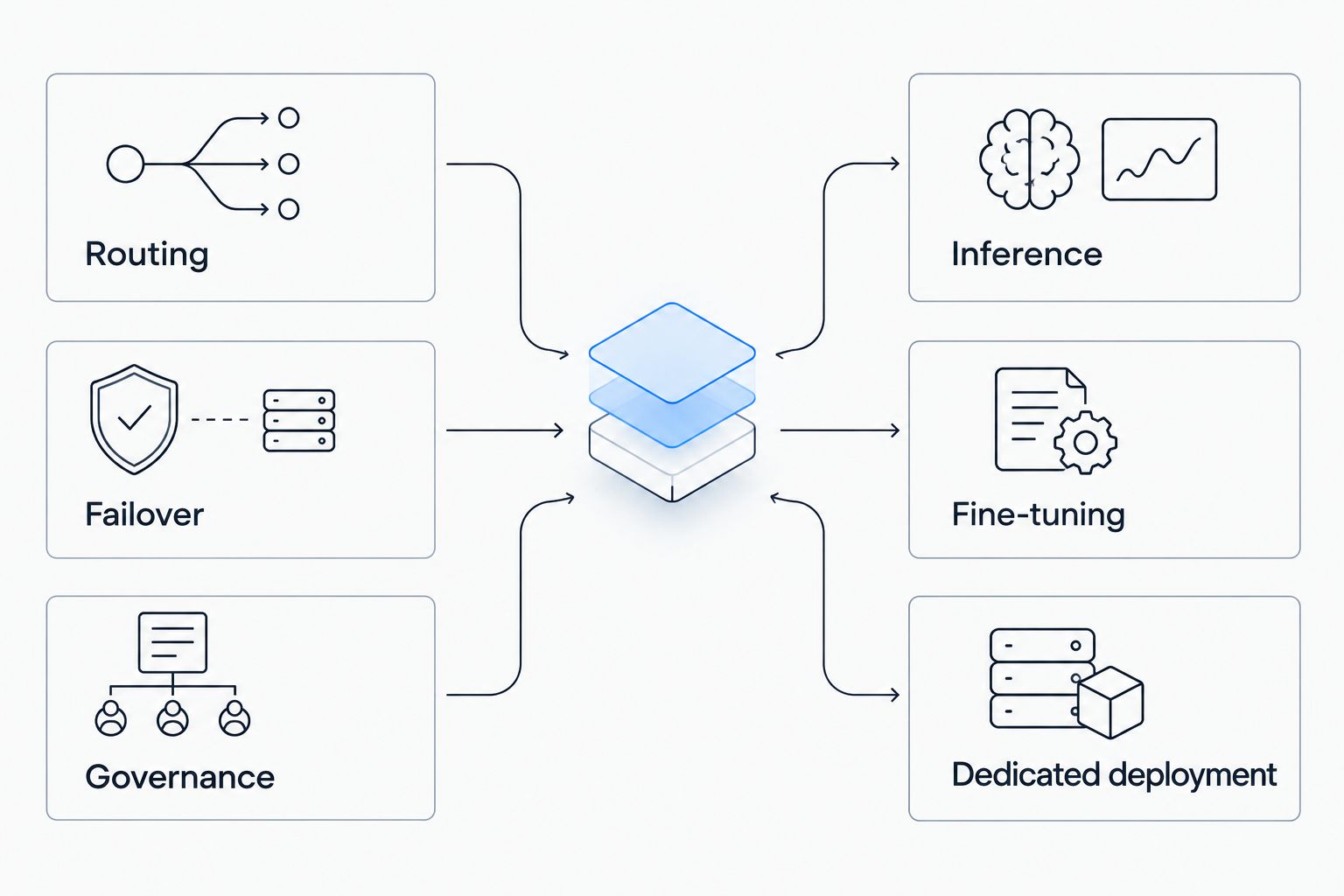
Choose the layer that owns the problem you need to solve.
Dedicated deployment introduces a different planning question from shared inference access. Your team must assess capacity needs, workload patterns, and responsibility for operating the application against that deployment.
Fine-tuning also requires a quality evaluation. Changing model weights is not evidence that the resulting model improves your production task.
Choose Together AI for a model-execution project. Keep routing and cross-provider governance as separate architecture requirements instead of expecting one purchase to answer both questions.
Neither wins on cost without your workload
A 2026 cost comparison must distinguish gateway billing from model-execution billing. Otherwise, you risk comparing different parts of the same request path.
For the gateway, inspect the current commercial terms and establish how gateway charges relate to underlying model consumption. Cost optimization is a stated capability, but it is not evidence of a specific saving for your application.
For Together AI, compare the commercial model for serverless inference with the model for a dedicated deployment. Consumption-based evaluation centers on request usage; dedicated deployment evaluation also requires capacity planning.
The tradeoff is flexibility versus commitment to execution capacity. Your workload determines which arrangement is useful, so assess it using the traffic pattern you actually expect.
Account for the complete operation:
- Model consumption for the original request.
- Additional attempts caused by retries or fallbacks.
- Evaluation traffic needed to approve a model change.
- Engineering work required to maintain integrations.
- Unused capacity where the deployment arrangement makes it relevant.
Compare cost per accepted application result, not just cost per request. A request that returns an unusable answer still consumes resources.
This is a tie until your own evaluation resolves it. Neither a larger catalog nor a dedicated deployment establishes the lower total cost for an unspecified workload.
Final verdict: choose the responsibility you need
Choose Fastrouter if you lead a shared platform
Your team supports multiple applications and needs a central LLM gateway for model routing, automatic failover, cost optimization, and usage governance. The priority is controlling access consistently rather than building an individual model deployment.
Choose this approach when policy belongs in a shared layer. Accept that application validation and gateway integration remain engineering responsibilities.
Choose Together AI if you own model execution
Your team needs open-model inference, fine-tuning, or a dedicated deployment. The priority is executing or adapting the selected model, not centralizing access across unrelated providers.
Choose this approach when the execution environment is the immediate requirement. Keep organization-wide routing and provider governance in the architecture review rather than assuming they are resolved.
For a 2026 procurement decision, attach each requirement to an owner and an acceptance test. That makes the comparison actionable without turning different product categories into a forced winner-takes-all contest.
Dimension | Winner |
|---|---|
Shared-platform buyer fit | Gateway for cross-provider coordination; inference platform for model execution |
Cross-provider routing | Gateway |
Automatic failover | Gateway |
OpenAI-compatible starting point | Tie |
Centralized usage governance | Gateway |
Model execution and adaptation | Together AI |
Workload-specific cost | Tie until evaluated |
Standout capability | Gateway for access policy; Together AI for execution infrastructure |
FAQ
Is Fastrouter vs Together AI a direct product comparison?
Fastrouter vs Together AI compares an LLM gateway with an inference platform. Choose the gateway for centralized routing and usage governance; choose Together AI for open-model execution and adaptation.
Which is better for fine-tuning an open model?
Together AI is the better fit for fine-tuning an open model. Fine-tuning belongs to its model-execution proposition, while the gateway proposition centers on access, routing, failover, and governance.
Which is better for automatic failover across model destinations?
The gateway is the better fit because automatic failover is an explicit capability. Validate every fallback model against your application's quality, output, and data-handling requirements.
Do both options support OpenAI-compatible integration?
Both support OpenAI-compatible access. Test the specific request fields, streaming behavior, tool calls, and error handling your application uses before approving a migration.
Which option costs less for an enterprise application?
Neither option is the cost winner without a workload-specific evaluation. Compare current billing terms, complete request paths, retries, accepted output quality, and relevant deployment capacity.
What should an enterprise team test before choosing in 2026?
An enterprise team should test application correctness, failure handling, usage accountability, and complete operating cost in 2026. Assign each requirement an owner and a measurable acceptance criterion.
One last thing
Test what happens after a provider accepts a request but before your application receives a usable response. A retry can repeat work, and a fallback can return a different answer.
Keep external side effects behind an application-controlled validation boundary. For a workflow that writes records or triggers actions, successful model execution is only one step; your application must decide whether the result is safe to commit.
Related Articles

FastRouter vs AI/ML API: which is better in 2026
FastRouter vs AI/ML API: choose centralized LLM routing or keep a validated integration. Compare failover, governance, API contracts, and migration criteria.

FastRouter vs CometAPI: which is better in 2026
FastRouter vs CometAPI in 2026: FastRouter wins for production teams needing failover, cost control, and governance. See the side-by-side verdict and scorecard.

Best AI/ML API alternatives for enterprise governance in 2026
Compare aiml api alternatives for enterprise governance. Choose Fastrouter for managed routing, LiteLLM for self-hosting, or Bedrock for AWS-based controls.