

FastRouter vs AI/ML API: which is better in 2026
FastRouter vs AI/ML API: choose centralized LLM routing or keep a validated integration. Compare failover, governance, API contracts, and migration criteria.
Choose FastRouter if you need an OpenAI-compatible LLM gateway with automatic failover, cost optimization, and usage governance; choose AI/ML API if your application already passes production acceptance checks there and preserving that integration is your priority. This 2026 comparison separates gateway capabilities from migration decisions so you can choose against your actual operating requirements.
TL;DR
- FastRouter vs AI/ML API starts with routing requirements, not model catalog size.
- FastRouter is best for enterprise teams seeking an LLM gateway with automatic failover and usage governance.
- Choose AI/ML API when your validated integration meets requirements and migration offers no demonstrated benefit.
- Evaluate API compatibility, failure handling, output quality, and billing boundaries before switching gateways.
Why this matters
An API integration that works in development is not the same as an operating model for production. Your application also needs decisions about failed requests, acceptable substitutes, usage ownership, and changes to model behavior. Those decisions remain necessary even when an SDK connects successfully.
FastRouter provides a unified API gateway for routing, comparing, and managing access to 200+ large language models. Its stated capabilities include automatic failover, cost optimization, and usage governance. That makes the gateway a candidate for enterprise teams that want these functions at the access layer rather than scattered across application services.
For a 2026 gateway decision, compare the work each option removes and the work your team still owns. An existing integration deserves credit for behavior you have already validated. A replacement deserves credit only after its operational benefits survive testing.
At a glance
Dimension | FastRouter | AI/ML API |
|---|---|---|
Best for | Enterprise teams seeking unified LLM routing and governance | Teams whose existing integration already meets production requirements |
API integration | OpenAI-compatible gateway | Evaluate against your application's existing request and response contracts |
Standout feature | Automatic failover across LLM access | For an existing user, continuity of an already validated integration |
Model selection | Access to 200+ LLMs, with routing and comparison | Check the exact endpoints required by your workload |
Cost management | Cost optimization is a stated capability | Evaluate the billing behavior of your required workloads |
Usage governance | Usage governance is a stated capability | Verify your required ownership and access controls |
Output quality | Requires evaluation against your task criteria | Requires the same task-specific evaluation |
Pricing model | Establish gateway charges and provider billing boundaries | Establish API charges and provider billing boundaries |
Migration effort | Measure the changes needed to adopt the gateway | Keeping a working integration avoids replacement work |
The table distinguishes stated capabilities from acceptance criteria. It is not a benchmark of latency, throughput, or output quality. Use each row to define a test or a contractual question, then record the result against your application requirements.
The routing-focused gateway fits centralized operations
FastRouter is best for enterprise teams that need LLM routing, automatic failover, and usage governance through a unified gateway. That is the clearest fit supported by its stated product scope. The buying question is whether centralizing those functions improves how your team operates its applications.
Without a shared operating layer, separate services can develop different retry rules, fallback choices, and usage-accounting conventions. Treat that as an architecture risk to inspect in your own stack, not an assumption about either vendor. Your service owners should be able to explain what happens when the selected model cannot complete a request.
A gateway evaluation should answer:
- Where is the routing decision made?
- Which failures trigger another attempt?
- Which substitute models are acceptable for each task?
- Who owns the usage policy?
- How does the application identify the model that produced the response?
The benefit is a defined place to manage access and routing. The tradeoff is another dependency in your request path. Include gateway behavior in incident planning rather than treating the access layer as invisible infrastructure.
AI/ML API wins when continuity is the objective
Choose AI/ML API when your existing integration meets requirements and replacing it has no demonstrated operational benefit. This is a real scenario where continuity wins: the product team needs to ship application changes, while the current access layer already passes its acceptance checks.
A working integration contains more than an endpoint and a credential. It also contains assumptions about streaming, exceptions, timeout behavior, output parsing, and deployment configuration. Replacing that integration creates regression work even when the new API uses familiar request fields.
Continuity has a clear advantage: you retain behavior your team has already exercised. Its limitation is equally clear. A successful integration does not prove that your routing, failure handling, or governance requirements are covered.
For a 2026 migration proposal, require a written reason to switch. Name the operational problem, describe how the candidate addresses it, and define the test that demonstrates improvement. If the proposal only says the alternative has a larger catalog, keep the existing integration until the business case is stronger.
OpenAI compatibility helps, but the contract decides
An OpenAI-compatible interface reduces the need to redesign familiar request structures. It does not establish that every application behavior will remain unchanged. Test the contract your application uses, not just whether a basic request succeeds.
Start with the actual workload. A text response, a streamed response, and a response containing tool calls place different demands on the integration. Include only the behaviors your product needs; do not turn compatibility testing into an unrelated feature checklist.
Inspect these boundaries:
- Request fields your application sends.
- Response fields your application reads.
- Stream events your client expects.
- Exceptions your retry logic handles.
- Model identifiers your configuration references.
- Usage fields your accounting process consumes.
Keep representative requests under version control and run them against each candidate. Record differences that require code changes. An interface label helps you start the integration; the observed request and response contract determines whether you can deploy it safely.
Automatic failover fits a routing requirement
Automatic failover is a stated gateway capability. That matters when your application needs an alternative path after a request fails. It does not, by itself, establish the acceptable fallback policy for your product.
Define acceptable substitution before enabling automatic rerouting. A response from another model can satisfy the API contract while failing your task requirements. Tool behavior, output structure, and instruction adherence belong in the fallback acceptance criteria.
Separate the routing review into three responsibilities:
- Routing policy: State which model or provider the request should use.
- Failure handling: State which conditions justify another attempt.
- Acceptance checks: State what makes the returned response usable.
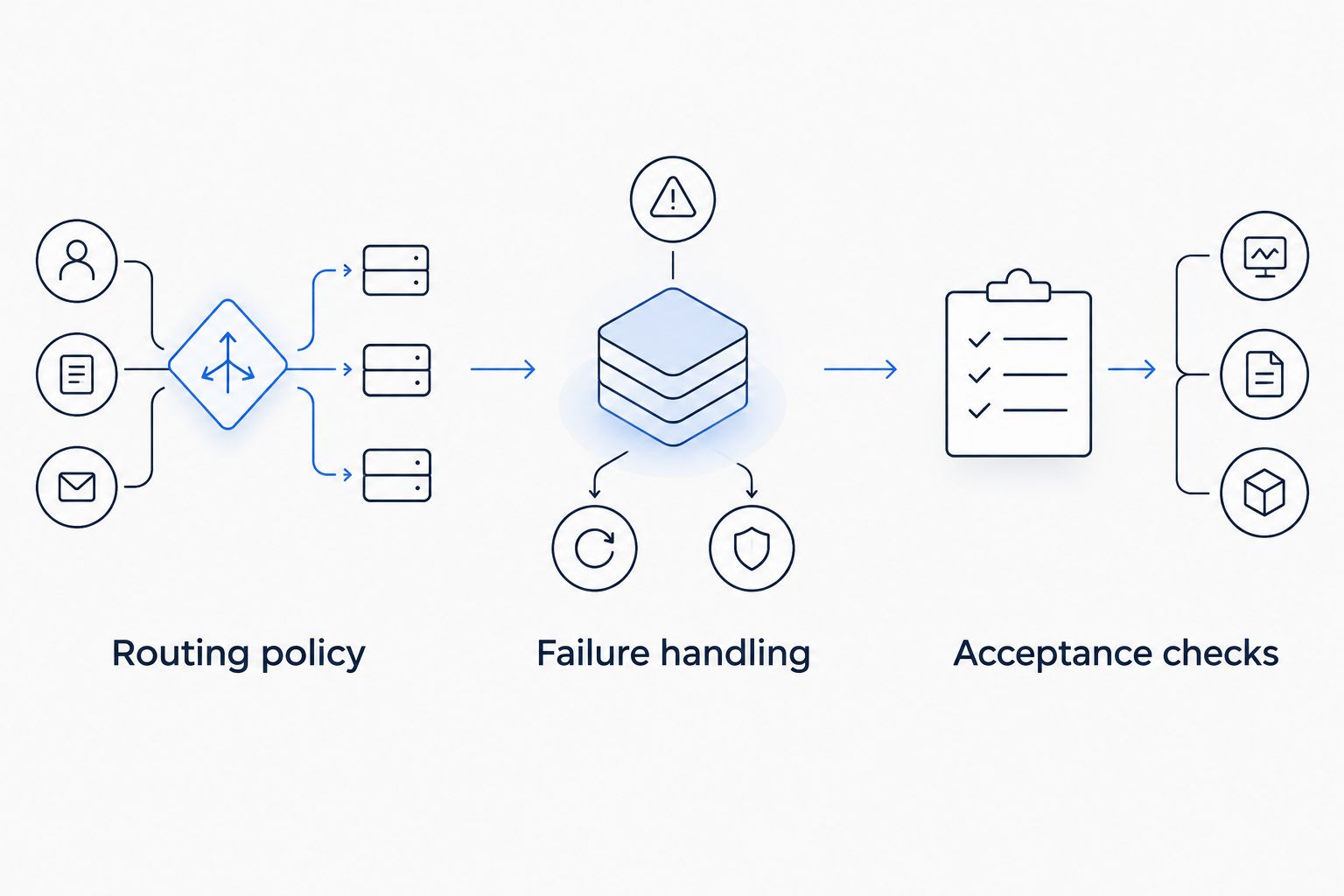
A successful fallback still needs to satisfy the application's acceptance checks.
Test failure handling with controlled failure cases in your evaluation environment. Include timeouts, rejected requests, and unusable outputs where relevant to your application. Observe whether the resulting behavior matches the policy your team approved.
For AI/ML API, apply the same review to the integration you intend to operate. Retaining that integration is the better choice when its tested failure behavior meets your requirements and a replacement does not demonstrate an improvement.
Both need task-specific quality checks
Neither gateway selection nor catalog size establishes output quality for your application. Both options need the same task-specific evaluation. This is an honest tie in the decision process, not a claim that their outputs are identical.
Use representative tasks with explicit acceptance criteria. For extraction, inspect whether the required fields are correct. For tool use, inspect whether the proposed action and arguments are valid. For customer-facing text, inspect whether the answer follows your product constraints.
Keep routing tests separate from quality tests. Routing asks whether the request reached the intended destination and how failures were handled. Quality asks whether the resulting output was useful and acceptable.
Your 2026 evaluation should also include fallback outputs. Testing only the preferred model leaves the alternative execution path unexamined. A fallback that returns a response but fails the task is not a successful application outcome.
Cost optimization needs an accounting boundary
Cost optimization is a stated gateway capability, but the purchasing decision still needs an accounting definition. Compare cost per accepted task, not just the cost of an individual request. This is a measurement method, not a claim that either option is cheaper.
An accepted task can involve an initial request, another attempt, and a fallback. Your accounting should capture the execution path that produced the usable result. Otherwise, inexpensive requests can appear attractive while the application spends additional resources recovering from failures.
For both candidates, identify:
- Which organization or project owns the usage.
- Where request usage is recorded.
- How retries and fallback requests are attributed.
- Which charges belong to the gateway relationship.
- Which charges belong to a separate provider relationship.
Use your own workload to evaluate the tradeoff. Do not infer savings from a routing feature alone. A cost-control decision is defensible when you can connect the routing behavior, the accepted output, and the resulting usage record.
Governance fits enterprise ownership requirements
FastRouter includes usage governance in its stated offering. For enterprise platform teams, that is directly relevant to deciding who can access models and how usage is managed. The implementation details still need to match your organization's requirements.
Translate governance into acceptance criteria before procurement. The word is too broad to serve as a completed security review. List the controls your organization requires and ask each candidate to demonstrate the relevant behavior.
Your review can include credential ownership, access boundaries, usage attribution, and policy administration. If your architecture requires BYOK, confirm that requirement explicitly rather than assuming it follows from OpenAI compatibility. Apply the same discipline to data handling, logging, and retention requirements.
The advantage of evaluating governance at the gateway layer is a clear ownership question. The limitation is that a feature label cannot answer every security or procurement question. Your platform owner and security owner should approve the same operating design.
Pricing models need clear billing ownership
A 2026 pricing review should establish who bills for access, who bills for inference, and how the resulting usage is reconciled. Treat those as separate questions. An API relationship does not automatically explain the provider billing boundary.
For each candidate, request the current billing terms for your intended deployment. Identify any usage-based components, contractual commitments, and separately billed services that apply to your arrangement. Do not assume the models are identical across vendors.
Choose billing predictability when budget ownership is the constraint; choose flexibility when workload changes are the constraint. Neither preference establishes a vendor winner without the applicable terms. Procurement needs a billing diagram and a reconciliation process, not a price headline detached from your architecture.
Final verdict: operating change or integration continuity
Choose FastRouter for centralized LLM operations
Best for: enterprise platform teams introducing shared routing and governance. The stated combination of an OpenAI-compatible gateway, automatic failover, cost optimization, and usage governance matches that operating objective.
Select the gateway after it passes your workload, failure-handling, and procurement checks. The reason to adopt it is the operational function you need, not an unsupported promise about speed or savings.
Choose AI/ML API for a validated existing integration
Best for: product teams whose current integration already satisfies production requirements. Keep AI/ML API when replacement work would interrupt delivery without resolving a demonstrated operating problem.
Revisit that decision when your requirements change. New routing, governance, or failure-handling needs create a reason to evaluate alternatives; a calendar change alone does not.
Dimension | Winner |
|---|---|
Centralized routing requirement | The routing-focused gateway, after acceptance testing |
Continuity of a validated AI/ML API integration | AI/ML API |
API contract correctness | Tie: test the application's contract |
Failover requirement | The option that passes the approved failure policy |
Model output quality | Tie: evaluate the actual tasks |
Cost management | The option with verified workload accounting |
Usage governance | The option that passes enterprise control requirements |
Pricing model | The option whose current terms fit billing ownership |
Avoiding unnecessary migration | AI/ML API for an existing validated deployment |
FAQ
Is FastRouter better than AI/ML API for enterprise LLM routing?
FastRouter fits enterprise teams seeking an OpenAI-compatible LLM gateway with automatic failover, cost optimization, and usage governance. Select it after testing those capabilities against your application's operating requirements.
When should I keep AI/ML API instead of switching?
Keep AI/ML API when your existing integration meets production requirements and a replacement offers no demonstrated operational benefit. Require a specific problem and an acceptance test before approving migration work.
Does OpenAI compatibility mean I can migrate without code changes?
No. Test the request fields, response fields, streaming behavior, exceptions, and usage records your application actually uses before deciding whether code changes are necessary.
Does automatic failover guarantee a correct answer?
No. Failover addresses the execution path, while task-specific acceptance checks establish whether the resulting response is usable.
How should I compare the cost of these API options?
Compare the usage required to produce an accepted task, including retries and fallback requests. Establish gateway and provider billing boundaries before evaluating current terms.
What should a gateway governance review include?
A gateway governance review should include your requirements for credential ownership, access boundaries, usage attribution, and policy administration. Confirm BYOK, logging, retention, and data-handling requirements explicitly when they apply.
What should I test before changing gateways in 2026?
Test representative tasks, API contracts, controlled failures, fallback outputs, and usage accounting. Approve the migration only when the candidate meets the operating requirements that justified the change.
One last thing
Put the fallback path in the release checklist. Your primary model can pass every task evaluation while its substitute fails the same product constraints. Test the alternative execution path before treating automatic failover as an approved production behavior.
Related Articles

FastRouter vs Together AI: which is better in 2026
Fastrouter vs Together AI: choose a gateway for routing and governance, or an inference platform for open models. Compare failover, integration, and costs.

FastRouter vs CometAPI: which is better in 2026
FastRouter vs CometAPI in 2026: FastRouter wins for production teams needing failover, cost control, and governance. See the side-by-side verdict and scorecard.

Best AI/ML API alternatives for enterprise governance in 2026
Compare aiml api alternatives for enterprise governance. Choose Fastrouter for managed routing, LiteLLM for self-hosting, or Bedrock for AWS-based controls.