
CometAPI alternatives in 2026
Compare CometAPI alternatives in 2026. FastRouter leads for enterprise routing, failover, and governance; see when LiteLLM or direct OpenAI access fits.
CometAPI gives developers one API for accessing multiple models. That convenience does not, by itself, answer how your team will handle provider failure, model selection, and usage governance. The best CometAPI alternative in 2026 is FastRouter for enterprise teams that need cross-model routing and governance; LiteLLM fits teams that want to operate their own gateway.
TL;DR
- FastRouter is the best CometAPI alternative for enterprise teams that need routing, automatic failover, and usage governance.
- LiteLLM fits teams that want to operate an open-source gateway themselves.
- The OpenAI API fits teams building directly against OpenAI rather than choosing a multi-provider gateway.
- Compare fallback behavior and governance controls before changing a production integration in 2026.
Why this matters
A shared API endpoint can simplify integration, but it is only one part of the architecture. An enterprise AI platform team also needs to decide who owns fallback rules, how model usage is governed, and what happens when a provider cannot serve a request.
In 2026, the useful question is not which service lists the most models. It is which operating model matches your application: a gateway with routing controls, a gateway your team operates, or a direct provider API. Those choices assign different responsibilities to your platform team.
CometAPI alternatives at a glance
Tool | Best for | Standout capability | How it differs from CometAPI |
|---|---|---|---|
CometAPI | Teams seeking multi-model access through one API | A shared integration for multiple models | The reference point for evaluating gateway behavior |
Enterprise teams managing multi-model access | OpenAI-compatible gateway with routing, automatic failover, cost optimization, and usage governance | Puts those operational controls at the center of the decision | |
LiteLLM | Teams that want to operate a gateway | Open-source gateway software | Your team owns its deployment and operation |
OpenAI API | Teams building directly on OpenAI | Direct access to OpenAI models | It is a provider API, not a cross-provider gateway |
The table separates model access from operational ownership. Before selecting a CometAPI alternative, decide which responsibilities your team wants to retain and which it wants a gateway to handle. Check each service’s current documentation for the exact controls your production workload requires.
1. FastRouter: best for enterprise routing and governance
FastRouter is an OpenAI-compatible API gateway for enterprise AI development teams. It provides access to 200+ large language models and supports routing, model comparison, automatic failover, cost optimization, and usage governance. That makes FastRouter the strongest fit here when the decision is about managing traffic across models, not simply reaching them through one endpoint.
Where FastRouter shines
- One integration surface: An OpenAI-compatible gateway gives teams a shared API pattern for model access.
- Automatic failover: Requests can be rerouted when a provider becomes unavailable.
- Governance: Usage controls belong in the gateway decision rather than being treated as an afterthought.
- Model comparison: Teams can assess model choices within a shared access layer.
Where FastRouter falls short
- A gateway adds another component to the request path. Teams that require direct provider connections must account for that architectural difference.
- OpenAI compatibility does not remove the need to check provider-specific behavior when an application depends on it.
- A team committed to operating its own gateway may prefer software it can deploy and control directly.
Best for: Enterprise engineering leaders and AI platform teams that need a unified gateway with routing, failover, and governance.
Decision point | FastRouter | CometAPI |
|---|---|---|
Primary fit | Enterprise routing and governance across models | Multi-model access through one API |
Integration | OpenAI-compatible API gateway | Shared API for multiple models |
Failover review | Automatic failover is part of the stated offering | Check current documentation and test the required behavior |
Governance review | Usage governance is part of the stated offering | Check current documentation against your policy requirements |
Verdict: Choose FastRouter when you need an enterprise API gateway that combines multi-model access with explicit routing, automatic failover, and usage governance. For a 2026 evaluation, map each required control to an application workflow before you commit to an integration.
2. LiteLLM: best for operating your own gateway
LiteLLM is open-source gateway software for teams that want to put an API layer between applications and model providers. Its distinction from a hosted gateway decision is operational ownership: your team chooses how to deploy, configure, and maintain the gateway. That is useful when gateway operation is already part of your platform team’s remit.
Where LiteLLM shines
- Deployment ownership: Your team controls where and how it runs the gateway.
- Configuration control: Platform engineers can make gateway configuration part of their own deployment process.
- Provider abstraction: Applications can integrate through a gateway instead of maintaining every provider connection independently.
Where LiteLLM falls short
- Your team must own deployment, monitoring, updates, and incident response for the gateway it operates.
- Self-operation moves the work of validating fallback behavior and configuration changes onto your engineers.
- It is a poor fit when your team wants to avoid maintaining another production service.
Best for: Platform teams that deliberately want to run their own gateway.
Decision point | LiteLLM | CometAPI |
|---|---|---|
Operating model | Team-operated gateway software | API service for multi-model access |
Infrastructure ownership | Your team operates its deployment | Evaluate the service’s current operating model |
Configuration review | Inspect and test your deployed configuration | Inspect and test the service configuration you would use |
The choice is not simply open source versus an API service. It is a choice about who responds when the gateway needs a configuration change or an incident investigation. Verdict: Choose LiteLLM if gateway operation is an intentional platform responsibility; otherwise, account for that work before adopting it as a CometAPI alternative in 2026.
3. OpenAI API: best for direct OpenAI access
The OpenAI API is the direct route when your application is built around OpenAI models and you do not need a cross-provider gateway. It removes the gateway layer from that integration. It does not replace the job of routing requests between independent providers.
Where the OpenAI API shines
- Direct integration: Your application connects to the provider whose models it uses.
- Clear ownership: Your team controls application-side request handling and integration decisions.
- Focused scope: A single-provider application does not need a multi-provider gateway solely for model access.
Where the OpenAI API falls short
- Cross-provider model access requires additional integrations or a separate gateway.
- Your application must own any fallback logic that crosses provider boundaries.
- Provider-specific integration work grows if the application later adds other providers.
Best for: Teams with a deliberate OpenAI-only architecture.
Decision point | OpenAI API | CometAPI |
|---|---|---|
Access model | Direct OpenAI integration | Multiple models through one API |
Cross-provider routing | Build or add a separate layer | Evaluate current routing controls |
Integration ownership | Application team owns provider integration | Application integrates through a shared API |
Verdict: Choose the OpenAI API when direct provider access is the requirement. Skip a multi-provider gateway only when your team accepts responsibility for adding one if the application’s provider strategy changes.
Why teams reconsider CometAPI
The reason to review CometAPI is an architectural requirement, not an assumption that it cannot serve production traffic. A team looking at alternatives in 2026 should put its own requirements into test cases before judging any gateway.
- Provider failure: Define the failure that should trigger a fallback. Test what the application receives when its first provider cannot complete a request.
- Model selection: Decide whether an application, a gateway rule, or an operator chooses the model for each workload.
- Usage governance: Identify which teams need access, how usage is reviewed, and where policy is enforced.
- Integration ownership: Determine whether you want to operate a gateway, consume one as a service, or connect directly to a provider.
These are separate decisions. A service that solves the integration problem does not automatically settle the governance question, and a team-operated gateway does not remove the work of defining routing policy.
Put the request path on one page
For each production workflow, document the Client request, Gateway routing, Healthy provider, and Usage governance decisions. The resulting request path shows where a fallback rule belongs and who must be able to inspect usage. It also exposes cases where a direct provider integration is sufficient.
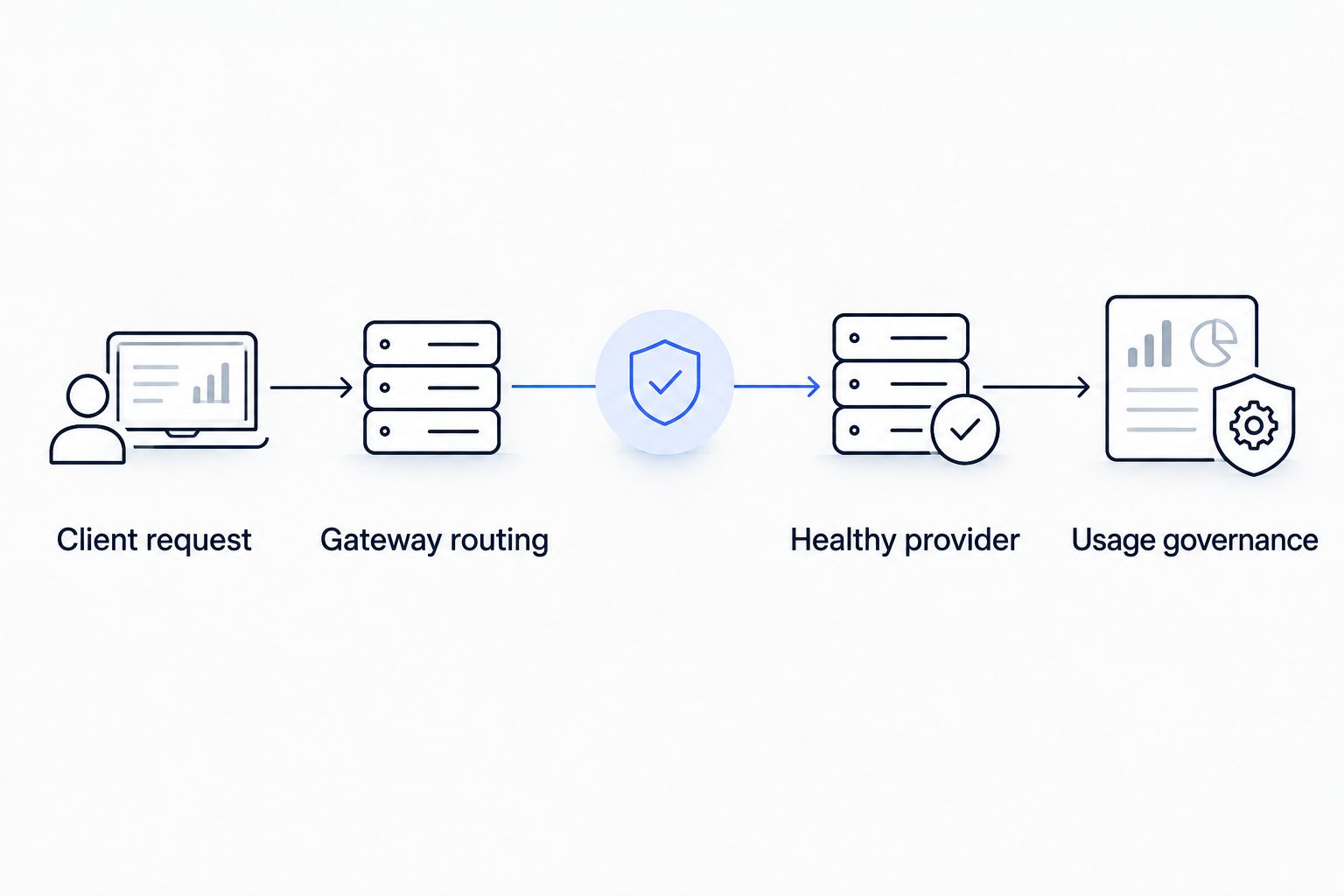
Do not treat a model catalog as a substitute for this exercise. If failover matters, write a failure test. If governance matters, specify the control an operator must apply. Those checks give engineering and product leaders a decision they can review together.
Review FastRouter for your gateway
Assess routing, automatic failover, and usage governance against your request path.
When staying with CometAPI makes sense
Stay with CometAPI if its current integration meets your model-access needs and your team has validated the fallback, governance, and operating behavior your workloads require. A change of gateway is not a benefit on its own. It introduces integration work that needs a concrete operational reason.
For a 2026 decision, run the same request-path tests against CometAPI and each shortlisted alternative. If CometAPI passes the requirements that matter to your application, keeping the existing integration is the straightforward call.
FAQ
What is the best CometAPI alternative in 2026?
FastRouter is the best CometAPI alternative for enterprise teams that need multi-model routing, automatic failover, and usage governance. LiteLLM is the better fit when the team wants to operate its own gateway.
Is FastRouter a CometAPI alternative for enterprise teams?
Yes. FastRouter provides an OpenAI-compatible API gateway with access to 200+ large language models, routing, automatic failover, cost optimization, and usage governance.
Is LiteLLM better than CometAPI for self-hosting?
LiteLLM fits teams that want to deploy and operate their own gateway. That choice also makes the team responsible for its deployment, maintenance, and incident response.
Should I use the OpenAI API instead of CometAPI?
Use the OpenAI API when direct access to OpenAI is your goal and you do not need a cross-provider gateway. If you later add other providers, you will need to plan those integrations or add a gateway.
Does one API guarantee provider failover?
No. A shared API interface and a tested fallback policy are different requirements. Verify the trigger, routing behavior, and application response for the failure cases you expect.
What should an enterprise team compare before changing gateways?
Compare integration compatibility, fallback behavior, model-selection controls, usage governance, and operational ownership. Test those requirements against the workflows that will run in production.
When should a team keep CometAPI?
Keep CometAPI when its current integration passes your required model-access, fallback, governance, and operational tests. Switching without a requirement the alternative meets adds integration work without resolving a defined problem.
One last thing
Test the failure path before the happy path. A successful model response proves that an integration works under normal conditions; it does not show what your application does when its selected provider cannot respond. That single test makes a 2026 CometAPI alternatives review more useful than comparing model lists alone.
Related Articles

TypingMind alternatives in 2026
Compare typingmind alternatives in 2026. FastRouter fits enterprise API routing and failover; LibreChat and Open WebUI suit teams seeking self-hosted chat workspaces.

Artificial Analysis alternatives in 2026
Compare Artificial Analysis alternatives in 2026. Fastrouter fits teams needing model routing, failover, and governance; Arena fits human-preference research.
.png&w=3840&q=75)
Your Coding-Agent Bill Is Growing. And You Can't See Why.
Cursor, Cline, and Claude Code burn tokens very differently by task type. See the real cost gap between them and how routing by task shape stops silent overspend.