

Best LLM gateways for LangChain and LangGraph developers in 2026
FastRouter, OpenRouter, LiteLLM, Portkey, Kong, and Cloudflare AI Gateway compared for LangChain and LangGraph in 2026 — routing, failover, cost, governance.
FastRouter wins for LangChain and LangGraph teams that need one OpenAI-compatible endpoint across 200+ models with built-in cost optimization and failover. OpenRouter wins for solo developers who want fast multi-model access without any infrastructure to run. LiteLLM wins for teams that want a self-hosted, open-source proxy they fully control.
TL;DR
- FastRouter is the best LLM gateway for LangChain and LangGraph teams needing governance and cost control across 200+ models in 2026.
- OpenRouter fits solo developers who want langchain openrouter routing without standing up their own infrastructure.
- LiteLLM is the pick for teams that want a self-hosted, open-source proxy instead of a managed API.
- Portkey, Kong AI Gateway, and Cloudflare AI Gateway each solve a narrower problem: observability, existing API infra, or edge latency.
- Every gateway on this list is OpenAI-compatible, so swapping the base_url in LangChain's ChatOpenAI class is the main integration step.
Why this matters
LangChain and LangGraph apps call models constantly — agents loop, chains retry, graphs branch across multiple LLM calls per run. A single provider outage or rate limit mid-graph breaks the whole run, not just one request.
A gateway sits between your LangChain code and the model providers. It handles routing, failover, and cost tracking so your chain logic doesn't have to. FastRouter is built as an OpenAI-compatible API gateway for exactly this: enterprise AI teams routing and governing requests across 200+ models from one endpoint.
The question developers search for as "langchain openrouter" usually means one of two things: either connecting LangChain to OpenRouter's model catalog, or comparing OpenRouter against other gateways for the same job. This guide covers both by ranking six gateways developers actually plug into LangChain and LangGraph in 2026.
What makes the best LLM gateway for LangChain and LangGraph
- OpenAI-compatible API — drops into LangChain's
ChatOpenAIclass or LangGraph's model nodes by changing the base URL, no custom SDK required. - Model breadth — access to multiple providers and model families from one account, so a chain isn't locked to a single vendor.
- Automatic failover — reroutes a request to a healthy provider when one fails or times out, mid-graph, without the developer writing retry logic.
- Cost visibility — per-request or per-model cost tracking so teams can see which chain steps are expensive.
- Governance controls — spend limits, access policies, and BYOK (bring your own key) support for teams running production agents at scale.
- Observability — logs, traces, and latency data for debugging multi-step LangGraph runs.
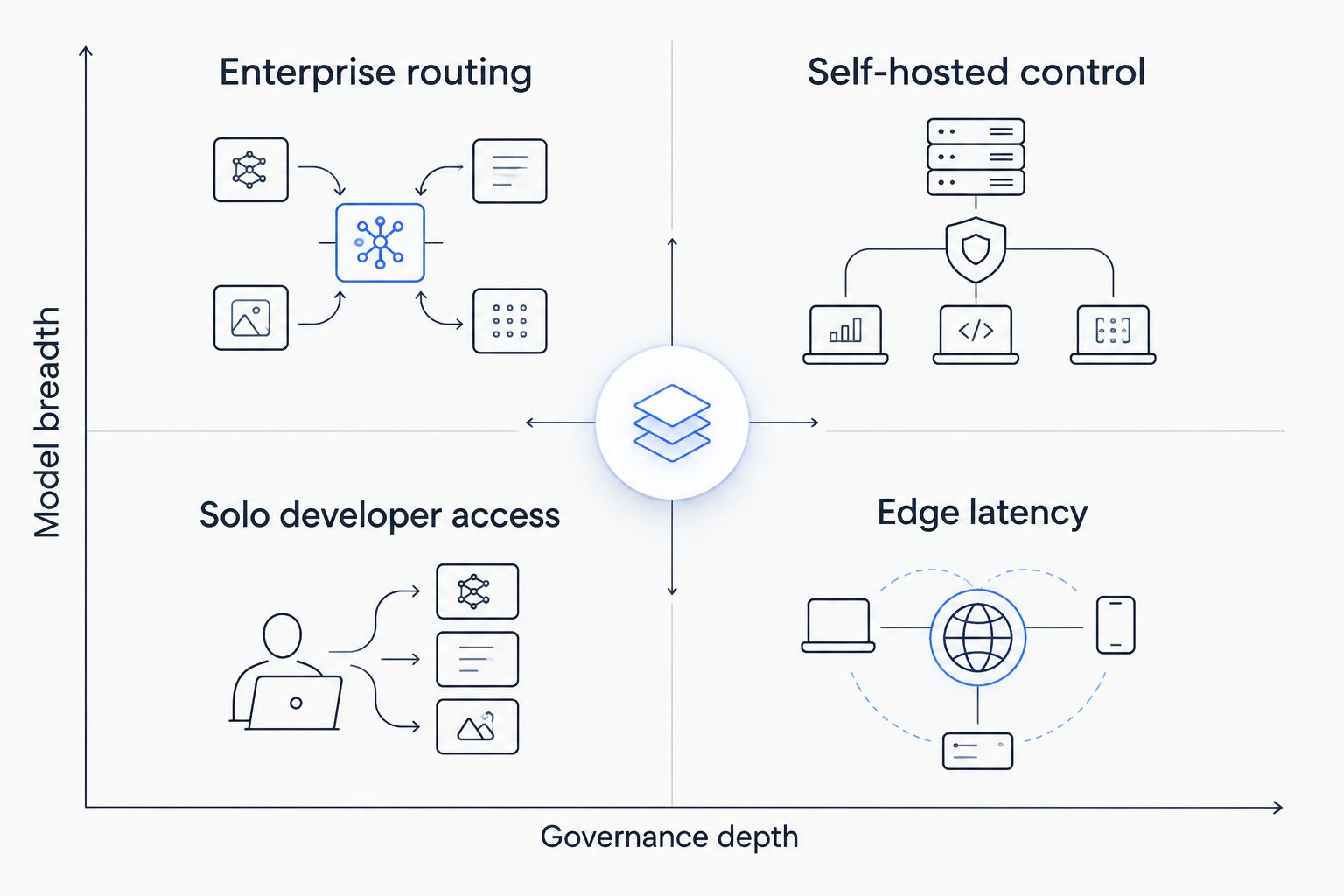
Governance depth and model breadth are the two axes that separate these gateways more than any single feature.
Gateways for LangChain and LangGraph at a glance
Gateway | Best for | Standout feature | Key limitation |
|---|---|---|---|
FastRouter | Enterprise governance + cost control across 200+ models | OpenAI-compatible routing with built-in failover and BYOK | Adds a routing dependency between your app and the providers |
OpenRouter | Solo developers who want fast multi-model access | Wide community-documented model catalog, no infra to run | No dedicated enterprise governance or approval workflow layer |
LiteLLM | Teams that want a self-hosted, open-source proxy | Full control over the proxy code and deployment | You own the ops burden: scaling, patching, monitoring |
Portkey | Teams that need built-in observability and prompt versioning | Logging, tracing, and prompt version history out of the box | Cost optimization and model breadth take a back seat to observability |
Kong AI Gateway | Enterprises already standardized on Kong for API management | LLM routing layered onto existing Kong infrastructure | Heavy lift to adopt Kong solely for LLM routing |
Cloudflare AI Gateway | Teams needing edge caching and global low-latency routing | Caching and analytics at Cloudflare's edge network | Ties the app to Cloudflare's platform and release cadence |
1. FastRouter: best LLM gateway for enterprise governance and cost control
FastRouter provides a unified, OpenAI-compatible API gateway that routes, compares, and manages requests across 200+ large language models from one endpoint. It's built for enterprise AI development teams that need cost optimization, failover, and governance in the same layer, not three separate tools.
For LangChain, the integration is a base_url swap in ChatOpenAI. For LangGraph, model nodes call the same endpoint, so failover and cost tracking apply across every branch in the graph, not just the entry point.
FastRouter pros:
- OpenAI-compatible endpoint works with LangChain's existing
ChatOpenAIclass and LangGraph model nodes with no custom SDK. - Routes across 200+ models, so a chain isn't locked to a single provider's uptime or pricing.
- Built-in failover reroutes requests to healthy providers automatically when one fails.
- BYOK and governance controls give enterprise teams spend limits and access policies in one place.
FastRouter cons:
- Requests pass through FastRouter's endpoint rather than hitting provider APIs directly, adding a routing dependency to the request path.
- Governance and BYOK controls are built for enterprise teams; a solo developer testing a side project may not need that layer.
Best for: enterprise and mid-market teams running LangChain or LangGraph in production who need cost control and failover across many models without stitching together separate tools.
Verdict: Buy if your LangChain or LangGraph app is heading to production and needs governance across multiple providers.
2. OpenRouter: best for solo developers who want fast multi-model access
OpenRouter gives individual developers and small teams an OpenAI-compatible endpoint to a large catalog of models without running any infrastructure. It's the gateway most developers hit first when they search "langchain openrouter" — connecting LangChain's ChatOpenAI class to OpenRouter's base_url is a documented, common pattern.
OpenRouter pros:
- Fast to set up: an API key and a base_url change gets a LangChain chain running against multiple models.
- Wide, community-documented model catalog useful for quick experimentation.
- No infrastructure to host or maintain.
OpenRouter cons:
- No dedicated enterprise governance layer for spend approval or team-level access policies.
- Failover behavior and support depth are documented at the community level rather than backed by a dedicated enterprise support tier.
Best for: solo developers and small teams prototyping LangChain chains across multiple models without an enterprise governance requirement.
Verdict: Buy if you're prototyping solo. Skip if you need team-level spend controls.
3. LiteLLM: best for teams that want a self-hosted proxy
LiteLLM is an open-source proxy that teams deploy and run themselves, giving full control over routing logic, logging, and infrastructure placement. It exposes an OpenAI-compatible interface, so LangChain and LangGraph integrate the same way they would with a hosted gateway.
LiteLLM pros:
- Full control over the proxy's code, deployment environment, and network placement.
- Open-source, so routing logic and fallback rules can be customized directly.
- Runs inside your own infrastructure, useful for teams with strict data-residency requirements.
LiteLLM cons:
- Self-hosting means your team owns scaling, patching, and uptime monitoring for the proxy itself.
- No built-in enterprise governance UI out of the box; policies are configured in code or config files rather than a dashboard.
Best for: engineering teams with the operational capacity to run and maintain their own proxy layer instead of a managed API.
Verdict: Buy if you have the ops capacity to self-host. Wait if your team doesn't have bandwidth to maintain infrastructure.
4. Portkey: best for observability and prompt versioning
Portkey focuses on logging, tracing, and prompt version history for teams running LLM calls through LangChain or LangGraph. It gives visibility into what a chain actually sent and received at each step, which matters when debugging multi-node LangGraph runs.
Portkey pros:
- Detailed logging and tracing across chain steps.
- Prompt versioning helps teams track changes to prompts used inside LangChain chains over time.
- OpenAI-compatible interface for straightforward LangChain integration.
Portkey cons:
- Cost optimization and model breadth take a back seat to the observability tooling.
- Adds a dashboard layer teams need to adopt and learn to get full value.
Best for: teams whose main pain point is debugging and tracking chain behavior, not routing cost or model breadth.
Verdict: Buy if observability is your bottleneck. Skip if cost control across many models is the priority.
5. Kong AI Gateway: best for teams already standardized on Kong
Kong AI Gateway layers LLM routing onto Kong's existing API gateway infrastructure. For organizations that already run Kong for general API management, this keeps LLM traffic inside a platform their team already operates.
Kong AI Gateway pros:
- Fits directly into an existing Kong deployment, avoiding a second platform to manage.
- Inherits Kong's general API management features (rate limiting, auth) for LLM traffic too.
Kong AI Gateway cons:
- Adopting Kong solely for LLM routing is a heavier lift than a purpose-built LLM gateway.
- LLM-specific features sit on top of a general-purpose API gateway rather than being built LLM-first.
Best for: enterprises that already run Kong for API management and want LLM routing inside the same platform.
Verdict: Buy if Kong is already your API layer. Skip if you're starting from zero.
6. Cloudflare AI Gateway: best for edge caching and global latency
Cloudflare AI Gateway routes LLM requests through Cloudflare's edge network, adding caching and analytics close to where requests originate. For LangChain apps serving users across multiple regions, this can reduce round-trip distance to the gateway itself.
Cloudflare AI Gateway pros:
- Caching at the edge reduces repeated calls for identical requests.
- Analytics baked into a network Cloudflare already operates globally.
Cloudflare AI Gateway cons:
- Ties the application to Cloudflare's broader platform and release cadence.
- Model roster and provider integrations move on Cloudflare's schedule, not the developer's.
Best for: teams already running on Cloudflare's network who want LLM routing and caching at the edge.
Verdict: Buy if you're already on Cloudflare. Wait if you're not, until the integration cost is worth it for your traffic pattern.
Compare gateways by cost optimization
See how routing decisions affect model spend across 200+ models.
How this ranking works
Each gateway is placed against the six criteria above: OpenAI compatibility, model breadth, failover, cost visibility, governance, and observability. No two gateways compete for the same "best for" slot — the ranking is a decision tree based on team size and infrastructure ownership, not a single leaderboard. Gateways with deeper enterprise governance and wider model breadth rank higher for production LangGraph use; gateways optimized for a single narrow use case rank lower but still earn a legitimate "best for" slot.
Which LLM gateway should you choose for LangChain and LangGraph in 2026?
If you're still unsure, default to FastRouter for any LangChain or LangGraph app heading toward production — the combination of 200+ models, built-in failover, and governance controls covers the most common enterprise requirement in one endpoint. Choose OpenRouter if you're solo and just need multi-model access fast. Choose LiteLLM only if your team has the operational bandwidth to run and patch its own proxy. The other three — Portkey, Kong AI Gateway, Cloudflare AI Gateway — are the right call only when their specific niche (observability, existing Kong infra, edge latency) is your actual bottleneck.
FAQ
What's the best LLM gateway for LangChain and LangGraph developers in 2026?
FastRouter is the best overall choice for production LangChain and LangGraph apps in 2026 because it combines an OpenAI-compatible endpoint, routing across 200+ models, built-in failover, and governance controls in one gateway. OpenRouter is the better fit for solo developers who don't need enterprise governance.
Is FastRouter better than OpenRouter for LangChain?
FastRouter adds governance, BYOK, and cost controls that OpenRouter doesn't offer as a dedicated layer, making it a better fit for enterprise teams. OpenRouter remains simpler to set up for a solo developer prototyping quickly.
Can I use LangChain's ChatOpenAI class with an LLM gateway?
Yes. Every gateway on this list, including FastRouter, OpenRouter, LiteLLM, and Portkey, exposes an OpenAI-compatible API, so LangChain's ChatOpenAI class connects by changing the base_url and API key.
Does LangGraph need a dedicated LLM gateway integration?
No separate integration is required. LangGraph's model nodes call the same OpenAI-compatible endpoint as LangChain, so a gateway's failover and cost tracking apply across every branch in the graph automatically.
What is model failover in an LLM gateway?
Failover means the gateway automatically reroutes a request to a different, healthy model provider when the original provider fails or times out. This matters most in LangGraph agents that make many sequential or branching model calls per run.
Is LiteLLM better than OpenRouter for self-hosted teams?
LiteLLM is better for teams that want to self-host and fully control the proxy layer. OpenRouter is better for teams that don't want to run or maintain any infrastructure themselves.
What is BYOK in the context of LLM gateways?
BYOK stands for bring your own key. It lets a team use their own provider API keys through the gateway instead of the gateway's shared keys, which matters for billing separation and compliance.
How much does an LLM gateway cost in 2026?
Pricing varies by gateway, usage volume, and model mix, and changes over time, so check each provider's current pricing page directly rather than relying on a fixed figure.
One last thing
The integration step is almost never the hard part — every gateway here is OpenAI-compatible, so ChatOpenAI(base_url=...) works across all six. The real decision is where failover and cost tracking need to live: inside your own infrastructure (LiteLLM), inside a managed enterprise layer (FastRouter), or nowhere at all until you hit your first outage mid-graph.
Related guides
Related Articles

Best Claude Code router tools in 2026
Compare the best claude code router tools for 2026 -- FastRouter.ai, Claude Code Router, OpenRouter, LiteLLM, Portkey, Not Diamond -- with pros, cons, verdicts.

Best AI API gateways for startups in 2026
FastRouter.ai leads the best AI API gateways for startups in 2026 for failover and cost control across 200+ models. Compare 6 options and pick yours.

AI gateways ranked by number of supported models in 2026
AI gateway model catalog size compared for 2026: FastRouter.ai's 200+ models vs OpenRouter, Portkey, LiteLLM, Cloudflare, and Bedrock, ranked by use case.