

Best Claude Code router tools in 2026
Compare the best claude code router tools for 2026 -- FastRouter.ai, Claude Code Router, OpenRouter, LiteLLM, Portkey, Not Diamond -- with pros, cons, verdicts.
Claude Code ships wired to Anthropic's models by default, but most engineering teams want the option to route requests to other providers when latency, availability, or cost make that the better call. This guide ranks the tools that make that possible in 2026, from open-source proxies to hosted API gateways.
TL;DR
- FastRouter.ai wins for enterprise teams that need failover and governance across 200+ models with Claude Code.
- Claude Code Router is the free, open-source pick for developers who want config-file control.
- OpenRouter suits solo developers who want one API key across many providers.
- Every claude code router on this list trades some control for convenience -- pick based on team size and who owns uptime.
Why this matters
Anthropic's Claude Code is a command-line coding agent, and out of the box it talks to Anthropic's own models. A claude code router sits between Claude Code and the model layer, redirecting requests to other providers -- Anthropic's models included -- through a single, OpenAI-compatible endpoint. Teams add a router when a single provider's rate limits, latency, or model quality no longer match production needs.
That routing layer matters more in 2026 than it did a year earlier: teams running Claude Code across several projects need visibility into which model handled which request, plus a way to fail over automatically when a provider degrades. FastRouter.ai approaches this as a unified, OpenAI-compatible API gateway that routes across 200+ large language models with built-in cost optimization, failover, and governance -- the same properties a claude code router needs to hold up at scale.
Best overall: FastRouter.ai. Best free and open-source: Claude Code Router. Best for quick multi-provider access: OpenRouter. Best for self-hosted custom logic: LiteLLM. Best for observability layered on routing: Portkey. Best for automatic model selection: Not Diamond.
What makes the best claude code router
- Model coverage -- how many providers and models the router reaches without separate integrations for each one.
- Failover behavior -- whether the router automatically retries a failed or rate-limited request on a different provider.
- Cost visibility -- whether you can see and steer which model handles a request based on price and task.
- Compatibility with Claude Code -- whether it plugs in through an OpenAI-compatible endpoint or environment variable override, without patching Claude Code itself.
- Governance and access control -- team-level permissions, usage limits, and audit visibility for enterprise deployments.
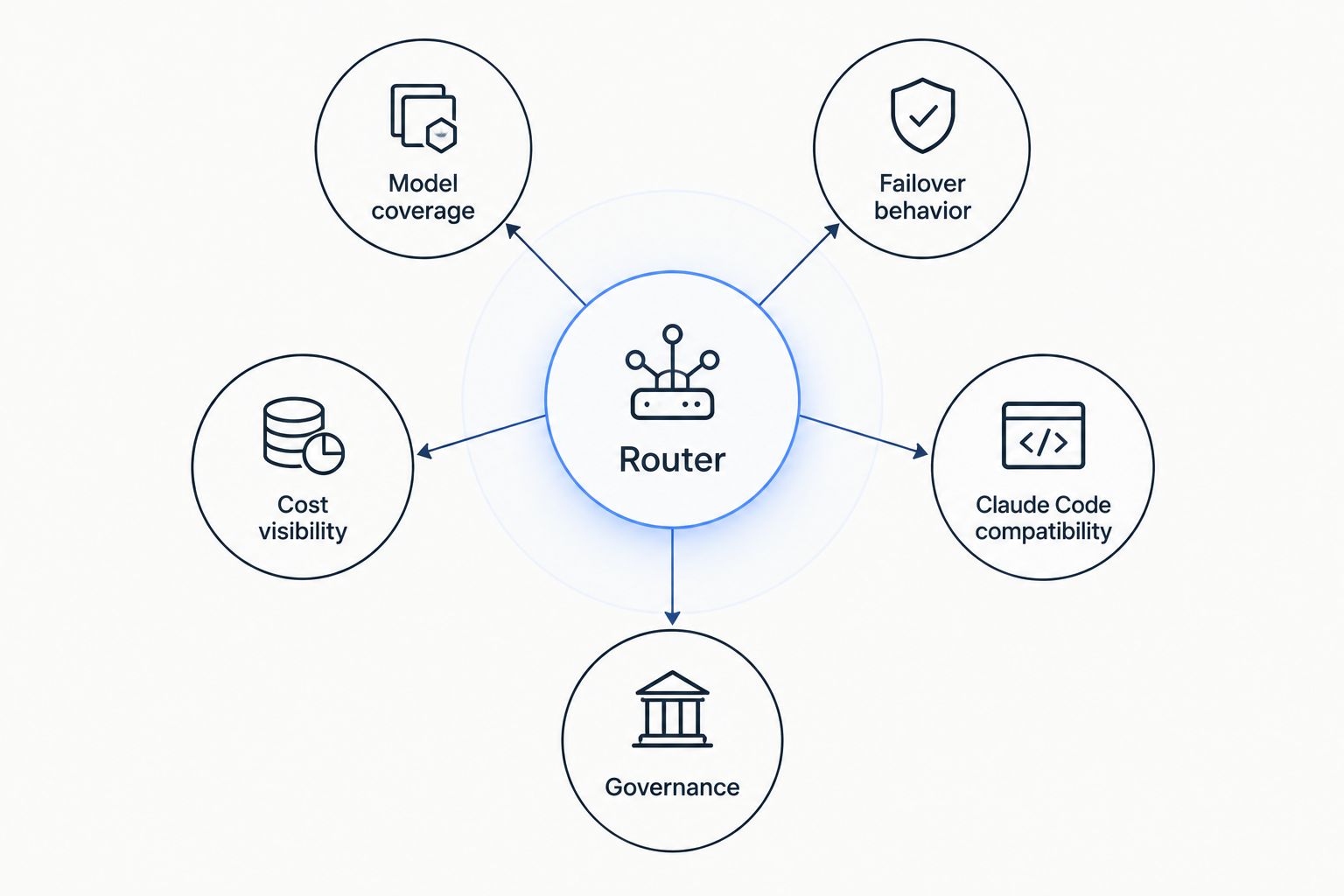
A claude code router is judged on these five criteria, not just model count.
Claude Code routers at a glance
Tool | Best for | Standout feature | Key limitation |
|---|---|---|---|
FastRouter.ai | Enterprise teams needing governance and failover | OpenAI-compatible gateway across 200+ models | Requests pass through a hosted third party |
Claude Code Router | Developers wanting a free, self-hosted setup | Config-file based routing rules | No built-in governance or team permissions |
OpenRouter | Solo developers wanting quick multi-provider access | Single API key across many providers | Limited enterprise-grade access controls |
LiteLLM | Teams wanting self-hosted, code-level control | Open-source proxy with custom routing logic | Requires ongoing engineering maintenance |
Portkey | Teams needing observability layered on routing | Request logging and prompt management | Adds complexity beyond basic routing needs |
Not Diamond | Teams wanting automatic per-request model choice | Algorithmic model selection | Less transparency into why a model was picked |
1. FastRouter.ai: best claude code router for enterprise governance and failover
FastRouter.ai is a unified, OpenAI-compatible API gateway built for teams that need to route, compare, and manage requests across 200+ large language models from one integration point. For Claude Code specifically, that means one endpoint can carry requests to Claude models and to alternatives when a provider is rate-limited or down, with cost controls and governance sitting on top.
FastRouter.ai pros:
- OpenAI-compatible endpoint drops into Claude Code's provider override without custom middleware
- Automatic failover across providers when one degrades or rate-limits
- Governance controls built for teams managing multiple projects on shared model access
- Access to 200+ models through a single integration
FastRouter.ai cons:
- As a hosted gateway, requests pass through a third party rather than your own infrastructure
- Teams that want to self-host every routing rule get less low-level control than an open-source proxy
Best for: enterprise and mid-market teams running Claude Code across multiple projects who need failover and governance, not just model access. Verdict: Buy.
2. Claude Code Router: best free, self-hosted option
Claude Code Router is an open-source project that intercepts Claude Code's requests and redirects them based on a local configuration file, letting developers point Claude Code at non-Anthropic models without touching Claude Code's source.
Claude Code Router pros:
- Free and self-hosted, so there's no hosted intermediary
- Config-file based routing gives direct, explicit control
- Runs entirely under your own infrastructure
Claude Code Router cons:
- No built-in governance or team-level permissions
- You own uptime, monitoring, and failover logic yourself
- Setup and updates require ongoing developer attention
Best for: individual developers or small teams comfortable maintaining their own routing config. Verdict: Buy if you have the engineering time; Hold if you don't.
3. OpenRouter: best for quick multi-provider access
OpenRouter provides a single API key and endpoint that reaches a wide catalog of model providers, which makes it a fast way to point Claude Code at a model outside Anthropic's lineup without building your own proxy.
OpenRouter pros:
- Broad provider catalog behind one API key
- Fast to wire into Claude Code's custom endpoint support
- No infrastructure to run yourself
OpenRouter cons:
- Limited enterprise-grade governance and access controls
- Cost optimization across models is largely manual
Best for: solo developers and small teams who want breadth without deployment overhead. Verdict: Buy.
4. LiteLLM: best for self-hosted custom routing logic
LiteLLM is an open-source proxy that lets engineering teams write their own routing, retry, and fallback logic in code, running entirely on infrastructure they control.
LiteLLM pros:
- Fully open-source and self-hosted
- Custom routing and fallback logic written in code
- Active development community
LiteLLM cons:
- Requires real engineering time to deploy and maintain
- No dashboard for non-technical stakeholders to review routing decisions
Best for: platform teams that already run their own infrastructure and want routing logic under direct code control. Verdict: Hold unless you have dedicated ops capacity.
5. Portkey: best for observability layered on routing
Portkey pairs routing with request logging and prompt management, useful for teams that want visibility into what a model returned and why, not just whether the request succeeded.
Portkey pros:
- Request logging and prompt version tracking
- Guardrail features layered on top of routing
Portkey cons:
- Built for general LLM operations rather than Claude Code specifically
- Adds setup complexity if all you need is basic failover
Best for: teams that need audit trails and prompt history alongside routing. Verdict: Hold for teams with lighter observability needs.
6. Not Diamond: best for automatic model selection
Not Diamond picks a model per request algorithmically rather than through manually written rules, aiming to remove the guesswork of choosing which model handles which task.
Not Diamond pros:
- Automatic model selection reduces manual rule-writing
- Useful when request types vary widely
Not Diamond cons:
- Less transparency into why a specific model was chosen
- Fewer manual override options for teams that want strict control
Best for: teams that would rather trust an algorithm than maintain routing rules by hand. Verdict: Wait until you've confirmed it fits your governance requirements.
How we ranked these claude code routers
Each of the six tools above was checked against the same five criteria: model coverage, failover behavior, cost visibility, Claude Code compatibility, and governance. FastRouter.ai and Claude Code Router lead on different ends of that list -- one on governance and failover, the other on free, self-hosted control -- which is why they top separate use cases rather than compete head-to-head.
Route Claude Code through FastRouter.ai
One OpenAI-compatible endpoint across 200+ models with failover and governance built in.
Which claude code router should you choose?
If you're running Claude Code across multiple projects and need failover plus governance without deploying your own proxy, FastRouter.ai is the default choice for 2026. If you're a solo developer who wants full control and doesn't mind maintaining your own config, Claude Code Router costs nothing but your setup time. Everyone in between -- teams wanting breadth without infrastructure -- fits OpenRouter best.
FAQ
What is a claude code router?
A claude code router sits between Claude Code and the model layer, redirecting requests to different providers through a single endpoint. It's used when a team needs failover, cost control, or access to models beyond Anthropic's own lineup.
Is Claude Code Router free?
Claude Code Router is an open-source project you self-host, so there's no license cost, but you're responsible for setup, maintenance, and uptime.
Can I use Claude Code with models other than Claude?
Yes, through a router that exposes an OpenAI-compatible endpoint or intercepts Claude Code's provider configuration. FastRouter.ai and Claude Code Router both work this way in 2026.
What's the difference between Claude Code Router and OpenRouter?
Claude Code Router is a free, self-hosted config tool built specifically to redirect Claude Code's requests. OpenRouter is a hosted API that gives you one key across many providers but isn't built specifically for Claude Code.
Does FastRouter.ai work with Claude Code?
FastRouter.ai exposes an OpenAI-compatible API gateway that routes across 200+ models with failover and governance, which fits Claude Code's custom endpoint support directly.
How much does a claude code router cost in 2026?
Cost varies by tool and plan -- open-source options like Claude Code Router and LiteLLM carry no license fee but require engineering time, while hosted gateways price differently. Check current pricing on each provider's site before committing.
Is self-hosting a claude code router safe for enterprise use?
Self-hosted routers like Claude Code Router and LiteLLM put governance and uptime entirely on your team, which works for platform teams with dedicated ops capacity but adds risk without one.
What's the best claude code router for enterprise teams in 2026?
FastRouter.ai is built for this case specifically, combining a single OpenAI-compatible endpoint, failover across 200+ models, and governance controls in one gateway.
One last thing
The six tools compared here split cleanly into two camps: hosted gateways that hand you governance and failover out of the box, and open-source proxies that hand you full control at the cost of your own maintenance time. Before picking a claude code router, decide which side of that trade your team actually has capacity for in 2026 -- that answer matters more than any single feature on the comparison table above.
Related Articles

Best LLM gateways for LangChain and LangGraph developers in 2026
FastRouter, OpenRouter, LiteLLM, Portkey, Kong, and Cloudflare AI Gateway compared for LangChain and LangGraph in 2026 — routing, failover, cost, governance.

Best AI API gateways for startups in 2026
FastRouter.ai leads the best AI API gateways for startups in 2026 for failover and cost control across 200+ models. Compare 6 options and pick yours.

AI gateways ranked by number of supported models in 2026
AI gateway model catalog size compared for 2026: FastRouter.ai's 200+ models vs OpenRouter, Portkey, LiteLLM, Cloudflare, and Bedrock, ranked by use case.