

Best AI/ML API alternatives for enterprise governance in 2026
Compare aiml api alternatives for enterprise governance. Choose Fastrouter for managed routing, LiteLLM for self-hosting, or Bedrock for AWS-based controls.
AI/ML API gives developers access to multiple models through a common API. Enterprise governance requires more than model access: you need enforceable rules for routing, credentials, usage, and failure handling. The best AI/ML API alternative in 2026 is Fastrouter if you need managed LLM routing and usage governance; LiteLLM if you need a self-hosted proxy.
TL;DR
- For aiml api alternatives for enterprise governance, choose Fastrouter for managed LLM routing, automatic failover, and usage governance.
- Choose LiteLLM when your platform team wants to operate a self-hosted LLM proxy.
- Choose Amazon Bedrock when AWS identity and model access are central to your architecture.
- Keep AI/ML API when its model access and verified controls meet your application requirements.
Why this matters
A shared model endpoint simplifies application integration. It does not, by itself, decide which team can use which model, where a fallback request goes, or who owns an unexpected usage increase.
For enterprise engineering leaders, the selection question is operational: can your platform enforce policy at the point where requests leave the application? A gateway belongs in that discussion, but so do identity, provider agreements, application permissions, and incident response.
Your 2026 shortlist should distinguish managed routing, a self-hosted proxy, and a cloud-native model service. These are different operating models, not interchangeable products with different interfaces.
AI/ML API alternatives at a glance
Option | Best for | Standout mechanism | Difference from AI/ML API | Main trade-off |
|---|---|---|---|---|
AI/ML API | Developers seeking common API access to multiple models | Multi-model API access | Baseline for this comparison | Model access still needs workload-specific governance validation |
Fastrouter | Enterprise teams seeking managed routing and usage governance | OpenAI-compatible gateway with automatic failover | Positions routing, cost optimization, and usage governance alongside model access | Gateway controls do not replace application authorization or model evaluation |
LiteLLM | Platform teams operating their own model proxy | Open-source proxy with virtual keys and budget controls | Provides a self-hosted proxy operating model | Your team owns deployment, upgrades, and proxy operations |
Amazon Bedrock | Teams building around AWS identity and infrastructure | Managed foundation-model access integrated with AWS IAM | Places model access inside an AWS service boundary | AWS architecture becomes part of the integration decision |
Choose the operating model before comparing the model catalog. A platform team that wants to control proxy deployment has a different requirement from a product team that wants a managed routing layer.
Use feature demonstrations to validate the table against your own workload. A feature name is not an acceptance test, and a successful request is not proof that access restrictions work.
1. Fastrouter: best for managed enterprise LLM routing
The LLM gateway provides an OpenAI-compatible interface to 200+ large language models, with automatic failover, cost optimization, and usage governance. It fits enterprise development teams that want routing and access management behind a unified API rather than separate integrations for every provider.
The important architectural distinction is the control point. Applications call the gateway; routing and access management sit between those applications and the available models. Evaluate that arrangement against your existing identity, reporting, and incident processes.
Where the gateway shines
- Unified access: A common API reduces the need to maintain separate provider-facing integration paths.
- Automatic failover: Failure handling is a stated gateway capability, rather than something every application must implement independently.
- Usage governance: Usage management belongs alongside routing in the product's stated scope.
- Model comparison: Teams can route, compare, and manage access to models through the same gateway.
Where the gateway falls short
- It is not your application authorization system. Your application still needs to decide which users can perform which actions.
- Routing is not quality assurance. A fallback model still needs evaluation against the task it will receive.
- API compatibility is not behavioral equivalence. Test structured outputs, streaming, tool calls, and error handling for each intended route.
These are boundaries of a gateway architecture, not reasons to avoid one. They define the work that remains with your engineering team.
Head-to-head with AI/ML API
Dimension | Fastrouter | AI/ML API |
|---|---|---|
Shared model access | Unified gateway across multiple models | Common API access across multiple models |
API integration | OpenAI-compatible gateway | OpenAI-compatible API access |
Selection focus | Routing, automatic failover, cost optimization, usage governance | Validate model access and governance behavior against your requirements |
For your 2026 evaluation, demonstrate a normal request, a rejected request, and a provider failure. Inspect the resulting route and usage record, not just whether the application receives an answer.
Best for: Enterprise teams seeking managed LLM routing with usage governance.
Verdict: Buy only after the gateway passes your access, failover, and reporting tests.
2. LiteLLM: best for a self-hosted model proxy
LiteLLM provides an open-source interface and proxy for interacting with multiple model providers. Its proxy documentation covers mechanisms such as virtual keys, budgets, and routing, making it a relevant alternative when your platform team wants to operate the control layer.
Self-hosting changes ownership. You control deployment and configuration, but your team also owns the proxy's operational lifecycle.
Where LiteLLM shines
- Deployment control: A self-hosted proxy lets your team choose where the proxy runs and how it connects to surrounding infrastructure.
- Credential mediation: Virtual keys provide a proxy-level mechanism for managing application access without distributing upstream credentials to every caller.
- Usage controls: Budget configuration gives platform teams a mechanism to evaluate against their spending policies.
Where LiteLLM falls short
- Operations stay with you. Deployment, monitoring, upgrades, and recovery require an explicit owner.
- Configuration needs testing. A declared budget or route must behave correctly under concurrency, retries, and provider failures.
- Self-hosting is not a complete data boundary. Requests still reach the upstream model providers selected by your routing configuration.
Compare LiteLLM with AI/ML API on operational responsibility, not just SDK compatibility. Ask who maintains the proxy, who responds when it fails, and how configuration changes reach production.
For a 2026 decision, use LiteLLM's official proxy documentation to check the exact deployment and control mechanisms you intend to operate. Match documentation to the version you deploy; do not treat an example configuration as a production policy.
Best for: Platform teams that want a self-hosted proxy and can own its operation.
Verdict: Buy into the operating model only when a named team owns the proxy lifecycle.
3. Amazon Bedrock: best for AWS-centered model governance
Amazon Bedrock provides managed access to foundation models through AWS. Its integration with AWS Identity and Access Management makes it a relevant choice when model access needs to fit existing AWS identities and policies.
This is a cloud-service decision, not simply a gateway replacement. Evaluate the application interface, selected models, region requirements, and identity design together.
Where Amazon Bedrock shines
- AWS identity integration: IAM provides a familiar policy mechanism for teams already managing application permissions in AWS.
- Managed model access: Applications use an AWS service rather than operating a model-serving stack themselves.
- Cloud architecture alignment: Model access can sit within an existing AWS operating model.
Where Amazon Bedrock falls short
- AWS becomes an architectural dependency. Account structure, permissions, and regional service configuration become part of your model integration.
- A different API requires integration work. Do not assume that an application built around another provider's interface can switch unchanged.
- Cloud permissions do not prove output quality. Your team still needs task-level evaluation and application safeguards.
For your 2026 assessment, use the Amazon Bedrock User Guide and AWS IAM documentation to validate the permissions required for your chosen operations. Test with the application's actual role, not an administrator credential.
Best for: Teams whose model platform belongs inside an AWS identity and infrastructure strategy.
Verdict: Buy when AWS alignment is a requirement; skip when a provider-neutral gateway is the main objective.
Why people switch from AI/ML API
The practical reasons to consider switching are architectural requirements, not assumptions about service quality. Start with the requirement that your current arrangement must satisfy, then test whether another operating model meets it more directly.
Centralized routing ownership
If each application chooses providers and implements retries separately, routing policy is distributed across application code. A gateway or proxy offers a shared place to manage that decision.
The acceptance test is specific: change an approved route without releasing every application. Then confirm that the intended applications receive the change and unrelated workloads do not.
A different deployment boundary
Some teams want to operate their own proxy. Others want model access within their cloud identity system, or want a managed gateway that handles routing.
Those requirements point toward LiteLLM, Amazon Bedrock, and a managed routing service respectively. They do not establish that AI/ML API lacks a particular feature; they establish what your replacement must accomplish.
Governed failure handling
Failover is useful only when the destination remains acceptable for the workload. A successful response from an unapproved provider is not a successful governance outcome.
Test provider failure with your real routing restrictions. Confirm the destination, record the decision, and inspect what happens when no approved fallback remains.
Attributable usage
Cost management needs a useful ownership boundary. A total usage figure cannot answer every question about which application, team, or workflow generated the activity.
Define the attribution fields your finance and engineering teams need. Then verify that normal calls, retries, and fallback requests produce records your reporting process can use.
Run a governance acceptance test
Evaluate 3 workflows: an ordinary request, a request that policy must reject, and a request that triggers failure handling. These are test scenarios, not performance benchmarks.
Apply 4 decision gates: access policy, fallback policy, usage attribution, and output quality. Keep the expected result explicit before running each workflow, so a convenient response does not get mistaken for a passing result.
- Access policy: Verify which application identity can use the selected route, then attempt a request that should be denied.
- Fallback policy: Interrupt the intended provider path and inspect which approved destination receives the request.
- Usage attribution: Check that request records identify the workload and represent retries or fallback activity correctly.
- Output quality: Run representative tasks against the primary and fallback models, including failure-sensitive outputs.
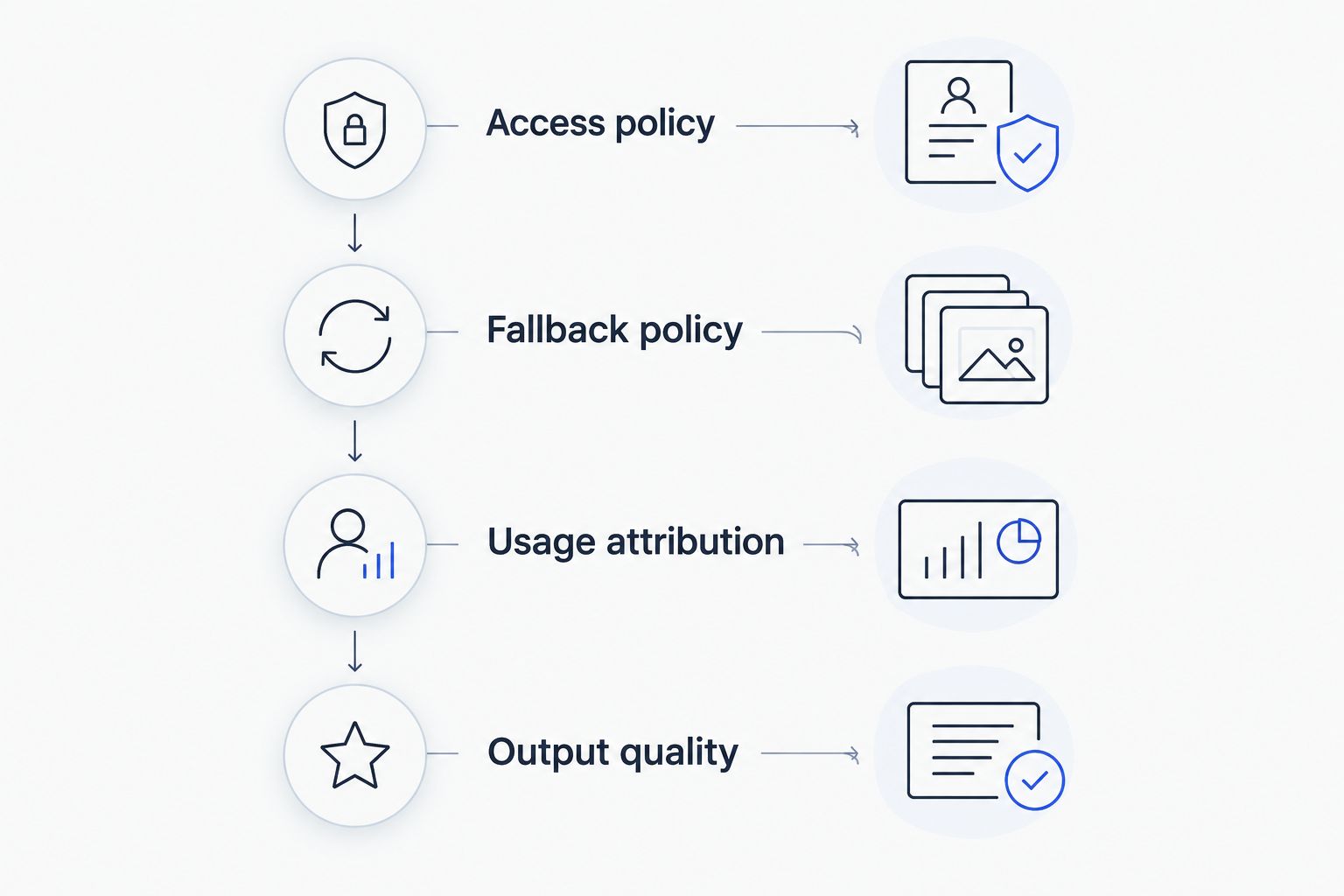
A working response passes only when its route, access, attribution, and output meet your requirements.
Record a pass or fail for each gate and workflow. Attach the observed behavior: selected destination, rejection result, usage record, and task output.
Do not turn these checks into invented latency or savings benchmarks. If throughput or latency determines the purchase, measure it under your intended concurrency, request shape, and routing configuration.
Separate credentials from permissions
Provider credentials establish access to an upstream service. Application permissions establish who is allowed to use that access. Treat them as separate controls even when the gateway simplifies credential management.
If BYOK is a requirement, include credential ownership, rotation, and revocation in your acceptance test. Verify support with the candidate before designing the architecture around it.
Review the evidence, not the label
A 2026 governance review should produce observable results and named owners. Require your security, platform, and application teams to agree on which controls belong in the gateway and which remain outside it.
Use official product documentation for feature scope, and your own acceptance results for workload fit. Neither a broad model catalog nor an enterprise label substitutes for those results.
When staying with AI/ML API is right
Keep AI/ML API when its model access and verified controls meet your workload requirements. A switch adds integration and operational work; it needs a specific architectural benefit.
Staying is the right call when your application already behaves correctly, your required access restrictions pass testing, and your team can account for usage and failure handling. Do not migrate solely because another service lists more governance terminology.
The baseline deserves the same scrutiny as every alternative. Test AI/ML API with the same application identity, task set, failure scenarios, and reporting requirements so the comparison measures behavior rather than presentation.
FAQ
What's the best AI/ML API alternative for enterprise governance?
Fastrouter is the best fit for enterprise teams seeking managed LLM routing, automatic failover, and usage governance. Choose LiteLLM for a self-hosted proxy or Amazon Bedrock for an AWS-centered architecture, then validate the required controls with your workload.
Is LiteLLM better than AI/ML API for enterprise teams?
LiteLLM is the better fit when operating a self-hosted proxy is a requirement. Its deployment control also makes your team responsible for proxy operations, configuration, and upgrades.
When should an enterprise choose Amazon Bedrock?
Choose Amazon Bedrock when model access needs to fit an AWS identity and infrastructure strategy. Validate IAM permissions, application integration, and model behavior using the role that will run the workload.
Does an OpenAI-compatible API make migration automatic?
No, an OpenAI-compatible API does not guarantee identical model behavior. Test streaming, structured outputs, tool calls, and errors before changing the production route.
Does automatic failover satisfy enterprise governance?
No, automatic failover must also obey your routing and access restrictions. Test the fallback destination and the behavior when no approved destination remains.
What should we test before replacing AI/ML API?
Test an ordinary request, a policy rejection, and a provider failure. Check access policy, fallback policy, usage attribution, and output quality for each workflow.
Should we stay with AI/ML API in 2026?
Stay with AI/ML API in 2026 when its model access and verified controls meet your requirements. Change platforms for a demonstrated architectural benefit, not a longer feature list.
One last thing
Test the route your application should never use. A permitted request proves that access works; a forbidden request proves whether the boundary holds.
Make that negative test part of the purchase decision and the deployment check. Your governance layer earns its place by rejecting the wrong request, not merely completing the right one.
Related Articles

Best Together AI alternatives for production LLM apps in 2026
Compare Together AI alternatives for production apps: choose Fastrouter for multi-provider routing, or evaluate managed inference and self-hosted deployment.

AI/ML API alternatives in 2026
Compare aiml api alternatives in 2026. Choose Fastrouter for managed routing and governance, or LiteLLM for self-hosting. Validate requests before switching.

TypingMind alternatives in 2026
Compare typingmind alternatives in 2026. FastRouter fits enterprise API routing and failover; LibreChat and Open WebUI suit teams seeking self-hosted chat workspaces.