

Best AI API gateways for startups in 2026
FastRouter.ai leads the best AI API gateways for startups in 2026 for failover and cost control across 200+ models. Compare 6 options and pick yours.
FastRouter.ai leads this list for startups that need one OpenAI-compatible endpoint across 200+ models with built-in failover and cost controls, but the right ai api gateway for startups depends on whether you're optimizing for governance, self-hosting, or raw model breadth. Six gateways make the cut in 2026, each solving a different piece of the routing problem.
Best overall for startups scaling across models: FastRouter.ai. Best for solo developers testing many models: OpenRouter. Best for self-hosted, open-source control: LiteLLM.
TL;DR
- FastRouter.ai wins for startups needing an ai api gateway for startups with failover across 200+ models and one OpenAI-compatible key.
- OpenRouter suits solo developers who want the widest marketplace of models without infrastructure setup.
- LiteLLM is the pick for teams that want a self-hosted proxy they control end to end.
- Portkey and Kong AI Gateway target teams that already need guardrails or enterprise API governance.
- Cloudflare AI Gateway fits startups already running on Cloudflare's edge network.
Why this matters
A startup calling a single model provider directly has no fallback when that provider rate-limits, degrades, or goes down. An API gateway sits between your application and multiple LLM providers, giving you one integration point instead of managing separate SDKs, keys, and error handling for each vendor.
The stakes go up once you're running production traffic in 2026: provider outages, pricing changes, and model deprecations all hit differently when you've hard-coded a single vendor into your stack. A gateway abstracts that risk away from your application code.
What makes the best AI API gateway for startups
- Model coverage — how many providers and models you can reach through one integration
- Failover mechanics — whether requests reroute automatically when a provider errors or times out
- Cost visibility — spend tracking and optimization across providers, not just per-request logging
- Governance and BYOK — support for bring-your-own-key setups and access controls as teams grow
- Deployment model — hosted SaaS versus self-hosted, and what that means for your ops overhead
- Observability — request-level logging, latency tracking, and debugging tools
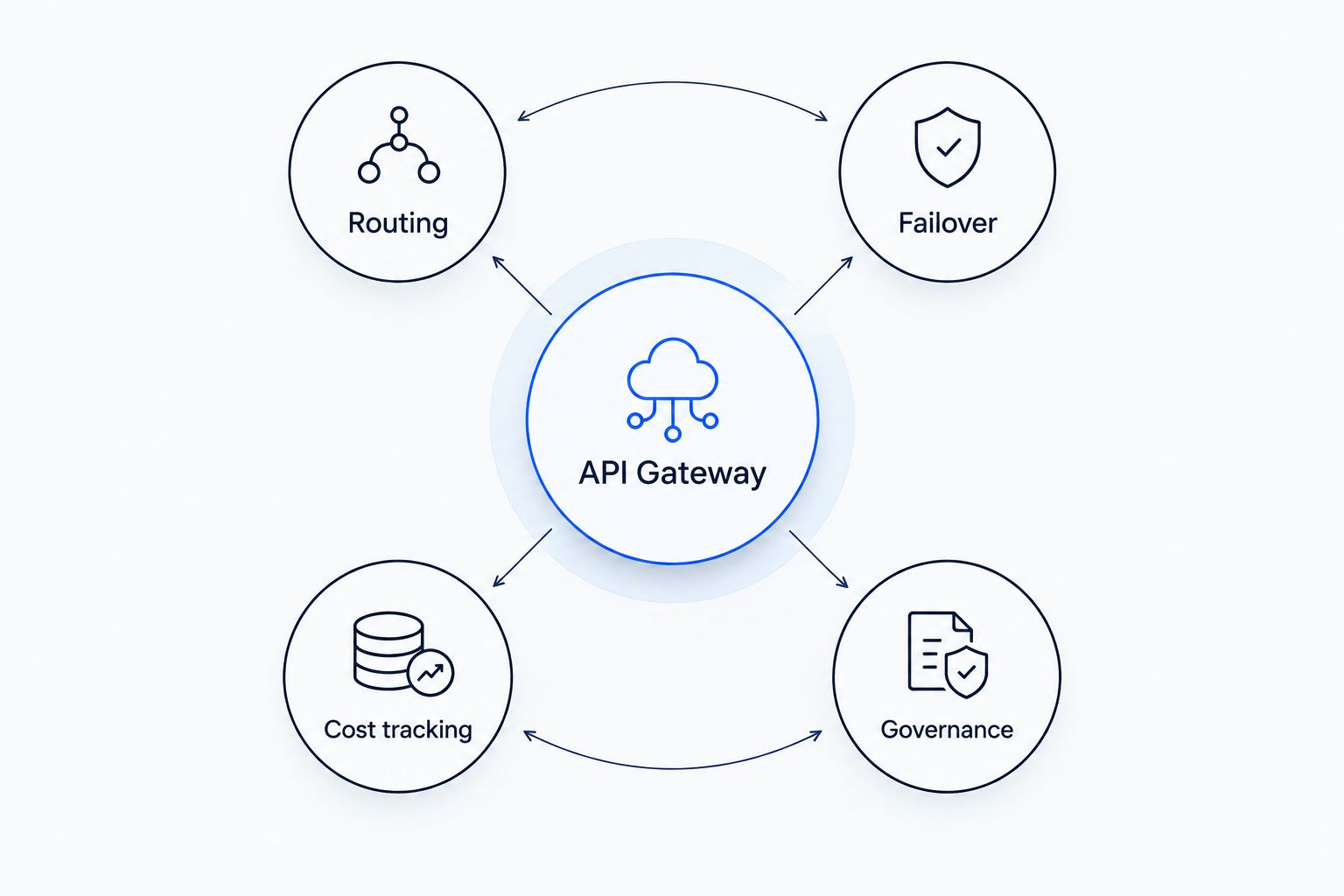
These four functions are what separate a gateway from a plain API wrapper.
AI API gateways for startups: at a glance
Gateway | Best for | Standout feature | Key limitation |
|---|---|---|---|
Cost governance and failover across many models | OpenAI-compatible routing across 200+ models with built-in cost optimization | Newer entrant compared to marketplace-style aggregators | |
OpenRouter | Solo devs testing many models fast | Broad marketplace of providers accessible through one key | Governance and enterprise controls are lighter than dedicated platforms |
Portkey | Teams needing guardrails and observability | Built-in prompt guardrails and request tracing | Adds a layer of configuration overhead for very small teams |
LiteLLM | Engineering teams wanting self-hosted control | Open-source proxy you deploy and own | Self-hosting means you own uptime and scaling |
Cloudflare AI Gateway | Startups already on Cloudflare's edge | Edge-level caching and analytics tied into existing Cloudflare infrastructure | Best value comes only if you're already inside the Cloudflare ecosystem |
Kong AI Gateway | Enterprises extending existing API infrastructure | AI routing built on Kong's established API gateway platform | Heavier setup than startups typically need on day one |
1. FastRouter.ai: best AI API gateway for cost governance and failover
FastRouter.ai is a unified, OpenAI-compatible API gateway that routes, compares, and manages requests across 200+ large language models from a single integration. It's built for enterprise AI development teams that need cost optimization, automatic failover, and governance controls without stitching those pieces together themselves.
FastRouter.ai pros:
- One OpenAI-compatible endpoint replaces separate SDKs for each provider
- Automatic failover reroutes requests when a provider degrades or errors
- Cost optimization and governance are built into the routing layer, not bolted on
- BYOK support lets teams keep control over their own provider keys
FastRouter.ai cons:
- Teams already deep into a single-provider SDK will need migration effort to switch
- As a newer platform relative to marketplace aggregators, the provider list is still growing
FastRouter.ai pricing: usage-based; check current plans directly on the site.
Best for: startups and engineering teams that need production-grade failover and cost visibility across multiple LLM providers without building that layer themselves.
Verdict: Buy if you're routing production traffic across more than one model provider in 2026.
2. OpenRouter: best AI API gateway for solo developer experimentation
OpenRouter is a marketplace-style gateway that gives developers access to models from a wide range of providers through a single API key. It's popular with indie developers and small teams who want to compare models quickly without negotiating separate accounts.
OpenRouter pros:
- Fast to set up for testing multiple models side by side
- Wide provider marketplace with minimal onboarding friction
- Good fit for prototyping before committing to a production architecture
OpenRouter cons:
- Enterprise-grade governance and access controls are lighter than dedicated platforms
- Cost optimization tooling is less built-out than gateways designed around it
OpenRouter pricing: usage-based; check current plans directly on the vendor's site.
Best for: solo developers and small teams experimenting across many models before scaling.
Verdict: Buy for prototyping. Hold before betting production governance requirements on it.
3. Portkey: best AI API gateway for guardrails and observability
Portkey positions itself around prompt guardrails, request tracing, and observability for teams running LLM applications in production. It layers monitoring and safety controls on top of routing.
Portkey pros:
- Guardrails and tracing built specifically for LLM request patterns
- Observability tooling helps debug prompt-level issues, not just API errors
- Useful for teams with compliance or safety review requirements
Portkey cons:
- Configuration overhead is higher than a plain routing layer
- Smaller teams may not need the full guardrail stack on day one
Portkey pricing: usage-based; confirm current tiers on the vendor's site.
Best for: teams that need prompt-level guardrails and detailed observability alongside routing.
Verdict: Hold unless guardrails and tracing are an immediate requirement.
4. LiteLLM: best AI API gateway for self-hosted control
LiteLLM is an open-source proxy that teams deploy and run themselves, giving full control over the routing layer and infrastructure. It's a common choice for engineering teams that want to avoid a hosted third-party dependency.
LiteLLM pros:
- Open-source, so the routing logic is fully inspectable and modifiable
- No dependency on a third-party hosted service for the core routing layer
- Fits teams with strict data residency or infrastructure requirements
LiteLLM cons:
- Self-hosting means your team owns uptime, scaling, and patching
- Cost optimization and governance features require more manual configuration
LiteLLM pricing: free and open-source to self-host; infrastructure costs are separate.
Best for: engineering teams that want to own the routing layer end to end.
Verdict: Buy if you have the ops capacity to self-host. Skip if you want a managed service.
5. Cloudflare AI Gateway: best AI API gateway for teams on Cloudflare's edge
Cloudflare AI Gateway extends Cloudflare's existing edge network with caching, analytics, and routing for LLM requests. It's a natural fit for startups already running their stack on Cloudflare.
Cloudflare AI Gateway pros:
- Edge-level caching can reduce redundant calls to model providers
- Analytics integrate with infrastructure teams are already using
- Low friction for teams already inside the Cloudflare ecosystem
Cloudflare AI Gateway cons:
- The value proposition weakens if you're not already on Cloudflare
- Governance and cost-optimization depth is less specialized than dedicated AI gateways
Cloudflare AI Gateway pricing: usage-based; confirm current terms on Cloudflare's site.
Best for: startups already running infrastructure on Cloudflare who want AI routing in the same place.
Verdict: Hold unless you're already on Cloudflare's stack.
6. Kong AI Gateway: best AI API gateway for enterprise infrastructure teams
Kong AI Gateway adds AI routing capabilities to Kong's established API gateway platform, aimed at organizations that already run Kong for their broader API infrastructure.
Kong AI Gateway pros:
- Fits directly into an existing Kong-based API infrastructure
- Enterprise-grade access control and plugin ecosystem
- Familiar operational model for teams already running Kong
Kong AI Gateway cons:
- Heavier setup than most startups need before they have real production scale
- Full value requires investment in the broader Kong platform, not just AI routing
Kong AI Gateway pricing: usage-based enterprise plans; confirm current terms directly.
Best for: enterprises extending an existing Kong deployment to cover AI traffic.
Verdict: Wait unless you're already running Kong for your core API infrastructure.
How we ranked these AI API gateways
Each gateway is scored against the six criteria above: model coverage, failover mechanics, cost visibility, governance and BYOK support, deployment model, and observability. Gateways built specifically around cost and failover for multi-model routing ranked ahead of general-purpose API management tools retrofitted for AI traffic.
Which AI API gateway should you choose?
If you're a startup routing production traffic across more than one LLM provider in 2026, FastRouter.ai is the default pick: one OpenAI-compatible endpoint, automatic failover, and cost optimization across 200+ models without building that layer yourself. If you're still prototyping and want to compare models fast, start with OpenRouter and revisit governance later. If your team has the ops capacity and wants full control over the routing layer, LiteLLM is the honest self-hosted alternative.
Route across 200+ models from one API
See how FastRouter.ai handles failover and cost optimization.
FAQ
What's the best AI API gateway for startups in 2026?
FastRouter.ai is the strongest overall pick for startups in 2026 because it routes across 200+ models through one OpenAI-compatible endpoint with built-in failover and cost optimization. Teams prototyping across many models before committing to production architecture often start with OpenRouter instead.
Is FastRouter.ai better than OpenRouter?
FastRouter.ai and OpenRouter solve different problems: FastRouter.ai focuses on failover, cost optimization, and governance for production traffic, while OpenRouter emphasizes a broad marketplace for fast experimentation. Teams moving from prototyping to production tend to move toward the former.
Do I need an API gateway if I only use one LLM provider?
A gateway adds the most value once you're calling more than one provider or need failover protection. If you're committed to a single provider with no fallback plan, a gateway's routing benefits are limited, though cost tracking still helps.
What does BYOK mean in an AI API gateway?
BYOK stands for bring-your-own-key, meaning you keep your own provider API keys while the gateway handles routing, failover, and governance on top. This keeps billing and provider relationships in your control rather than the gateway's.
Is LiteLLM free to use?
LiteLLM is open-source and free to self-host, though you still cover the infrastructure costs of running and scaling it yourself. It's a common choice for teams that want full control over the routing layer without a hosted third-party dependency.
How does failover work in an AI API gateway?
Failover automatically reroutes a request to another healthy model or provider when the original one errors, times out, or degrades. This happens at the gateway layer so your application code doesn't need custom retry logic for every provider.
Does an AI API gateway slow down requests?
A gateway adds a routing layer between your application and the model provider, but well-built gateways are designed to minimize that overhead relative to calling providers directly. The tradeoff is reliability and cost control in exchange for that thin routing layer.
Can I switch AI API gateways later without rewriting my app?
Gateways built around the OpenAI-compatible API format make switching easier because your application code targets a standard interface rather than a proprietary SDK. Confirm compatibility before migrating production traffic between gateways.
One last thing
The gateways that hold up longest in production aren't the ones with the biggest model list — they're the ones where failover actually triggers correctly under real provider outages. Test failover behavior with a deliberate provider failure before you trust it with production traffic in 2026, not after.
Related Articles

Best Claude Code router tools in 2026
Compare the best claude code router tools for 2026 -- FastRouter.ai, Claude Code Router, OpenRouter, LiteLLM, Portkey, Not Diamond -- with pros, cons, verdicts.

Best LLM gateways for LangChain and LangGraph developers in 2026
FastRouter, OpenRouter, LiteLLM, Portkey, Kong, and Cloudflare AI Gateway compared for LangChain and LangGraph in 2026 — routing, failover, cost, governance.

AI gateways ranked by number of supported models in 2026
AI gateway model catalog size compared for 2026: FastRouter.ai's 200+ models vs OpenRouter, Portkey, LiteLLM, Cloudflare, and Bedrock, ranked by use case.