

Best 7 AI image generation APIs in 2026
Compare the best image generation APIs for 2026: OpenAI's GPT Image models, Google, Stability AI, FLUX, Ideogram, Recraft, and Leonardo.Ai, ranked by use case.
Seven APIs turn text prompts into usable images at production scale in 2026, and they split cleanly by job: OpenAI's Images API (GPT Image 2) wins for general-purpose product integration, Google Imagen on Vertex AI wins for enterprise Google Cloud stacks, and Stability AI's Stable Diffusion API wins for teams that need open-weight flexibility or self-hosting. The other four — Black Forest Labs' FLUX, Ideogram, Recraft, and Leonardo.Ai — each own a narrower job the first three don't do as well.
TL;DR
- OpenAI's Images API (GPT Image 2) is the default image generation API for general product integration in 2026.
- Google Imagen on Vertex AI is the pick for teams already governed inside Google Cloud IAM.
- Stability AI's Stable Diffusion API is the only major option built for self-hosting and fine-tuning.
- Ideogram and FLUX solved legible in-image text rendering, a problem most diffusion models still handle badly.
- Recraft and Leonardo.Ai serve narrower jobs: vector brand assets and game/design asset pipelines.
Why this matters
Picking the wrong image generation API costs you twice: once in integration time, once when you have to migrate off a model that can't hit your quality bar or licensing requirements. The seven APIs below split by output style, licensing terms, and infrastructure control, not by who's "best" in the abstract.
Most teams building image generation into a product are also running LLM calls for prompting, moderation, or captioning alongside it. If you're already managing multiple model providers for text, a unified API gateway that handles routing and failover across 200+ language models is worth pairing with whichever image API you pick below — it keeps governance in one place instead of scattered across provider dashboards.
What makes the best image generation API
- Output quality and photorealism control — how close renders get to production-ready without heavy post-processing
- Speed under production load — response time consistency when requests queue up, not just single-call latency
- Licensing and commercial usage rights — whether outputs are cleared for commercial products, ads, and resale
- Style and prompt control — aspect ratio, negative prompts, seeds, and reproducibility across runs
- Text rendering accuracy — whether the model can put legible words inside an image at all
- Integration and documentation quality — SDK maturity, error handling, and how fast a team can ship with it
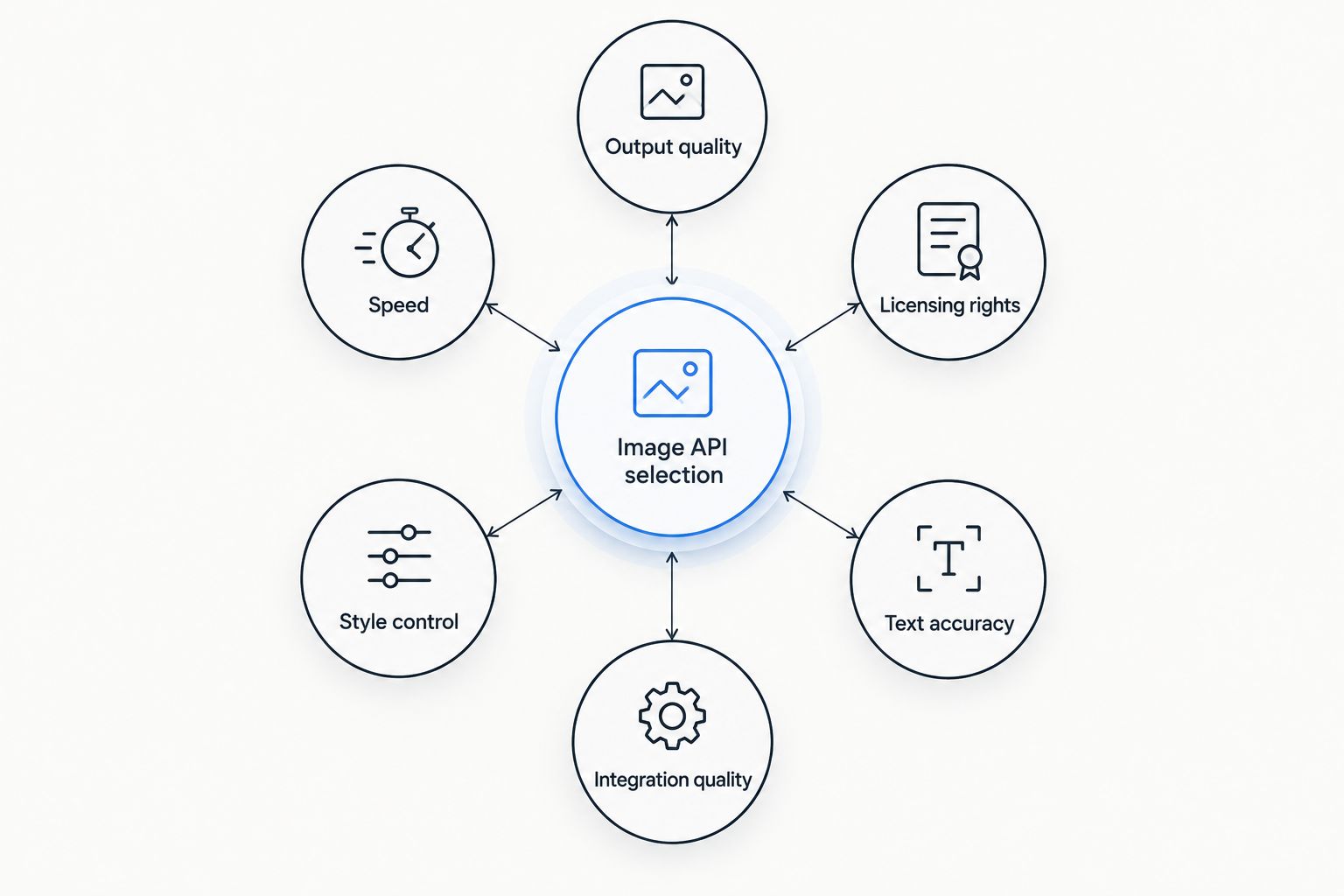
No single API wins every criterion — the right pick depends on which two or three matter most for your product.
At a glance: 7 image generation APIs compared
API | Best for | Standout feature | Key limitation |
|---|---|---|---|
OpenAI Images API (GPT Image 2) | General-purpose product integration | Composition planning on complex prompts, with generation and editing in one API and built-in safety filtering | Token-based billing makes per-image cost less predictable than flat per-image rivals |
Google Imagen (Vertex AI) | Enterprise Google Cloud stacks | Native IAM, VPC, and audit logging inside Vertex AI | Tied to a Google Cloud account and its IAM setup |
Stability AI Stable Diffusion API | Open-weight flexibility and self-hosting | Weights can be self-hosted or fine-tuned outside the hosted API | Licensing terms vary by model version and use case |
Black Forest Labs FLUX API | Photorealistic speed | FLUX.1 models, built by former Stability AI researchers, tuned for fast photoreal output | Smaller third-party tooling ecosystem than OpenAI or Stability |
Ideogram API | Text-in-image and typography | Renders legible text and typography directly inside generated images | Narrower general style range than broader models |
Recraft API | Vector and brand asset generation | Native SVG/vector export alongside raster images | Weaker at photorealistic scene generation |
Leonardo.Ai API | Game asset and design pipelines | Asset-focused presets and canvas/editing tools built for design workflows | Roadmap now tied to Canva's platform since its 2024 acquisition |
1. OpenAI Images API (GPT Image 2): best image generation API for general-purpose product integration
GPT Image 2 (gpt-image-2, released April 21, 2026) is OpenAI's current production image model, generating and editing images through the same API key structure developers already use for GPT models — the fastest path from prototype to production for teams already on OpenAI. It plans composition before rendering, which shows up as stronger adherence on complex, multi-object prompts, and it handles generation, editing, and inpainting through one interface. Billing is token-based, which works out to roughly $0.006–$0.21 per 1024×1024 image depending on quality tier, so teams with predictable volume should profile cost against flat per-image rivals before committing. It includes a built-in safety and content-moderation layer applied automatically to every generation.
OpenAI Images API pros:
- Fastest integration path if you're already calling GPT models
- Built-in content moderation reduces manual review overhead
- Strong instruction-following on complex, multi-object prompts
OpenAI Images API cons:
- Token-based billing makes per-image cost harder to predict than flat per-image rivals
- Fewer fine-grained parameters (seeds, negative prompts) than open-weight models
Best for: teams shipping image generation as a feature inside a product already built on OpenAI's API. Verdict: Buy.
2. Google Imagen (Vertex AI): best image generation API for enterprise Google Cloud stacks
Imagen runs inside Vertex AI, which means every call inherits your existing Google Cloud IAM roles, VPC controls, and audit logging instead of requiring a separate access-management layer. That's the entire pitch: not a better renderer, a better-governed one for teams already inside Google's enterprise stack. It supports text-to-image generation, inpainting/editing, and upscaling within the same platform, and Google's newer Gemini-based image models (the 'Nano Banana' family) are available through the Gemini API for teams that want Google image generation outside Vertex AI.
Google Imagen pros:
- Inherits Google Cloud IAM, VPC, and logging without extra setup
- Editing and upscaling live in the same platform as generation
- Straightforward procurement for teams already on a Google Cloud enterprise agreement
Google Imagen cons:
- Adds no value if your team isn't already on Google Cloud
- Migrating off Vertex AI later means re-architecting the whole integration
Best for: enterprise teams whose AI infrastructure already runs inside Google Cloud. Verdict: Buy if you're on GCP, Skip if you aren't.
3. Stability AI Stable Diffusion API: best image generation API for open-weight flexibility and self-hosting
Stability AI publishes Stable Diffusion as open-weight models alongside a hosted API, which is the only setup on this list that lets you run the same model on your own infrastructure if you outgrow the hosted tier. Stable Diffusion 3 improved text rendering and prompt adherence over earlier versions, though it still trails Ideogram and FLUX on legible in-image text. Licensing differs by model version — some releases carry non-commercial restrictions — so check the specific model's license before shipping a commercial product on it.
Stable Diffusion API pros:
- Self-hosting option removes hard dependency on one vendor's uptime
- Fine-tuning on custom datasets is supported and well-documented
- Large open community of tooling, extensions, and fine-tuned checkpoints
Stable Diffusion API cons:
- Licensing terms vary by model version and require manual verification
- Self-hosting shifts infrastructure and scaling work onto your team
Best for: teams that need to fine-tune on proprietary data or avoid single-vendor lock-in. Verdict: Buy for self-hosting flexibility.
4. Black Forest Labs FLUX API: best image generation API for photorealistic speed
Black Forest Labs was founded by former Stability AI researchers and released the FLUX.1 model family in 2024, built specifically for fast, photorealistic output. FLUX is accessible through Black Forest Labs' own API and through infrastructure partners like Replicate and fal.ai, giving you a choice of hosting layer. Photorealism and prompt adherence on human faces and complex scenes are where FLUX consistently stands out.
FLUX API pros:
- Strong photorealism, particularly on faces and complex lighting
- Available through multiple hosting partners, not locked to one platform
- Fast inference relative to comparable photorealistic models
FLUX API cons:
- Smaller third-party tooling and plugin ecosystem than OpenAI or Stability
- Newer company with a shorter enterprise support track record
Best for: teams whose core requirement is photorealistic output at speed. Verdict: Buy for photoreal use cases.
5. Ideogram API: best image generation API for text-in-image and typography
Ideogram built its reputation solving a problem most diffusion models handled badly for years: putting legible, correctly spelled text inside a generated image. If your use case is posters, product packaging mockups, memes, or ads with copy baked into the visual, this is the API built for exactly that job rather than general scene generation.
Ideogram API pros:
- Renders multi-word text and typography legibly inside images
- Strong at logo-style and poster-style compositions
- Simple API surface focused on this one job
Ideogram API cons:
- Narrower general-purpose style range than OpenAI, Stability, or FLUX
- Less suited to photorealistic scene generation without text
Best for: ad creative, packaging mockups, and any output where legible in-image text is non-negotiable. Verdict: Buy for text-heavy visuals, Skip otherwise.
6. Recraft API: best image generation API for vector and brand asset generation
Recraft generates both raster images and true vector output, exporting directly to SVG — a format none of the other six APIs on this list produce natively. That makes it the pick for design and brand teams generating icons, logos, and scalable assets rather than photographic scenes.
Recraft API pros:
- Native SVG/vector export alongside raster generation
- Style presets built around brand and icon design work
- Editable vector output plugs directly into design tools
Recraft API cons:
- Weaker at photorealistic scene generation than FLUX or GPT Image 2
- Smaller model ecosystem and community than Stability's
Best for: teams generating vector icons, logos, or scalable brand assets. Verdict: Buy for vector work, Skip for photorealism.
7. Leonardo.Ai API: best image generation API for game asset and design pipelines
Leonardo.Ai built its API around asset-focused presets and canvas/editing tools aimed at game development and design workflows rather than one-off image generation. Canva acquired Leonardo.Ai in 2024, and its product roadmap now runs alongside Canva's broader design platform.
Leonardo.Ai API pros:
- Presets tuned for game assets, textures, and concept art
- Canvas and editing tools built into the same workflow as generation
- Fine-tuning support for custom art styles
Leonardo.Ai API cons:
- Roadmap direction now depends on Canva's platform priorities post-acquisition
- Less general-purpose than OpenAI or Stability for non-design use cases
Best for: game studios and design teams generating stylized assets at volume. Verdict: Buy for game/design pipelines.
How we ranked
Each API was scored against the six criteria above: output quality, production-load speed, licensing clarity, style control, text-rendering accuracy, and integration quality. None of the seven wins on every axis — OpenAI and Google win on integration and governance, Stability wins on control, FLUX wins on photorealism, Ideogram wins on text, and Recraft and Leonardo.Ai win on their respective design niches. That's the honest shape of this market in 2026: specialization, not one API that beats the rest across the board.
Which image generation API should you choose?
Default to OpenAI's Images API if you're integrating image generation into a general product and want the fastest path to shipping. Move to Google Imagen if your infrastructure and governance already live inside Google Cloud — the IAM inheritance alone justifies it. Pick Stability AI's Stable Diffusion API if you need to fine-tune on your own data or self-host to avoid vendor dependency, and reach for Ideogram or FLUX the moment your output needs legible text or heavier photorealism than the general-purpose models deliver.
If your team is already managing multiple LLM providers for the text side of the pipeline — prompting, captioning, moderation — pairing that workload with a single routing and failover layer keeps cost and governance visibility in one place instead of five separate dashboards.
Centralize your AI model routing
Manage 200+ language models with failover and cost tracking in one gateway.
FAQ
What's the best image generation API in 2026?
OpenAI's Images API with GPT Image 2 is the best general-purpose image generation API in 2026 for teams that want the fastest integration path. Google's Imagen and Gemini-based image models win for Google Cloud-native stacks, and Stability AI's Stable Diffusion API wins for teams that need self-hosting or fine-tuning.
Is GPT Image 2 or Stable Diffusion better for commercial products?
GPT Image 2 is simpler to ship commercially because OpenAI applies consistent licensing and moderation across all outputs. Stable Diffusion's commercial terms vary by model version, so check the specific license before shipping a paid product on it.
How much does an image generation API cost in 2026?
Most image generation APIs bill on a per-image or per-generation basis rather than a flat fee, and rates differ by resolution and model tier. Check each provider's current pricing page before committing, since usage-based rates change frequently.
Can I self-host an image generation API instead of using a hosted one?
Stability AI is the main option on this list built for self-hosting, since its Stable Diffusion weights are open and can run on your own infrastructure. OpenAI, Google Imagen, and Leonardo.Ai are hosted-only.
Which image generation API handles text inside images best?
Ideogram is built specifically for legible, correctly spelled text inside generated images, and Black Forest Labs' FLUX also handles in-image text better than most diffusion models. Older Stable Diffusion versions and general-purpose models still struggle with this.
Do image generation APIs support commercial use rights?
OpenAI, Google Imagen, Ideogram, Recraft, and Leonardo.Ai all support commercial use through their standard API terms. Stability AI's terms vary by model version, so commercial clearance needs to be checked per model.
Which image generation API integrates best with enterprise cloud platforms?
Google Imagen integrates most directly with enterprise infrastructure because it runs inside Vertex AI and inherits existing Google Cloud IAM, VPC, and audit logging. Teams outside Google Cloud get no advantage from choosing it over the others.
Should I generate images and route LLM calls through the same gateway?
Image generation APIs and LLM routing are typically separate integrations, but teams already managing multiple LLM providers often pair that workload with a single gateway for cost tracking and failover. FastRouter handles this for 200+ language models, separate from image generation traffic.
One last thing
Legible text inside a generated image was effectively unsolved across the industry until Ideogram and Black Forest Labs' FLUX addressed it directly — most general-purpose diffusion models, including earlier Stable Diffusion releases, still render garbled or misspelled text by default in 2026. If your output needs a headline, a product label, or a sign baked into the image itself, test that one capability before you evaluate anything else on this list.
Related Articles

Best 8 AI APIs compatible with OpenAI chat completions in 2026
FastRouter.ai leads 8 OpenAI-compatible chat completions APIs ranked for 2026 — routing, failover, latency, and governance compared side by side.
Best AI gateways with prompt caching support in 2026
Compare 7 AI gateways with prompt caching support in 2026. FastRouter wins for multi-model routing with cache-aware failover across 200+ models.

Best LLM routers for Cursor and AI coding tools in 2026
Cursor openrouter setups compared to FastRouter, LiteLLM, Portkey, and Requesty for 2026 — failover, governance, and cost visibility ranked by use case.