
Artificial Analysis alternatives in 2026
Compare Artificial Analysis alternatives in 2026. Fastrouter fits teams needing model routing, failover, and governance; Arena fits human-preference research.
Artificial Analysis gives engineering teams a useful public view of model quality and performance, but a benchmark cannot route production requests or manage access to models. The best Artificial Analysis alternative in 2026 is Fastrouter if you need an OpenAI-compatible gateway for routing, failover, and usage governance; Arena is the better choice if you need human-preference comparisons. The right choice depends on whether your next decision is which model to test or how to run models in production.
TL;DR
- Among Artificial Analysis alternatives, Fastrouter is best for enterprise teams that need model routing, automatic failover, and usage governance.
- Arena is best for comparing human preferences; it does not answer the same production-routing question.
- OpenRouter is an API-access option to compare when your priority is using multiple models through one integration.
- Keep Artificial Analysis when independent, published model comparisons are the decision tool you need.
Why this matters
Model selection and model operations are different jobs. A published benchmark helps you narrow candidates; a gateway determines how your application sends requests, handles a provider failure, and tracks usage after deployment. Treating those jobs as interchangeable leaves an important part of the production design undecided.
For a 2026 enterprise evaluation, write down the decision you need to make before comparing tools. If the question is which model performs well on a published measure, start with a comparison source. If the question is how your application accesses models and responds when a provider is unavailable, assess gateways against your own workload and governance requirements. Use both categories when both questions matter.
Alternatives at a glance
Tool | Best for | Standout capability | How it differs from Artificial Analysis |
|---|---|---|---|
Artificial Analysis | Reviewing published model comparisons | Public model analysis and benchmarks | The reference point for research, rather than a production gateway |
Fastrouter | Enterprise teams managing model access in production | OpenAI-compatible gateway with routing, automatic failover, and usage governance | Moves the decision from comparing models to operating access to them |
Arena | Comparing human preferences across model responses | Human-preference comparisons | Emphasizes comparative judgments from people rather than gateway operations |
OpenRouter | Developers comparing multi-model API access | Access to multiple models through an API | Serves the application integration rather than acting as an independent benchmark |
The table separates research tools from API gateways; it does not rank model quality. In 2026, check a candidate against the outcome you own: a defensible model shortlist, a working production integration, or both. A tool that answers one question well does not automatically answer the other.
1. Fastrouter: best for production model access
Fastrouter is a unified, OpenAI-compatible API gateway for enterprise AI development teams. It provides access to 200+ large language models and supports routing, model comparison, automatic failover, cost optimization, and usage governance. Choose it when the work has moved beyond reading benchmarks and into controlling application requests.
Where Fastrouter shines
- One integration point: An OpenAI-compatible gateway gives a team a common API surface for model access instead of making every application integration a separate decision.
- Failure handling: Automatic failover addresses the operational question of what happens to a request when its chosen route cannot serve it.
- Usage control: Governance and cost optimization bring access and consumption into the same production discussion as routing.
- Candidate breadth: Access to 200+ models gives a platform team options to compare without treating any one published ranking as its deployment policy.
Where Fastrouter falls short
- Not a substitute for independent benchmarks: Gateway capabilities do not turn a provider's own model comparison into an independent public assessment. Keep a separate evidence source if that is what your review requires.
- More than a research-only team needs: If you are selecting candidates but do not operate an application integration, a gateway adds a deployment decision before you need one.
- Your workload still decides suitability: The supplied capabilities do not establish latency, throughput, savings, or reliability for your application. Validate those against your own requests before setting a production policy.
Decision dimension | Fastrouter | Artificial Analysis |
|---|---|---|
Primary job | Route and manage model access | Publish model comparisons and benchmarks |
Application integration | OpenAI-compatible gateway | Research and comparison source |
Provider disruption | Automatic failover is a stated capability | Not the question a published benchmark resolves |
Governance | Usage governance is a stated capability | Benchmark results do not define your access policy |
Best for: AI platform teams that need one API gateway for model access, routing, failover, and governance. Verdict: Buy when those production controls are the purchase decision; retain an independent comparison source for model selection.
2. Arena: best for human-preference comparisons
Arena lets people compare model responses and uses those judgments to inform its leaderboards. Its value is perspective: a human-preference result can challenge a shortlist built from other benchmark measures. It remains a comparison tool, not a decision about your application's routing or access policy.
Where Arena shines
- Human judgments: Its comparison format puts response preferences at the center of the evaluation.
- A second research lens: You can compare a benchmark-led shortlist with observed human preferences before deciding what to test internally.
- Clear research role: It helps answer which responses people favor, without claiming that a leaderboard is your deployment configuration.
Where Arena falls short
- Preference is not fit: A general comparison does not establish how a model handles your prompts, data, latency requirements, or failure conditions.
- No production policy from a ranking: You still have to define how your application selects a model, changes routes, and records usage.
Decision dimension | Arena | Artificial Analysis |
|---|---|---|
Primary job | Compare responses using human preferences | Publish model analysis and benchmarks |
Evidence to inspect | Human-preference comparisons | Published comparative measures |
Production decision | Informs a shortlist | Informs a shortlist |
Best for: Teams that want human-preference evidence alongside other model comparisons. Verdict: Hold if your current research source already answers the selection question; add Arena when preference evidence changes what you will test.
3. OpenRouter: best for comparing API access
OpenRouter provides API access to multiple models, making it relevant when an integration rather than a public benchmark is the next decision. Compare it with Fastrouter as an API option, not as another published leaderboard. Evaluate the routing behavior and controls your workload needs instead of treating broad model access as the whole requirement.
Where OpenRouter shines
- Multi-model API access: Developers can evaluate an API-based route to different models rather than choosing solely from a ranking.
- Integration-focused comparison: It belongs on the shortlist when the team is deciding how an application will reach models.
Where OpenRouter falls short
- Not an independent benchmark replacement: API access does not, by itself, settle which model is strongest on an external measure.
- Controls need direct review: Do not assume one gateway's failover, governance, or cost controls match another's. Check the requirements that matter to your application before committing.
Decision dimension | OpenRouter | Artificial Analysis |
|---|---|---|
Primary job | Provide multi-model API access | Publish model comparisons and benchmarks |
Main user action | Integrate an application with model access | Review evidence to select model candidates |
Next validation | Test integration against application requirements | Test shortlisted models on your workload |
Best for: Developers who need to compare multi-model API access options. Verdict: Hold until the integration and operational controls meet your written requirements; API access alone is not a model-selection verdict.
Match the tool to the decision
A benchmark can identify a promising model without telling you how to operate it. An API gateway can make models accessible without proving that a particular model answers your customers' questions well. Run these as connected decisions, not competing claims about a single winner.
- Model shortlist: Identify the tasks your application performs and use published comparisons to select candidates. Record what each comparison measures so a favorable result is not mistaken for a guarantee on your workload.
- Workload test: Run candidate models against representative application requests. Review response quality alongside the latency, throughput, and failure behavior your team must manage; do not substitute a public ranking for those observations.
- Production policy: Define how requests are routed, when failover should occur, who can access models, and how usage is governed. This is the point where an API gateway becomes an operational choice rather than a research tool.
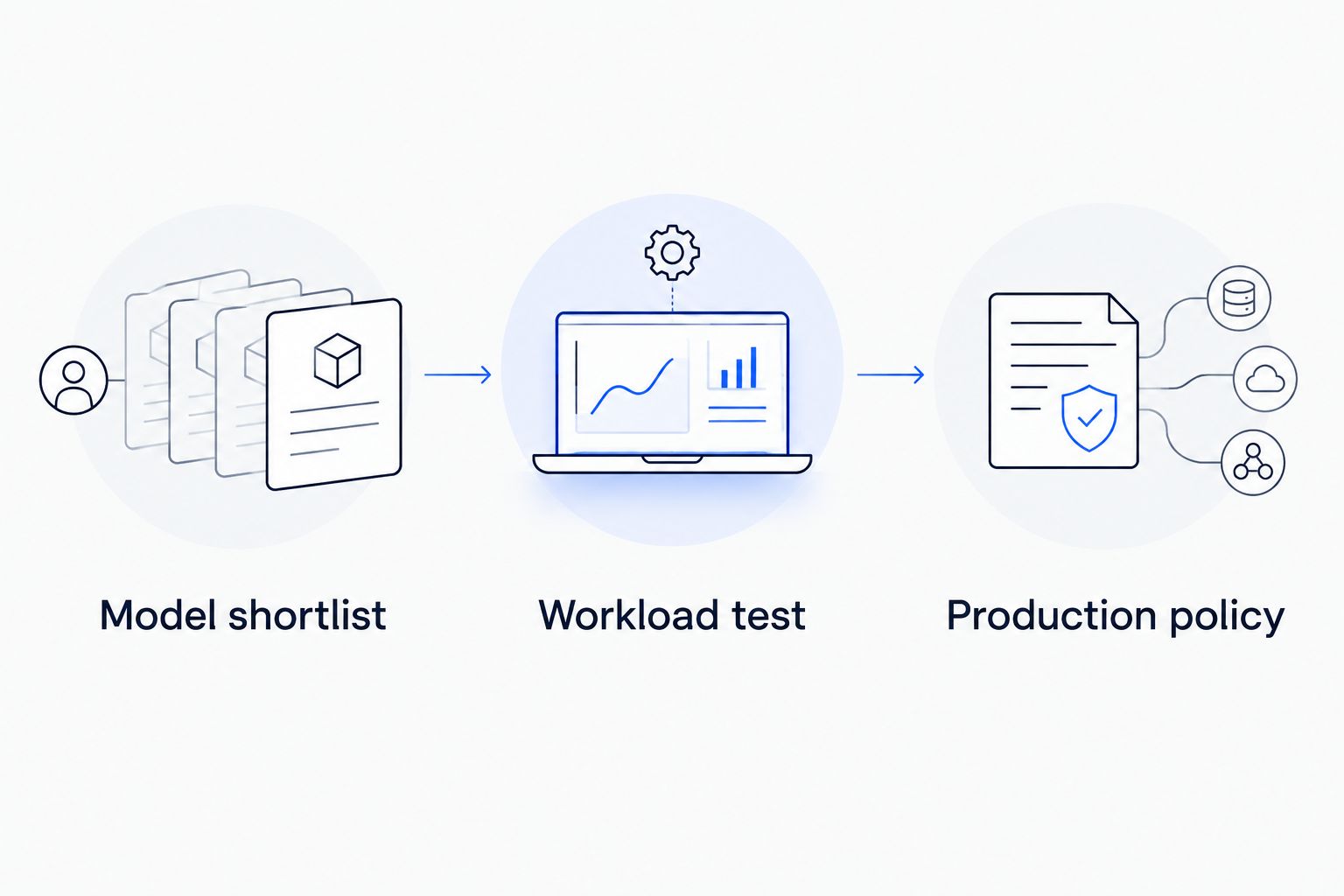
Published comparisons narrow candidates; workload tests and routing policy determine deployment.
For a 2026 review, give each stage an owner and an acceptance question. The model shortlist asks what deserves testing. The workload test asks what works for your application. The production policy asks what the system should do when normal routing is not enough. This prevents a leaderboard result from becoming an unexamined operating rule.
Why teams switch from Artificial Analysis
The reason to choose an alternative is a change in the job, not a defect in Artificial Analysis. Its published comparisons remain useful when you are researching models. They stop being sufficient when the team needs to implement access, route requests, or govern usage in a running application.
- From comparison to integration: Choose a gateway when an application must send requests through an API, rather than when a researcher only needs to inspect published results.
- From a preferred model to a fallback policy: Choose a tool with the required routing and failover controls when a single selected model is not a complete operating plan.
- From general evidence to local evidence: Add workload testing when published measures do not represent your prompts and acceptance criteria.
- From individual experiments to governed access: Assess usage governance when model access becomes a platform responsibility shared across applications or teams.
These are 2026 selection criteria, not claims that Artificial Analysis changed its service or that another provider performs better. A team can keep Artificial Analysis for research while adopting Fastrouter for production routing. The tools answer different questions, and using both preserves that distinction.
Assess production model routing
Review the gateway capabilities against your routing and governance requirements.
When staying with Artificial Analysis makes sense
Stay with Artificial Analysis if your immediate deliverable is a model shortlist informed by published comparisons. Adding a gateway before an application needs one will not make the research more independent. Keep the benchmark in the process even after deployment if your team needs an external reference when reconsidering its model choices.
The split is straightforward: use Artificial Analysis to inform what to test; use a gateway when you need to manage how an application accesses models. Neither replaces tests on your own workload. That distinction is more useful than declaring one tool the universal winner in 2026.
FAQ
What is the best Artificial Analysis alternative in 2026?
Fastrouter is the best fit when you need an OpenAI-compatible gateway for model routing, automatic failover, and usage governance. If you need human-preference comparisons instead, evaluate Arena.
Is Fastrouter a replacement for Artificial Analysis?
Fastrouter replaces a production model-access decision, not an independent benchmark. Use published comparisons to select candidates and a gateway to manage application requests.
Is Arena better than Artificial Analysis for choosing a model?
Arena is useful when human-preference comparisons are the evidence you need. Neither source establishes how a model will perform on your application's requests without workload testing.
How does OpenRouter differ from Artificial Analysis?
OpenRouter provides API access to multiple models, while Artificial Analysis publishes model comparisons. Choose between them based on whether the immediate task is application integration or research.
Can I use Artificial Analysis and Fastrouter together?
Yes. Use Artificial Analysis to inform a model shortlist and Fastrouter to route and govern access when those candidates move into an application.
Does a high benchmark ranking guarantee production performance?
No. A published ranking does not establish response quality, latency, or failure behavior for your own workload; test candidates against your application requirements.
What should an enterprise team check before choosing a model gateway?
Check the required API integration, routing policy, failover behavior, and usage governance against the team's application requirements. Verify operational results with your own requests rather than adopting an external benchmark as a service-level claim.
One last thing
Do not frame the 2026 choice as benchmark versus gateway. The useful boundary is between evidence about a model and control over a request: keep the former in your selection process, then require the latter to meet the needs of your running application.
Related Articles

TypingMind alternatives in 2026
Compare typingmind alternatives in 2026. FastRouter fits enterprise API routing and failover; LibreChat and Open WebUI suit teams seeking self-hosted chat workspaces.

CometAPI alternatives in 2026
Compare CometAPI alternatives in 2026. FastRouter leads for enterprise routing, failover, and governance; see when LiteLLM or direct OpenAI access fits.
.png&w=3840&q=75)
Your Coding-Agent Bill Is Growing. And You Can't See Why.
Cursor, Cline, and Claude Code burn tokens very differently by task type. See the real cost gap between them and how routing by task shape stops silent overspend.